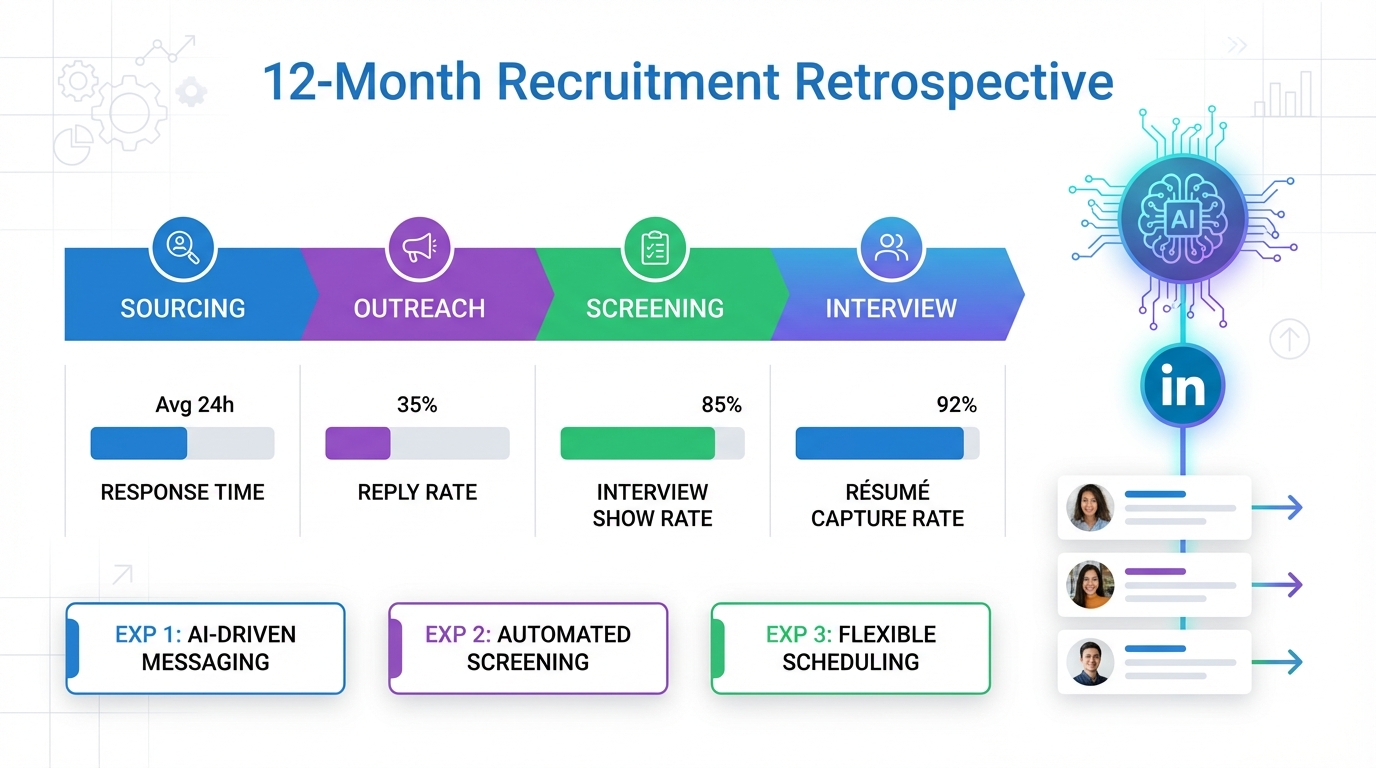
An ai hiring platform is most effective when you pair automation with a deliberate monthly review of what worked, what failed, and what to change next. In practice, we recommend a 60 minute “12 month hiring retrospective” that audits sourcing, outreach, screening, and interviews, then turns the findings into 3 measurable experiments for the next quarter. If your workflow includes ai video interview and live interview ai, the same reflection loop helps you spot where candidates drop off, where response times lag, and where recruiters are still doing repetitive work. In our own recruiting operations, we use StrategyBrain AI Recruiter to automate LinkedIn outreach, follow up, and résumé collection, then we review the results to decide which roles, messages, and markets to scale.
Key Takeaways
- Best starting point: Run a 60 minute retrospective before you add more automation to your ai hiring platform.
- What to measure: Track response time, reply rate, interview show rate, and résumé capture rate with clear units and date ranges.
- Where AI helps most: Use StrategyBrain AI Recruiter for LinkedIn connecting, role introduction, Q and A, interest confirmation, and résumé plus contact capture.
- Global hiring advantage: 24/7 multilingual messaging reduces time zone delays and avoids language friction during early screening.
- Interview stack fit: Pair AI outreach and qualification with ai video interview for asynchronous screening and live interview ai for structured real time panels.
- Scale responsibly: When managing multiple LinkedIn accounts, define guardrails for messaging volume, approvals, and privacy compliance.
Why reflection still matters in an AI hiring platform
Automation can make recruiting feel like a conveyor belt. More messages, more screens, more interviews. But speed without reflection often amplifies the wrong behavior, such as targeting the wrong profiles, asking the wrong questions, or pushing candidates into interviews before they are ready.
That is why we treat reflection as a core control system. It is the part of the process that tells you whether your ai hiring platform is improving outcomes or just increasing activity. It also keeps recruiters grounded, because the work is still human at the decision points.
Scope note: This article focuses on the operating rhythm and where AI fits. It does not attempt to list every vendor feature in the market, and it does not provide legal advice.
The original message: stop and smell the successes
In a team note shared by Cam Macmillan, President, the message was simple and surprisingly tactical. Take an in depth review of the past twelve months. Do it in December. Understand what was accomplished. Celebrate the wins. Dissect the wins and losses. Then walk into the next year with your eyes open.
We like this framing because it applies directly to modern recruiting operations. The “next deal, next project, next post” mindset maps to “next req, next shortlist, next interview.” If you never pause, you lose the chance to identify what actually made you successful and what did not work.
A practical 12 month retrospective framework for recruiting teams
Below is the framework we use when we audit a hiring function that is adopting AI. It is designed to be reproducible and to produce decisions, not just commentary.
Step 1: Define the funnel stages you will review
- Sourcing: Where candidates came from and which roles were hardest to fill.
- Outreach: First contact, follow up, and candidate questions.
- Screening: Qualification signals and résumé collection.
- Interviewing: ai video interview, live interview ai, and decision consistency.
- Offer and close: Drop off reasons and time to decision.
Step 2: Pick 4 metrics with units and a fixed time window
Choose metrics you can measure every month. Keep them stable for at least 90 days so you can see trend lines.
- Median first response time: measured in minutes or hours from candidate reply to recruiter response.
- Outreach reply rate: measured as a percentage of replies per messages sent in the same period.
- Interview show rate: measured as a percentage of attended interviews per scheduled interviews.
- Résumé capture rate: measured as a percentage of interested candidates who submit a résumé within 7 days.
If you do not have clean data yet, start by instrumenting your workflow. An ai hiring platform is only as good as the feedback loop you build around it.
Step 3: Write down 3 wins and 3 losses, then attach evidence
We recommend a simple rule. If you cannot attach evidence, treat it as a hypothesis, not a conclusion. Evidence can be a report export, a message transcript sample, or a structured interview scorecard summary.
This is also where teams often discover that “busy” was not the same as “effective.” The retrospective makes that visible without blame.
Step 4: Turn the review into 3 experiments for the next quarter
Each experiment should have a single owner, a start date, and a success metric. Examples include changing the first message, tightening the screening questions, or shifting which roles use ai video interview versus live interview ai.
Where StrategyBrain AI Recruiter fits in the workflow
StrategyBrain AI Recruiter is an AI powered recruiting tool built for LinkedIn hiring. In our experience, it is most valuable in the early funnel where speed and consistency matter, and where recruiters lose hours to repetitive messaging.
What it automates in practice
- Candidate connection: Automatically connects with candidates that match your search criteria.
- Role introduction: Introduces the opportunity and the employer context using the information you provide.
- Candidate Q and A: Answers questions about the role, company, compensation, and benefits based on your inputs.
- Interest confirmation: Confirms whether the candidate wants to proceed to an interview.
- Résumé and contact capture: Collects résumés and contact details from interested candidates.
How it supports global hiring
One operational advantage is 24/7 multilingual communication. Candidates get timely responses in their native language, which reduces delays across time zones and lowers misunderstanding risk during early screening.
Scaling with multiple LinkedIn accounts
For teams that need volume, AI Recruiter supports managing more than 100 LinkedIn accounts so you can build an AI powered recruitment team. In the retrospective, we recommend reviewing account level performance monthly so scaling does not hide quality issues.
Limitations to plan for
- It does not replace final qualification: AI Recruiter can identify willingness to communicate or interview, but recruiters still need to evaluate résumé fit against job requirements.
- It depends on your inputs: If compensation, benefits, or role scope are unclear, candidate conversations will reflect that ambiguity.
- Governance matters: When you scale outreach, you need internal rules for messaging tone, approvals, and escalation paths.
How to combine AI video interview and live interview AI without losing signal
Many teams adopt ai video interview to screen faster, then add live interview ai to standardize evaluation. The risk is that you end up with more steps but not better decisions. The fix is to assign each interview mode a clear job.
Recommended division of labor
- AI video interview: Use for asynchronous screening when you need consistent prompts and quick early signal. Keep it short and role specific.
- Live interview AI: Use for structured real time interviews where you need deeper probing, panel alignment, and consistent scoring.
- Human review: Reserve human time for the highest leverage moments, such as final fit, motivation, and offer closing.
Where StrategyBrain AI Recruiter connects to the interview stack
When AI Recruiter confirms interest and captures a résumé, you can route candidates into the right interview path. In our workflow, the retrospective tells us which roles benefit from ai video interview first and which should go straight to live interview ai because the talent market is tight.
Common mistakes we see when teams adopt AI too fast
- Measuring activity instead of outcomes: Counting messages sent without tracking reply rate and interview show rate.
- Skipping the retrospective: Adding tools before you understand last quarter’s wins and losses.
- Over automating the decision: Letting automation imply “qualified” when it only indicates “interested.”
- Inconsistent candidate experience: Different recruiters using different scripts, languages, and follow up timing.
- No privacy narrative: Not being clear internally about how candidate data is protected and used.
Quick checklist you can copy
- Define your funnel stages: sourcing, outreach, screening, interviewing, offer and close.
- Pick 4 monthly metrics with units and a fixed date range.
- List 3 wins and 3 losses with evidence attached.
- Choose 3 experiments for the next quarter with owners and success metrics.
- Automate early funnel work with StrategyBrain AI Recruiter, then review results monthly.
- Use ai video interview for fast early signal and live interview ai for structured deep evaluation.
FAQ
What is an ai hiring platform in practical terms?
An ai hiring platform is a set of tools that uses automation and machine learning to support sourcing, outreach, screening, and interviewing. In day to day operations, it should reduce repetitive work and improve consistency, while keeping final hiring decisions with humans.
Where does StrategyBrain AI Recruiter fit compared to interviews?
StrategyBrain AI Recruiter focuses on the early funnel on LinkedIn, including connecting, introducing the role, answering questions, confirming interest, and collecting résumés and contact details. It complements ai video interview and live interview ai by feeding better qualified and better informed candidates into interviews.
Does AI Recruiter decide whether a candidate is qualified?
No. AI Recruiter identifies willingness to communicate or interview and captures the résumé and contact details. Recruiters still evaluate résumé fit against job requirements.
How can I use ai video interview without harming candidate experience?
Keep prompts role specific, limit the time burden, and explain what happens next. Use the retrospective to track completion rate and drop off reasons so you can adjust quickly.
What is the best use of live interview ai?
Live interview ai is best for structured real time interviews where consistent questions and scoring improve fairness and decision quality. It is most effective when paired with clear rubrics and trained interviewers.
Can AI Recruiter support multilingual hiring?
Yes. AI Recruiter provides 24/7 multilingual communication so candidates can interact in their native language. This is especially useful when hiring across countries and time zones.
How does AI Recruiter handle résumés and contact details?
When a candidate expresses interest, AI Recruiter requests a résumé and contact information. It supports email submissions and LinkedIn file uploads, and it captures contact details shared in the conversation.
What should we review each month after adding an ai hiring platform?
Review response time, reply rate, interview show rate, and résumé capture rate for the last 30 days. Then decide what to scale, what to pause, and what to test next.
Conclusion
The fastest way to improve an ai hiring platform is not always adding another feature. It is building a repeatable reflection habit that turns the last 12 months into clear decisions for the next quarter. Cam Macmillan’s reminder to stop and take stock still holds, especially when AI makes it easy to move faster than your learning.
Next steps: schedule a 60 minute retrospective this week, pick 4 metrics with units, and choose 3 experiments. If LinkedIn outreach is consuming recruiter time, consider using StrategyBrain AI Recruiter to automate early conversations and résumé capture, then use ai video interview and live interview ai where they add the most signal.