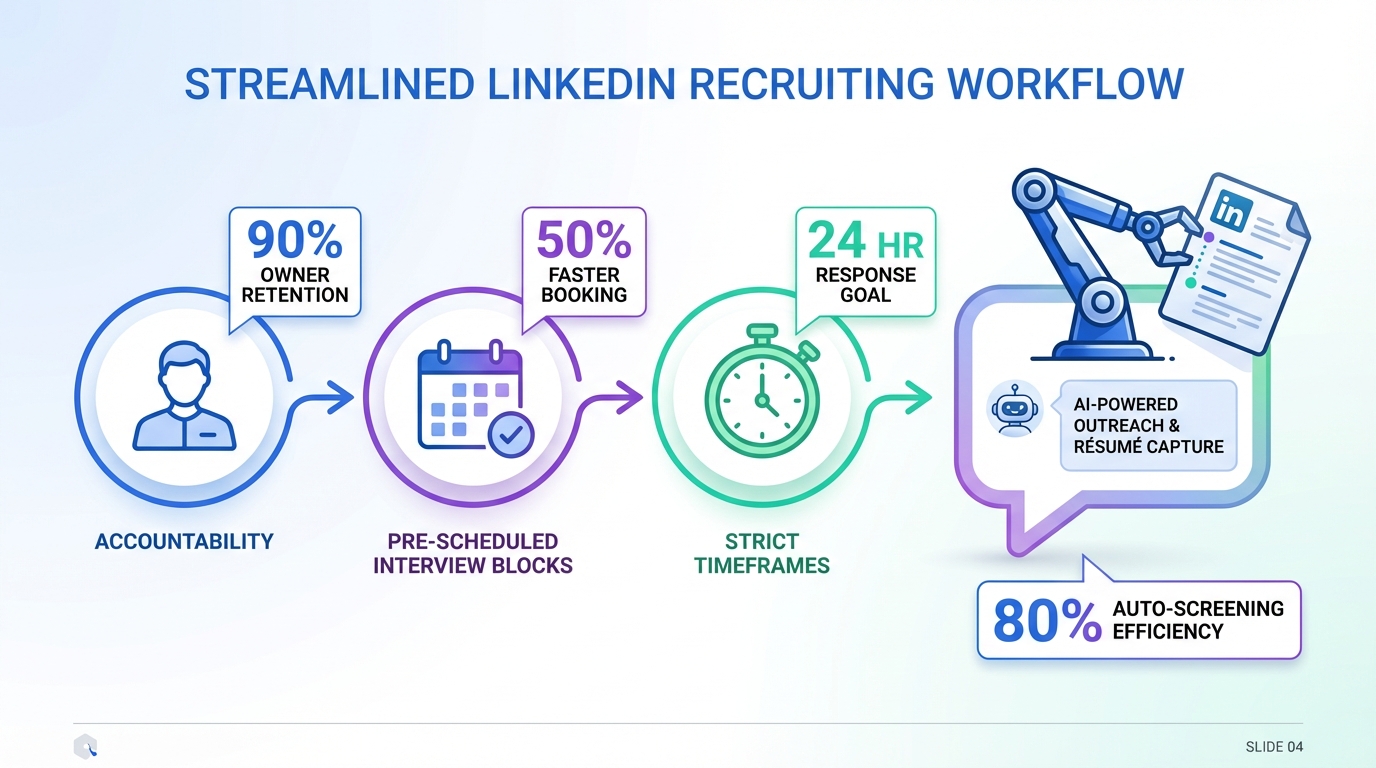
If candidates are slipping away because your team cannot reply fast enough, the most reliable fix is to combine a single accountable owner, pre scheduled interview blocks, and strict hiring timeframes with ai hiring software that automates first touch outreach and follow up. In practice, we see the biggest gains when recruiters stop relying on memory and inbox triage and instead run a repeatable workflow: one person owns movement, interviews are already on calendars, and every stage has a deadline. This guide keeps the original three levers from the source article and strengthens them with an AI enabled operating model, including where StrategyBrain AI Recruiter can automate LinkedIn candidate engagement and résumé collection without replacing your final hiring decision.
Key Takeaways
- Responsiveness is a system problem: assign 1 accountable owner for moving candidates from résumé received to interview to offer.
- Schedule before you source: reserve interview blocks on calendars even when you do not yet have candidates.
- Timeframes prevent drift and bias: define deadlines for each stage so “next week” does not become the default.
- Use ai hiring software for first touch and follow up: automate repetitive outreach and reminders so humans handle judgment calls.
- Assessments should not slow the funnel: place hiring assessments and candidate assessments at a single, defined stage with a clear pass through rule.
- StrategyBrain AI Recruiter is strongest on LinkedIn: it can automate connecting, role introduction, Q and A, interest confirmation, and résumé plus contact capture.
What ai hiring software should fix first
Many teams buy tools to “speed up hiring” but keep the same loose workflow. The result is predictable: candidates wait, recruiters chase internal approvals, and interviews happen whenever someone finds time. Ai hiring software creates leverage only when it is attached to a clear process with owners, calendars, and deadlines.
In this article, we focus on three operational pillars that directly affect candidate experience and time to hire: accountability, scheduling, and timeframes. We then show how an AI layer, specifically StrategyBrain AI Recruiter for LinkedIn, can execute the repetitive parts consistently, including multilingual messaging and 24/7 follow up.
Pillar 1: Accountability
The first bottleneck is almost always ownership. If nobody is clearly responsible for moving a candidate forward, the process becomes a shared inbox problem. Messages get missed, résumés sit unreviewed, and interview requests stall.
What “accountable” means in a hiring workflow
- Single owner per requisition: one person is responsible for stage movement, not “the team.”
- Defined handoffs: the owner knows exactly when to involve the hiring manager and when to escalate.
- Visible status: every candidate has a current stage and next action with a due date.
How StrategyBrain AI Recruiter supports accountability on LinkedIn
Accountability improves when the first steps are consistent. StrategyBrain AI Recruiter can run the initial LinkedIn workflow on behalf of the recruiter by automatically connecting with candidates that match your search criteria, introducing the role, answering common questions about the company and compensation, confirming interview interest, and collecting résumés and contact details from interested candidates. That means the accountable owner spends less time on repetitive messaging and more time on decisions and coordination.
Limitations to plan for
AI can confirm interest and gather information, but it should not be your final judge of fit. StrategyBrain AI Recruiter does not determine whether a résumé fully matches job requirements. Your accountable owner still needs a defined review step for final qualification.
Pillar 2: Scheduling
The second lever is calendar discipline. If interviews are not pre scheduled, you will lose candidates to faster processes. The source article makes a simple point: when something matters, you schedule it. Hiring is no different.
How to schedule interviews before you have candidates
- Create recurring interview blocks: reserve time on the hiring manager’s calendar each week.
- Pre align the panel: confirm who participates and what each person evaluates.
- Use a standard interview packet: set questions and a scoring rubric reduce rework and extra rounds.
What we see when teams do this consistently
When interview time is protected, recruiters can confidently tell candidates what happens next and when. That clarity increases reply rates and reduces drop off. It also makes your ai hiring software more effective because automated outreach is only valuable if you can convert interest into a scheduled conversation quickly.
Pillar 3: Timeframes
Loose timeframes create two problems: candidates disengage, and internal bias creeps in because decisions stretch out and more people get added “just in case.” The source article references a Google finding that four interviewers maximized the chances of a good hire, with no marginal improvement from adding a fifth. The practical takeaway is not the number itself, it is the discipline: define the process so it does not expand endlessly.
Set a tight, explicit timeline for each stage
- Response SLA: define the maximum time to reply to an inbound candidate message.
- Screen to schedule deadline: define how quickly a qualified candidate gets an interview slot.
- Interview to decision deadline: define when feedback is due and when the offer decision is made.
How AI helps without adding chaos
StrategyBrain AI Recruiter can respond to candidate messages 24/7 and in the candidate’s native language, which reduces delays caused by time zones and language barriers. This is especially useful when you are sourcing globally or when your team cannot monitor LinkedIn continuously. The key is to keep the AI within a defined stage: outreach, Q and A, interest confirmation, and information capture, then hand off to humans for evaluation and closing.
Where hiring assessments and candidate assessments fit
Assessments can improve signal quality, but they can also slow the funnel if they are inserted randomly or repeated across rounds. To keep responsiveness high, treat assessments as a single, time boxed checkpoint.
Recommended placement (fast and defensible)
- After interest is confirmed: do not assess candidates who are not engaged.
- Before final interviews: use results to focus interview questions, not to replace interviews.
- With a clear turnaround time: define how many hours candidates have to complete and how many hours your team has to review.
What to standardize in your assessment stage
- One assessment per competency: avoid stacking multiple tests that measure the same thing.
- Scoring rubric: define pass through thresholds and what triggers a follow up question.
- Candidate communication template: explain purpose, time required, and next steps.
Quick comparison: manual vs process vs AI assisted
| Approach | Typical failure mode | What improves responsiveness | Best for |
|---|---|---|---|
| Manual recruiting with ad hoc follow up | Messages and scheduling slip when workload spikes | None unless a single owner enforces discipline | Low volume hiring with stable pipelines |
| Structured process without AI | Still limited by human availability and time zones | Accountability, pre scheduled interviews, stage deadlines | Teams that want consistency before automation |
| AI assisted workflow with StrategyBrain AI Recruiter on LinkedIn | Risk of unclear handoff if stages are not defined | 24/7 multilingual messaging, automated follow up, résumé and contact capture | High volume sourcing, global hiring, multi account LinkedIn operations |
Implementation checklist (copy and use)
Use this checklist to operationalize responsiveness in 7 days. Keep it simple and measurable.
- Name the accountable owner: assign 1 person per requisition who owns movement and deadlines.
- Define your stages: inbound, outreach, interest confirmed, assessment, interview, decision, offer.
- Set response SLAs: write down the maximum time to reply at each stage.
- Reserve interview blocks: schedule weekly interview time on calendars in advance.
- Standardize the interview packet: questions plus scoring rubric for consistent evaluation.
- Time box assessments: one assessment stage with a clear completion and review deadline.
- Automate the repetitive LinkedIn work: configure StrategyBrain AI Recruiter to connect, introduce roles, answer common questions, confirm interest, and collect résumés and contact details, then route qualified candidates to the accountable owner for final review.
FAQ
What is ai hiring software in practical terms?
Ai hiring software is a system that uses automation and AI to handle repetitive recruiting tasks such as outreach, candidate messaging, follow up, and information capture. It should support a structured process, not replace your hiring judgment.
How do I improve candidate responsiveness without hiring more recruiters?
Start by assigning one accountable owner, pre scheduling interview blocks, and setting strict timeframes for each stage. Then use AI to automate first touch messaging and follow up so your team spends time on decisions rather than chasing replies.
Can StrategyBrain AI Recruiter replace recruiter screening?
No. StrategyBrain AI Recruiter can confirm interest, answer questions, and collect résumés and contact details, but final qualification against job requirements should be done by a recruiter or hiring manager after reviewing the résumé.
How do hiring assessments fit into a fast process?
Use hiring assessments only after interest is confirmed and before final interviews. Keep the assessment stage time boxed and use a scoring rubric so results inform interviews instead of adding extra rounds.
Does multilingual messaging actually matter for responsiveness?
Yes when you recruit across regions or time zones. Always on multilingual communication reduces delays and misunderstandings, which can increase the chance that interested candidates stay engaged through scheduling.
How many interviewers should we use?
The source article cites a Google finding that four interviewers maximized the chances of a good hire, with no marginal improvement from adding a fifth. Regardless of the exact number, the operational point is to define the panel and avoid adding extra rounds that slow decisions.
What is the biggest red flag in a slow hiring process?
When nobody can commit to a scheduled interview time or when decisions are repeatedly pushed to “next week.” Both signal that accountability and timeframes are not enforced.
Is it safe to use AI on LinkedIn for outreach?
It can be, if you use explicit authorization, secure credential handling, and clear data protection practices. StrategyBrain AI Recruiter states that credentials are encrypted and that customer provided data is not used to train AI models, which are important trust requirements to verify during procurement.
Conclusion
Candidate responsiveness improves fastest when you treat it as an operating system: one accountable owner, interviews scheduled in advance, and strict timeframes that prevent drift. Once those pillars are in place, ai hiring software becomes a multiplier rather than another tool to manage. If LinkedIn is a major sourcing channel for you, StrategyBrain AI Recruiter can take over the repetitive front end work, connecting with candidates, introducing roles, answering common questions, confirming interest, and collecting résumés and contact details, while your team focuses on final qualification, interviews, and offers.
Next step: pick one open role, implement the 7 day checklist above, and measure two numbers for two weeks: median time to first reply and median time from interest confirmed to interview scheduled.