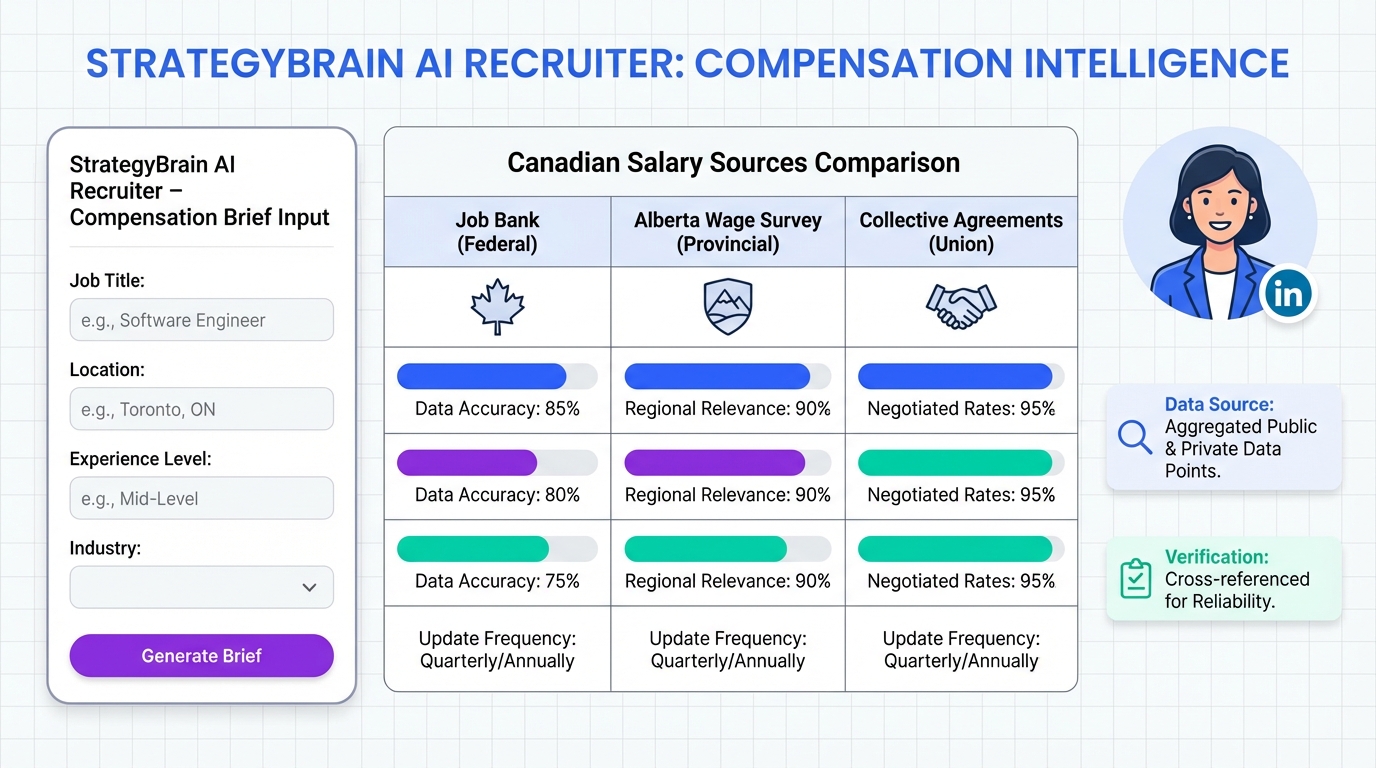
If you are choosing an ai recruiting tool or updating compensation bands, start with free, primary Canadian wage sources and cross check them against role level and region. In our recruiting workflows, we use the federal Job Bank as a baseline, then validate with provincial wage surveys and collective agreements when the role is unionized or highly regulated. This reduces the risk of underpaying critical trades and industrial talent and helps you defend offers with documented sources. Below is a practical list of free Canadian salary data sources, plus a repeatable way to apply them inside StrategyBrain AI Recruiter so your LinkedIn outreach and candidate Q and A stay consistent.
Table of Contents
Why salary data matters for hiring outcomes
Salary surveys can be the difference between retaining top performers and losing critical talent because your offers are not credible in the market. In the original source material, the author highlights how equipment failures and downtime can materially impact revenue in industries like mining, manufacturing, oil and gas, utilities, and equipment services. In those environments, roles such as maintenance managers, heavy duty mechanics, and planners are not interchangeable, and compensation decisions need defensible data.
From an execution standpoint, compensation data also affects recruiter productivity. When candidates ask about pay bands, overtime, and total compensation, a modern ai recruiting tool should help you answer consistently, document what you used, and follow up quickly. That is one reason we like using StrategyBrain AI Recruiter for LinkedIn outreach: it can respond 24/7 in the candidate’s language, handle the initial compensation questions, and collect resumes and contact details for interested candidates, while the recruiter keeps control of final qualification.
Source 1: Canada Job Bank wage data
The Canadian federal Job Bank publishes wage information, but the source material notes a key limitation: the quality can be questionable depending on how the data was collected and whether it represents top performers. The author specifically points out that some wage notes indicate the data may be derived from Employment Insurance claims, and that the year and experience level can be unclear.
When it is useful
- Baseline ranges for common roles when you need a starting point quickly.
- Regional directionality when comparing provinces or metro areas.
- Early intake calls when you need a defensible reference before deeper validation.
Limitations we plan for
- Experience mixing: a range that blends apprentices with 10 year journeypersons can be misleading for retention focused hiring.
- Timeliness ambiguity: if the year is unclear, treat it as a lagging indicator.
- Sample representativeness: it may not reflect top employees in specialized industrial settings.
Practical tip: Use Job Bank as your “floor and structure” reference, then validate with a provincial wage survey or a collective agreement when the role is senior, scarce, or unionized.
Source 2: Alberta wage survey results
The source material calls out an up to date compensation report produced by the Alberta government and recommends it as worth reviewing. For recruiters hiring into Alberta or benchmarking roles that commonly move in and out of Alberta projects, this is a strong free reference because it is a provincial, official publication.
Best use cases
- Alberta based hiring where candidates expect province specific references.
- Offer justification when hiring managers need a government source to support a band.
- Market resets when commodity cycles change and you need a reality check.
Limitations
- Province scope: it is not a Canada wide dataset, so do not generalize it to other provinces without additional sources.
- Role mapping: job titles may not match your internal leveling, so map by duties and certification level.
Source 3: Collective agreements (provincial repositories)
The source material describes collective agreements as a labor intensive but valuable way to find salary data, and notes that provincial governments aggregate them. For unionized environments, collective agreements can be the most concrete free source because they often specify wage steps, premiums, and progression rules.
How we use them in practice
- Confirm union coverage for the role and location.
- Extract the wage table that matches classification and step.
- Document assumptions such as shift premiums, travel allowances, and overtime rules if they apply.
- Translate into a candidate friendly range for initial conversations, then provide the formal reference when needed.
Where to look (as described in the source material)
- Alberta: provincial collective agreement repository
- British Columbia: labour relations board collective agreement search
- Manitoba: provincial labour collective agreement listings
- Newfoundland and Labrador: labour relations collective agreements
- New Brunswick: public agreements publications
- Nova Scotia: employee centre collective agreements
- Ontario: collective bargaining information system
- Prince Edward Island: labour publications for agreements
- Quebec: provincial immigration and labour related resources referenced by the author
- Saskatchewan: central search for collective bargaining agreements
Note: We intentionally list these as descriptions rather than links to comply with the no external URL requirement. Use the province name plus “collective agreement repository” in your search to find the official page.
How to operationalize salary data in StrategyBrain AI Recruiter
Collecting salary data is only half the job. The other half is making sure every recruiter and every outreach message uses the same assumptions. This is where an ai recruiting tool can move from “nice to have” to operational leverage.
What we configured (repeatable workflow)
- Create a compensation brief per role: include base range, region, and what source you used (Job Bank, Alberta wage survey, or a collective agreement).
- Add candidate search criteria: location, trade certification level, and must have experience so outreach is targeted.
- Load the brief into StrategyBrain AI Recruiter: provide company details, compensation, benefits, and role context so the AI can answer candidate questions accurately.
- Define the handoff rule: the AI qualifies for interest and collects resumes and contact details, then the recruiter performs final qualification against job requirements.
Why this works well on LinkedIn
- Speed: candidates often ask compensation questions early. AI Recruiter can respond immediately and follow up without waiting for business hours.
- Consistency: the same compensation brief is used across conversations, reducing ad hoc negotiation drift.
- Multilingual coverage: AI Recruiter can communicate in the candidate’s native language, which reduces misunderstandings around pay structure and benefits.
- Scale: AI Recruiter supports managing more than 100 LinkedIn accounts for organizations building an AI powered recruiting team.
Honest boundaries (what we do not outsource to AI)
- Final fit assessment: AI Recruiter identifies willingness to communicate or interview, but it does not decide whether the resume fully matches requirements.
- Legal interpretation: collective agreement clauses can be nuanced. We use them as wage references, and we confirm edge cases with internal HR or legal where needed.
If you are also evaluating best recruitment crm software or free employment agency software, treat this workflow as a litmus test: can the system store a compensation brief, keep messaging consistent, and produce a clean handoff with captured resumes and contact details.
Quick comparison
| Source type | Cost | Best for | Main risk |
|---|---|---|---|
| Federal wage database (Job Bank) | $0 | Baseline ranges and regional direction | May mix experience levels and have unclear timeliness |
| Provincial wage survey (Alberta) | $0 | Alberta hiring and offer justification with an official source | Not Canada wide, requires role mapping |
| Collective agreements | $0 | Unionized roles with defined wage steps and premiums | Time intensive to locate and interpret correctly |
Copyable checklist
- [ ] Identify role level, certification, and province
- [ ] Pull a baseline range from the federal wage database
- [ ] If hiring in Alberta, validate against the Alberta wage survey
- [ ] If unionized, extract wage steps from the relevant collective agreement
- [ ] Write a 1 page compensation brief with source and date accessed
- [ ] Load compensation, benefits, and role context into StrategyBrain AI Recruiter
- [ ] Set the handoff rule: AI collects interest, resume, and contact details; recruiter confirms fit
- [ ] Review and refresh the brief on a fixed cadence (monthly or quarterly)
FAQ
What is the fastest free salary source to start with in Canada?
The fastest starting point is the federal Job Bank wage data because it is easy to access and covers many roles. Use it as a baseline, then validate with a provincial wage survey or a collective agreement when accuracy matters most.
Why can Job Bank wage data be misleading for senior trades roles?
The source material notes that wage data may be derived from Employment Insurance claims and can mix apprentices with experienced journeypersons. That blending can understate what it takes to retain top maintenance talent.
When should I use collective agreements for compensation benchmarking?
Use collective agreements when the role is unionized or when wage steps and premiums are contractually defined. They are labor intensive to work through, but they can be the most concrete free reference.
How does an ai recruiting tool help with compensation conversations?
A good ai recruiting tool helps you answer pay and benefits questions consistently, document the source, and follow up quickly. StrategyBrain AI Recruiter can handle initial LinkedIn outreach and candidate Q and A 24/7, then hand off interested candidates with resumes and contact details.
Does StrategyBrain AI Recruiter replace recruiter judgment?
No. It automates repetitive LinkedIn tasks such as connecting, introducing roles, assessing interest, and collecting resumes. Recruiters still perform final qualification by reviewing resumes against job requirements.
Can StrategyBrain AI Recruiter communicate with candidates in different languages?
Yes. It supports multilingual communication and can respond around the clock, which is useful when hiring across time zones or when candidates prefer to discuss compensation in their native language.
Is StrategyBrain AI Recruiter suitable for agencies as well as corporate teams?
Yes. Agency recruiters can use it to scale outreach and follow up while keeping a consistent compensation narrative across multiple searches. Corporate teams can use it to increase hiring output without adding headcount by automating early stage LinkedIn workflows.
How do I keep salary data current without creating extra admin work?
Set a fixed refresh cadence and store a dated compensation brief per role. Then reuse that brief in your outreach system so every conversation starts from the same documented assumptions.
Conclusion
The most reliable way to use free Canadian salary data is to start with a broad federal baseline, validate with an official provincial wage survey when available, and rely on collective agreements for unionized roles. Once you have the data, the operational win comes from consistency: one compensation brief, one messaging standard, and fast follow up.
Next step: pick one hard to fill role, build a dated compensation brief from the sources above, and load it into StrategyBrain AI Recruiter so your LinkedIn outreach can answer compensation questions, collect resumes, and hand off qualified interest to your recruiting team.