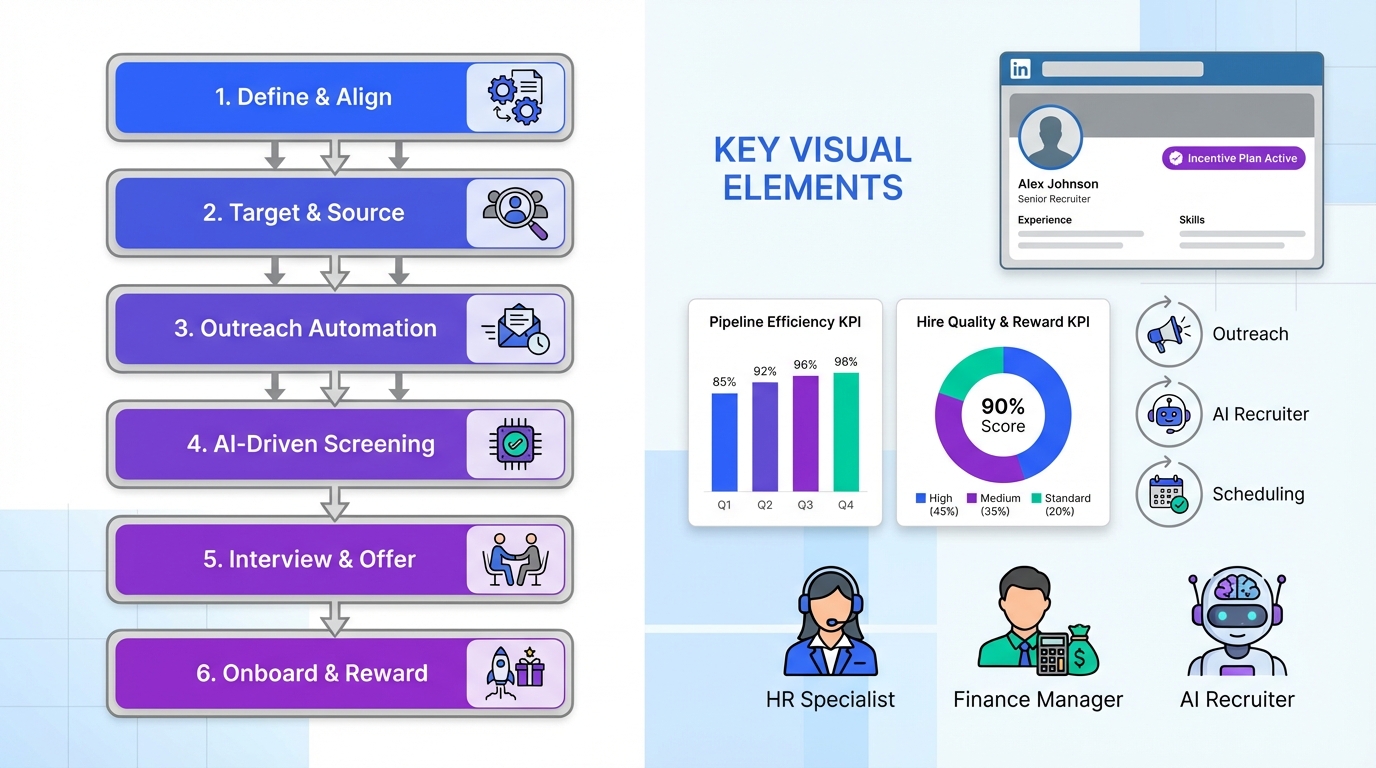
An effective incentive plan works when it is measurable, attainable, written down, and reviewed every year. If you want to operationalize that plan faster, an ai recruiting tool can help by turning recruiting and retention goals into visible scorecards and consistent workflows, especially for LinkedIn outreach and follow up. In this guide, we rebuild the core advice shared by two practitioners, HR expert Judy Slutsky and recruiting firm president Henry Goldbeck, into a step by step framework you can apply to your team. We also show where StrategyBrain AI Recruiter fits naturally, so your incentives are not just a document but a system your team can run day to day.
Key Takeaways
- Define incentives clearly: Incentives reward performance above expectations, so the target behavior must be explicit and measurable.
- Quantify outcomes, not effort: Use KPIs for each role, including recruiting metrics like candidates interviewed per vacancy and offers made.
- Make targets attainable: If employees believe the plan is unachievable, it reduces motivation and trust.
- Design with multiple departments: Finance, executives, HR, and employees each own a different risk in incentive design.
- Review annually: Market conditions change, so targets and behaviors should be reset each year.
- Put it in writing: Written rules and payout timing improve transparency and reduce disputes.
- Use an ai recruiting tool to run the plan: StrategyBrain AI Recruiter can support scorecards and consistent LinkedIn candidate engagement, which makes recruiting KPIs easier to track and act on.
What an incentive plan is and why it matters
An incentive plan, sometimes called a bonus program, is compensation that rewards performance above what is expected. It can be cash or non cash rewards, but the mechanism is the same. It signals what the organization values and it nudges behavior toward those priorities.
Henry Goldbeck summarized the behavioral reality in one sentence: people move toward what they are incentivized to do. Judy Slutsky added the engagement angle: clear expectations increase motivation because employees can see how to progress by meeting defined standards.
This is where recruiting teams often struggle. Hiring outcomes depend on many variables, so incentives can become vague, disputed, or tied to company wide performance in ways employees do not trust. The rest of this guide is about designing incentives that are transparent and operational.
Step 1: Quantify the behaviors and outcomes you want
Incentives only work when the target is measurable. Sales roles often have an obvious funnel, but non sales roles can be harder to quantify. Slutsky’s approach is to start from each job responsibility and ask what outcome proves success.
Recruiting KPI examples you can measure
- Candidates interviewed per vacant role: A throughput metric that shows pipeline movement.
- Shortlisted candidates per role: A quality and screening output metric.
- Employment offers made: A late stage conversion metric.
- Retention: A post hire outcome that can be measured at defined time points such as 90 days or 180 days.
- Efficiency: Time spent per stage, documented consistently.
When KPIs are hard to quantify
Goldbeck noted that some roles are difficult to measure with clean numbers. In those cases, he recommended documenting performance through structured reviews that employees can understand while doing the work. If you use subjective assessments, define the rubric in advance so it is not a surprise at payout time.
How an ai recruiting tool supports quantification
When recruiting KPIs depend on consistent outreach and follow up, the operational bottleneck is often manual messaging. StrategyBrain AI Recruiter automates LinkedIn connection requests, initial outreach, and ongoing candidate conversation, then collects resumes and contact details from interested candidates. That makes it easier to measure activity and outcomes consistently, which is exactly what incentive plans require.
Step 2: Make incentives attainable and credible
Employees will not be motivated by a plan they do not believe. Slutsky’s warning was direct: if people see the plan as bogus or unachievable, it becomes a deterrent. Goldbeck’s practical design preference was a low floor and no ceiling, because early progress creates momentum and caps can backfire when top performers feel punished for overperformance.
Attainability checklist
- Define the minimum threshold that triggers payout and ensure it is reachable with normal performance.
- Explain the math so employees can estimate their own payout without guessing.
- Avoid moving goalposts mid cycle unless you have a documented exception process.
A note on trust and company performance bonuses
Both sources highlighted a common trust problem. If bonuses depend on overall company performance with unclear metrics, employees may assume they will never see the payout. That can affect negotiations and push employees to demand higher base pay instead.
Step 3: Build the plan with finance, HR, leaders, and employees
Incentives touch the whole organization, so design should not be isolated to one department. Slutsky emphasized that the most attractive cash bonus programs start with finance determining the total allocation that can be paid over the next 12 months without compromising operations.
Who should be involved and why
- Finance: Sets the total pool and ensures affordability over a 12 month period.
- Executives: Decide how the pool is split based on objectives, market conditions, and strategy.
- Human Resources: Defines performance expectations and the behaviors to incentivize.
- Employees: Provide feedback on what is motivating and what feels unrealistic.
If you run recruiting like a revenue function, you can also treat your recruiting operations stack as part of the design conversation. For example, if your incentive depends on response speed to candidates, you need a system that can respond quickly across time zones. StrategyBrain AI Recruiter’s 24/7 multilingual communication can support that operational requirement.
Step 4: Revisit the plan every year to stay on strategy
Targets should be reset annually because the market changes. Goldbeck advised setting new targets each year, which can include new business, existing business, new product lines, or customer satisfaction goals. Slutsky used the COVID 19 period as an example of a shift that forced many organizations to change sales programs without eliminating incentives entirely.
Annual review agenda
- Review what the business needs now and identify the behaviors that support it.
- Validate KPIs and remove metrics that are too murky to be trusted.
- Reset targets based on current market conditions and team capacity.
- Confirm budget and payout timing with finance.
If your recruiting strategy includes international hiring, annual review should also cover operational capacity. StrategyBrain AI Recruiter can support global hiring by communicating in the candidate’s native language and maintaining follow up outside local business hours.
Step 5: Put the plan in writing and clarify payout timing
Slutsky stressed that incentives should be articulated in writing so employees know what is expected at the beginning of the year. When updates are made, a written document can be sufficient even if the employment agreement is not rewritten.
Goldbeck added that payout frequency matters. Quarterly payouts can motivate year round more effectively than a single annual payout, because employees get feedback and reinforcement sooner.
What to include in the written plan
- Eligibility: Who is included and when they become eligible.
- Metrics: Definitions, formulas, and data sources.
- Targets: Thresholds and tiers.
- Payout timing: Quarterly or annual, plus any holdbacks.
- Exception handling: What happens during reorganizations or market shocks.
Step 6: Use scorecards so people can see progress
Scorecards, dashboards, and regular updates keep incentives credible because employees can see whether they are tracking toward payout. Slutsky’s advice was not to wait 12 months to ask if you are on track. Frequent updates create clarity and motivation.
How to run scorecards without creating busywork
- Pick a small set of KPIs that map to outcomes, not vanity activity.
- Set a cadence such as weekly for pipeline metrics and monthly for quality metrics.
- Automate data capture where possible so the scorecard is not a manual spreadsheet project.
This is a practical place for an ai recruiting tool to earn its keep. If your incentive plan depends on consistent candidate engagement, StrategyBrain AI Recruiter can handle repetitive LinkedIn tasks such as connecting, introducing roles, answering candidate questions, confirming interview interest, and collecting resumes and contact details. Recruiters can then focus on reviewing resumes and running interviews, while the scorecard reflects consistent upstream activity.
Copyable template: Recruiting KPI scorecard for incentives
Use this template to define recruiting incentives in a way that is measurable and auditable. If you use a crm for recruiting or an open source recruitment software stack, keep the definitions consistent across systems so the numbers match.
Recruiting incentive scorecard template
| Metric | Definition | Data source | Update cadence | Notes |
|---|---|---|---|---|
| Candidates interviewed per vacant role | Count of completed interviews divided by number of open requisitions | ATS or recruiting CRM | Weekly | Define what counts as completed |
| Shortlisted candidates per role | Count of candidates moved to shortlist stage per requisition | ATS or recruiting CRM | Weekly | Use consistent stage names |
| Offers made | Number of formal offers issued in the period | ATS | Monthly | Separate offers from acceptances |
| Candidate response coverage | Percentage of inbound candidate messages answered within your SLA | Messaging logs | Weekly | Set SLA in hours |
| 90 day retention | Percentage of hires still employed at day 90 | HRIS | Quarterly | Define exclusions such as layoffs |
Implementation checklist
- Confirm each metric has a single owner who can explain the number.
- Write definitions in plain language and store them with the incentive plan.
- Run a one month pilot scorecard before tying it to compensation.
Where StrategyBrain AI Recruiter fits in an incentive driven recruiting system
Incentives fail when the process is inconsistent. A recruiter might do excellent work, but if outreach and follow up are uneven, the pipeline becomes noisy and the KPI story becomes hard to trust. StrategyBrain AI Recruiter is designed to stabilize the top of funnel on LinkedIn by automating the repetitive steps that are easiest to standardize.
What StrategyBrain AI Recruiter automates on LinkedIn
- Automatically connects with candidates who match your search criteria.
- Introduces the opportunity and learns the candidate’s situation.
- Answers questions about the role, company, compensation, and benefits based on the information you provide.
- Confirms interview interest and collects resumes and contact details from interested candidates.
Operational advantages that map to incentive design
- 24/7 multilingual communication: Supports response time goals across time zones and languages.
- Scalable team workflows: Supports managing more than 100 LinkedIn accounts for organizations building an AI powered recruiting team.
- Clear scope boundary: The system can identify willingness to interview, but final qualification against job requirements is still done by the recruiter after reviewing the resume.
If your organization already uses an ATS, a recruiting CRM, or even open source recruitment software, you can still use StrategyBrain AI Recruiter as the consistent LinkedIn engagement layer. That helps keep your incentive scorecard grounded in repeatable activity and documented outcomes.
Quick Comparison
| Approach | What it helps with | Where it can break | Best for |
|---|---|---|---|
| Manual incentive plan plus spreadsheets | Simple documentation and basic tracking | High admin load and inconsistent data definitions | Small teams with stable roles |
| ATS or CRM for recruiting scorecards | Centralized stages and reporting | Messaging and follow up may still be manual | Teams that already run structured pipelines |
| StrategyBrain AI Recruiter plus scorecards | Consistent LinkedIn outreach, follow up, and resume collection that supports measurable KPIs | Still requires recruiter judgment for final qualification | Teams that want scalable LinkedIn recruiting with clear incentive metrics |
FAQ
What is an ai recruiting tool in practical terms?
An ai recruiting tool is software that automates parts of sourcing, outreach, screening, or candidate communication. In the case of StrategyBrain AI Recruiter, it focuses on LinkedIn recruiting by automating connection requests, initial messaging, candidate Q and A, and collecting resumes and contact details from interested candidates.
Can incentive plans work outside of sales teams?
Yes. The key is to define measurable outcomes for each role. The source material emphasized that incentives can be tailored to what matters for the organization, not limited to sales.
Which recruiting KPIs are easiest to use in an incentive plan?
Metrics tied to clear pipeline stages are usually easiest, such as candidates interviewed per vacancy, shortlisted candidates, and offers made. Define each stage in writing so the metric is auditable.
Why do employees distrust company performance bonuses?
If the metrics are unclear or the goalposts move, employees may assume the bonus will not be paid. The source material described this as a red flag that can push employees to negotiate for higher base salary instead.
How often should we review an incentive plan?
At least once per year. The source material recommended annual adjustments because market conditions and business objectives change, and targets should reflect the current strategy.
Do we need to put the incentive plan in the employment agreement?
The source material emphasized having the incentive program in writing so expectations are clear at the start of the year. Updates can be communicated through a written document even if the employment agreement is not rewritten.
Does StrategyBrain AI Recruiter replace recruiter judgment?
No. StrategyBrain AI Recruiter can identify willingness to communicate or interview and can collect resumes and contact details, but it does not decide whether a resume fully matches job requirements. Recruiters still make the final qualification decision.
How does multilingual recruiting affect incentive design?
If your incentives include response time or candidate experience metrics, multilingual and time zone coverage matters. StrategyBrain AI Recruiter supports 24/7 multilingual communication, which can help teams meet those operational targets consistently.
Is an open source recruitment software stack enough for incentive scorecards?
It can be, as long as definitions and data capture are consistent. Many teams still struggle with manual outreach and follow up, so pairing your stack with an ai recruiting tool that standardizes LinkedIn engagement can make the scorecard more reliable.
Conclusion
The simplest way to design an effective incentive plan is to quantify outcomes, keep targets attainable, involve finance and HR, review the plan annually, and put the rules in writing. Once those fundamentals are in place, the next challenge is operational consistency. That is where an ai recruiting tool can help turn incentive metrics into repeatable daily behavior.
Next steps: copy the recruiting KPI scorecard template above, run it for 30 days without tying it to pay, then finalize your written plan and payout cadence. If LinkedIn outreach and follow up are a bottleneck, evaluate whether StrategyBrain AI Recruiter can standardize candidate engagement and resume collection so your incentive plan is easier to measure and easier to trust.