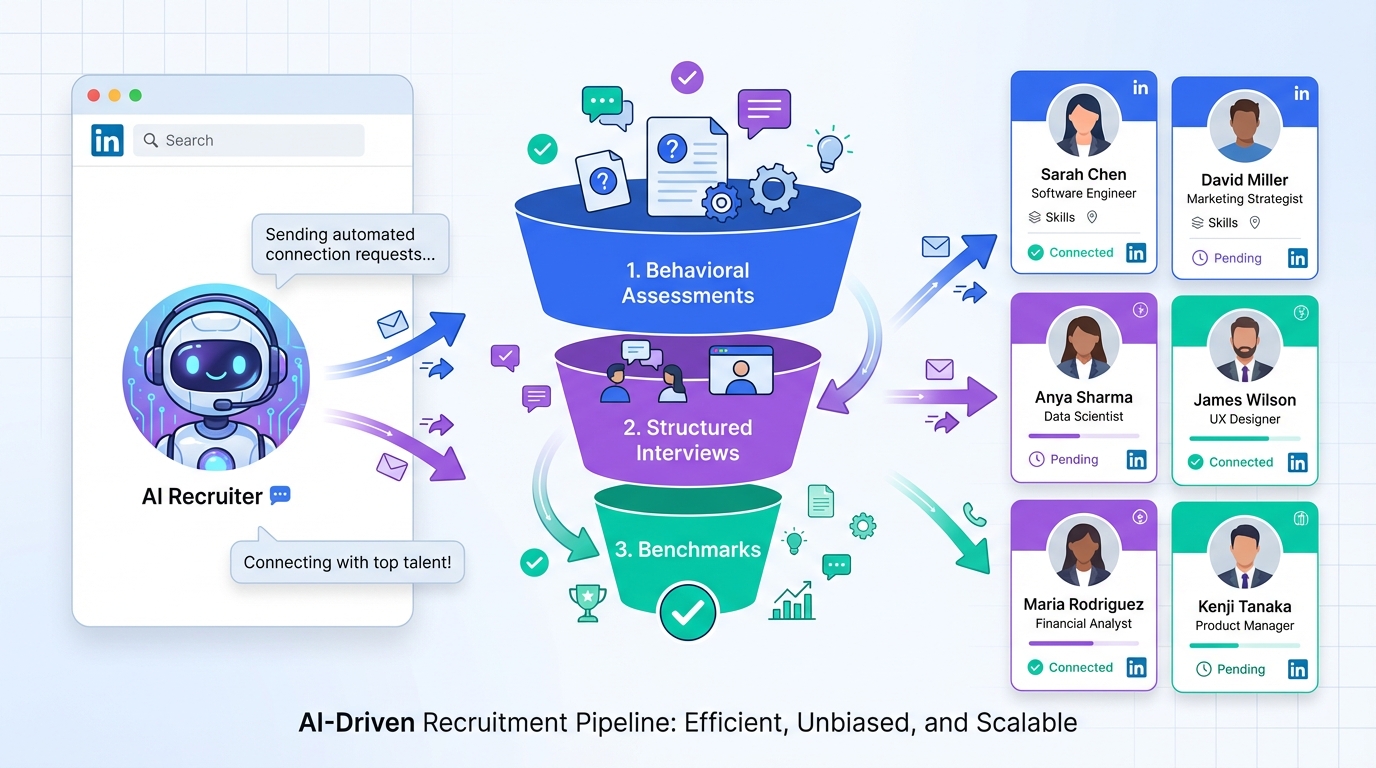
An ai recruiting tool reduces hiring bias when it helps you apply the same evidence based criteria to every candidate, starting early in the funnel. The most dependable pattern we see is to combine behavioral assessments (tools that measure work related traits and preferences), benchmarks (a defined standard for what “good” looks like in a role), and structured interviews (the same questions and scoring rubric for all candidates). In our day to day recruiting operations, we also found that automation matters: when outreach and follow up are inconsistent, you often end up evaluating whoever replies fastest, not whoever fits best. That is where StrategyBrain AI Recruiter fits naturally into the workflow by automating LinkedIn connection, role introduction, Q and A, follow up, and résumé and contact collection so recruiters can focus on fair, job relevant evaluation.
Table of Contents
- What this guide covers and what it does not
- Why bias enters hiring decisions
- Method 1: Add behavioral assessments early
- Method 2: Use structured interviews and scorecards
- Method 3: Set benchmarks for each role
- Method 4: Choose assessments designed to avoid discrimination
- Method 5: Measure potential and widen the funnel with consistent outreach
- Quick comparison: 5 methods at a glance
- Implementation checklist
- FAQ
- Conclusion and next steps
What this guide covers and what it does not
Covered: practical ways to reduce bias using behavioral assessments, structured interviews, and benchmarks, plus how an ai recruiting tool can standardize candidate communication and sourcing workflows.
Not covered: legal advice, a guarantee of compliance in any specific jurisdiction, or claims that any method eliminates bias completely. Bias reduction is a process control problem, not a one time purchase.
Why bias enters hiring decisions
Bias often shows up when decisions are made with incomplete information, inconsistent processes, or subjective shortcuts. For example, if you only introduce objective measures after you have already “picked favorites,” the earlier stages can quietly filter out qualified people. Similarly, if interviews vary by interviewer, candidates are not being evaluated on the same criteria.
In our experience, the operational issue is just as important as the evaluation method. When recruiters are overloaded, outreach becomes uneven, follow ups slip, and the pipeline becomes a reflection of who got contacted and who got a timely response. That is why pairing assessment and interview structure with an ai recruiting tool that keeps communication consistent can materially improve fairness.
Method 1: Add behavioral assessments early
Behavioral assessments can help reduce bias when they are used during pre screening, not only after finalists are chosen. The goal is to introduce objective, job relevant signals before subjective impressions harden.
Steps
- Define the role outcomes you need in the first 90 days, using 3 to 5 measurable outcomes.
- Select a behavioral assessment that maps to work behaviors relevant to those outcomes.
- Administer the assessment early for candidates who meet baseline requirements.
- Use results as one input alongside skills evidence and structured interview scores.
Features to look for
- Job relevance: traits measured should connect to role performance, not personal style preferences.
- Consistency: the same assessment and interpretation rules for all candidates in the same role.
- Documentation: clear explanation of what is measured and how results should be used.
Limitations
- Assessments do not replace skills validation or work samples.
- Misuse can create new bias if results are treated as a pass fail gate without context.
Best for
- High volume roles where early screening decisions are frequent.
- Teams that want a repeatable, evidence based hiring workflow.
Method 2: Use structured interviews and scorecards
Structured interviews reduce bias by removing improvisation. Every candidate gets the same core questions, and answers are scored against the same rubric. This directly addresses the common failure mode where “likeability” becomes a hidden selection criterion.
Steps
- Create a scorecard with 4 to 6 competencies tied to role outcomes.
- Write standardized questions for each competency, including what a strong answer includes.
- Train interviewers to score independently before discussion.
- Debrief using scores first, then discuss qualitative notes.
Limitations
- Requires upfront design time and interviewer discipline.
- Still needs calibration to avoid inconsistent scoring across interviewers.
Method 3: Set benchmarks for each role
Benchmarks are the standard you use to evaluate candidates fairly. Without benchmarks, teams often compare candidates to each other, which can amplify bias if the early pipeline is not diverse.
Steps
- Identify top performer patterns in the role, using performance reviews and manager input.
- Translate patterns into measurable criteria such as competency ratings, work sample thresholds, and assessment ranges.
- Document the benchmark and use it as the reference point for every candidate.
Limitations
- If your historical “top performer” definition is biased, benchmarks can inherit that bias.
- Benchmarks must be reviewed when the role changes.
Method 4: Choose assessments designed to avoid discrimination
Not all assessments are equal. If you use assessments, choose tools that are designed and validated to avoid discrimination on protected characteristics such as gender, race, and ethnicity. This is a selection and governance decision, not just a feature checklist.
Steps
- Ask for validation documentation and how adverse impact is monitored.
- Confirm accessibility for candidates with disabilities and different language needs.
- Define how results are used so the assessment supports decisions rather than replacing them.
Limitations
- Even well designed tools can be misapplied without clear process rules.
Method 5: Measure potential and widen the funnel with consistent outreach
Behavioral assessments can help you measure potential, which matters when candidates have not had equal access to education, networks, or promotions. However, potential only helps if you actually reach a broad set of candidates and keep them engaged long enough to be evaluated.
This is where StrategyBrain AI Recruiter becomes a practical part of bias reduction. It automates LinkedIn recruiting tasks that are easy to do inconsistently when teams are busy: connecting with candidates who match your search criteria, introducing the role, answering questions about the company and compensation, confirming interview interest, and collecting résumés and contact details. Because it can respond 24/7 in the candidate’s native language, it also reduces the “time zone advantage” effect where some candidates get faster replies than others.
Steps
- Define sourcing criteria in LinkedIn search so outreach targets role relevant profiles.
- Standardize the first message so every candidate receives the same role context and expectations.
- Automate follow up on a consistent schedule so candidates are not dropped due to recruiter workload.
- Collect résumés and contact details only after the candidate expresses interest, then hand off to a recruiter for final qualification.
Limitations
- AI Recruiter can identify willingness to talk and interview, but it does not decide whether a résumé fully matches job requirements. Recruiters still do final qualification.
- Automation must be governed with clear messaging policies to avoid spam like behavior.
Quick comparison: 5 methods at a glance
| Method | Primary bias reduction mechanism | Where it helps most | Operational requirement |
|---|---|---|---|
| Behavioral assessments early | Objective signals before subjective impressions | Pre screening | Assessment governance and interpretation rules |
| Structured interviews and scorecards | Same questions and rubric for all candidates | Interview stage | Interviewer training and calibration |
| Role benchmarks | Consistent standard for evaluation | Selection decisions | Documented criteria and periodic review |
| Non discriminatory assessment selection | Reduces adverse impact risk | Assessment design and governance | Validation review and accessibility checks |
| Consistent outreach with AI automation | Standardizes candidate communication and follow up | Sourcing and engagement | Clear messaging policy and recruiter oversight |
Implementation checklist
Use this checklist to implement the workflow in a way that is auditable and repeatable.
- Pre screening: behavioral assessment is applied before finalists are chosen.
- Interview design: structured questions and a scorecard exist for the role.
- Benchmarking: role benchmarks are documented and shared with interviewers.
- Assessment governance: tool documentation is reviewed for discrimination safeguards and accessibility.
- Outreach consistency: candidate messaging and follow up cadence are standardized.
- Automation guardrails: recruiters review handoffs and make final qualification decisions.
FAQ
What is an ai recruiting tool in this context?
An ai recruiting tool is software that uses automation and AI to support recruiting tasks such as sourcing, outreach, candidate communication, and workflow routing. In this guide, the focus is on tools that improve consistency and reduce bias by standardizing steps and reducing subjective, ad hoc decisions.
Do behavioral assessments eliminate hiring bias?
No. They can reduce bias when used correctly, especially early in the process, but they are only one input. You still need structured interviews, benchmarks, and governance to avoid replacing one bias with another.
When should we introduce assessments in the hiring funnel?
Introduce them during pre screening, after baseline requirements are met and before finalists are selected. Waiting until the end reduces their ability to counter early stage bias.
How do structured interviews reduce “likeability” bias?
They force the team to evaluate the same competencies using the same questions and scoring rubric. This reduces the chance that personal rapport becomes a hidden selection criterion.
How does StrategyBrain AI Recruiter support LinkedIn recruiting?
StrategyBrain AI Recruiter automates LinkedIn connection and initial messaging, introduces the role, answers candidate questions about the role and compensation, confirms interview interest, and collects résumés and contact details for interested candidates. Recruiters then review the collected information and proceed with interviews and final qualification.
Can AI Recruiter communicate with candidates in different languages?
Yes. It supports multilingual communication and can respond 24/7, which helps maintain consistent candidate experience across time zones and reduces delays that can skew who stays in the pipeline.
Does AI Recruiter decide who is qualified for the job?
No. It identifies willingness to communicate or interview and collects information, but it does not determine whether a résumé fully matches job requirements. Recruiters make the final qualification decision.
How does AI Recruiter handle data privacy and security?
According to StrategyBrain product documentation, customer provided data is not used to train AI models, and candidate data is encrypted and isolated per customer. Recruiters should still review their own legal and security requirements before deployment.
What are “ai sourcing tools for recruiting” and how do they relate to bias reduction?
AI sourcing tools for recruiting help identify and engage candidates at scale. They support bias reduction when they widen the top of funnel and keep outreach consistent, so evaluation is based on job relevant evidence rather than who happened to be contacted or replied first.
Conclusion and next steps
To reduce bias and build diverse teams, treat hiring as a controlled process: add behavioral assessments early, run structured interviews with scorecards, set role benchmarks, and choose assessment tools designed to avoid discrimination. Then make the workflow operationally consistent with an ai recruiting tool that standardizes outreach and follow up. If LinkedIn is a major sourcing channel for you, StrategyBrain AI Recruiter can automate the repetitive connection and messaging steps, collect résumés and contact details from interested candidates, and leave recruiters with the work that should stay human: evidence based evaluation and final decisions.
Next step: pick one role, document a benchmark and scorecard, and run a two week pilot where outreach and follow up are standardized. Measure response rate, interview show rate, and time to shortlist, then iterate.