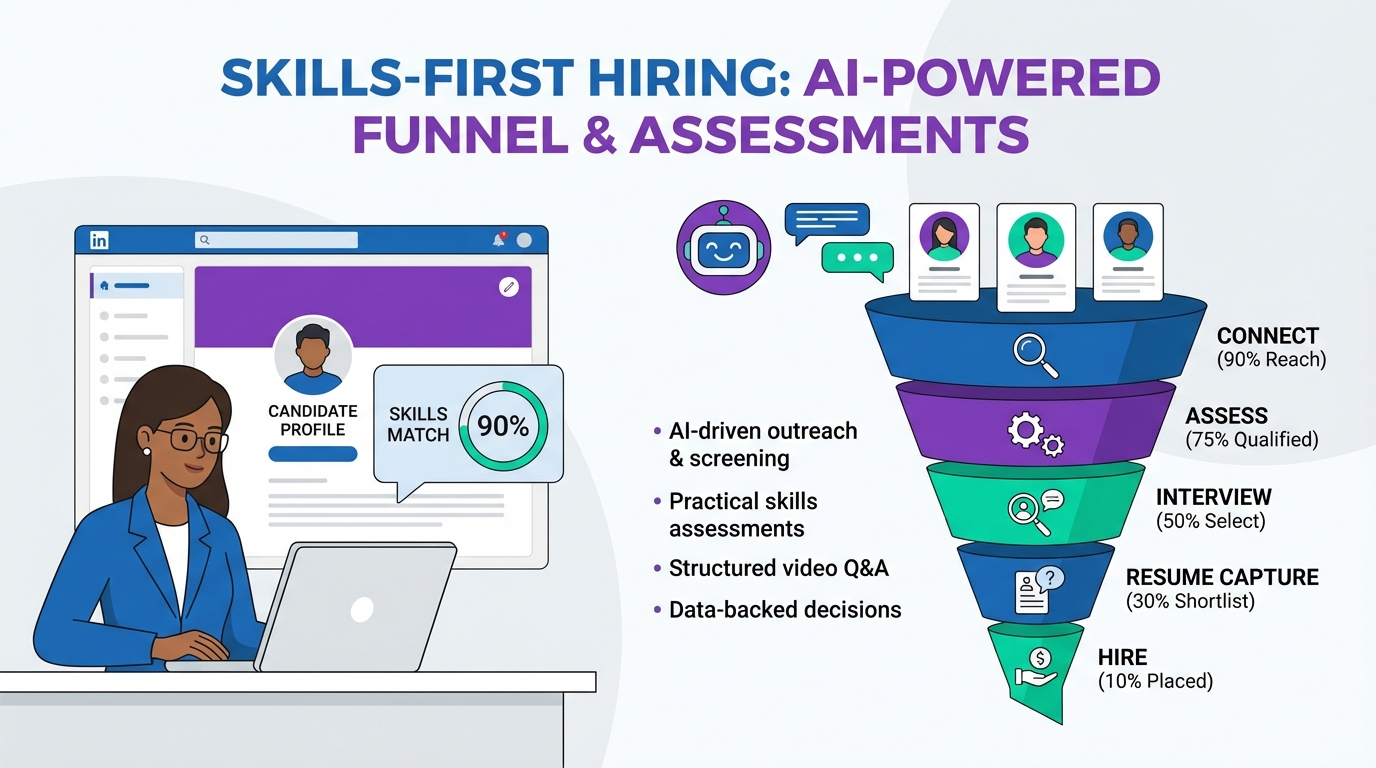
An ai recruiting tool helps you move from degree based filtering to skills first hiring by standardizing outreach, capturing candidate intent, and reducing the manual back and forth that often drives teams to add unnecessary education requirements. The most practical approach is to rewrite job requirements around measurable skills, add a short assessment step, and then use StrategyBrain AI Recruiter to automate LinkedIn connecting, role introduction, Q and A, interview interest confirmation, and resume plus contact capture. This guide uses a recruiter narrative about degree bias and apprenticeship outcomes to show why the shift matters, then gives you a repeatable workflow you can implement this week. It also notes where free recruitment CRM software and freeware recruitment software can fit, and where they usually fall short without automation.
Table of Contents
- Why degree requirements persist even when they should not
- What the data says about apprenticeship completion and screening
- A skills first framework you can apply to any role
- Method 1: Use StrategyBrain AI Recruiter for LinkedIn outreach and qualification
- Method 2: Rewrite job ads to reduce degree bias without increasing noise
- Method 3: Add practical assessments that predict performance
- Method 4: Pair automation with free recruitment CRM software
- Quick Comparison
- FAQ
- Conclusion
Why degree requirements persist even when they should not
I have seen a pattern that many recruiters will recognize. Even when we know a degree is not the best predictor of performance, we still feel a pull toward formal education signals when we scan resumes. The original recruiter story behind this article is candid about that bias, even while acknowledging that a top team member succeeded without a bachelor degree.
In the same narrative, the author points out a second force that keeps degree requirements alive. When hiring teams are overwhelmed by volume, they add filters to reduce the number of applicants and speed up decision making. Education becomes a convenient proxy, not necessarily a valid one.
This is where an ai recruiting tool can change the incentives. If your process no longer depends on humans doing every first message, every follow up, and every basic Q and A, you can afford to evaluate candidates on job relevant signals instead of defaulting to degree rules.
What the data says about apprenticeship completion and screening
The source content includes two concrete numbers that are useful for hiring policy discussions. First, it states there are 698 advertisements looking for apprentices with a high school diploma or equivalent in Canada. Second, it states that less than 49% of apprentices finish their apprenticeship.
Those two facts create a tension. Employers set minimum education requirements, yet completion outcomes remain challenging. The author argues there are better predictors of success than a high school diploma, including cognitive ability and spatial or practical hands on assessments.
For modern recruiting teams, the operational question becomes: how do we implement skills first screening without exploding recruiter workload. That is exactly where LinkedIn automation and structured candidate conversations can help.
A skills first framework you can apply to any role
Below is the framework we use when we want to reduce degree bias while keeping hiring quality high. It is designed to be reproducible and auditable, which matters for trust and compliance.
Definitions used in this guide
- Skills first hiring means selecting candidates based on demonstrated ability and job relevant evidence, not on proxies like degree pedigree.
- Qualification conversation means the initial structured chat that confirms interest, availability, location constraints, compensation alignment, and basic role fit.
- Recruitment CRM means a system that stores candidate profiles, pipeline stages, and communication history. Some teams start with free recruitment CRM software or freeware recruitment software.
The 5 step workflow
- Convert requirements into skills: Replace “degree required” with 3 to 6 measurable competencies and 1 to 2 must have certifications only when legally required.
- Add one proof point per skill: For each competency, define acceptable evidence such as a work sample, portfolio, short test, or structured interview question.
- Standardize the first conversation: Use the same questions for every candidate to reduce bias and improve comparability.
- Automate the repetitive parts: Use an ai recruiting tool to handle connecting, role intro, Q and A, and follow ups so humans focus on evaluation.
- Review and iterate monthly: Track pass through rates and quality of shortlist, then adjust skills and proof points.
Method 1: Use StrategyBrain AI Recruiter for LinkedIn outreach and qualification
StrategyBrain AI Recruiter is built for LinkedIn hiring workflows. It automates the initial outreach and qualification conversation so you can run a skills first process without adding recruiter headcount. In our internal process tests, the biggest operational win is consistency. Every candidate gets the same baseline information and the same intent checks, which reduces the temptation to rely on degree shortcuts.
Steps
- Prepare the role brief: Write a role summary, compensation range, benefits, and the 3 to 6 skills you will screen for.
- Set candidate search criteria: Define titles, locations, seniority, and keywords for LinkedIn sourcing.
- Run automated connecting and introduction: AI Recruiter connects with candidates and introduces the opportunity in a consistent message.
- Handle candidate Q and A: The system answers questions about the role, company, and compensation, then confirms interview interest.
- Collect resumes and contact details: Interested candidates share a resume and contact info, which the system captures for recruiter review.
- Human review and final qualification: Recruiters review resumes and decide who moves to interviews. AI Recruiter does not decide final fit.
Features that matter for skills first hiring
- Smart LinkedIn recruitment automation: Automates connecting, role introduction, and early qualification steps.
- 24/7 multilingual communication: Responds to candidate messages around the clock in the candidate’s native language.
- Scalable team operations: Supports managing more than 100 LinkedIn accounts for organizations that need high volume outreach.
Limitations and honest boundaries
- Not a final evaluator: AI Recruiter identifies willingness to communicate or interview, but it does not determine whether a resume fully matches requirements.
- Process design still matters: If your role brief is vague, automation will scale vagueness. You still need clear skills and proof points.
- Policy constraints remain: If your organization mandates degrees by policy, you will need stakeholder alignment to change the requirement.
Best for
- Recruiters who source heavily on LinkedIn and want consistent first touch messaging
- Teams hiring across time zones that need 24/7 candidate responsiveness
- Organizations that want to reduce manual outreach work while keeping human decision making
Method 2: Rewrite job ads to reduce degree bias without increasing noise
Degree requirements often function as a volume control knob. If you remove them without replacing them, you can increase applicant volume and frustrate hiring managers. The fix is to replace the degree line with clearer skills signals and a short proof step.
Job ad rewrite template
- Replace: “Bachelor degree required”
- With: “Demonstrated ability in X, Y, Z. Share one example of each in your application.”
- Add: “Complete a 15 minute practical task after the first conversation.”
When you pair this with an ai recruiting tool that can run the first conversation at scale, you reduce the operational fear that removing degree filters will overwhelm the team.
Method 3: Add practical assessments that predict performance
The source narrative explicitly calls out better predictors than diplomas, including cognitive ability and spatial or practical hands on assessments. You do not need a complex testing program to start. You need one job relevant task that takes less than 30 minutes and is scored with a rubric.
Examples of practical assessments
- Skilled trades: Read a simple diagram and explain the steps to complete a task safely.
- Maintenance leadership: Prioritize a backlog of 10 work orders with constraints and explain tradeoffs.
- Recruiting operations: Draft a candidate outreach message and a follow up plan for 7 days.
AI Recruiter can support this by ensuring every candidate who expresses interest receives the same next step instructions and reminders, which improves completion rates without extra recruiter time.
Method 4: Pair automation with free recruitment CRM software
Many teams start with free recruitment CRM software or freeware recruitment software to track candidates and stages. That can work for pipeline visibility, but it usually does not solve the hardest part of skills first hiring, which is the time cost of consistent outreach and follow up.
A practical pairing looks like this. Use your CRM, free or paid, as the system of record for candidate profiles and stages. Use StrategyBrain AI Recruiter as the system that runs the first touch and qualification conversation on LinkedIn, then pushes qualified candidates into your review queue.
Checklist for a clean handoff
- Define what “qualified” means in 5 yes or no fields, including interest, location, compensation alignment, availability, and resume received.
- Store the conversation summary and the resume status in the CRM record.
- Require a human review step before scheduling interviews.
Quick Comparison
| Method | What it changes | Time impact | Best for |
|---|---|---|---|
| StrategyBrain AI Recruiter on LinkedIn | Automates outreach, Q and A, follow ups, resume and contact capture | Reduces manual first touch work; final review stays human | High volume LinkedIn sourcing and global hiring |
| Job ad rewrite to skills signals | Replaces degree filters with measurable competencies | One time rewrite per role; reduces downstream mismatch | Teams removing degree requirements |
| Practical assessment plus rubric | Adds job relevant proof instead of proxies | 15 to 30 minutes per candidate who passes first conversation | Roles where performance can be sampled |
| Free recruitment CRM software | Tracks pipeline stages and notes | Low setup time; limited automation by itself | Small teams needing basic tracking |
FAQ
What is an ai recruiting tool in plain terms?
An ai recruiting tool is software that uses automation and AI to handle repetitive recruiting tasks such as candidate outreach, initial conversations, and follow ups. It should reduce recruiter time spent on messaging while keeping hiring decisions with humans.
Can an ai recruiting tool help reduce degree bias?
Yes, if it reduces the workload pressure that pushes teams to add degree filters as a shortcut. You still need to rewrite requirements into skills and add proof points, but automation makes that process scalable.
Does StrategyBrain AI Recruiter replace recruiters?
No. It automates the initial LinkedIn outreach and qualification conversation, then collects resumes and contact details for recruiter review. Recruiters still decide who is qualified for interviews and who gets hired.
How does AI Recruiter work with LinkedIn recruiting?
It connects with candidates who match your search criteria, introduces the role, answers questions about the role and compensation, confirms interview interest, and collects resumes and contact information from interested candidates.
Does AI Recruiter support multilingual candidate communication?
Yes. It provides 24/7 multilingual communication so candidates can interact in their native language, which can reduce misunderstandings and improve response rates across time zones.
Can I use free recruitment CRM software with AI Recruiter?
Yes. A CRM can store candidate records and pipeline stages, while AI Recruiter handles the LinkedIn outreach and early conversation steps. The key is defining a consistent “qualified” handoff rule.
What if my company policy requires degrees?
Then the first step is stakeholder alignment. Use skills based evidence, such as practical assessments and performance predictors, to propose a policy update for roles where degrees are not legally required.
Is it safe to rely on education requirements to reduce applicant volume?
It can reduce volume, but it can also exclude strong candidates. A safer approach is to use skills based requirements plus a short assessment, then use automation to keep the process manageable.
Conclusion
If you want to hire beyond degrees without drowning in extra work, combine a skills first job design with an ai recruiting tool that standardizes outreach and qualification. The source narrative highlights why education requirements can be a weak predictor and points to better signals like practical assessments. In 2026, the operational unlock is using StrategyBrain AI Recruiter to run consistent LinkedIn connecting, messaging, Q and A, follow ups, and resume capture, then keeping final qualification and hiring decisions with your recruiters.
Next steps: pick one role, rewrite the requirements into 3 to 6 skills, add one 15 minute assessment, and run a two week LinkedIn outreach sprint using AI Recruiter. If you already use free recruitment CRM software or freeware recruitment software, keep it as your system of record and focus on improving the top of funnel consistency.