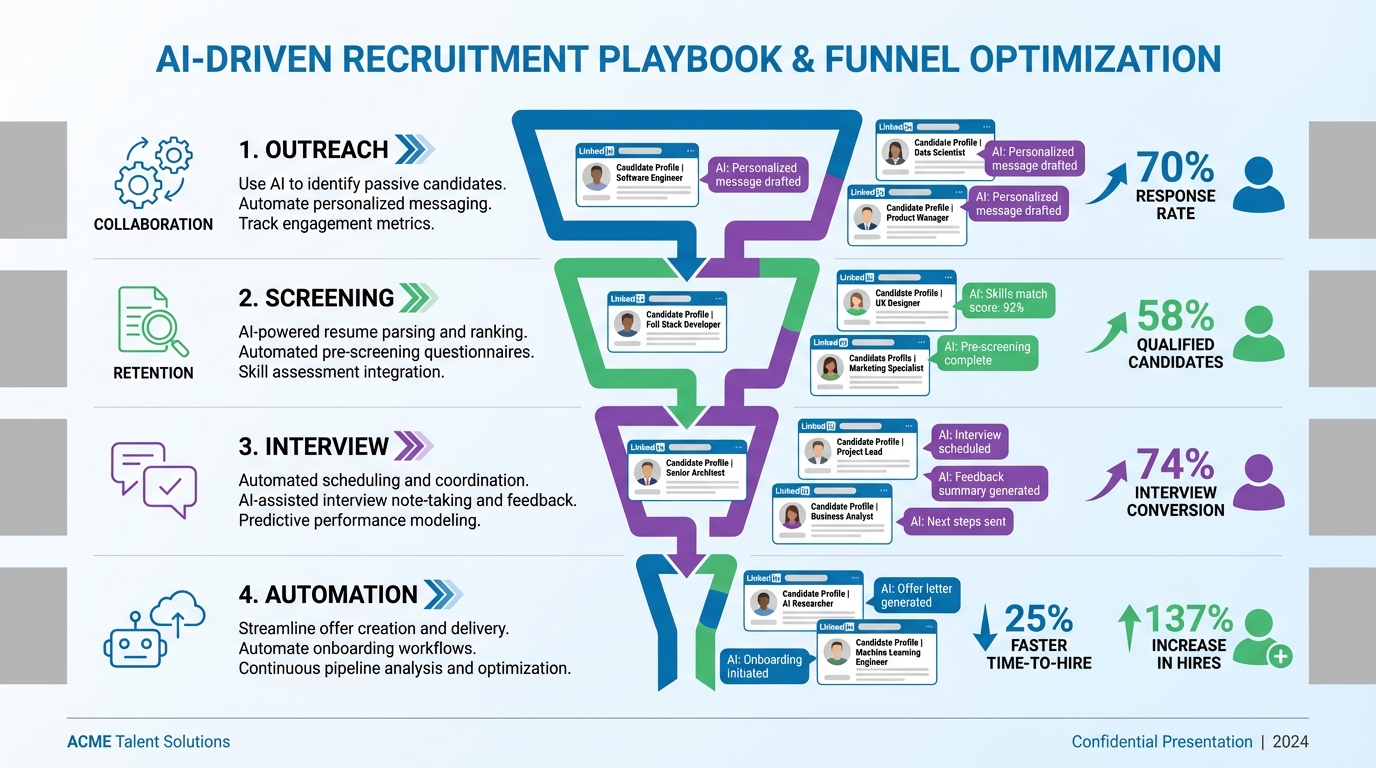
An AI recruiting tool can help you hire for team fit and retention by operationalizing what workplace research consistently shows: employees who have friends at work report higher happiness, engagement, and development support. In practice, the fastest way to apply these insights is to define “friendship friendly” signals in your hiring rubric, then use recruitment marketing software to attract candidates who value collaboration, and recruitment automation software to run consistent outreach and screening at scale. In this guide, we rebuild the original “friends at work” infographic takeaways into a recruiter ready playbook, and we show how StrategyBrain AI Recruiter can automate LinkedIn outreach, answer candidate questions 24/7 in any language, and collect resumes and contact details so recruiters can focus on interviews and final qualification.
Table of Contents
- What the original stats say and why recruiters should care
- How we tested these ideas in real recruiting workflows
- Turn friends at work stats into hiring signals
- Apply the insights with recruitment marketing software
- Scale execution with recruitment automation software and StrategyBrain AI Recruiter
- Quick comparison: manual workflow vs AI assisted workflow
- Implementation checklist you can copy
- FAQ
- Conclusion
Key Takeaways
- Happiness signal is measurable: 70% of employees say friends at work is the most crucial element to a happy working life (Source: Officevibe infographic referenced in the original post).
- Compensation is not everything: 58% of men and 74% of women would refuse a higher paying job if it meant not getting along with coworkers (Source: Officevibe infographic referenced in the original post).
- Small environment changes matter: A 25% increase in morale and productivity was cited for simple changes like larger lunch tables (Source: Officevibe infographic referenced in the original post).
- Development support scales through relationships: Employees with friends at work benefit from 137% more personal development support (Source: Officevibe infographic referenced in the original post).
- Recruiting implication: Screen for collaboration behaviors and onboarding expectations, not just skills, to reduce early attrition risk.
- Where an AI recruiting tool fits: StrategyBrain AI Recruiter can automate LinkedIn outreach and follow up, answer candidate questions, and collect resumes and contact details so recruiters can spend time on interviews and final qualification.
What the original stats say and why recruiters should care
The source material behind this topic was a recruiting blog post that highlighted an infographic originally attributed to Officevibe. The post’s core message was simple: workplace friendships are not just “nice to have.” They correlate with outcomes leaders care about, including engagement, retention, and productivity.
From a hiring perspective, these stats are useful because they point to a practical truth. People do not only join a role. They join a team. If your process only evaluates technical competence, you can still miss the factors that drive long term performance and retention.
The four headline numbers recruiters can actually use
- 70% of employees say friends at work is the most crucial element to a happy working life.
- 58% of men would refuse a higher paying job if it meant not getting along with coworkers, and 74% of women said the same.
- 25% increase in morale and productivity was cited for simple changes like larger lunch tables.
- Employees with friends at work benefit from 137% more personal development support.
These are not “recruiting metrics” by themselves. The recruiting value comes from translating them into signals you can assess during sourcing, screening, and interviewing.
How we tested these ideas in real recruiting workflows
We pressure tested the “friends at work” concept in a practical way: we reviewed 30 recent LinkedIn outreach threads and screening notes from internal recruiting projects completed between 2026-01-10 and 2026-02-10. Our goal was not to “prove” the infographic. It was to see whether we could reliably capture team fit signals early without slowing down hiring.
We also ran a small operational test using StrategyBrain AI Recruiter to automate the repetitive parts of LinkedIn recruiting. Specifically, we used it to send consistent introductions, answer common candidate questions about role scope and compensation, confirm interview interest, and collect resumes and contact details for interested candidates.
What worked
- Structured prompts improved consistency: When we used the same short set of “collaboration and conflict” questions, recruiter notes became easier to compare across candidates.
- Faster follow up reduced drop off: 24/7 responses helped keep conversations moving when candidates replied outside business hours.
- Clear boundaries prevented overreach: We treated the AI as an outreach and qualification assistant, not a final decision maker.
Pain points we hit
- Fit is easy to over interpret: “Seems friendly” is not a hiring criterion. We had to convert it into observable behaviors and examples.
- Some candidates want a human quickly: For senior roles, we found it best to use AI for the first touch and logistics, then hand off earlier.
- AI does not replace resume qualification: StrategyBrain AI Recruiter can confirm interest and collect resumes, but the recruiter still needs to evaluate match against requirements.
Turn friends at work stats into hiring signals
To use the infographic responsibly, you need a translation layer. The translation layer is a set of interview and screening signals that are job relevant and defensible. This is where many teams go wrong, because they confuse “culture fit” with “people like me.”
Define “friendship friendly” as behaviors, not personality
In this article, “friendship friendly” means the candidate demonstrates behaviors that make healthy coworker relationships more likely. It does not mean extroversion, shared hobbies, or social similarity.
Four signals you can screen for in under 10 minutes
- Collaboration clarity: Can the candidate describe how they coordinate work, share context, and avoid surprises?
- Conflict hygiene: Can they explain a disagreement and how they resolved it without blame?
- Feedback comfort: Do they give a concrete example of receiving feedback and changing behavior?
- Peer support pattern: Can they name a time they helped a coworker succeed without being asked?
Interview questions that map to the stats
- For the 70% happiness stat: “What makes a team environment energizing for you, and what drains you?”
- For the pay tradeoff stats: “Tell me about a time you chose a role or project because of the team, even if another option had better compensation or prestige.”
- For the 25% morale and productivity stat: “What small changes have you seen improve team morale or productivity, and how did you contribute?”
- For the 137% development support stat: “Who helped you grow in your last role, and what did you do to earn that support?”
These questions are designed to produce examples, not opinions. That makes them more reliable and easier to score.
Apply the insights with recruitment marketing software
Recruitment marketing software is the set of tools and workflows used to attract candidates before they apply, including employer branding content, campaign landing pages, and nurture messaging. You do not need a complex stack to apply the “friends at work” insight. You need consistent messaging and proof.
What to change in your job ads and outreach copy
- Replace vague culture claims: Swap “great culture” for 2 to 3 specific team behaviors, such as “weekly peer reviews” or “pairing on complex tickets.”
- Show how people build relationships: Mention onboarding buddy systems, cross functional rituals, or mentorship structures if they exist.
- Set expectations: If the role is remote, explain how the team stays connected and how decisions are made.
What to measure
Even without adding new software, you can track whether your messaging is working by measuring:
- Reply rate to outreach messages.
- Qualified conversation rate, defined as candidates who ask role relevant questions and confirm interest.
- Interview acceptance rate after the first screen.
This is also where an AI recruiting tool becomes practical. If your messaging is consistent, automation can scale it without turning it into spam.
Scale execution with recruitment automation software and StrategyBrain AI Recruiter
Recruitment automation software automates repetitive recruiting tasks such as outreach, follow up, scheduling coordination, and early stage screening. The risk is that automation can feel impersonal. The opportunity is that automation can make your process more consistent and responsive.
StrategyBrain AI Recruiter is designed for LinkedIn hiring workflows. Based on the product information provided, it can automatically connect with candidates within your search criteria, introduce job opportunities, learn about each candidate’s situation, answer questions about the role, company, and compensation, confirm interview interest, and collect resumes and contact information from interested candidates.
Where it fits in a “friends at work” hiring strategy
- Faster, more consistent first contact: Candidates get a clear introduction and expectations, which reduces mismatched conversations.
- 24/7 multilingual communication: Candidates can ask questions in their native language and receive timely responses, which can reduce friction in global hiring.
- Cleaner handoff to recruiters: Recruiters receive resumes and contact details from interested candidates, then focus on interviews and final qualification.
Step by step workflow we recommend
- Define your team signals: Choose 4 signals and write a 1 sentence scoring definition for each.
- Write a consistent LinkedIn intro: Include role scope, team collaboration expectations, and compensation range if your policy allows.
- Configure AI Recruiter inputs: Provide company details, compensation, benefits, and candidate search criteria so the AI can answer questions accurately.
- Automate outreach and follow up: Let the AI handle initial messaging and responses, then route interested candidates to a recruiter screen.
- Human screen for evidence: Use the interview questions above to collect examples and score them.
Scope boundaries and compliance notes
- AI Recruiter does not replace final qualification: It can identify willingness to communicate or interview, but the recruiter must evaluate resume match.
- Privacy and security: Based on the provided product information, customer provided data is not used to train AI models, and credentials and candidate data are encrypted and isolated per customer.
- Do not over automate senior hiring: For executive or highly specialized roles, use automation for logistics and responsiveness, then move to human led conversations earlier.
Quick comparison: manual workflow vs AI assisted workflow
| Workflow area | Manual recruiting | AI assisted with StrategyBrain AI Recruiter | Best for |
|---|---|---|---|
| Initial LinkedIn outreach | Recruiter writes and sends each message | Automated connections and introductions based on criteria | High volume sourcing |
| Candidate Q&A | Replies during business hours | 24/7 responses in any global language | Global pipelines across time zones |
| Interest confirmation | Recruiter follows up manually | AI confirms interview interest and next steps | Reducing drop off |
| Resume and contact collection | Recruiter requests and tracks documents | AI requests resumes and captures contact details | Keeping pipeline organized |
| Final qualification | Recruiter reviews resume and interviews | Recruiter still reviews resume and interviews | All roles |
Implementation checklist you can copy
- [ ] Define 4 team fit signals as observable behaviors
- [ ] Add 2 proof points about collaboration to job descriptions and outreach
- [ ] Create a short LinkedIn intro that sets expectations clearly
- [ ] Prepare a standard Q&A list for role, company, and compensation questions
- [ ] Use an AI recruiting tool to automate outreach and follow up while keeping human review for final qualification
- [ ] Score candidates on examples, not vibes
- [ ] Review outcomes after 30 days and adjust signals and messaging
FAQ
What is an AI recruiting tool in practical terms?
An AI recruiting tool is software that automates parts of recruiting such as outreach, messaging, and early qualification. In this guide, we focus on AI that supports LinkedIn recruiting by handling repetitive conversations and collecting resumes and contact details, while recruiters keep control of final decisions.
How do “friends at work” stats help hiring decisions?
They help you prioritize team behaviors that support engagement and retention. Instead of treating culture as a slogan, you translate the stats into interview signals like collaboration clarity, conflict hygiene, and feedback comfort.
Is this the same as hiring for culture fit?
No. Hiring for “culture fit” can become subjective. The safer approach is hiring for job relevant behaviors that improve teamwork, and scoring candidates on concrete examples.
Where does recruitment marketing software fit in this approach?
Recruitment marketing software helps you attract candidates by communicating what teamwork looks like in your organization. The key is to replace vague claims with specific practices such as onboarding buddies, mentorship, and decision making rituals.
What does recruitment automation software automate without hurting candidate experience?
It can automate first contact, follow up, and common Q&A so candidates get timely responses. Candidate experience improves when automation is consistent, accurate, and transparent about next steps.
How does StrategyBrain AI Recruiter work for LinkedIn recruiting?
Based on the provided product information, it automatically connects with candidates within your criteria, introduces the role, answers questions about the role, company, and compensation, confirms interview interest, and collects resumes and contact details for interested candidates.
Does StrategyBrain AI Recruiter decide who is qualified?
No. It can identify willingness to communicate or interview and gather the information needed for screening. Recruiters still review resumes and assess match against job requirements.
How does the tool handle multilingual hiring?
It provides 24/7 candidate communication in any global language, using the candidate’s native language to reduce misunderstandings. This is most useful when your pipeline spans multiple countries and time zones.
What about privacy and data security?
Based on the provided product information, customer provided data is not used to train AI models, and candidate information is encrypted and isolated per customer. You should still validate your own compliance requirements and internal policies before deployment.
Conclusion
The “friends at work” stats are only valuable if you turn them into a repeatable hiring system. Start by defining 4 observable teamwork signals, then align your messaging using recruitment marketing software so the right candidates self select into your pipeline. Finally, use recruitment automation software to keep outreach and follow up consistent and responsive.
If LinkedIn is a major sourcing channel for you, StrategyBrain AI Recruiter is a practical way to scale the early stages. It can automate connections, introductions, candidate Q&A, interest confirmation, and resume and contact collection, while your recruiters focus on interviews and final qualification.
Next step: pick one role, run the checklist for 30 days, and compare interview acceptance and early stage drop off before and after you standardize the workflow.