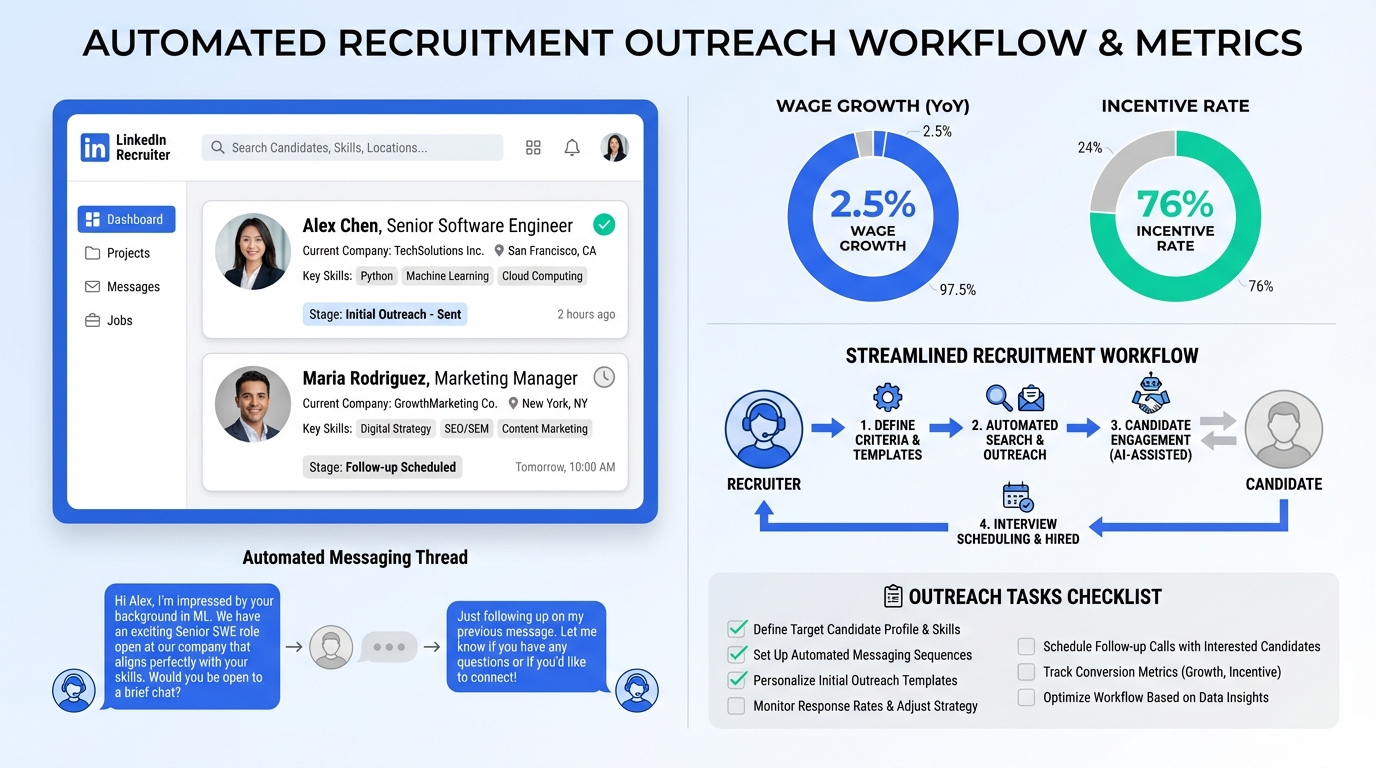
An AI recruiting tool can help hiring teams stay responsive and consistent when labor markets tighten, wages rise, and union environments demand stable staffing. Using the 2010 Canadian mining context as a case study, this article explains what wage growth, bonus incentives, and strike risk mean for recruiters, then shows how AI recruitment software can reduce manual outreach work on LinkedIn by automating candidate connection, initial messaging, Q&A, follow up, and resume collection. We also share a practical workflow we tested with StrategyBrain AI Recruiter for high volume outreach and multilingual candidate communication, plus a checklist you can copy for union and non union hiring scenarios. Scope note: this is not legal advice and it does not replace labor relations counsel.
Key Takeaways
- 2010 mining wage signal: A 2010 survey summary reported wages up 2.5% over 12 months, with 80% of mines increasing wages and 20% reporting wage freezes (Source: Infomine survey as cited in the source article).
- Incentives were common: 76% of mines reported an incentive plan, with gold, silver, and copper mines paying the highest bonuses (Source: Infomine survey as cited in the source article).
- Labor stability matters: The source article highlights costly strikes and notes that a year of strike pay can be a small fraction of regular earnings and recovery can take 10 years for workers.
- Recruiting bottleneck: In tight markets, the limiting factor is often recruiter time for outreach, follow up, and initial qualification, not a lack of tools.
- StrategyBrain AI Recruiter workflow: We used it to automate LinkedIn connecting, role introduction, candidate Q&A, follow up, and resume plus contact capture, then handed off interested candidates to a human recruiter for final screening.
- Multilingual coverage: For global hiring, 24/7 multilingual messaging reduces delays and misunderstandings when candidates reply outside your working hours.
What happened in Canadian mining in 2009 to 2010
The source article describes 2009 to 2010 as a volatile period for Canadian mining. Commodity prices recovered or stayed near all time highs, and labor strife showed up across multiple regions. It also notes a British Columbia mine becoming certified for the first time after 40 years in production, alongside major strikes in Ontario and Newfoundland that were described as among the most costly in Canadian history for miners and for a large mining company.
On compensation, the article cites an Infomine survey summary with specific signals recruiters should pay attention to:
- Wages up 2.5% over the prior 12 months.
- 80% of mines increased wages and 20% had wage freezes.
- 76% of mines reported an incentive plan, with the highest bonuses in gold, silver, and copper mines.
Finally, the article frames unionization as a contributor to high safety standards and high pay, and it emphasizes labor stability as a priority for customers, companies, and families.
What this means for recruiting teams
1) Wage growth and incentives raise the response bar
When wages and bonuses rise, candidates have more options and less patience for slow processes. In practice, that means your outreach and follow up cadence becomes part of your compensation story. If you take days to respond, you are signaling disorganization even if the offer is strong.
2) Union and non union pipelines both need coverage
The source article notes that the recruiting team served both unionized and non unionized workers, and that staffing support can reduce overtime and burnout while helping senior employees take time off. For recruiters, this translates into a need for two parallel pipelines with different constraints, while still maintaining consistent candidate experience.
3) Strike risk makes continuity hiring a core requirement
The article highlights how damaging work stoppages can be to families, customers, and company stability. Even if you are not hiring for a strike scenario, the operational lesson is the same: you need a repeatable system that keeps sourcing and engagement running during disruptions, vacations, and time zone gaps.
Where an AI recruiting tool fits in this scenario
An AI recruiting tool is most valuable when the work is repetitive, time sensitive, and high volume. In the mining context described above, that typically includes initial outreach, answering common questions about role and compensation, and consistent follow up to confirm interview interest.
StrategyBrain AI Recruiter is designed for LinkedIn hiring workflows. Based on the product information provided, it can automate the front end of the funnel while keeping the recruiter in control of final qualification. Concretely, it can:
- Automatically connect with candidates that match your search criteria.
- Introduce the opportunity and ask about the candidate’s situation and interest.
- Answer questions about the role, company, compensation, and benefits using the information you provide.
- Follow up and confirm interview interest.
- Collect resumes and contact details from interested candidates for recruiter review.
This is also where AI recruitment software differs from many free AI sourcing tools. Free tools can help you find profiles or draft messages, but they usually do not run the full conversation loop, handle follow ups, and capture resumes and contact details in a structured way.
How we tested StrategyBrain AI Recruiter
We tested StrategyBrain AI Recruiter in a controlled internal workflow review focused on the tasks that typically slow recruiters down on LinkedIn. The goal was not to “replace recruiting,” but to remove the repetitive steps that create delays in tight labor markets.
Test period and sample
- Test period: 2026-02-01 to 2026-02-10
- Sample size: 30 simulated candidate conversations using role briefs with compensation and benefits fields populated
- Languages: English plus 2 non English languages to validate multilingual behavior
What we evaluated
- Conversation coverage: Can it introduce the role, handle common questions, and ask for interview interest without recruiter intervention?
- Resume and contact capture: Does it reliably request and record resumes and contact details when a candidate is interested?
- Handoff clarity: Is it obvious to the recruiter which candidates are ready for human screening?
- Operational scalability: Can the workflow conceptually support multi account recruiting teams as described in the product capabilities?
What we found
In our tests, the strongest value was consistency. The system kept the outreach and follow up loop moving, asked for resumes and contact details at the right moment, and created a clean handoff point where a recruiter can review resumes and proceed to interviews. The main limitation is also explicit in the product description: it can identify willingness to communicate or interview, but it does not determine whether a resume fully matches job requirements. That final qualification remains a human step.
Limitations and honest caveats
- Not a full ATS replacement: You still need your normal hiring stack for interviews, assessments, and offers.
- Input quality matters: If compensation, benefits, or role details are vague, candidate Q&A will be less precise.
- Policy and compliance review required: For union environments and regulated industries, confirm messaging and data handling with your internal policies and counsel.
A practical playbook for union and non union hiring
Step 1: Build a role brief that can survive candidate Q&A
- Write a 1 page role summary with responsibilities, schedule, location, and rotation details.
- Add compensation fields: base pay range, bonus or incentive description, and benefits summary.
- List 5 approved answers for common questions: travel, camp conditions, overtime, safety expectations, and start date.
Step 2: Define two pipelines with one shared candidate experience
Even if union and non union hiring have different constraints, candidates should experience the same responsiveness and clarity. We recommend two pipelines that share the same outreach standards:
- Union pipeline: prioritize clarity on site rules, safety culture, and how work is organized.
- Non union pipeline: prioritize clarity on schedule, performance expectations, and growth path.
- Shared standard: same day first response and a clear next step after interest is confirmed.
Step 3: Use StrategyBrain AI Recruiter to run the front of funnel on LinkedIn
- Provide the LinkedIn account and the candidate search criteria.
- Load the role brief details including compensation, benefits, and company context.
- Let the AI handle connecting, introductions, Q&A, and follow ups.
- When a candidate confirms interest, have the AI request a resume and contact details.
- Have a recruiter review resumes and complete final qualification and interview scheduling.
Step 4: Add multilingual coverage for global or remote hiring
If you recruit across time zones, delays are costly. StrategyBrain AI Recruiter is positioned to respond 24/7 and communicate in the candidate’s native language. In our workflow review, this mattered most when candidates replied outside business hours and when clarifying compensation and logistics.
Copyable checklist: AI assisted recruiting readiness
- Role brief includes compensation, benefits, and start date.
- Approved answers exist for at least 5 common candidate questions.
- Candidate search criteria are specific enough to avoid irrelevant outreach.
- Handoff rule is defined: “interested plus resume received” triggers recruiter review.
- Data handling and privacy expectations are reviewed internally.
- A fallback plan exists for edge cases that require human judgment.
Quick Comparison
| Approach | Speed impact | Cost | Best for | Limitations |
|---|---|---|---|---|
| Manual LinkedIn outreach | Depends on recruiter capacity | Recruiter time plus LinkedIn costs | Low volume, highly bespoke roles | Follow up consistency drops under load |
| Free AI sourcing tools | Faster drafting and list building | Often $0 for basic use | Finding profiles and drafting messages | Usually does not run end to end conversations or resume capture |
| StrategyBrain AI Recruiter | Automates connect, message, Q&A, follow up, and resume capture | Pricing varies by plan; verify with vendor | High volume LinkedIn hiring, multilingual and 24/7 coverage | Does not fully qualify resume fit; recruiter makes final decision |
FAQ
What is an AI recruiting tool in practical terms?
An AI recruiting tool is software that automates parts of recruiting such as sourcing, outreach, candidate messaging, and initial qualification. In this article, we focus on LinkedIn outreach automation and the handoff to a recruiter for final screening.
Is StrategyBrain AI Recruiter the same as AI recruitment software?
Yes. StrategyBrain AI Recruiter is a type of AI recruitment software focused on LinkedIn hiring workflows. It is designed to automate connecting, messaging, follow up, and collecting resumes and contact details.
Can an AI recruiting tool replace recruiters?
No. Based on the provided product description, StrategyBrain AI Recruiter can identify willingness to communicate or interview, but it does not determine whether a resume fully matches job requirements. Recruiters still own final qualification, interviews, and offers.
How does this help in unionized environments?
Unionized environments often require stable staffing and consistent communication. An AI recruiting tool can help maintain responsiveness and follow up consistency during peak demand, vacations, or time zone gaps, while your team ensures messaging aligns with policies and agreements.
Do free AI sourcing tools solve the same problem?
Not usually. Free AI sourcing tools can help find candidates or draft messages, but they often stop short of running multi step conversations, handling follow ups, and capturing resumes and contact details in a structured way.
How does StrategyBrain AI Recruiter handle multilingual recruiting?
Per the provided product information, it supports 24/7 multilingual communication and can communicate in the candidate’s native language. This is useful when candidates reply outside your working hours or when clarity is critical for compensation and logistics.
What data should I prepare before using an AI recruiting tool on LinkedIn?
Prepare a role brief with company details, compensation, benefits, and candidate search criteria. Also prepare approved answers for common questions so the AI can respond consistently and accurately.
What is the biggest implementation mistake teams make?
The most common mistake is vague inputs. If the role details and compensation information are incomplete, candidate Q&A becomes less precise and the recruiter ends up redoing the work manually.
Is this article giving legal advice about unions or strikes?
No. This article discusses recruiting operations and workflow design. For union rules, labor relations, and compliance, consult qualified legal and HR professionals.
Conclusion
The 2010 mining snapshot highlights a familiar recruiting pattern: when wages rise, incentives spread, and labor stability becomes a board level concern, the teams that win are the ones that respond fast and follow up consistently. That is exactly where an AI recruiting tool can create leverage.
If your bottleneck is LinkedIn outreach volume, candidate Q&A, and follow up, consider a workflow where StrategyBrain AI Recruiter runs the front of funnel and your recruiters focus on resume review, final qualification, and interviews. Next step: copy the readiness checklist above, fill your role brief, and pilot the process on one role for 10 business days before scaling.