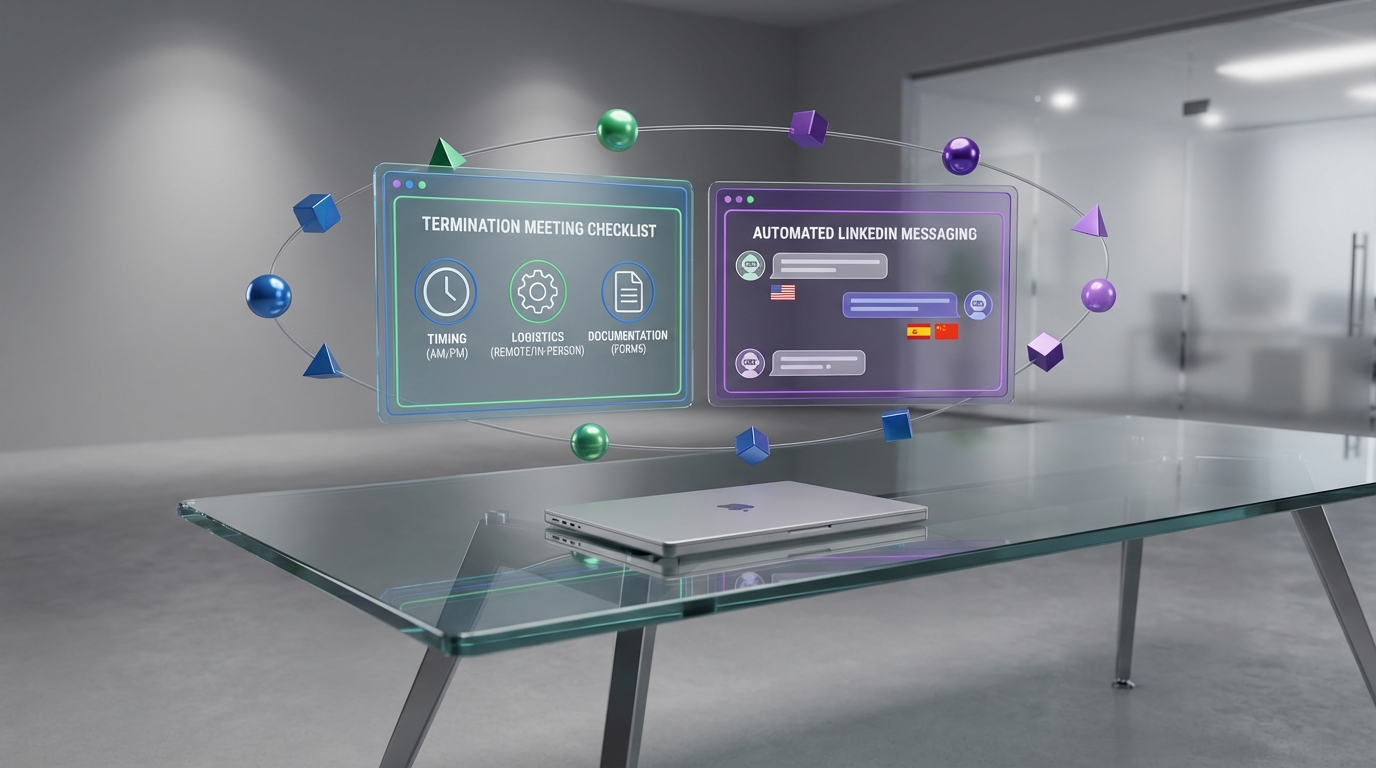
An ai recruiting tool can’t replace the human judgment required in a termination meeting, but it can reduce downstream risk by standardizing documentation, ensuring consistent messaging, and coordinating follow ups with remaining employees and active candidates. This article summarizes a webinar hosted by The Headhunters featuring Dr. Howie Outerbridge on how to terminate employees with better planning, timing, and logistics. It also adds a practical recruiter layer: how to keep hiring operations stable during sensitive exits using recruitment marketing software and a recruitment management system, including StrategyBrain AI Recruiter for LinkedIn outreach and candidate communication. Scope note: this is not legal advice and does not replace jurisdiction specific HR or employment counsel.
Table of Contents
- Webinar context and why it matters
- The 3 objectives to balance in a termination
- Planning, logistics, and security considerations
- Scripts and scenarios you can reuse
- 6 common employee reactions and how to respond
- When an outside career transition consultant helps
- Keeping hiring stable with an AI recruiting tool
- Quick comparison: manual vs AI assisted recruiting ops
- Copyable checklist: termination meeting readiness
- FAQ
- Conclusion and next steps
Webinar context and why it matters
The Headhunters hosted a webinar with guest speaker Dr. Howie Outerbridge, VP Client Solutions at Logan HR, focused on How to Terminate Employees. The session emphasized that termination meetings are difficult for everyone involved, yet they can be conducted in a way that leaves both sides “in the best possible place” when planning is done well.
One quote from the session captures the standard to aim for: “Most companies do a good job of treating people well when they’re hired. The truly excellent companies also do a great job when it’s time to part ways.” This mindset is operational, not just cultural. It affects employer brand, retention of remaining employees, and the credibility of your recruiting pipeline.
The 3 objectives to balance in a termination
In the webinar, Dr. Outerbridge highlighted the importance of aligning on objectives for three groups. Before you schedule the meeting, write these down and confirm internal agreement.
- The employer’s objective: deliver a clear decision, protect the organization, and ensure a controlled transition of access, assets, and responsibilities.
- The departing employee’s objective: receive a respectful, unambiguous message and understand next steps such as final pay, benefits, and transition support.
- The remaining employees’ objective: maintain trust, reduce uncertainty, and prevent productivity loss caused by rumors or inconsistent communication.
These objectives also connect directly to recruiting. If your internal messaging is inconsistent, candidates will hear it. That is where a recruitment management system helps by keeping communications and approvals consistent across HR, hiring managers, and recruiters.
Planning, logistics, and security considerations
The webinar stressed that planning and logistics are not “nice to have.” They are the difference between a controlled meeting and a chaotic one. In practice, I treat logistics as a risk control layer.
What to plan before the meeting
- Timing: choose a time that supports privacy and reduces disruption to the team’s workflow.
- Location and attendees: decide who must be present and who should not be present.
- Access and security: coordinate system access changes and asset return steps so they happen predictably.
- Documentation: prepare the written materials you will provide and the internal notes you must retain.
Where an ai recruiting tool fits: it does not run the termination meeting, but it can reduce operational spillover. For example, if a recruiter is impacted by the change, StrategyBrain AI Recruiter can keep LinkedIn candidate conversations moving with 24/7 responses and multilingual communication, while the team handles internal transitions.
Scripts and scenarios you can reuse
Dr. Outerbridge’s session included sample scripts and scenarios. The practical takeaway is to script the parts that must be consistent, then leave room for human empathy in the moment.
A simple script structure
- Decision statement: a clear, direct message that the employment is ending.
- Reason framing: keep it factual and aligned with your internal documentation.
- Next steps: explain logistics such as final pay, benefits, and return of property.
- Support options: if applicable, explain transition support and how it works.
- Close: confirm understanding and end the meeting respectfully.
Operational note: store the approved script version in your recruitment management system or HR knowledge base so managers do not improvise different versions across departments.
6 common employee reactions and how to respond
The webinar covered six common employee reactions and how to deal with each. The key is not to “win” the conversation. The goal is to keep the meeting safe, respectful, and procedurally consistent.
Because reactions vary by person and context, the most reliable approach is to prepare response patterns rather than memorize lines. For example, prepare a calm repetition of the decision, a short bridge back to next steps, and a plan for pausing the meeting if emotions escalate.
If you are also running active hiring, plan for the team’s emotional bandwidth. This is another place where recruitment marketing software and an ai recruiting tool can help by keeping candidate outreach and follow ups consistent even when internal capacity is temporarily reduced.
When an outside career transition consultant helps
Dr. Outerbridge also discussed when and why an outside career transition consultant can be a helpful resource. The practical decision point is whether the organization needs specialized support to help the departing employee move forward, and whether that support reduces risk and improves outcomes for everyone involved.
From an employer brand perspective, transition support can also reduce negative word of mouth. That matters for recruiting because candidates often evaluate how companies treat people during hard moments, not just during onboarding.
Keeping hiring stable with an AI recruiting tool
Termination events often create a hidden recruiting problem: response times slow down, candidate experience becomes inconsistent, and hiring managers lose confidence in the pipeline. This is where an ai recruiting tool can provide measurable operational stability, especially on LinkedIn where candidate expectations for responsiveness are high.
What StrategyBrain AI Recruiter can automate on LinkedIn
StrategyBrain AI Recruiter is designed to automate the initial LinkedIn recruiting workflow. It can automatically connect with candidates that match your search criteria, introduce the opportunity, answer questions about the role, company, and compensation, confirm interview interest, and collect résumés and contact information from interested candidates.
Why this matters during sensitive internal changes
- 24/7 continuity: candidate messages still get timely responses across time zones.
- Multilingual communication: candidates can communicate in their native language, reducing misunderstandings.
- Scalable operations: teams can manage more than 100 LinkedIn accounts to build an AI powered recruiting team when needed.
Important limitation to understand
StrategyBrain AI Recruiter can identify willingness to communicate or interview, but it does not decide whether a résumé fully matches job requirements. Recruiters still perform final qualification after reviewing the résumé. This boundary is useful because it keeps decision accountability with humans while removing repetitive outreach work.
Quick comparison: manual vs AI assisted recruiting ops
| Workflow area | Manual recruiting operations | AI assisted with StrategyBrain AI Recruiter | Best for |
|---|---|---|---|
| Initial LinkedIn outreach | Recruiter sends connection requests and first messages | Automated connecting and role introduction based on criteria | High volume sourcing |
| Candidate Q&A | Recruiter replies during working hours | 24/7 responses, including multilingual communication | Global hiring |
| Interest confirmation | Recruiter manually follows up | Automated follow up to confirm interview interest | Reducing drop off |
| Résumé and contact capture | Recruiter requests and tracks files and details | Automatically requests and captures résumés and contact details | Pipeline hygiene |
| Final qualification | Recruiter reviews résumé and screens | Recruiter still reviews résumé and makes fit decisions | Quality control |
Copyable checklist: termination meeting readiness
Use this checklist to reduce preventable mistakes. It is written to be copied into your internal HR playbook or recruitment management system.
- Decision clarity: the decision is final, documented, and approved by the right stakeholders.
- Meeting plan: time, location, and attendees are confirmed and appropriate for privacy.
- Logistics plan: access changes, asset return, and security steps are coordinated.
- Script readiness: the opening statement and next steps are written and rehearsed.
- Support plan: transition support options are confirmed if offered.
- Team communication: a plan exists for informing remaining employees with consistent messaging.
- Hiring continuity: candidate communications and outreach are covered, including automation coverage if needed.
FAQ
Is an ai recruiting tool appropriate to use during layoffs or terminations?
Yes, if it is used for recruiting operations rather than for termination decisions. An ai recruiting tool can keep candidate outreach and responses consistent while HR and leadership handle sensitive internal meetings.
What does “recruitment management system” mean in this context?
A recruitment management system is the system of record for hiring workflows, approvals, and candidate stages. In practice it helps keep scripts, documentation, and communication standards consistent across recruiters and hiring managers.
How does StrategyBrain AI Recruiter work on LinkedIn?
It automates initial outreach and qualification steps by connecting with candidates that match your criteria, introducing the role, answering questions about the role, company, and compensation, confirming interest, and collecting résumés and contact details for recruiters to review.
Does StrategyBrain AI Recruiter replace recruiter judgment?
No. It can identify willingness to communicate or interview, but it does not determine whether a résumé fully matches job requirements. Recruiters still make the final fit decision after reviewing the résumé.
Can StrategyBrain AI Recruiter communicate with candidates in different languages?
Yes. It supports multilingual candidate communication and can respond around the clock, which is useful for global hiring across time zones.
How does the tool capture résumés and contact details?
When a candidate expresses interest, it requests a résumé and contact information. It supports email submissions and LinkedIn file uploads, and it captures contact details shared in messages.
What is the biggest risk of using automation during sensitive HR events?
The biggest risk is inconsistent or inappropriate messaging. Mitigate this by using approved templates, limiting automation to recruiting workflows, and keeping termination decisions and communications strictly human led.
Is this article legal advice?
No. This article summarizes a webinar and adds operational recruiting guidance. Always consult qualified HR and legal professionals for jurisdiction specific requirements.
Conclusion and next steps
Termination meetings are hard, but the webinar’s core message is practical: planning, logistics, and consistent messaging reduce harm for the departing employee, the employer, and the remaining team. If you also need to protect hiring momentum, pair that human centered approach with a disciplined recruiting operations layer using recruitment marketing software, a recruitment management system, and an ai recruiting tool such as StrategyBrain AI Recruiter for LinkedIn outreach continuity.
Next steps: document your termination meeting script, confirm your logistics checklist, and decide in advance how candidate communications will be covered during high stress periods so your pipeline does not stall.