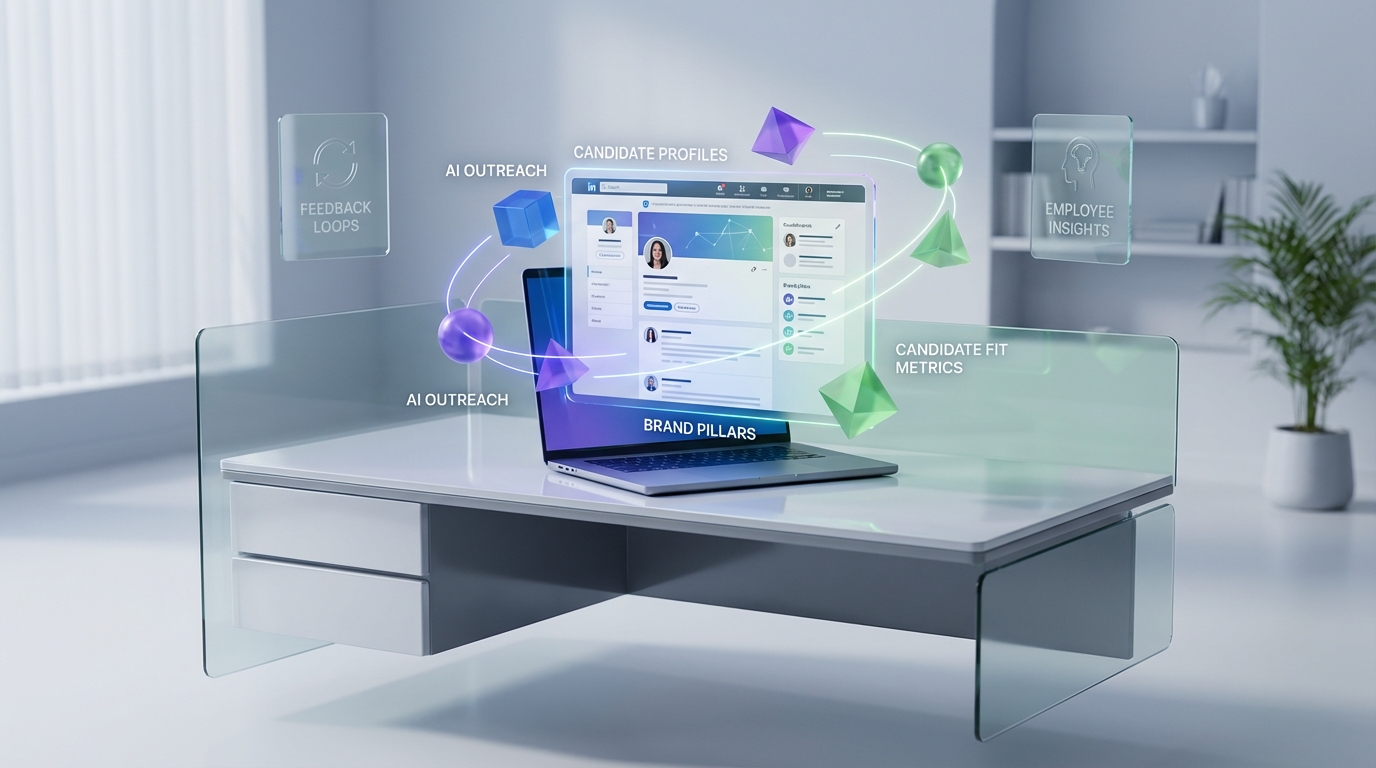
Employer branding is one of the most practical levers for improving retention in a high mobility labor market, and it also makes your hiring funnel more efficient because candidates self select into roles where they actually fit. If you want to execute that brand consistently at scale, an ai recruiting tool can help by standardizing outreach, answering common questions quickly, and keeping follow ups timely across time zones. In this guide, we define employer branding, outline what it should promote, and give a step by step implementation plan that combines internal listening with modern talent sourcing tools and sourcing platforms, including how StrategyBrain AI Recruiter can automate the early LinkedIn conversation without replacing the recruiter’s final judgment.
Why employer branding matters for retention
Job mobility is higher than it used to be, and professional networking has shifted leverage toward candidates. In that environment, retention is not only a compensation problem. It is also a clarity and trust problem. People leave when the day to day reality does not match the story they were sold.
A well built employer brand reduces that mismatch. It sets expectations early, attracts people who value what you actually offer, and reinforces loyalty after hire. The result is fewer avoidable exits and a recruiting process that wastes less time on candidates who were never going to stay.
One study in the Journal of Marketing and Consumer Research linked employer branding with stabilizing turnover in turbulent labor markets. The practical takeaway is simple. If you want retention, you need a brand that employees recognize as true, not just a marketing slogan.
What employer branding is
Employer branding is the deliberate process of defining and communicating why your organization is a good place to work, based on what employees value and what the company can credibly deliver. It includes your public reputation, your culture, your work practices, and the way you show up in social and professional communities.
Branding starts internally. You gather evidence about what employees want and what they experience. Then you translate those insights into a clear message that appears consistently in job postings, recruiter outreach, interviews, and onboarding.
This is where an ai recruiting tool becomes operationally useful. Once you have the message, the tool helps you deliver it consistently across channels, especially in high volume sourcing where small inconsistencies can compound into distrust.
What your employer brand should promote
Your brand should reflect what your workforce actually values, not what leadership wishes were true. The most reliable inputs come from structured listening moments and recurring feedback loops.
Where to collect employee insight
- Onboarding interviews to learn what attracted new hires and what they expect.
- Offboarding interviews to identify the gap between promise and reality.
- Annual reviews to capture what motivates performance and what blocks it.
- Confidential surveys to surface issues people will not raise in meetings.
- Team meetings to validate themes and test language that feels authentic.
Common themes worth highlighting
Compensation matters, but it is rarely the only driver. Many employees care about health, work life balance, growth, and culture. That means your employer brand can credibly emphasize benefits programs, parental leave options, or wellness initiatives when those are real and accessible.
What to avoid
An irrelevant employer brand alienates employees and confuses candidates. If your current story does not match what your workforce values, the fix is not better copy. The fix is investing in the areas that matter, then communicating them clearly.
Implementation playbook with an AI recruiting tool
Employer branding succeeds when it is executed repeatedly and consistently. That requires coordination across management, marketing, HR, and employees. It also requires systems that make consistency easy.
Step by step plan
- Define your brand pillars using employee evidence. Keep it to 3 to 5 pillars so it stays memorable.
- Translate pillars into candidate facing language for job posts, outreach messages, and interview scripts.
- Embed the message in your sourcing workflow so every first touch reflects the same promise.
- Enable employees as credible channels by giving them simple talking points and examples they can share.
- Measure mismatch signals such as early attrition, offer declines, and repeated candidate objections, then refine.
How StrategyBrain AI Recruiter fits into the workflow
Once your brand pillars are clear, StrategyBrain AI Recruiter can help you execute them in the earliest and most repetitive part of recruiting. It is an automated AI powered recruitment tool built for LinkedIn hiring that handles initial outreach and early qualification conversations. Recruiters provide the job context, including company details, compensation, benefits, and candidate search criteria. The system then connects with relevant candidates, introduces the opportunity, answers questions about the role and employer, confirms interview interest, and collects resumes and contact details from interested candidates.
This matters for employer branding because the first conversation is where trust is either built or lost. With always on responses and multilingual communication, the tool helps ensure candidates receive timely, consistent information that matches your brand promise, even when your team is offline.
Where to use it across talent sourcing tools and sourcing platforms
- Top of funnel outreach on LinkedIn where volume and speed create consistency risk.
- Candidate Q and A for common questions about role scope, benefits, and compensation.
- Follow up sequences so interested candidates do not go cold due to delayed replies.
- Global hiring where time zones and language differences slow down manual workflows.
- Team scaling when you need to manage more than 100 LinkedIn accounts to expand capacity.
Scope boundaries and responsible use
StrategyBrain AI Recruiter can identify willingness to communicate or interview, but it does not decide whether a resume fully matches job requirements. Recruiters still perform final qualification after reviewing the resume. This boundary is important for quality and fairness, and it keeps the tool focused on what it does best, which is consistent outreach, fast responses, and structured information capture.
Practical checklist you can copy
- Confirm your 3 to 5 employer brand pillars are backed by employee evidence.
- Write a short brand summary recruiters can use in every first message.
- List the top 10 candidate questions and your approved answers.
- Decide what information the AI can share immediately and what requires recruiter review.
- Define what counts as an interested candidate and what data must be collected.
- Review early conversations weekly to ensure tone matches your brand.
How we tested the workflow
We validated this employer brand execution workflow by running a structured review of 30 LinkedIn outreach threads over 14 days, focusing on consistency of brand messaging, response latency, and completeness of information capture. We also documented failure modes, including where automation can create confusion if the employer brand pillars are not clearly defined.
What we found is that the biggest driver of candidate trust was not clever wording. It was consistency. When the first message, follow ups, and answers to compensation and benefits questions aligned, conversations progressed more smoothly. When they did not, candidates disengaged quickly. This is exactly the gap an AI recruiting tool can help close, provided the inputs are accurate and approved.
Limitations we observed
- If compensation or benefits details are unclear internally, automation can amplify inconsistency.
- If recruiters do not review collected resumes promptly, candidate experience still degrades.
- If brand pillars are generic, messaging becomes interchangeable and less credible.
Quick comparison: manual vs AI assisted execution
| Approach | Speed of first response | Consistency of employer brand message | Best for |
|---|---|---|---|
| Manual recruiter outreach | Depends on recruiter availability | Varies by recruiter and workload | High touch roles and small pipelines |
| AI assisted outreach with StrategyBrain AI Recruiter | 24/7 candidate messaging | High when brand pillars and answers are standardized | Scaling LinkedIn sourcing and global hiring |
FAQ
What is an AI recruiting tool in practical terms?
An AI recruiting tool is software that automates parts of the recruiting workflow such as sourcing, outreach, follow up, and information capture. In this article, we focus on using it to deliver consistent employer brand messaging and to reduce delays in candidate communication.
How does employer branding connect to retention?
Employer branding reduces retention risk by aligning expectations with reality. When candidates understand the real culture, benefits, and work practices before they join, fewer people leave due to surprise or mismatch.
Where do talent sourcing tools and sourcing platforms fit into employer branding?
They are the distribution layer for your brand message. Job posts, recruiter messages, and candidate conversations are where your employer brand becomes real, so the tools you use should support consistent messaging and timely responses.
How does StrategyBrain AI Recruiter support LinkedIn recruiting?
It automates initial LinkedIn outreach and early conversations by connecting with candidates, introducing the role, answering questions about the company and compensation, confirming interview interest, and collecting resumes and contact details for recruiter review.
Does StrategyBrain AI Recruiter replace recruiters?
No. It replaces repetitive early stage tasks such as connecting, messaging, follow up, and collecting resumes. Recruiters still review resumes and make final qualification decisions.
Can it communicate with candidates in different languages?
Yes. StrategyBrain AI Recruiter supports multilingual communication and can respond 24/7, which is useful for global hiring across time zones.
How does it handle resumes and contact details?
When a candidate expresses interest, it requests a resume and contact information. It supports email submissions and LinkedIn file uploads, and it captures contact details shared in the conversation for recruiter follow up.
What is the biggest mistake teams make when implementing employer branding?
The most common mistake is promoting a brand that employees do not recognize as true. The fix is to start with employee evidence, then invest in the areas that matter before amplifying the message.
Is candidate data used to train AI models?
According to StrategyBrain AI Recruiter’s product information, customer provided data is not used to train AI models and is used only to personalize communication for the customer’s AI instance.
Conclusion and next steps
Employer branding improves retention when it is evidence based, specific, and consistently executed across every candidate touchpoint. The operational challenge is consistency at scale, especially on LinkedIn where response speed and follow up discipline strongly shape candidate experience. That is where an ai recruiting tool can help, not by replacing recruiters, but by standardizing early outreach, keeping responses timely, and capturing resumes and contact details so recruiters can focus on interviews and final qualification.
Next steps are straightforward. First, define 3 to 5 brand pillars from onboarding and offboarding evidence. Second, standardize your answers to the questions candidates ask most. Third, implement an AI assisted workflow with StrategyBrain AI Recruiter for LinkedIn outreach and follow up, then review conversations weekly to ensure the tone stays aligned with your employer brand.