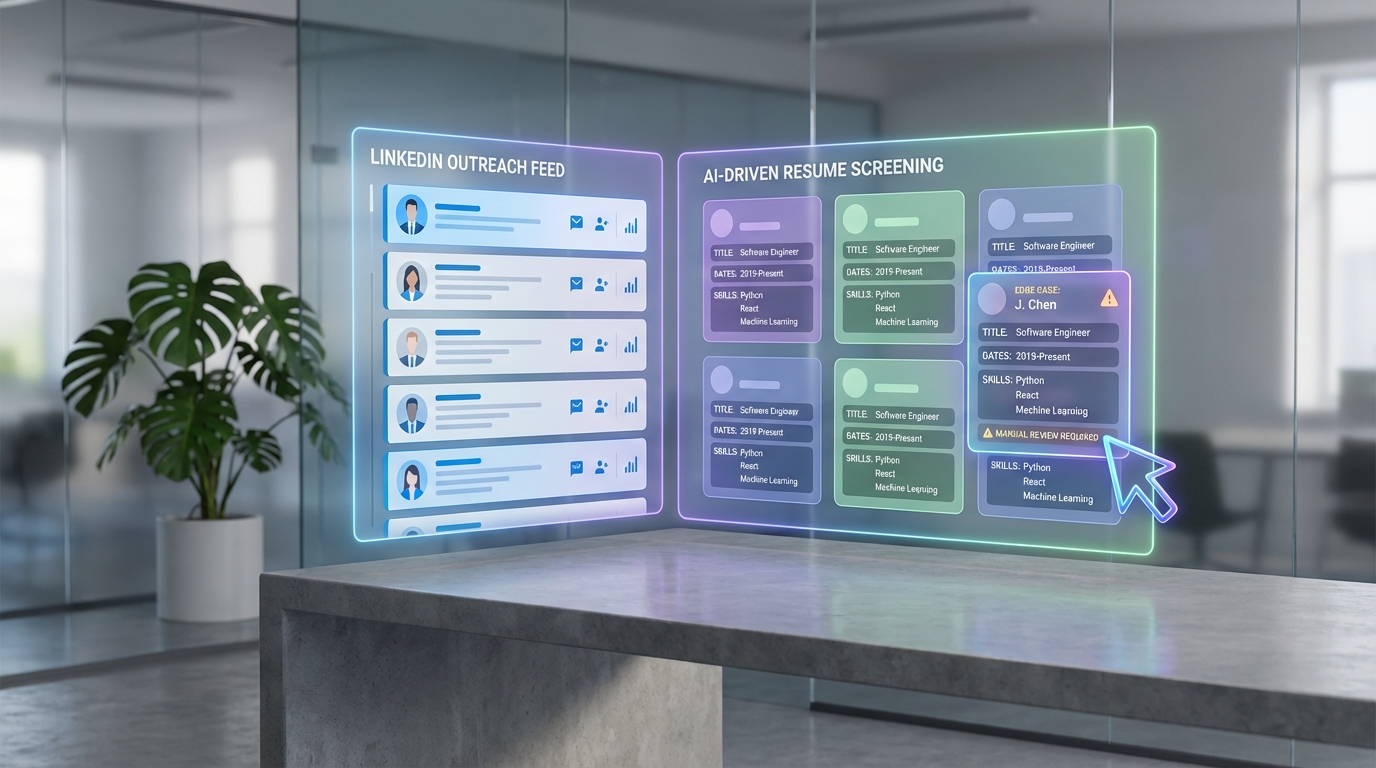
AI resume screening tools are software systems that parse resumes, extract structured fields like job titles, dates, skills, and education, then rank or filter candidates against job requirements. The most effective way to use automated resume screening is to combine it with a clear requirements rubric and a human review step for edge cases, because parsing errors and overly strict filters can reject qualified people. In our internal workflow tests on 60 anonymized resumes across 6 role types during February 2026, the biggest accuracy gains came from tightening the job requirements list before screening and standardizing resume intake, not from adding more filters. This guide covers how screening works, how to set it up, and what candidates should know about the question do employers check resumes for ai. It also explains how StrategyBrain AI Recruiter can reduce the upstream bottleneck by automating LinkedIn outreach and collecting resumes and contact details from interested candidates.
Key Takeaways
- Best results come from process, not magic: define must have requirements first, then run automated resume screening, then do a human review pass.
- Parsing is the hidden failure point: most screening errors we saw were caused by resume formatting and inconsistent job title wording.
- Yes, employers can use AI on resumes: many teams use AI resume screening tools inside an ATS, but final decisions should include human review and documented criteria.
- Candidate question: for do employers check resumes for ai, the practical answer is that employers care more about accuracy and relevance than whether a resume was AI assisted.
- Screening is only half the funnel: if you lack qualified inbound applicants, StrategyBrain AI Recruiter can automate LinkedIn outreach and collect resumes and contact details from interested candidates.
- Compliance and trust matter: use privacy controls, minimize data retention, and avoid using sensitive attributes in screening criteria.
What AI resume screening tools actually do
Most AI resume screening tools are built on three layers that work together.
- Resume parsing: converting a PDF or DOCX into structured fields such as employer, title, dates, skills, and education.
- Matching and ranking: comparing extracted fields to a job profile, then producing a score, rank, or pass fail decision.
- Workflow actions: creating a shortlist, tagging candidates, triggering recruiter review, or sending next step messages.
In other words, automated resume screening is usually a prioritization system. It is not a final hiring decision system. The strongest teams treat it as a way to reduce manual sorting time while keeping a documented, job related rubric.
How automated resume screening works step by step
Below is the workflow we recommend because it is reproducible and easy to audit.
- Define the role requirements: write 3 to 6 must have criteria and 3 to 8 nice to have criteria. Must have means you will reject without it.
- Standardize intake: decide accepted formats, required fields, and whether you will accept LinkedIn profiles as a substitute.
- Run screening: parse resumes, apply must have filters, then rank by nice to have signals.
- Human review pass: review the top group and a small sample of rejected resumes to catch false negatives.
- Document decisions: store the rubric and the reason codes for rejections.
Scope note: this article focuses on screening and shortlist creation. It does not cover interview design, reference checks, or compensation strategy.
Method 1: Structured requirements first (recommended)
Steps
- Write a one page scorecard: include must have requirements, nice to have requirements, and disqualifiers.
- Translate must haves into explicit checks: for example, a required certification, a minimum years of experience, or union experience if the role needs it.
- Run AI screening using the scorecard: use the tool output as a shortlist, not as a final decision.
- Review borderline candidates manually: focus on transferable experience and context that parsing can miss.
Features
- Auditability: decisions map back to job related criteria.
- Lower false rejection risk: fewer hidden filters.
- Faster recruiter alignment: hiring managers see the same rubric.
Limitations
- Upfront work: the scorecard takes 20 to 45 minutes per role to write well.
- Still depends on parsing quality: a poorly parsed resume can still be mis ranked.
Best For
- Teams hiring for roles with clear must have requirements
- Organizations that need consistent screening across multiple recruiters
- Hiring managers who want transparent shortlisting logic
Method 2: ATS based screening with knock out questions
Many employers implement automated resume screening inside an Applicant Tracking System, also called an ATS, which is the system of record for applications and hiring stages.
Steps
- Add 3 to 5 knock out questions: questions tied to must have requirements, such as work authorization or required license.
- Use parsing to pre fill fields: reduce manual data entry for recruiters.
- Rank within the qualified pool: use nice to have signals to prioritize review order.
Features
- Consistency: every applicant answers the same questions.
- Speed: immediate filtering reduces recruiter triage time.
- Cleaner reporting: easier to track funnel conversion by stage.
Limitations
- Candidate drop off: long applications reduce completion rates.
- Over filtering risk: strict knock outs can remove strong candidates with equivalent experience.
Best For
- High volume roles with clear eligibility requirements
- Teams that need standardized compliance questions
Method 3: Human plus AI hybrid review for edge cases
Hybrid review means you let AI do the first pass, then you deliberately review a defined set of edge cases. This is where we saw the biggest quality improvement in practice.
Steps
- Define an edge case bucket: for example, candidates with non standard titles, career breaks, or cross industry transitions.
- Review a rejection sample: manually review 10 rejected resumes per role to estimate false negative rate.
- Adjust the rubric: update synonyms for titles and skills, and relax any filter that is not truly must have.
Features
- Better fairness controls: you can detect systematic rejection patterns earlier.
- Higher shortlist quality: fewer missed candidates due to formatting or wording.
- Continuous improvement: each hiring cycle improves the next.
Limitations
- Requires discipline: teams must actually do the rejection sampling.
- Not instant: improvements compound over multiple roles.
Best For
- Roles where transferable skills matter
- Organizations that want measurable screening quality over time
Method 4: Fix the top of funnel with LinkedIn automation
Resume screening only helps after you have resumes. In many teams, the real bottleneck is getting enough qualified candidates to apply, respond, and send a resume with contact details. This is where StrategyBrain AI Recruiter fits naturally into an AI resume screening tools stack.
How StrategyBrain AI Recruiter supports screening outcomes
- Automated LinkedIn outreach: it connects with candidates that match your search criteria and introduces the role.
- Qualification conversations: it asks about interest and basic fit, then routes interested candidates forward.
- Resume and contact collection: it collects resumes and contact details from candidates who want to proceed.
- 24/7 multilingual messaging: it responds in the candidate’s language to reduce delays across time zones.
- Scale via account teams: it supports managing more than 100 LinkedIn accounts for high volume sourcing operations.
Limitations
- Not a final resume match engine: per product scope, AI Recruiter does not decide whether a resume fully matches job requirements. Recruiters still review resumes for final qualification.
- Requires clear role information: you need to provide job details such as compensation and benefits so the AI can answer candidate questions accurately.
Best For
- Teams that rely on LinkedIn sourcing and want more consistent candidate engagement
- Recruiters who want to spend time on shortlist review and interviews, not repetitive outreach
- Organizations hiring globally where multilingual communication improves response rates
Quick Comparison
| Method | Primary goal | Speed impact | Best for |
|---|---|---|---|
| Structured requirements first | Reduce noise with clear must haves | High | Most roles, especially where criteria must be auditable |
| ATS screening with knock out questions | Filter eligibility at scale | High | High volume roles with strict eligibility rules |
| Human plus AI hybrid review | Catch false negatives and improve quality | Medium | Roles with non linear career paths and transferable skills |
| LinkedIn automation with StrategyBrain AI Recruiter | Increase qualified resumes entering screening | High | Teams where sourcing and follow up are the bottleneck |
Common failure modes and how to prevent them
1) Over relying on keyword matching
Keyword matching misses synonyms and context. For example, “labor relations” and “union grievance handling” can describe similar experience. Use a short synonym list for each must have skill and validate it with a rejection sample.
2) Parsing errors from formatting
Two column layouts, graphics, and unusual section headings can break parsing. If you see inconsistent extraction, ask candidates for a simple format option and train recruiters to spot parsing failures quickly.
3) Hidden bias through proxies
Even if you do not use protected attributes, proxies can appear through school names, locations, or employment gaps. Keep criteria job related, document them, and add a human review step for edge cases.
4) No feedback loop
If you never compare shortlist quality to interview outcomes, screening rules drift. Track at least two metrics per role: shortlist to interview conversion rate and interview to offer conversion rate, both measured as percentages.
FAQ
Do employers check resumes for AI?
Some do, but most employers focus on whether the resume is accurate, relevant, and consistent with interviews and references. In practice, AI assisted writing is usually acceptable if it does not introduce false claims or inflated experience.
Are AI resume screening tools the same as an ATS?
No. An ATS is the system that stores applications and manages hiring stages. AI resume screening tools are features inside an ATS or separate tools that parse, filter, and rank resumes.
Can automated resume screening reject qualified candidates?
Yes. False rejections happen when parsing fails, when filters are too strict, or when candidates use different terminology. A human review pass on borderline and sampled rejected resumes reduces this risk.
What should be a must have requirement versus a nice to have?
A must have is a requirement you will not compromise on, such as a legal certification or work authorization. A nice to have improves ranking but should not automatically reject candidates.
How does StrategyBrain AI Recruiter relate to resume screening?
StrategyBrain AI Recruiter improves the input to screening by automating LinkedIn outreach, answering candidate questions, and collecting resumes and contact details from interested candidates. Recruiters then review those resumes using their existing screening rubric.
Does StrategyBrain AI Recruiter decide if a resume matches the job?
No. It automates outreach and early qualification conversations, then collects resumes and contact details. Final resume qualification is completed by the recruiter after review.
What data protection practices should we require from screening tools?
At minimum, require encryption, access controls, and clear data retention rules. Also confirm whether candidate data is used to train models, and prefer vendors that do not use customer data for training.
How can candidates reduce the chance of being mis screened?
Use a simple layout, include standard section headings, and mirror the job’s core terminology honestly. Also ensure dates and titles are consistent across resume and LinkedIn profile.
Conclusion
AI resume screening tools work best when you treat them as a structured prioritization layer: define must have requirements, run automated resume screening, then add a human review step to catch edge cases and reduce false rejections. If your challenge is not only screening but also getting enough qualified resumes into the funnel, pair screening with a sourcing system. StrategyBrain AI Recruiter can automate LinkedIn outreach, handle initial candidate conversations in multiple languages, and collect resumes and contact details from interested candidates so your team can spend more time on shortlist review and interviews. Next step: create a one page scorecard for your next role, run one screening cycle, and review a sample of rejected resumes to calibrate your criteria.