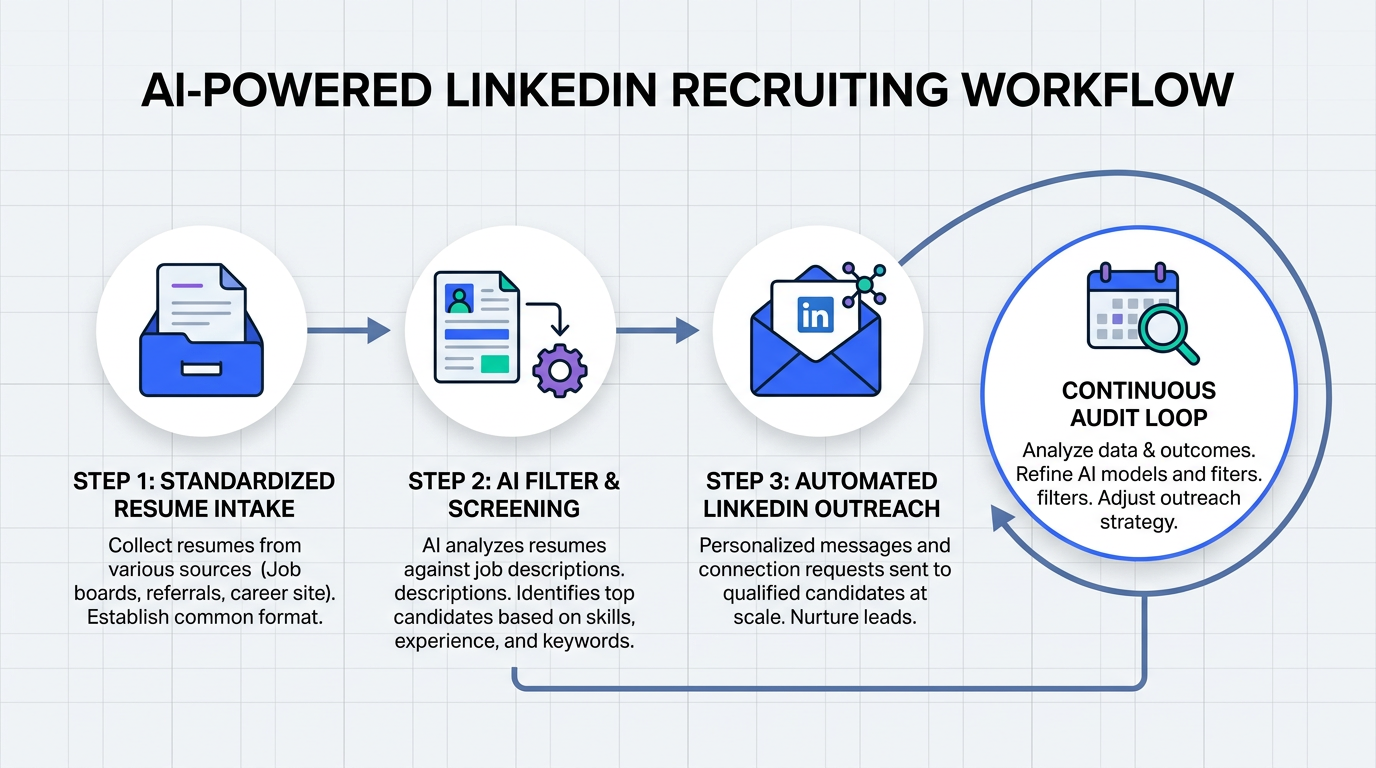
AI resume screening tools work best when you treat them as a change management project, not just a software rollout. The practical path is to define role criteria, standardize an AI readable resume intake, configure an AI resume filter to rank and route candidates, and then audit outcomes weekly so humans stay accountable for decisions. In our LinkedIn heavy hiring workflows, we also found that pairing screening with automated outreach and resume collection reduces the biggest time sink, which is the back and forth before you even have a resume to review. StrategyBrain AI Recruiter fits here by automating LinkedIn connection, initial messaging, Q and A, and collecting resumes and contact details, while recruiters keep final qualification decisions.
Table of Contents
- What AI resume screening tools actually change
- Key Takeaways
- Before you buy: set scope and guardrails
- Method 1: Transparent rollout
- Method 2: Inclusive feedback loop
- Method 3: Leader led adoption
- Method 4: Preparedness and audits
- Method 5: Pair screening with LinkedIn automation
- Quick Comparison
- AI readable resume checklist
- FAQ
- Conclusion
What AI resume screening tools actually change
Most teams adopt AI resume screening tools to reduce time spent on first pass review. In practice, the bigger change is governance: you are introducing a system that influences who gets seen first, which means you need clear rules, documentation, and a feedback loop.
To keep terminology precise, here are the three concepts that get mixed up:
- AI resume screening tools: software that parses resumes, scores or ranks candidates, and helps route them through a hiring workflow.
- AI resume filter: the specific rules or model driven criteria used to include, exclude, or prioritize candidates.
- AI readable resume: a resume format that can be reliably parsed by applicant tracking systems and AI parsers, with consistent headings, dates, and plain text structure.
This article focuses on change management and operational rollout. It does not provide legal advice, and it does not claim any specific accuracy rate for any vendor because that depends on your job family, data, and configuration.
Key Takeaways
- Start with transparency: explain what the AI resume filter will and will not do, and who owns final decisions.
- Standardize intake first: an AI readable resume process reduces parsing errors and false negatives.
- Make it inclusive: collect recruiter and hiring manager feedback in a structured weekly review.
- Use leader led adoption: adoption improves when managers commit to consistent usage and messaging.
- Plan for surprises: run weekly audits and be ready to adjust criteria when roles or markets shift.
- Remove the upstream bottleneck: if LinkedIn outreach is the slow part, automate outreach and resume collection with StrategyBrain AI Recruiter, then screen the resumes you receive.
Before you buy: set scope and guardrails
AI resume screening tools fail most often when teams skip alignment. Before configuration, write down the scope in one page and get sign off from recruiting leadership and the hiring manager.
Define what the AI will do
- Input: resumes, LinkedIn profiles, or application forms.
- Output: ranked list, shortlist, or routing tags.
- Decision boundary: AI recommends, humans decide.
Define what the AI will not do
- It will not replace structured interviews.
- It will not be the final authority on candidate fit.
- It will not remove the need for compliance review and documentation.
Method 1: Transparent rollout
Transparency is the fastest way to reduce internal resistance. People accept change more easily when they understand why it is happening, what the plan is, and how it affects them.
Steps
- Write a plain language policy that explains how the AI resume filter ranks candidates and what humans must review.
- Announce the rollout to recruiters and hiring managers with a timeline and a clear owner for questions.
- Document exceptions such as referrals, internal candidates, and hard to fill roles.
- Publish an audit cadence such as a weekly review meeting and a monthly summary.
Limitations
- Transparency takes time upfront, especially if stakeholders want to debate criteria.
- If you cannot explain the filter in plain language, adoption will stall.
Best For
- Teams introducing AI resume screening tools for the first time.
- Organizations with multiple hiring managers who need consistent process.
Method 2: Inclusive feedback loop
Change sticks when people feel involved. Inclusion does not mean every suggestion becomes a requirement. It means you create a real channel for feedback and you close the loop with decisions.
Steps
- Create a weekly 30 minute review with one recruiter, one hiring manager, and one ops owner.
- Review 10 screened resumes that were ranked high and 10 that were ranked low, then discuss why.
- Log adjustments to criteria and the reason for each change.
- Update the intake guidance so candidates submit a more AI readable resume.
Limitations
- Feedback can drift into opinion unless you anchor it to job requirements.
- Without a decision owner, the loop becomes a complaint session.
Best For
- Roles with evolving requirements such as sales, operations, and early stage teams.
- Organizations that want consistent recruiter and manager alignment.
Method 3: Leader led adoption
During change, leadership commitment matters. If managers use the tool inconsistently, recruiters will revert to old habits and the AI resume filter will never stabilize.
Steps
- Assign an executive sponsor who communicates why the change matters.
- Set a usage rule such as every requisition must have documented criteria and a screening workflow.
- Train managers on what the AI output means and what it does not mean.
- Measure adoption with a simple weekly check: screened, reviewed, interviewed, hired.
Limitations
- Leader led adoption can feel top down if you skip the feedback loop.
- Training must be repeated for new managers and new recruiters.
Best For
- High volume hiring where consistency matters more than customization.
- Distributed teams where process drift is common.
Method 4: Preparedness and audits
You cannot predict every outcome. Be prepared for the tool to behave differently across job families, resume formats, and candidate markets. The operational answer is a lightweight audit that catches issues early.
Steps
- Pick an audit sample such as 25 candidates per role per week.
- Check parsing quality by verifying that titles, dates, and skills were captured correctly.
- Check routing outcomes by comparing AI ranking to recruiter judgment and interview outcomes.
- Adjust criteria and update documentation the same week.
Limitations
- Audits require discipline. If you skip 2 weeks, small issues become systemic.
- Audits do not remove bias risk. They help you detect and respond faster.
Best For
- Teams hiring across multiple locations or countries.
- Organizations that need defensible process documentation.
Method 5: Pair screening with LinkedIn automation
Many teams focus on screening, but the real bottleneck is upstream: sourcing, outreach, follow up, and collecting resumes and contact details. If your recruiters spend hours sending messages and chasing replies, AI resume screening tools will not help until you have resumes to screen.
In our experience, this is where StrategyBrain AI Recruiter can be operationally useful. It automates LinkedIn connection and initial conversations, answers candidate questions about the role and compensation based on the information you provide, confirms interview interest, and collects resumes and contact details from interested candidates. Recruiters then review the resumes and make the final qualification decision, which keeps accountability with humans.
Steps
- Define candidate search criteria and the job information the AI can use in conversations, including compensation and benefits.
- Run automated outreach to connect and start conversations with candidates that match your criteria.
- Collect resumes and contact details from candidates who express interest.
- Screen the received resumes using your AI resume filter and human review process.
Limitations
- AI Recruiter does not decide whether a resume fully matches requirements. Recruiters still do final qualification.
- You still need clear messaging rules and compliance review for outreach content.
Best For
- LinkedIn heavy recruiting where outreach and follow up consume most recruiter time.
- Global hiring where 24/7 multilingual communication reduces delays and misunderstandings.
- Teams scaling outreach across many LinkedIn accounts, including setups above 100 accounts.
Quick Comparison
| Approach | Primary goal | What it changes | Best for |
|---|---|---|---|
| Transparent rollout | Reduce resistance | Clarity on AI resume filter usage | First time adoption |
| Inclusive feedback loop | Improve fit over time | Weekly criteria tuning and intake guidance | Evolving roles |
| Leader led adoption | Consistency | Manager commitment and training | High volume hiring |
| Preparedness and audits | Risk control | Parsing checks and outcome review | Multi location hiring |
| Screening plus LinkedIn automation | Increase qualified inflow | Automated outreach, Q and A, resume collection | LinkedIn sourcing bottlenecks |
AI readable resume checklist
Use this checklist to reduce parsing errors before you judge any AI resume screening tools. It also helps candidates submit an AI readable resume that your systems can interpret consistently.
- Use standard headings: Experience, Education, Skills, Certifications.
- Use plain text dates: YYYY to YYYY or MMM YYYY to MMM YYYY.
- Avoid tables for core content: tables often break parsing for titles and dates.
- One role per block: title, company, location, dates, then bullets.
- Spell out acronyms once: include both the acronym and the full term in Skills.
- Export to PDF only if parsing is verified: otherwise use DOCX.
FAQ
Do AI resume screening tools replace recruiters?
No. AI resume screening tools can speed up first pass review and routing, but recruiters still own final qualification, interviews, and hiring decisions. Treat the AI resume filter as a recommendation layer with human accountability.
What is the biggest rollout mistake with an AI resume filter?
The biggest mistake is skipping transparency and governance. If stakeholders do not understand how the AI resume filter is used and audited, adoption drops and the process becomes inconsistent.
How do I know if my resumes are AI readable?
If your parser consistently extracts job titles, employers, dates, and skills into the right fields, your resumes are likely AI readable. If you see missing dates, merged roles, or scrambled sections, standardize formatting and reduce tables and complex layouts.
Where does StrategyBrain AI Recruiter fit if I already have screening software?
StrategyBrain AI Recruiter helps before screening by automating LinkedIn outreach, follow up, candidate Q and A, and collecting resumes and contact details from interested candidates. You can then run your existing AI resume screening tools on the resumes you receive.
Does AI Recruiter decide who is qualified?
No. AI Recruiter identifies willingness to communicate or interview and collects resumes and contact details, but it does not determine whether a resume fully matches job requirements. Recruiters make the final qualification decision after review.
Can AI Recruiter communicate with candidates in different languages?
Yes. AI Recruiter supports 24/7 multilingual communication and can respond in the candidate’s native language, which can reduce delays across time zones and lower misunderstanding risk in early conversations.
How many LinkedIn accounts can AI Recruiter manage?
AI Recruiter supports managing more than 100 LinkedIn accounts so organizations can build AI powered recruitment teams and scale outreach capacity.
How does AI Recruiter handle privacy and data security?
According to the product documentation provided, customer data is not used to train AI models, credentials are encrypted, and candidate information is encrypted and isolated per customer. You should still run your own security and compliance review for your environment.
Conclusion
AI resume screening tools deliver value when you roll them out with the same discipline you would use for any sensitive operational change: transparency, inclusion, leadership commitment, and preparedness through audits. Start by making resumes more AI readable, then configure your AI resume filter with clear decision boundaries and a weekly review loop.
Next step: if your bottleneck is LinkedIn sourcing and follow up, pair screening with StrategyBrain AI Recruiter so you can automate outreach, answer candidate questions, and collect resumes and contact details at scale, then apply your screening workflow to the resumes you receive.