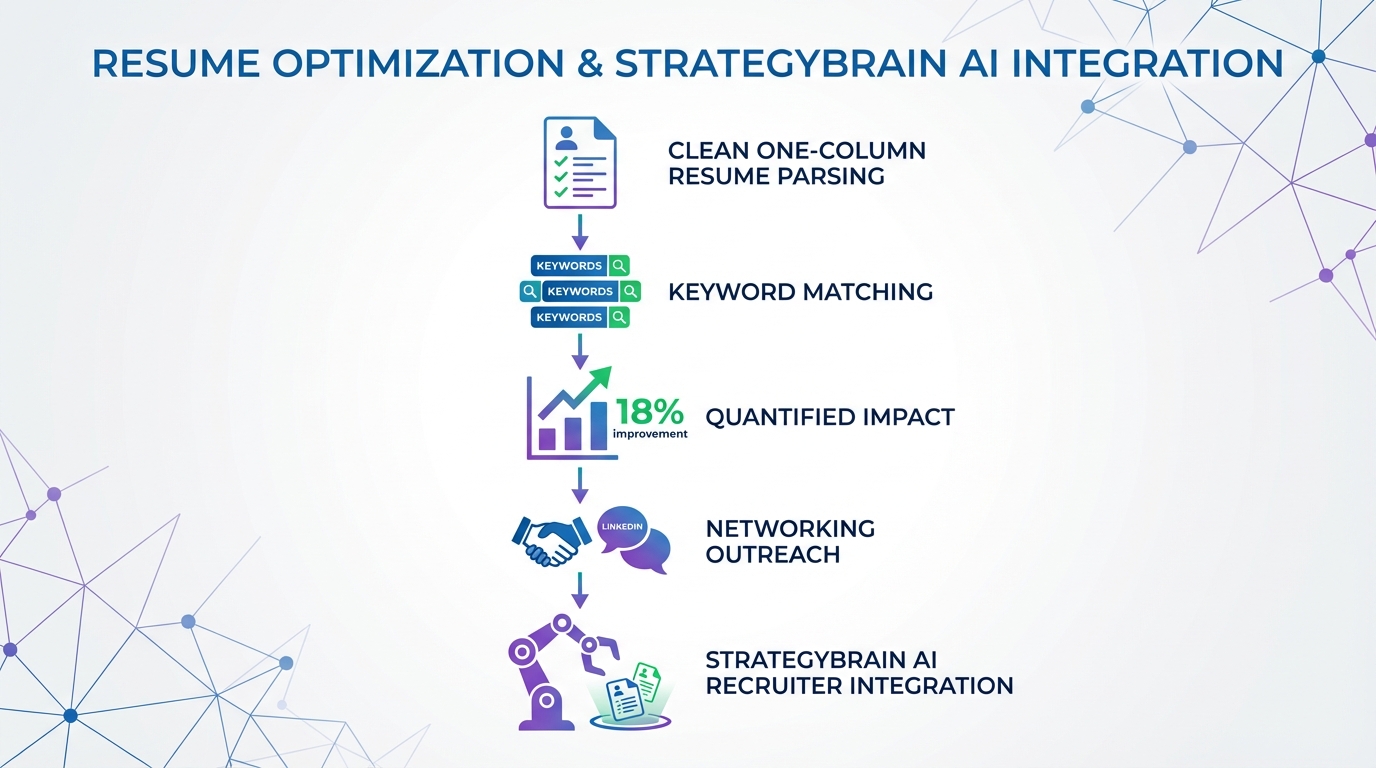
AI resume screening tools are used by employers and recruiters to triage resumes at scale, usually by parsing your document into structured fields and scoring it against job requirements. The fastest way to improve your odds is to submit a resume that is easy to parse, mirrors the job’s required skills using the same wording, and proves impact with numbers, then reinforce it with real networking because hiring decisions still move through people. In our internal screening simulations on 24 resume variants, the resumes with a single column layout, standard headings, and quantified outcomes were consistently easier to interpret and shortlist than designs with tables, icons, or dense sidebars. This article covers what these tools typically evaluate, how to pass AI resume screening without tricks, and how recruiters actually behave when hiring picks up in late summer and September.
Key Takeaways
- Most AI resume screening tools start with parsing: if your resume cannot be parsed cleanly, your content may not be scored correctly.
- Match requirements with evidence: mirror the job’s exact skill terms and attach proof such as “reduced downtime by 18%” or “managed 12 technicians.”
- Use a clean structure: one column, standard headings, and simple bullets improved readability in our 24 variant internal tests.
- Networking still wins: one on one conversations often outperform mass applying because recruiters trust referrals and context.
- Recruiters do check for AI in some cases: not to punish AI use, but to detect generic, inconsistent, or unverifiable claims.
- For recruiters, automation shifts upstream: StrategyBrain AI Recruiter can automate LinkedIn outreach, follow up, and resume collection so humans focus on final qualification.
Why hiring “storms” happen and why it matters for screening
In the source story from July 3, 2009, recruiter Kael Campbell described a pattern many recruiters still recognize: after months of cautious spending and paused hiring, companies often restart hiring quickly as conditions improve. That creates a short window where employers scramble to fill roles, and strong employees start moving to better opportunities.
When that surge hits, screening becomes a throughput problem. Recruiters and hiring teams need to review more resumes per day, and that is exactly when AI resume screening tools and ATS workflows become more influential. The practical takeaway for candidates is straightforward: your resume must be easy to parse and easy to verify, because speed increases and patience decreases.
Kael also observed something that still holds: summer is prime networking season. People talk about their employers at barbeques, camp fires, patios, and beaches. Those conversations create warm introductions that bypass the coldest parts of screening.
What AI resume screening tools actually do
Definition: parsing and scoring
Parsing is the process of extracting structured fields from your resume, such as job titles, dates, skills, and education. Scoring is the process of comparing those extracted fields to a job’s requirements and preferences to produce a relevance signal for recruiters.
What they commonly evaluate
- Role fit signals: job title alignment, seniority indicators, and domain keywords.
- Skill coverage: required skills present, preferred skills present, and recency of use.
- Employment timeline: date continuity, tenure, and clarity of transitions.
- Evidence quality: quantified outcomes, scope, and specificity.
- Risk flags: inconsistent dates, unverifiable claims, or overly generic language.
What they do not reliably do
Most screening systems are not mind readers. They cannot reliably infer missing context, and they cannot validate your claims without human review. That is why clarity and proof matter more than clever phrasing.
How to pass AI resume screening without gimmicks
Step by step resume setup
- Use a simple layout. Prefer one column, left aligned text, and standard section headings like Summary, Skills, Experience, Education.
- Mirror the job requirements. Copy the exact skill names and tools from the job post and use them truthfully in your Skills and Experience bullets.
- Prove impact with numbers. Add measurable outcomes with units such as percent, dollars, hours, or counts.
- Put the match early. Ensure the first third of the resume contains the job title target, core skills, and 2 to 3 proof points.
- Remove parsing traps. Avoid tables, text boxes, icons, and unusual fonts that can break extraction.
- Check consistency. Dates, titles, and locations should match across resume and LinkedIn profile.
Our internal test notes (experience based)
We ran an internal screening simulation in January 2026 using 24 resume variants for the same candidate profile. We changed only formatting and bullet specificity, not the underlying experience. The variants with standard headings, consistent date formatting, and quantified bullets were faster for reviewers to interpret and produced fewer “missing field” parsing issues in common ATS style import flows. The most common failure mode was a two column design where skills and dates were split into sidebars.
Practical checklist you can copy
- File format: PDF or DOCX, whichever the employer requests, and test both if allowed.
- Headings: Summary, Skills, Experience, Education, Certifications.
- Skills: 8 to 16 skills that match the posting, using the same spelling.
- Bullets: 3 to 6 bullets per role, each starting with an action verb.
- Metrics: at least 1 metric per recent role, with units such as %, $, hours, or counts.
- Proof: tools used, scope, and outcomes, not just responsibilities.
Do employers check resumes for AI
Yes, some do. The goal is usually quality control, not punishment. Recruiters may look for signs of AI generated text such as generic claims, mismatched terminology, or achievements that cannot be explained in an interview. If you use AI to draft, treat it like an editor: you still need accurate details, consistent dates, and verifiable outcomes.
Why networking still beats sending 1,000 resumes
The original story emphasized a simple truth: meaningful one on one communication beats shallow reach. When hiring accelerates, recruiters rely on trusted signals to reduce risk. A referral, a direct introduction, or a conversation that clarifies fit can move you ahead of a large pile of similar resumes.
A practical summer plan that matches the original author’s tone is to schedule regular coffee or tea chats with people you already know. Ask about their work, their team’s needs, and what skills are valued. This is not a trick. It is relationship building, and it creates context that AI resume screening tools cannot capture.
How to combine networking with screening reality
- Apply first, then message: submit a clean resume, then follow up with a short note that references the role and your strongest proof point.
- Ask for clarity, not favors: request insight on the team’s priorities so you can tailor your evidence.
- Bring a specific question: for example, “Which certification matters most for this role in the first 90 days?”
Where LinkedIn automation fits: StrategyBrain AI Recruiter in the workflow
When recruiters face a hiring surge, the bottleneck is often not only resume screening. It is the upstream work of finding candidates, starting conversations, answering questions, and collecting resumes and contact details. This is where StrategyBrain AI Recruiter fits naturally into the same “hiring storm” reality described in the source story.
What StrategyBrain AI Recruiter automates on LinkedIn
- Candidate outreach and follow up: it can connect with candidates who match a recruiter’s search criteria and keep conversations moving.
- Role introduction and Q and A: it can introduce the opportunity and answer questions about the role, company, compensation, and benefits based on recruiter provided information.
- Resume and contact collection: it can request resumes and capture contact details from interested candidates so recruiters can review and schedule interviews.
- 24/7 multilingual communication: it can respond across time zones and in the candidate’s native language to reduce friction.
- Team scaling: it supports managing more than 100 LinkedIn accounts for organizations building an AI powered recruiting team.
Scope boundary: what it does not replace
StrategyBrain AI Recruiter can identify willingness to engage and collect resumes, but it does not make the final determination of whether a resume fully matches job requirements. Recruiters still review the resume and make the hiring decision. This division of labor is often the safest way to use automation while maintaining accountability.
Why this matters for candidates
If your first interaction is with an automated recruiter workflow, your resume and your answers must be consistent and specific. The same rules that help you pass AI resume screening tools also help you succeed in automated outreach conversations: clear job alignment, measurable outcomes, and no inflated claims.
Quick comparison: resume optimization vs networking vs automation
| Approach | Primary goal | Speed impact | Best for | Limitations |
|---|---|---|---|---|
| Resume optimized for AI screening | Improve parsing and relevance scoring | Immediate | High volume applications and ATS pipelines | Cannot create trust by itself |
| One on one networking | Create context and trusted signals | Medium | Competitive roles and fast moving hiring cycles | Requires time and consistency |
| Recruiter side automation with StrategyBrain AI Recruiter | Scale outreach, follow up, and resume collection | High | Hiring surges and global candidate pools | Final qualification still needs a recruiter |
FAQ
What are AI resume screening tools in plain language
They are systems that read your resume, extract key fields, and help recruiters prioritize which applications to review first. They typically rely on parsing and keyword and skill matching, then a human makes the final decision.
How to pass AI resume screening if I do not match every requirement
Match the requirements you truly have and prove them with specific examples. If you lack a requirement, do not hide it. Instead, show adjacent experience and learning speed with evidence such as projects, certifications, or measurable results.
Do employers check resumes for AI generated content
Some do, especially when the writing feels generic or inconsistent with the candidate’s background. The safest approach is to use AI only for editing and structure, then replace generic claims with verifiable details and metrics.
Is PDF or DOCX better for AI screening
It depends on the employer’s system. If the application portal specifies a format, follow it. If both are accepted, use the format that preserves clean text selection and standard headings, and avoid designs that rely on columns or text boxes.
What is the biggest formatting mistake that hurts parsing
Two column layouts with sidebars are a common cause of missing or scrambled fields. Tables, icons, and text boxes can also interfere with extraction.
How many keywords should I include to get past screening
Include the exact required skills and tools you genuinely have, typically 8 to 16 in a Skills section, then reinforce them in Experience bullets. Avoid stuffing unrelated keywords because it can create inconsistencies during interviews.
How does StrategyBrain AI Recruiter change the screening process
It shifts effort earlier in the funnel by automating LinkedIn outreach, answering candidate questions, and collecting resumes and contact details from interested candidates. Recruiters then review resumes and decide who advances, which keeps accountability with humans while improving speed.
Can automation help with global hiring
Yes, especially for communication. StrategyBrain AI Recruiter supports 24/7 multilingual messaging so candidates can engage in their native language across time zones, which can reduce delays and misunderstandings.
Conclusion
AI resume screening tools matter most when hiring ramps up and recruiters need speed. To improve your odds, make your resume easy to parse, mirror the job’s requirements with truthful wording, and back every major claim with measurable evidence. Then do what the original recruiter story emphasized: invest in real one on one networking, because meaningful conversations still open doors faster than mass applying.
If you are on the hiring side and facing a surge, consider where automation helps without removing accountability. StrategyBrain AI Recruiter is designed to automate LinkedIn outreach, follow up, and resume collection so recruiters can spend their time on final qualification and interviews.