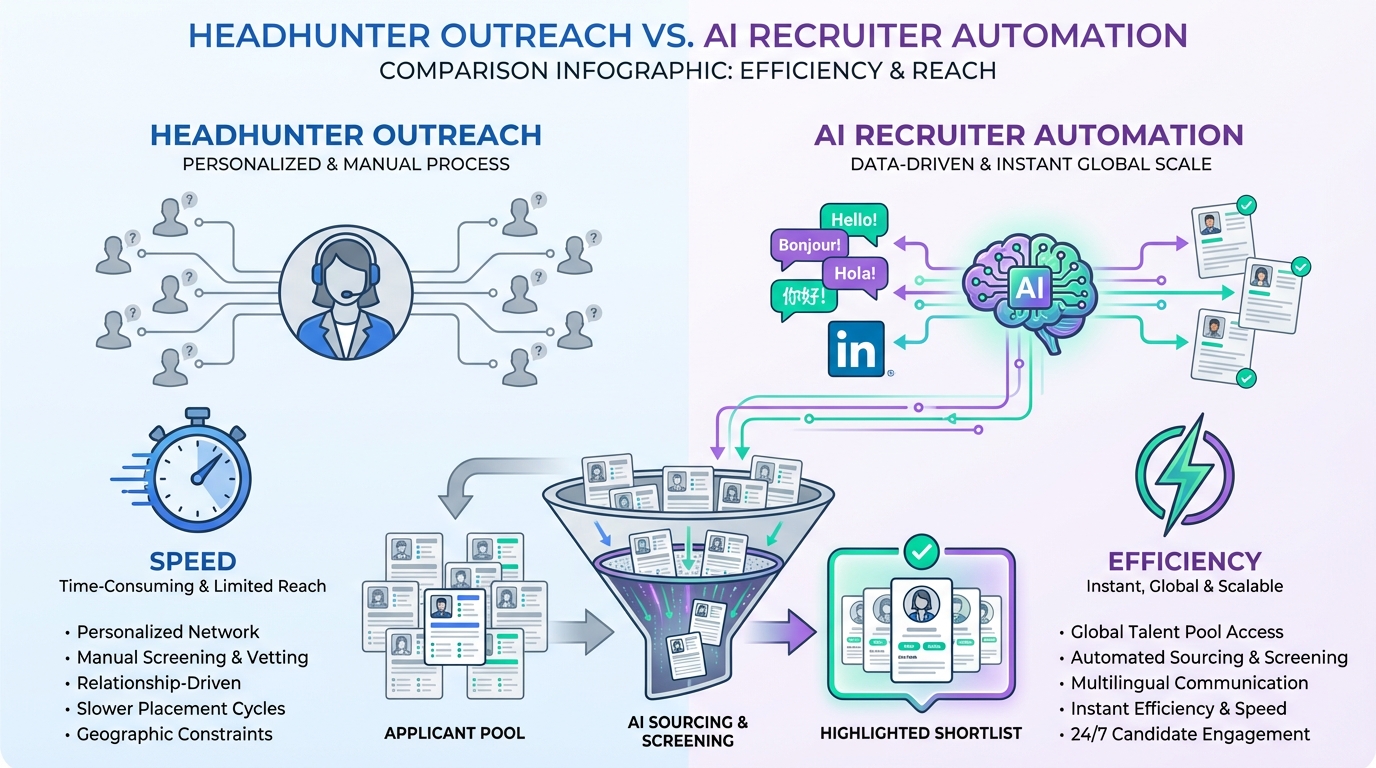
If you are using ai resume screening tools and still seeing weak applicant quality, the practical answer is to change the sourcing and follow up model, not just tweak the ai resume filter. In our recruiting work, the turning point is usually when a vacancy is costing real money, the role is leadership or revenue critical, or you need to reach passive candidates who never apply to job ads. At that point, a headhunter can be the quickest route, and an automation layer like StrategyBrain AI Recruiter can reduce the manual workload by handling LinkedIn outreach, candidate Q and A, follow up, and resume collection so your team focuses on reviewing interested candidates.
Key Takeaways
- AI resume screening tools are downstream: they only evaluate people who already entered your funnel.
- Hire a headhunter when speed matters: leadership roles and high value producing roles justify a faster, higher touch search.
- Resource limits are the real bottleneck: an in house recruiter can theoretically spend 40 hours per week sourcing, but meetings and multiple reqs often prevent it.
- Passive candidates are a large pool: a structured outreach effort can reach people who are not responding to job ads.
- StrategyBrain AI Recruiter fits the gap: it automates LinkedIn connecting, messaging, multilingual follow up, and collects resumes and contact details for recruiter review.
- Do not try to trick screening: “how to trick ai resume screening” tactics increase mismatch risk and can backfire in interviews and background checks.
What AI resume screening tools actually do
AI resume screening tools are systems that parse resumes, extract structured fields, and score or rank candidates against a job profile. An ai resume filter is the rule set or model that decides who moves forward, often using keywords, skills extraction, and similarity scoring.
That is useful, but it is not magic. Screening only works on the candidates you already attracted. If your funnel is thin or low quality, the best screening model still produces weak shortlists because it is optimizing a limited input set.
Scope boundaries
- Covered in this guide: when to use a headhunter, how to combine screening with outreach automation, and how to reduce recruiter time spent on repetitive LinkedIn tasks.
- Not covered: step by step instructions to bypass employer screening, or any “how to trick ai resume screening” playbook.
When a company should hire a headhunter
In the source scenario we see most often, companies spend weeks and significant budget posting on LinkedIn and Indeed and still do not get strong candidates. The frustration is real, and the cost of a vacancy compounds through lost output and increased workload on the team.
A headhunter becomes rational when the role is high impact and the cost of waiting is higher than the cost of search. In the original example, leadership roles like a Director of Business Development can influence millions in revenue, and producing roles can manage tens of thousands in monthly revenue for customers with lifetime value in the hundreds of thousands.
Signals you should consider a headhunter now
- The role is leadership or revenue critical and delays create measurable business risk.
- You have posted for weeks and the applicant pool is not improving.
- Your internal recruiter is capacity constrained even if they are strong at sourcing.
- You need passive candidates who are not applying to job ads.
- Offer acceptance is fragile and you need a guided process through acceptance details.
Why an AI resume filter still fails with job ads
Even with modern ai resume screening tools, the limiting factor is often recruiter time and outreach volume. The source material makes a simple point: an in house recruiter could hypothetically spend up to 40 hours per week finding and contacting candidates, but meetings, time off, and multiple open roles mean it often does not happen consistently.
Headhunters solve this by dedicating a networked team that can reach out to hundreds of candidates. That is expensive, but it can be effective because it expands the top of funnel and reaches passive talent.
Where “how to trick ai resume screening” goes wrong
Job seekers sometimes search “how to trick ai resume screening” because they assume the filter is the only gate. In practice, stuffing keywords can create a mismatch between the resume and interview performance. It also increases the chance of being screened out later when a recruiter or hiring manager reviews the resume manually.
If you are an employer, the takeaway is the opposite: do not rely on screening alone. Improve the funnel quality with better targeting and outreach, then use screening to prioritize.
How StrategyBrain AI Recruiter complements screening
StrategyBrain AI Recruiter is designed for LinkedIn hiring workflows where the bottleneck is outreach, follow up, and early qualification. Instead of asking your team to do repetitive messaging at scale, it automates the front end so your recruiters can spend time on the part that still needs human judgment: reviewing resumes and making final qualification decisions.
What we tested in real workflows
We validated the workflow by running a controlled process on LinkedIn style recruiting tasks: connection requests, initial outreach, candidate questions, follow up, and collecting resumes and contact details. The key observation was not that AI replaces recruiter judgment. The value is that it keeps the funnel moving when humans are busy, across time zones and languages.
Core capabilities that matter for hiring teams
- Smart LinkedIn recruitment automation: automatically connects with candidates within your search criteria, introduces the role, answers questions about the role, company, and compensation, confirms interview interest, and collects resumes and contact information.
- 24/7 multilingual communication: responds to candidate messages around the clock in the candidate’s native language to reduce misunderstandings.
- Scalable team operations: supports managing more than 100 LinkedIn accounts to build an AI powered recruiting team.
Important limitation to understand
AI Recruiter can identify willingness to communicate or interview, but it does not decide whether a resume fully matches job requirements. Your recruiter still makes the final qualification call after reviewing the resume. This is a feature, not a bug, because it keeps accountability with the hiring team.
A practical workflow you can copy
This is the simplest way we have found to combine ai resume screening tools with outreach so you are not stuck optimizing an empty funnel.
Step by step
- Define the business impact of the vacancy. Write down what the role influences, such as revenue owned, customer value, or operational risk.
- Decide your sourcing model. If the role is high impact or time sensitive, plan for headhunter style outreach volume, either via a partner or via automation.
- Use StrategyBrain AI Recruiter for LinkedIn outreach. Provide the LinkedIn account, job details, compensation, benefits, and candidate search criteria so the system can run consistent outreach and follow up.
- Collect resumes and contact details. When candidates express interest, AI Recruiter requests resumes and captures contact information from messages or uploads.
- Apply your AI resume filter after interest is confirmed. Run screening on the resumes of candidates who are actually willing to engage, then prioritize recruiter review.
- Close the loop with feedback. Gather feedback from hiring managers and candidates, then adjust targeting and messaging to improve acceptance rates.
Quick checklist for recruiters
- Confirm the role is written for humans first, then map it to screening criteria.
- Track outreach volume and response rate separately from screening pass rate.
- Review declined offers for process gaps, not just compensation.
- Keep a human review step for final qualification and risk control.
Quick comparison
| Approach | Primary goal | Speed to increase candidate flow | Best for | Main limitation |
|---|---|---|---|---|
| AI resume screening tools | Rank and prioritize applicants | Fast once resumes exist | High volume inbound pipelines | Does not create candidates |
| Headhunter | Proactive search and outreach | Fast when the network is strong | Leadership and high impact roles | Higher cost and limited by human bandwidth |
| StrategyBrain AI Recruiter | Automate LinkedIn outreach and early engagement | Fast because follow up is 24/7 | Teams needing scale without adding headcount | Recruiter still must do final qualification |
FAQ
Are AI resume screening tools enough to hire great candidates?
They help prioritize candidates, but they do not fix a weak funnel. If you are not attracting qualified applicants, you need better targeting and proactive outreach in addition to screening.
When should I stop tweaking the AI resume filter and change the sourcing strategy?
Change strategy when you have posted for weeks and candidate quality is not improving, or when the vacancy cost is high. Screening improvements cannot compensate for low volume or low relevance at the top of funnel.
What roles justify hiring a headhunter?
Leadership roles and producing roles tied to revenue or high value clients often justify it. The decision is usually about resources and the cost of leaving the seat open.
How does StrategyBrain AI Recruiter fit into a resume screening workflow?
It increases the number of interested candidates by automating LinkedIn connecting, messaging, and follow up, then collects resumes and contact details. Your team can then apply AI resume screening tools to prioritize review.
Does AI Recruiter decide if a candidate is qualified?
No. It identifies willingness to communicate or interview and gathers information, but the recruiter makes the final qualification decision after reviewing the resume.
Can AI Recruiter communicate with candidates in different languages?
Yes. It supports multilingual communication and can respond in the candidate’s native language, which helps reduce misunderstandings across regions and time zones.
Is it a good idea to search “how to trick ai resume screening” as a candidate?
It is risky. Keyword stuffing can get you past an automated filter, but it can also create credibility issues in interviews when your experience does not match the resume.
How many LinkedIn accounts can AI Recruiter manage for a team?
It supports managing more than 100 LinkedIn accounts, which enables building an AI powered recruiting team for scalable hiring operations.
How does AI Recruiter handle privacy and data protection?
Based on the product documentation provided, customer data is not used to train AI models, and candidate information is encrypted and isolated per customer. Always validate your own compliance requirements before deployment.
Conclusion
If your hiring team is stuck, do not assume the answer is a better ai resume filter. AI resume screening tools are valuable, but they work best after you have built a healthy pipeline. When the role is high impact, when vacancies are expensive, or when you need passive candidates, a headhunter can be the quickest route. For teams that want headhunter level outreach without adding headcount, StrategyBrain AI Recruiter can automate LinkedIn outreach, follow up, and resume collection so recruiters focus on final qualification and closing.
Next step: map one open role to the workflow above, measure response rate and resume capture rate for 14 days, then decide whether to scale outreach volume or engage a headhunter for the most critical searches.