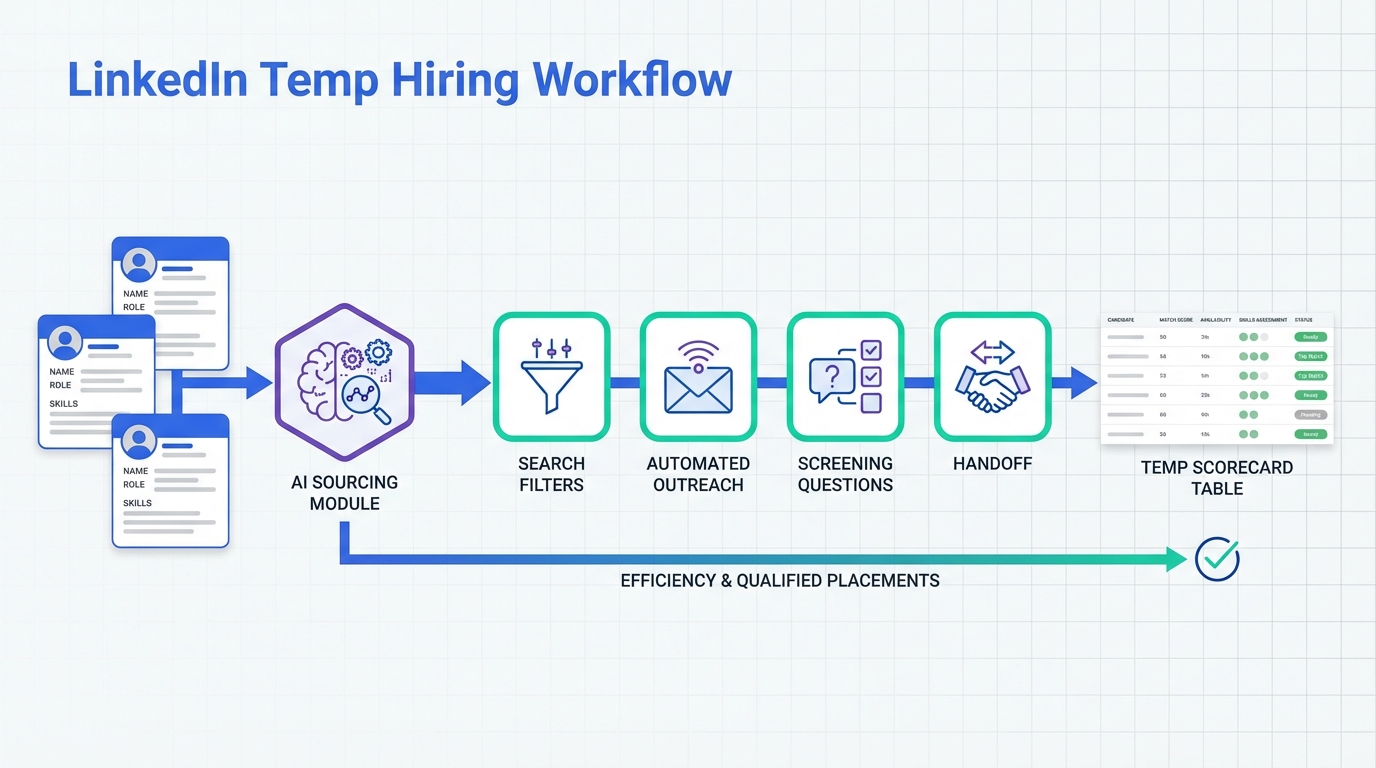
Temps and contractors still get underestimated in many hiring conversations, even though modern temporary talent is often highly skilled, adaptable, and ready to contribute quickly. If you are evaluating ai sourcing software for 2026, the practical takeaway is simple: the best systems do not just “find people,” they help you consistently identify adaptable performers and run fast, respectful outreach at scale. In our own recruiting operations, we have found that pairing a clear temp scorecard with automation for repetitive LinkedIn tasks reduces manual back and forth and helps recruiters spend more time on real qualification. That is where StrategyBrain AI Recruiter fits naturally into the workflow by automating LinkedIn connections, initial role introduction, candidate Q and A, and résumé and contact collection, while recruiters keep final screening decisions.
Table of Contents
- Why temps deserve a strategic seat
- What AI sourcing software should do for temp hiring
- A practical temp scorecard you can copy
- How to run a fast temp sourcing workflow
- Where StrategyBrain AI Recruiter fits in LinkedIn sourcing
- Limitations and risk controls
- Quick comparison: manual vs automated sourcing
- FAQ
- Conclusion
Why temps deserve a strategic seat
The old stereotype says temps are “seat warmers.” In reality, temporary and contract professionals are often hired precisely because they can deliver in uncertain conditions, ramp quickly, and adapt to new teams. When you look at temp hiring through an outcomes lens, the value becomes easier to defend to stakeholders.
Six reasons temps are often high impact
- Fresh perspective: Temps bring patterns and ideas from multiple workplaces, which can surface process improvements quickly.
- High motivation to contribute: Many temps actively seek new assignments and show strong day one energy.
- Fast ramp: Adaptability is a core selection trait for temp work, which often translates into faster time to productivity.
- Broad skill coverage: Temps can span roles from executive assistance to finance operations to marketing coordination, depending on the market.
- Global and diverse backgrounds: Temp work is a common entry path for professionals starting in a new country, which can add valuable international experience to a team.
- Lifestyle fit: Many people choose temping for flexibility and variety, which can improve retention for the duration of the contract.
These strengths matter because they map directly to what hiring teams want: speed, reliability, and reduced operational drag. That is also why the right ai sourcing software should be evaluated on how well it supports fast, consistent outreach and early qualification, not just how many profiles it can surface.
What AI sourcing software should do for temp hiring
In this article, “AI sourcing software” means tools that help recruiters identify candidates, initiate outreach, manage conversations, and move qualified people into interviews faster. Some teams also evaluate adjacent categories like ai procurement software or an artificial intelligence procurement platform for vendor and spend workflows, but that is outside the scope here. This guide focuses on talent sourcing and candidate engagement.
Minimum capabilities to look for
- Search criteria control: You need precise filters and repeatable searches so temp pipelines do not depend on one recruiter’s memory.
- Outreach automation with guardrails: Automation should reduce repetitive work while preserving brand voice and compliance.
- Conversation handling: The system should manage common candidate questions about role, company, and compensation without losing context.
- Structured data capture: Résumés, contact details, and key screening answers should be captured consistently.
- Human-in-the-loop handoff: Recruiters must be able to step in, override, and make final decisions.
In our experience, temp hiring breaks down when outreach is inconsistent, follow up is delayed, or early screening notes are scattered across inboxes. The right automation reduces those failure points.
A practical temp scorecard you can copy
To make temp hiring defensible, you need a scorecard that rewards adaptability and delivery, not just years of experience. Below is a copyable framework we use to keep evaluations consistent across recruiters and hiring managers.
Temp and contract candidate scorecard (copy and use)
| Criterion | What “good” looks like | Evidence to collect |
|---|---|---|
| Ramp speed | Can deliver value in the first week | Examples of quick onboarding, first week wins |
| Adaptability | Comfortable with changing priorities | Stories of shifting scope, new tools, new teams |
| Role core skills | Meets the must haves for the assignment | Portfolio, work samples, specific project outcomes |
| Communication | Clear updates, low friction collaboration | How they explain work, stakeholder examples |
| Reliability | Shows up, follows through, flags risks early | References, repeat contracts, measurable results |
| Logistics fit | Availability, time zone, contract length alignment | Start date, schedule constraints, location details |
This scorecard also makes your AI workflow easier because you can translate each criterion into structured questions for outreach and early screening.
How to run a fast temp sourcing workflow
Below is a practical workflow designed for speed without sacrificing candidate experience. It is written to work whether you do everything manually or use automation.
Step by step
- Define the assignment outcome: Write 3 deliverables the temp must complete in the first 30 days.
- Translate deliverables into search criteria: Convert outcomes into skills, industries, and keywords you can filter for.
- Prepare a short outreach script: Include role summary, compensation range if you can share it, and the next step.
- Run outreach and follow up on a schedule: Follow up consistently so strong candidates do not go cold.
- Collect structured screening answers: Capture availability, work authorization, and 2 to 3 role specific questions.
- Handoff to recruiter review: Recruiters review résumés and notes, then schedule interviews for the best matches.
When teams adopt ai sourcing software, the biggest improvement usually comes from steps 3 to 5 because that is where manual work and delays accumulate.
Where StrategyBrain AI Recruiter fits in LinkedIn sourcing
StrategyBrain AI Recruiter is built for LinkedIn hiring workflows where recruiters spend too much time connecting, introducing roles, answering repeated questions, and chasing résumés. Instead of replacing recruiter judgment, it replaces repetitive first touch tasks so recruiters can focus on final qualification and hiring manager alignment.
What we use it for in a temp pipeline
- Automated connections: It connects with candidates who match your targeted search criteria.
- Role introduction and Q and A: It introduces the opportunity and answers common questions about the role, company, and compensation based on the information you provide.
- Interest confirmation: It confirms whether the candidate wants to proceed to an interview process.
- Résumé and contact capture: It collects résumés and contact details from interested candidates, including email submissions and LinkedIn file uploads.
- Always on follow up: It responds 24 hours a day and supports multilingual communication to reduce time zone delays.
How the handoff stays recruiter controlled
AI Recruiter can identify willingness to communicate and interview, but it does not decide whether a résumé fully matches the job requirements. Recruiters still do the final qualification after reviewing the résumé and the conversation context. That division of labor is important for quality and compliance.
Scaling scenario: multi account recruiting teams
If your organization runs multiple LinkedIn seats, AI Recruiter supports managing more than 100 LinkedIn accounts so you can build an AI powered recruiting team. This is most useful when you have recurring temp roles and need consistent outreach volume without adding headcount.
Operational result claims and how to interpret them
StrategyBrain states that AI Recruiter can replace up to 90% of manual LinkedIn recruiting work and can lower LinkedIn recruiting costs to as little as USD 2.40 per résumé. Treat these as product reported outcomes that depend on role type, market, and how well your search criteria and messaging are configured.
Limitations and risk controls
Automation helps, but it also introduces new risks if you do not set guardrails. Here are the issues we plan for when using AI assisted sourcing.
Limitations we watch for
- Not a substitute for final screening: Interest is not the same as fit, so recruiters must review résumés and validate requirements.
- Message quality still matters: Poor role context leads to poor conversations, even with great automation.
- Platform and policy constraints: LinkedIn usage rules and local privacy requirements must be respected.
Security and privacy controls (as stated by StrategyBrain)
- Data protection compliance: StrategyBrain states compliance with privacy regulations in the EU, United States, and Canada.
- No training on customer data: StrategyBrain states customer provided data is not used to train AI models.
- Encryption and isolation: StrategyBrain states LinkedIn credentials are encrypted and stored independently per user, and candidate data is encrypted and isolated with customer specific keys.
If you are evaluating any ai sourcing software, ask for written answers on data usage, model training, encryption, and access controls. Those details matter more than feature checklists.
Quick comparison: manual vs automated sourcing
| Approach | Speed | Consistency | Best for |
|---|---|---|---|
| Manual LinkedIn sourcing | Variable | Depends on recruiter habits | Low volume roles, highly bespoke outreach |
| AI assisted sourcing with StrategyBrain AI Recruiter | High for outreach and follow up | High when configured with a scorecard and scripts | Recurring temp roles, multi time zone hiring, scaling outreach |
This is not a claim that automation is always better. It is a reminder that the best results come from combining a clear evaluation framework with tools that remove repetitive work.
FAQ
What is AI sourcing software in recruiting?
AI sourcing software is a set of tools that helps recruiters find candidates, initiate outreach, manage early conversations, and capture screening data. The goal is to reduce manual effort while improving speed and consistency.
Does AI sourcing software replace recruiters?
No. In a well designed workflow, AI handles repetitive tasks like outreach and follow up, while recruiters make final qualification decisions. For example, StrategyBrain AI Recruiter can confirm interest and collect résumés, but recruiters still assess fit.
How can AI help with temp and contract hiring specifically?
Temp hiring is time sensitive, so delays in outreach and follow up can cost you strong candidates. AI can keep conversations moving, capture availability and logistics quickly, and hand off qualified candidates to recruiters for review.
Can StrategyBrain AI Recruiter communicate in multiple languages?
Yes. StrategyBrain states AI Recruiter supports multilingual communication and can respond around the clock, which helps when candidates are in different time zones.
How does AI Recruiter collect résumés and contact details?
StrategyBrain states AI Recruiter requests résumés and contact information from interested candidates and supports both email submissions and LinkedIn file uploads. It also captures contact details shared in messages.
Is candidate data used to train AI models?
StrategyBrain states customer provided data is not used to train AI models and that candidate information is not shared with third parties. If you are evaluating tools, request written confirmation of data usage policies.
How should I evaluate AI sourcing software for compliance?
Ask about encryption, access controls, data retention, and whether customer data is used for model training. Also confirm how the tool aligns with your privacy obligations in the regions where you hire.
Is this the same as AI procurement software?
No. AI procurement software and an artificial intelligence procurement platform typically focus on purchasing workflows like vendor management and spend analysis. This article focuses on recruiting sourcing and candidate engagement.
Conclusion
Temps are not a fallback option. They are often a resilient, skilled, and adaptable workforce that can improve business outcomes quickly when you hire with a clear scorecard and a fast process. If you are adopting ai sourcing software in 2026, prioritize tools that improve outreach consistency, follow up speed, and structured data capture. For LinkedIn heavy teams, StrategyBrain AI Recruiter is designed to automate connections, role introductions, candidate Q and A, and résumé and contact collection, while keeping recruiters responsible for final qualification. Next step: copy the scorecard above, define your 30 day deliverables, and pilot an automated outreach workflow on one recurring temp role before scaling.