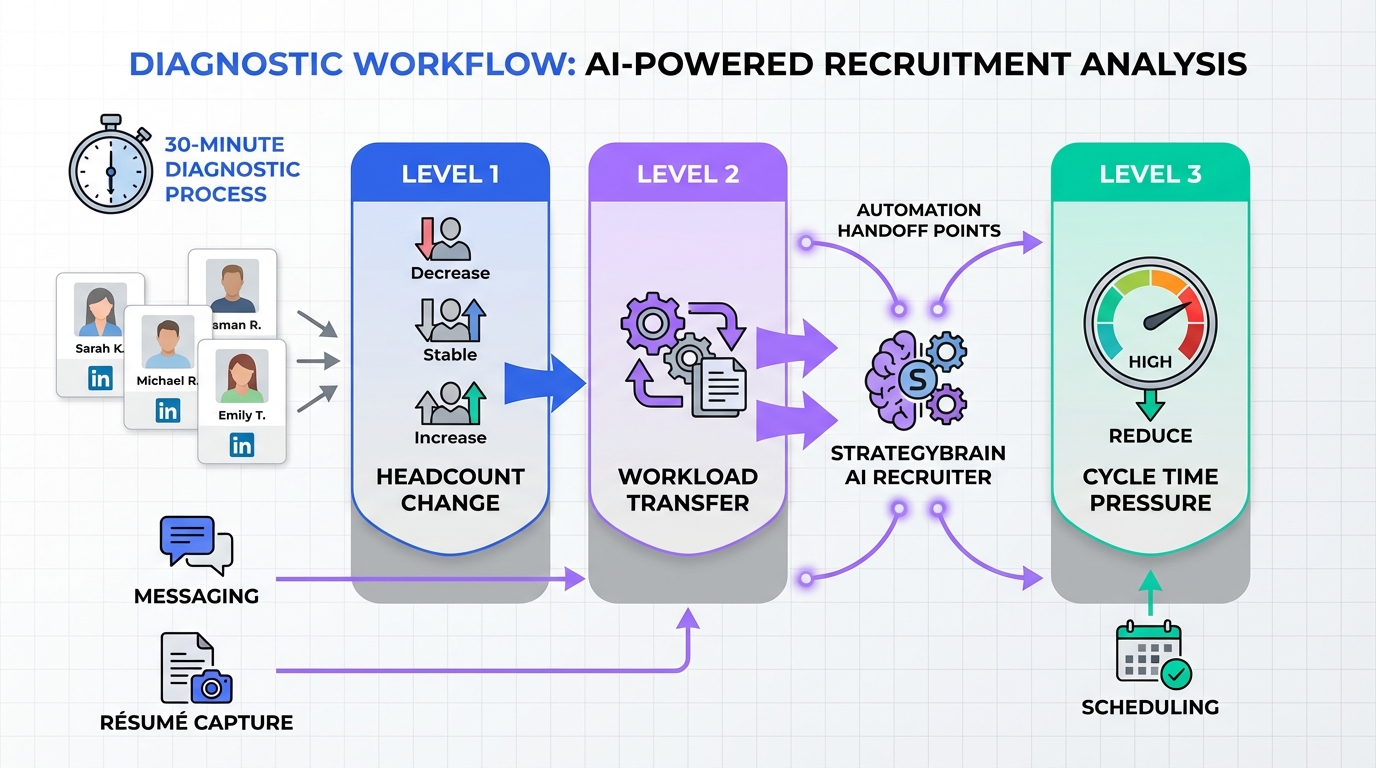
Companies worldwide have been “doing more with less” for the past three years. From a Talent Acquisition and HR vantage point, that pressure usually shows up as a squeeze on the layers where work is being reorganized fastest, especially coordination and process heavy roles. In many organizations, that means middle management and adjacent support functions feel the cuts first, because their work can be redesigned, consolidated, or partially automated with talent management solutions and AI talent management software. Today’s post takes a simple weekly poll question and turns it into an internal diagnostic you can run in 30 minutes, including where StrategyBrain AI Recruiter can remove repetitive LinkedIn outreach and follow up work so recruiters can focus on final qualification and interviews.
Table of Contents
Key Takeaways
- “Squeezed” is measurable: Track headcount change, workload shift, and cycle time by level, not just total reductions.
- Middle layers are often first hit: Coordination and reporting work is easiest to consolidate when organizations redesign processes.
- AI talent management software shifts work: Automation reduces manual steps, but it can also increase expectations for speed and responsiveness.
- Recruiting is a high leverage target: Automating outreach and follow up can protect candidate experience while reducing recruiter load.
- StrategyBrain AI Recruiter fits the “do more with less” reality: It automates LinkedIn connecting, role introduction, Q&A, interest confirmation, and résumé plus contact capture, while recruiters keep final qualification.
- Global hiring pressure is real: 24/7 multilingual messaging reduces time zone delays and missed candidate replies.
- Run a 30 minute diagnostic: A simple level by level map helps you decide where talent development software and automation will prevent burnout.
Why this question matters right now
When leaders say “we’re doing more with less,” the hidden question for HR is: which work is being removed, which work is being redistributed, and which work is being automated. If you only look at total headcount, you miss the operational reality that some levels absorb more work even when they are not the ones being cut.
That is why the weekly poll question is useful. It forces a level by level view of organizational change, which is exactly how you should evaluate AI talent management software and broader talent management solutions. The value is not only in cost reduction. It is in preventing bottlenecks, protecting candidate experience, and keeping managers and recruiters from becoming the “catch all” layer for every new process.
What “getting squeezed” means in HR terms
In HR operations, “getting squeezed” is not just layoffs. It is a combination of three measurable effects that can happen together or separately.
1) Headcount compression
This is the obvious one: fewer roles at a given level. It can be driven by budget cuts, delayering, or consolidation after reorgs.
2) Workload transfer
Work does not disappear automatically when roles do. It moves. Often it moves downward to individual contributors or upward to managers, depending on what the organization values and what tools exist to absorb the work.
3) Cycle time pressure
Even if headcount stays flat, expectations can rise. For TA, that looks like faster response times to candidates, shorter time to shortlist, and more roles per recruiter. This is where automation and talent development software can either relieve pressure or unintentionally increase it if not implemented with clear boundaries.
Where the squeeze usually shows up by company level
Every organization is different, so treat this as a pattern library rather than a universal rule. The goal is to help you interpret what you are seeing internally.
Executives
- Typical squeeze signal: fewer direct reports and fewer layers between the executive team and delivery teams.
- What changes: decision cadence increases, and executives expect faster reporting with fewer manual updates.
- HR implication: talent management solutions need to produce clean, consistent metrics without extra analyst work.
Middle management
- Typical squeeze signal: delayering, role consolidation, and broader spans of control.
- What changes: managers inherit more coaching, performance conversations, and operational coordination.
- HR implication: talent development software becomes critical because managers need scalable coaching and development workflows, not ad hoc programs.
Front line managers and team leads
- Typical squeeze signal: more administrative work and more hiring responsibility without added support.
- What changes: they become the “last mile” for process compliance and candidate scheduling.
- HR implication: recruiting workflows must reduce back and forth. If candidate messaging is slow, managers feel it immediately.
Individual contributors
- Typical squeeze signal: higher output expectations and more cross functional work.
- What changes: less time for learning and development, even though skill demands increase.
- HR implication: talent development software must be embedded into work, not treated as optional training.
HR and Talent Acquisition
- Typical squeeze signal: more requisitions per recruiter and higher expectations for candidate responsiveness.
- What changes: recruiters spend more time on repetitive outreach, follow up, and answering the same questions about role, company, and compensation.
- HR implication: this is a prime area for AI talent management software and automation. StrategyBrain AI Recruiter is designed to take over the initial LinkedIn outreach and qualification conversation, then hand off interested candidates with résumés and contact details for recruiter review.
A 30 minute diagnostic you can run this week
When I run this exercise with TA and HR teams, the goal is not to “win” the poll. It is to identify where the organization is silently accumulating work and risk. You can do this with a small group and a whiteboard.
Step 1: Map levels and the work that moved
- List your levels: executives, senior leaders, middle managers, front line managers, individual contributors, HR and TA.
- Write down the work that increased at each level in the last 12 months. Keep it concrete, like reporting, candidate follow up, performance documentation, interview scheduling.
- Mark what is repetitive: anything that follows a predictable script or sequence.
Step 2: Score squeeze intensity
Use a simple 0 to 3 score for each level across three dimensions. Keep the scoring consistent and fast.
- Headcount change: 0 no change, 1 small reduction, 2 moderate reduction, 3 major reduction.
- Workload increase: 0 no change, 1 small increase, 2 moderate increase, 3 major increase.
- Cycle time pressure: 0 stable, 1 slightly faster, 2 significantly faster, 3 constant urgency.
Step 3: Identify the best automation candidates
Now match repetitive work to the right tool category.
- Recruiting outreach and follow up: candidate connecting, role introduction, answering common questions, confirming interest, collecting résumés and contact details. This is where StrategyBrain AI Recruiter can remove a large portion of manual LinkedIn work while keeping recruiters responsible for final qualification.
- Development workflows: structured learning plans, manager prompts, skills tracking. This is where talent development software is most effective.
- Operational reporting: standardized dashboards and automated data pulls. This is where broader talent management solutions reduce analyst burden.
Copyable checklist
- [ ] We can name the top 5 tasks that increased for TA and HR in the last 90 days.
- [ ] We know which of those tasks are repetitive and scriptable.
- [ ] We have a defined handoff point where humans must decide, such as final candidate qualification.
- [ ] We have a candidate experience standard, including response time expectations.
- [ ] We can measure impact with at least two metrics, such as recruiter hours saved per week and candidate response rate.
How AI changes the math for TA and HR
AI talent management software changes organizational design in a specific way. It reduces the cost of coordination and communication, which are two of the main reasons layers exist. That does not mean layers disappear automatically. It means you can redesign work so fewer people spend time on repetitive steps.
Where StrategyBrain AI Recruiter fits
In many TA teams, the most time consuming work is not the final decision. It is the repeated sequence of connecting with candidates, introducing the role, answering questions, following up, and collecting the information needed to move forward. StrategyBrain AI Recruiter is built to automate that LinkedIn workflow. It can connect with candidates based on your search criteria, introduce the opportunity, learn about the candidate’s situation, answer questions about the role, company, and compensation, confirm interview interest, and capture résumés and contact details from interested candidates.
Two operational details matter for “doing more with less.” First, it supports 24/7 multilingual communication, which reduces time zone delays and missed replies. Second, it supports scaling across more than 100 LinkedIn accounts, which enables an AI powered recruiting team model when hiring volume demands it.
Important boundary: what AI should not decide
A common failure mode is asking automation to make the final judgment. In our experience, the cleanest boundary is: AI handles initial outreach and interest confirmation, humans handle final qualification and hiring decisions. StrategyBrain AI Recruiter is designed with that boundary in mind. It identifies willingness to proceed and collects materials, but recruiters still review résumés for fit.
Implementation playbook for talent teams
If you want to use talent management solutions to relieve the squeeze rather than amplify it, implementation needs to be explicit. Here is a practical sequence that keeps the work redesign front and center.
1) Start with one workflow, not the whole stack
Pick the workflow with the highest repetitive load. For many TA teams, that is LinkedIn outreach and follow up. For many HR teams, that is manager driven development and performance documentation. Starting small makes it easier to measure impact and adjust.
2) Define success metrics with units
- Recruiter time saved: hours per recruiter per week.
- Candidate responsiveness: reply rate percentage and median response time in hours.
- Pipeline throughput: number of interested candidates with résumés collected per week.
3) Build a clear handoff and escalation path
Automation should know when to hand off. For example, once a candidate confirms interview interest and shares a résumé, the recruiter takes over. If a candidate asks a policy question outside the approved scope, the system should escalate to a human.
4) Protect trust and compliance
Any AI talent management software touching candidate data must be evaluated for privacy and security. StrategyBrain AI Recruiter states that it complies with privacy regulations in the EU, United States, and Canada, and that customer provided data is not used to train AI models. It also states that LinkedIn account credentials are encrypted and stored independently per user with explicit authorization. Validate these claims with your internal security review before rollout.
Common mistakes to avoid
- Only tracking headcount: you can cut a layer and still increase workload and cycle time pressure elsewhere.
- Automating without redesigning: if you keep the same approvals and reporting, you may just speed up the noise.
- Letting AI become the decision maker: use AI for repetitive steps, keep humans for judgment and accountability.
- Ignoring multilingual and time zone realities: global hiring requires responsiveness outside local business hours.
- Measuring activity instead of outcomes: count qualified handoffs and candidate experience metrics, not just messages sent.
FAQ
Which company level is getting squeezed most right now?
In many organizations, the squeeze concentrates in middle management and adjacent support layers because coordination and reporting work is being consolidated. The right answer for your company comes from measuring headcount change, workload transfer, and cycle time pressure by level.
How does ai talent management software help with “doing more with less”?
AI talent management software reduces repetitive coordination work, speeds up communication, and standardizes workflows. The biggest gains usually come from automating high volume steps while keeping human decision points intact.
Is recruiting a good place to start with automation?
Yes, because recruiting includes many repeatable steps such as outreach, follow up, and answering common questions. Automating those steps can reduce recruiter workload while maintaining candidate responsiveness.
What does StrategyBrain AI Recruiter automate on LinkedIn?
StrategyBrain AI Recruiter automates connecting with candidates, introducing job opportunities, learning about the candidate’s situation, answering questions about the role, company, and compensation, confirming interview interest, and collecting résumés and contact details from interested candidates.
Does StrategyBrain AI Recruiter replace recruiter judgment?
No. It can identify willingness to proceed and collect materials, but it does not determine whether a résumé matches job requirements. Recruiters still perform final qualification and make hiring decisions.
How does multilingual messaging affect hiring outcomes?
Multilingual messaging reduces misunderstandings and delays when candidates prefer to communicate in their native language. It also helps maintain responsiveness across time zones, which can improve candidate experience.
How do I connect talent development software to organizational delayering?
When spans of control increase, managers need scalable development workflows. Talent development software can provide structured plans, prompts, and skills tracking so development does not disappear under workload pressure.
What should we measure after implementing talent management solutions?
Measure outcomes with units, such as recruiter hours saved per week, candidate reply rate percentage, median response time in hours, and number of interested candidates with résumés collected per week.
What is the fastest way to run the internal diagnostic?
Gather a small HR and TA group, map levels, list the work that increased in the last 12 months, and score each level on headcount change, workload increase, and cycle time pressure. Then pick one repetitive workflow to automate and measure impact for 30 days.
Conclusion
The weekly poll question is simple, but it points to a real operational issue: organizations are changing their size and shape, and the squeeze is rarely evenly distributed. If you want to respond with more than a headcount plan, run the level by level diagnostic, identify where repetitive work is accumulating, and then apply AI talent management software where it protects both productivity and experience.
Next step: pick one workflow to redesign this month. If LinkedIn outreach and follow up is consuming recruiter capacity, evaluate StrategyBrain AI Recruiter as a targeted automation layer that can handle initial conversations, 24/7 multilingual messaging, and résumé plus contact capture, while your team keeps final qualification and hiring decisions.