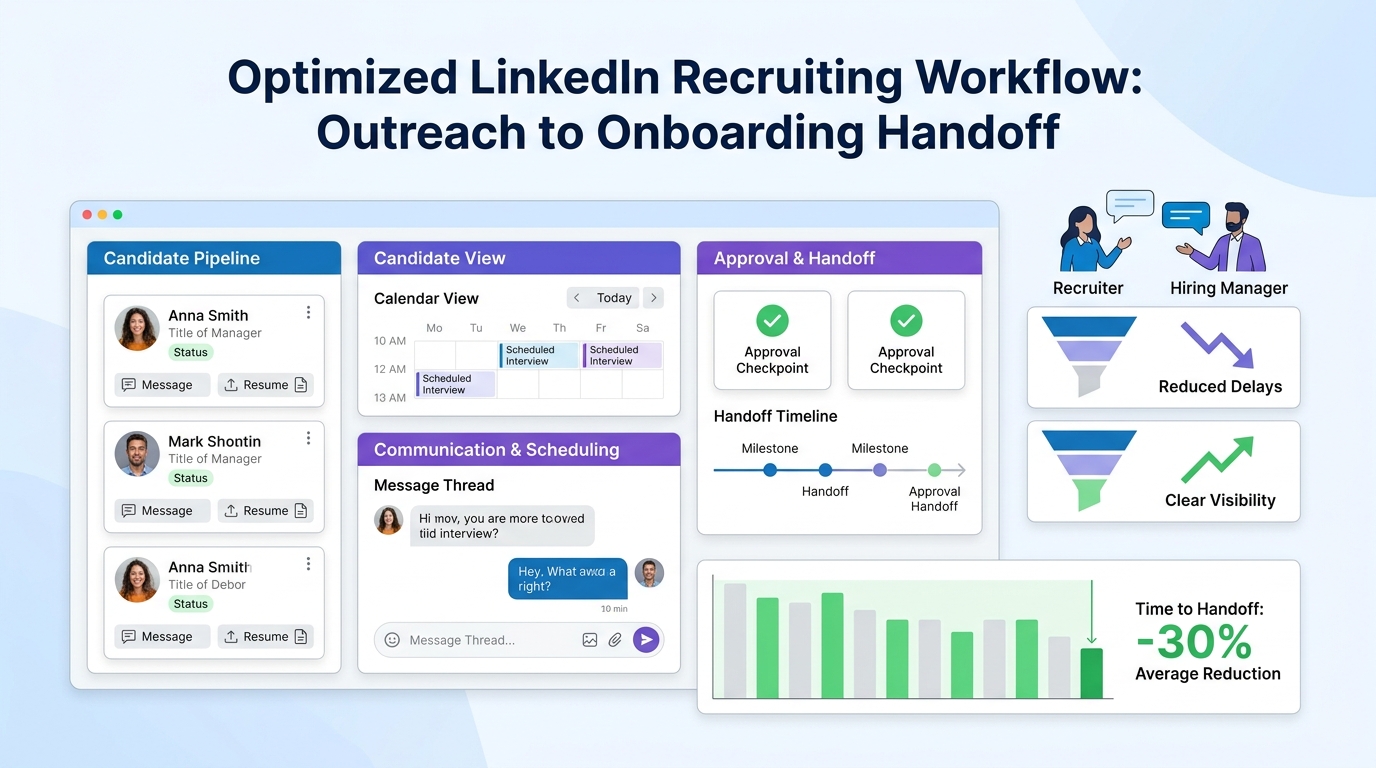
When recruiting leaders assess artificial intelligence for recruiting, this article shows how to prevent slow handoffs, weak visibility, and messy workflows.
That sounds straightforward until a search turns messy in practice. A recruiter is juggling outreach, candidate replies after hours, resume follow-up, stakeholder updates, and a hiring manager who expects a shortlist fast. For a small agency owner, that means margin pressure when consultants spend time on admin instead of billable search work. For an in-house recruiter, it means slower first response, weaker candidate experience, and more friction with hiring managers when records, notes, and next steps are scattered.
One way I have reduced that operational drag is by using StrategyBrain AI Recruiter for the repetitive top-of-funnel work that usually piles up in LinkedIn recruiting. Its strongest fit is not making the final hiring call, but handling candidate outreach, after-hours messaging, and resume or contact collection so the recruiter can stay focused on qualification and next-step decisions. In my experience, tools like this are most useful when they remove delay without taking over recruiter judgment.
That same principle shows up clearly when a company brings in a consultant for a defined project. The pressure is different from a standard permanent hire. The consultant is expected to contribute quickly, often in a virtual setup, and the work can stall immediately if access, paperwork, schedules, and team introductions are not lined up before day one. Then the project suffers because the person who was hired for speed is instead waiting on logistics, chasing context, or trying to understand why the team is unsure about their role.
The issue does not end with setup. In the first one to two weeks, the consultant still needs a full view of company goals, clear deliverables, and regular two-way feedback with stakeholders. If those expectations are vague, small disconnects turn into project delays, budget tension, and distrust. That is exactly why AI recruiting software should be evaluated as a workflow support layer, not just a sourcing engine: the real test is whether it helps recruiting teams organize handoffs, align people early, and maintain clean communication from first outreach to first-week success.
That opening scenario matters because many teams talk about artificial intelligence ai in recruitment as if the value begins and ends with matching candidates. In reality, the operational gain often comes from a better start: organized communication, clearer context, faster document collection, recruiter visibility, and more structured handoff into onboarding. If you are deciding how to use ai in recruiting, those are the standards worth using.
- What AI Recruiting Software Really Solves
- Start With Organized Handoffs
- Where AI Fits Across the Recruiting Funnel
- How to Use AI in Recruiting Step by Step
- Why ATS and Workflow Fit Matter
- Benefits for Recruiters, HR, and Hiring Managers
- Risks, Governance, and Human Oversight
- How to Compare AI Recruiting Tools
- Common Mistakes to Avoid
- FAQ
What AI Recruiting Software Really Solves
At a practical level, AI recruiting software helps teams manage repetitive, high-volume, and pattern-based work that slows down hiring before real evaluation even begins. That includes sourcing, message handling, resume parsing, candidate matching, scheduling, interview support, and workflow visibility. The important distinction is that good software supports recruiter execution; it does not remove recruiter accountability.
From an operator's point of view, the better question is not whether a tool has AI features. It is whether the software prevents the exact problems that damage hiring outcomes: delayed responses, weak handoffs, inconsistent records, vague screening logic, and lost context between recruiter, hiring manager, and candidate. That is where artificial intelligence for recruiting becomes useful in everyday work.
In other words, the software should help the recruiting team do the equivalent of a strong consultant onboarding process. It should make sure logistics are covered early, expectations are visible, the broader business context is not lost, and follow-up does not depend on memory alone. That is a more realistic way to think about artificial intelligence ai in recruitment than the usual automation hype.
Start With Organized Handoffs, Not More Automation
One of the most valuable lessons from project-based hiring is simple: if setup is disorganized, speed disappears. The same applies to recruiting technology. Teams often buy AI tools to move faster, but if candidate records live in one place, outreach history in another, and feedback somewhere else, the tool creates extra admin rather than less.
Before evaluating advanced features, ask whether the software helps your team do these five things well:
- Prepare before first contact: job details, outreach context, and role expectations are complete
- Set the tone with stakeholders: hiring managers understand why candidates are being surfaced and how the process works
- Give candidates real context: outreach and follow-up reflect the business need, not generic template language
- Create measurable goals early: screening criteria, handoff standards, and shortlist expectations are documented
- Maintain two-way feedback: recruiters, managers, and candidates do not disappear into a set-and-forget workflow
Those are not just onboarding principles. They are also sound buying criteria for AI recruiting software.
Practical takeaway: If an AI workflow makes candidate communication faster but makes recruiter visibility weaker, it is probably solving the wrong problem.
Where AI Fits Across the Recruiting Funnel
The most useful way to assess artificial intelligence for recruiting is by funnel stage. Teams get more value when they choose a narrow operational problem first rather than trying to automate everything at once.
Sourcing and rediscovery
AI can help recruiters identify candidates from internal databases, prior applicants, and external platforms by looking beyond exact title matches. This is useful for headhunters working related searches and in-house teams with recurring role families. The key test is relevance. A long list is not a good result if the shortlist still needs heavy cleanup.
Outreach and candidate engagement
This is where AI is often immediately useful. Recruiters lose time to repetitive introduction messages, FAQ replies, follow-ups, and after-hours candidate responses. Used carefully, automation can keep momentum going without forcing recruiters to stay online constantly.
For LinkedIn-heavy workflows, I have found AI Recruiter most helpful when the problem is not sourcing alone but the whole first-contact cycle: connecting with candidates, introducing the role, handling common questions, and gathering resumes from people who are actually interested. The recruiter still has to review the resume and decide whether there is a real fit, which is exactly how the process should work.
Screening and qualification support
Resume parsing, role-specific questions, knockout criteria, and candidate matching can make first review more consistent. But screening logic must stay visible. Teams should be able to explain why candidates were surfaced, what criteria mattered, and where recruiter review begins. That transparency is central to responsible artificial intelligence ai in recruitment.
Scheduling and coordination
Scheduling is often the lowest-risk place to start. It reduces the usual back-and-forth and improves candidate responsiveness. This is especially useful when candidate conversations happen across time zones or outside working hours.
Interviewing and evaluation
Interview support tools can organize scorecards, transcripts, and notes so hiring managers compare candidates more consistently. Their best role is structure, not final decision-making. The recruiter and hiring team still need to interpret evidence and make the call.
Handoff into onboarding
This stage is often ignored in AI conversations, but it is where many placements lose momentum. If the shortlist was clear but the hiring team does not have aligned expectations, project context, or first-week goals ready, the value of faster recruiting quickly fades. The consultant-style onboarding lesson applies here: preparation before day one matters as much as matching before offer.
How to Use AI in Recruiting Step by Step
For teams asking how to use ai in recruiting, the best approach is to start with a workflow problem and build from there.
- Define the bottleneck. Is the problem sourcing volume, LinkedIn follow-up, resume collection, screening delay, scheduling friction, or poor handoff into interviews?
- Map the live process. Document where recruiters lose time, where hiring managers stall, and where candidates stop responding.
- Choose one use case first. For many teams, the best starting point is outreach automation, resume capture, scheduling, or first-pass matching.
- Set review checkpoints. Decide exactly where the recruiter must approve outreach, shortlist movement, rejection, or interview progression.
- Connect the core system. If the workflow does not connect to your ATS or core candidate record, admin work usually increases.
- Align stakeholders early. Make sure hiring managers understand what the AI is doing and what still needs human review.
- Keep feedback active. Do not launch the workflow and ignore it. Review response quality, shortlist quality, and handoff quality regularly.
A contained rollout usually works best. One role family, one recruiter workflow, one success definition. That mirrors how strong project onboarding works: clear setup, visible goals, and early feedback instead of broad assumptions.
A real use case from LinkedIn recruiting
In my own workflow, the most practical use of StrategyBrain AI Recruiter has been in searches where message volume becomes the real blocker. Candidates respond late, ask basic but necessary questions, and only a subset will send a resume after showing interest. Letting AI handle that repetitive conversation layer kept the search moving overnight and across time zones, while I stayed responsible for the actual qualification step. That balance matters. I do not want software deciding whether a resume truly fits the role; I want it clearing the admin path so I can make that judgment faster and with better context.
Why ATS and Workflow Fit Matter
Experienced recruiters know that a feature list is not the same as a usable process. The best AI recruiting workflow is the one that preserves a clean candidate history, keeps recruiter review visible, and avoids duplicate records. Without that, even strong top-of-funnel automation can create downstream confusion.
This becomes obvious in project or consultant hiring. If the organization cannot keep one version of the role brief, one set of goals, and one record of communication, alignment breaks down before the person starts. The same applies to permanent hiring. Workflow fit matters more than novelty.
What to check in integration depth
- Two-way sync for candidate profile updates and stage changes
- Clear attachment of resumes, notes, and transcripts to the candidate record
- Visibility into outreach history and candidate responses
- Recruiter approval points before progression or rejection
- Reporting that combines AI-assisted actions with ATS status data
If a tool is especially strong in LinkedIn outreach but lighter on ATS depth, teams should decide whether it works best as a focused front-end assistant rather than as the whole system of record. That is often a healthier implementation choice than forcing one tool to do everything poorly.
Benefits for Recruiters, HR, and Hiring Managers
The main value of artificial intelligence for recruiting is operational. It helps the recruiting function spend less time on repetitive motion and more time on judgment, alignment, and candidate quality.
| Stakeholder | Where AI Helps | Practical Benefit |
|---|---|---|
| Recruiters | Outreach, follow-up, resume capture, scheduling | Less admin and faster movement to real qualification |
| Agency owners | Repeatable top-of-funnel process | Better consultant productivity and less after-hours manual work |
| HR leaders | Workflow visibility and consistency | Cleaner governance and more predictable process control |
| Hiring managers | Structured handoffs and scorecards | Clearer understanding of why candidates are advancing |
| Candidates | Faster responses and clearer next steps | More organized and responsive experience |
These gains matter most when hiring speed and first-week impact are connected. If the business needs someone to contribute quickly, the recruiting process must not end with the offer letter. Strong AI-assisted workflows support the transition into a better start.
Risks, Governance, and Human Oversight
Compliance, fairness, and accountability are central to any serious use of artificial intelligence ai in recruitment. The more a system influences sourcing, ranking, or communication, the more important it is to define oversight clearly.
Human judgment still owns the hiring decision
AI may surface candidates, respond to common questions, or gather resumes, but the recruiter and employer remain responsible for qualification and hiring decisions. This is especially important in tools that automate early candidate conversations.
Transparency matters
Candidates should not feel they are moving through a hidden process. If AI is involved in communication, screening support, or scheduling, the employer should be prepared to explain that simply and clearly.
Data discipline matters
Only collect what is needed for the recruiting purpose. Teams should understand what data is stored, how long it is retained, and whether it is isolated from model training or unrelated reuse.
When reviewing a tool such as AI Recruiter, I would still apply the same standard I apply to any recruiting technology: what data does it use, what part of the workflow does it automate, and where does recruiter review begin? Those are the questions that keep adoption practical and defensible.
How to Compare AI Recruiting Tools
If you are comparing platforms, avoid generic claims about transformation. Compare them based on the work they improve and the control they preserve.
A practical evaluation framework
- Primary job to be done: sourcing, outreach, screening, scheduling, interviewing, or reporting
- Workflow fit: whether it reduces or adds process friction
- Explainability: whether surfaced candidates and actions are understandable
- Human-review design: whether recruiters stay in control at meaningful checkpoints
- Candidate experience: whether communication is timely, clear, and respectful
- Integration depth: whether the core record stays complete and usable
- Governance readiness: whether privacy, notice, and audit needs are supported
- Best-fit hiring type: high-volume, specialist, agency, in-house, or global hiring
For many recruiting teams, the smart buying decision is not a search for the one best tool overall. It is a choice between a point solution that fixes the most painful bottleneck and a broader platform that improves coordination across stages.
Common Mistakes to Avoid
- Buying for features instead of process. If the workflow is unclear, automation just speeds up confusion.
- Ignoring first-week success. Faster hiring has less value if stakeholder alignment and onboarding are still weak.
- Letting AI become a black box. Recruiters need to see how candidates were surfaced and where decisions are made.
- Automating outreach without context. Generic messages can damage response quality and employer brand.
- Skipping feedback loops. Strong recruiting, like strong consultant onboarding, depends on regular check-ins and expectation alignment.
- Forgetting system hygiene. Duplicate records and missing notes quietly destroy trust in the workflow.
If your team is still working out how to use ai in recruiting, treat implementation as an operations project. Start small, observe what breaks, and improve the workflow before scaling.
FAQ
What does AI recruiting software actually do?
It helps with repetitive recruiting work such as sourcing, message handling, resume parsing, candidate matching, scheduling, interview support, and analytics. The best implementations improve recruiter efficiency while keeping hiring judgment with people.
Does AI replace recruiters?
No. It can reduce manual effort, especially in sourcing and communication, but recruiters still own qualification, stakeholder alignment, candidate assessment, and final recommendations.
How should recruiters start using AI?
Start with one bottleneck. For many teams, that means outreach follow-up, scheduling, resume collection, or first-pass screening. Then define clear review checkpoints and monitor quality closely.
Where is AI most useful in LinkedIn recruiting?
It is often most useful in repetitive first-contact work: introductions, FAQ handling, after-hours replies, and collecting resumes from interested candidates. Recruiters should still review resumes and decide who moves forward.
What makes AI recruiting software risky?
The main risks are weak transparency, unclear screening logic, poor data governance, over-automation, and missing human oversight. Those risks increase when the tool affects candidate ranking or progression without clear review.
Why does onboarding logic matter in an AI recruiting article?
Because hiring speed is only valuable if the person can contribute quickly after acceptance. The same process discipline that helps onboard consultants well also helps evaluate AI recruiting workflows: preparation, context, aligned goals, and regular feedback.
Conclusion
Artificial intelligence for recruiting is most valuable when it solves the operational problems recruiters actually live with: fragmented outreach, slow follow-up, inconsistent screening, and weak handoffs into the next stage. That is why the best evaluation lens is not novelty. It is readiness, clarity, and control.
Whether you are an agency recruiter, an internal talent team, or a hiring leader supporting project-based and permanent hiring, the useful question is the same: does the software help people get organized earlier, communicate better, and make stronger decisions? That is the practical standard for artificial intelligence ai in recruitment, and it is the right starting point for deciding how to use ai in recruiting well.