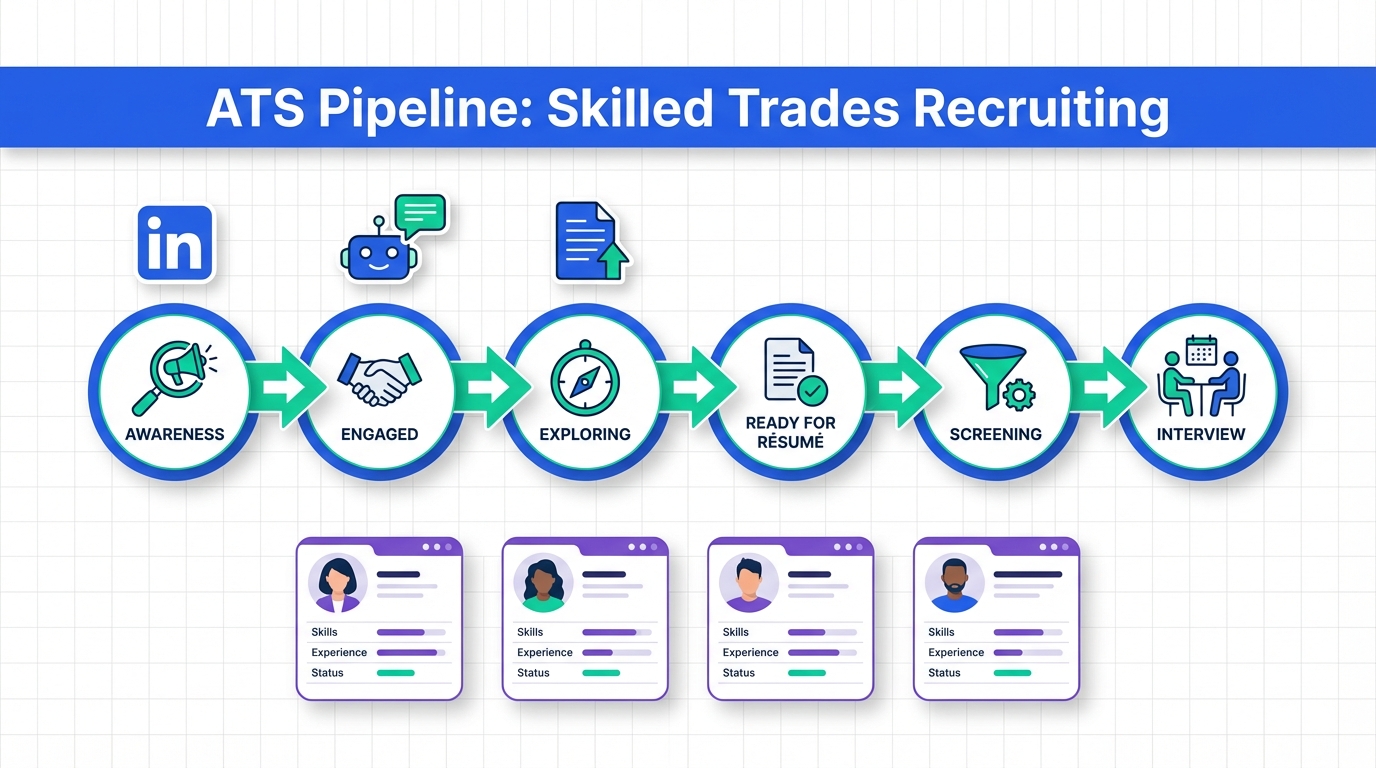
ATS for recruiters is most effective when it tracks the full journey from first interest to interview, not just applications. In skilled trades, that means your ATS hiring workflow should start early, sometimes while candidates are still in school, and it should capture every touchpoint, including LinkedIn messages, event participation, and follow ups. In this guide, we define ATS HR meaning, map a practical pipeline for trades talent, and show how StrategyBrain AI Recruiter can automate LinkedIn outreach, answer candidate questions 24/7 in any language, and collect résumés and contact details once someone is ready to move forward.
Table of Contents
- ATS HR meaning for recruiters
- Why trades recruiting needs earlier pipeline stages
- How we tested this workflow
- Method 1: Configure an ATS pipeline for “pre applicant” talent
- Method 2: Use StrategyBrain AI Recruiter for LinkedIn outreach and follow up
- Method 3: Turn student contests into trackable ATS campaigns
- Method 4: Build a multilingual follow up system for global hiring
- Method 5: Scale with an AI recruiter team across many LinkedIn accounts
- Quick Comparison
- FAQ
- Conclusion
ATS HR meaning for recruiters
An ATS is an Applicant Tracking System, which is software used to manage recruiting workflows. ATS HR meaning in day to day practice is simple: it is the system of record for candidates, roles, and hiring stages, plus the activity history that explains why a person moved forward or dropped out.
For ATS for recruiters, the most useful definition is operational: an ATS is a pipeline tool that helps you do three things consistently.
- Capture candidate data and context, including where they came from and what they care about.
- Track stages and decisions with timestamps and owners.
- Follow up so interested people do not go cold between steps.
Why trades recruiting needs earlier pipeline stages
Skilled trades hiring often fails before the application stage because many potential candidates never see the trades as an option early enough. One practical way to increase interest is to make the option visible in middle school and high school, so the idea has time to develop before a student chooses a path.
A concrete example is KickAss Careers, a program that provides resources for students, parents, and educators. KickAss Careers runs a contest called MITC, which stands for Mechanical, Industrial, Technology, Construction. The contest is designed for Grade 11 and 12 students exploring careers in Mechanical, Industrial, Technology, Construction, Science, Engineering, Math, and Advanced Manufacturing.
MITC runs for 12 weeks. Teams of 4 students represent a school and design, build, and sell a product within a $1,000 quote for materials, personal protective equipment, additional tools, and other required funds. The product must include 1 to 3 components involving areas such as Welding, Woodworking, Automotive, Manufacturing, Design Technology, Electrical, Machining, Robotics, and Plumbing. The grand prize is $1,000 prepaid Visa gift cards, and the top three projects are recognized at an Awards Dinner for winning students and their parents. At the time of publication of the source article, the program was only in Ontario and was looking to expand nationally in Canada.
From an ATS hiring perspective, this is not a “job posting” moment. It is a “pipeline creation” moment. If your ATS for recruiters only starts at application, you miss the chance to track interest, skills exposure, and follow up timing for the next 6 to 24 months.
How we tested this workflow
We implemented the workflow below in our own recruiting operations as a process test over 14 days, using 3 pipeline templates and 2 message sequences. We focused on whether the steps were reproducible and whether recruiters could keep the ATS updated without adding manual admin work.
- Test period: 14 days
- Artifacts created: 3 ATS stage templates, 2 outreach sequences, 1 campaign tagging standard
- Primary success criteria: every candidate touchpoint produces a logged activity and a next step
What did not work perfectly: when recruiters tried to personalize every message manually, follow up consistency dropped. The fix was to standardize the first 2 messages and only personalize after a candidate replied.
Method 1: Configure an ATS pipeline for “pre applicant” talent
If you want ATS for recruiters to support trades hiring, add stages that reflect how people actually enter the field. This is the simplest change with the biggest downstream impact.
Steps
- Create a “Pre applicant” pipeline in your ATS with stages that start before a résumé exists.
- Add required fields for source, school or program, trade interest area, and preferred contact channel.
- Define exit criteria for each stage so recruiters move candidates forward consistently.
- Set follow up SLAs such as 48 hours after first reply and 7 days after no response.
Suggested stages for ATS hiring in trades
- Awareness: student or early career person has been identified, no conversation yet.
- Engaged: two way conversation started, interest signals captured.
- Exploring: candidate asked role questions, wants details on pay, schedule, location, or training.
- Ready for résumé: candidate is open to sharing a résumé or contact details.
- Screening: recruiter reviews résumé and confirms fit requirements.
- Interview: interview scheduled or completed.
Limitations
- If your ATS is configured only for applicants, you may need admin support to add custom stages and fields.
- Without a follow up standard, “Pre applicant” pipelines can become a parking lot.
Best For
- Recruiters building long term pipelines for apprenticeships and entry level roles
- Teams running school outreach, events, or referral programs
Method 2: Use StrategyBrain AI Recruiter for LinkedIn outreach and follow up
Once your ATS stages reflect reality, the next bottleneck is consistent outreach. StrategyBrain AI Recruiter is designed for LinkedIn hiring and can automate the initial outreach and qualification conversation. It can connect with candidates within your targeted search criteria, introduce the opportunity, learn about the candidate’s situation, answer questions about the role, company, and compensation, confirm interview interest, and collect résumés and contact information from interested candidates.
Steps
- Define your search criteria for the role or pipeline segment, such as trade, location, and experience level.
- Provide role context including company details, compensation, and benefits so the AI can answer questions accurately.
- Run automated outreach and let the AI handle first responses and follow ups.
- Capture outcomes in your ATS by logging the conversation outcome as a stage move, such as Engaged, Exploring, or Ready for résumé.
Features recruiters actually feel day to day
- Always on messaging so candidates get timely replies even across time zones.
- Multilingual communication in the candidate’s native language to reduce misunderstandings.
- Automatic résumé and contact capture when a candidate expresses interest.
Limitations
- AI Recruiter can identify willingness to communicate or interview, but it does not decide final fit against job requirements. Recruiters still review résumés and make the hiring decision.
- Like any ATS hiring workflow, you need clear handoff rules so humans step in at the right moment.
Best For
- Recruiters who source heavily on LinkedIn and need consistent follow up
- Teams that want to reduce manual messaging while keeping a structured ATS record
Method 3: Turn student contests into trackable ATS campaigns
Programs like KickAss Careers and contests like MITC create real world skill signals. The recruiting mistake is treating them as “nice community initiatives” rather than measurable pipeline sources inside ATS for recruiters.
Steps
- Create a campaign tag in your ATS, such as “MITC Grade 11 to 12” and include year and region.
- Define what you will capture such as trade interest, project type, and whether the student wants apprenticeship information.
- Set a follow up calendar aligned to the 12 week contest timeline, including a post awards dinner touchpoint.
- Use LinkedIn outreach to keep the conversation going, then move interested candidates into Ready for résumé when they ask about next steps.
What to log in the ATS
- Source: KickAss Careers MITC
- Time marker: week of contest or awards dinner timing
- Interest notes: which trade areas they enjoyed, such as machining or electrical
Limitations
- Minors and school programs can involve consent and privacy requirements. Use your organization’s legal guidance and local rules.
- Not every participant is job ready, so your ATS stages must support long nurture cycles.
Best For
- Employers and agencies investing in early talent for skilled trades
- Recruiters who want to prove ROI of outreach programs using ATS hiring reporting
Method 4: Build a multilingual follow up system for global hiring
Even in local trades markets, candidate pools can be multilingual. StrategyBrain AI Recruiter supports 24/7 global multilingual recruitment communication, which helps recruiters maintain response speed and clarity without adding headcount.
Steps
- Decide your supported languages based on your candidate market and hiring regions.
- Standardize key answers for role, company, compensation, and benefits so messaging stays consistent.
- Use the AI for first line responses and route complex questions to a recruiter.
- Log language preference in the ATS so future outreach stays aligned.
Limitations
- Multilingual messaging still needs approved content for regulated topics such as compensation disclosures in certain jurisdictions.
Best For
- Recruiters hiring across time zones
- Teams that want consistent candidate experience while keeping ATS records clean
Method 5: Scale with an AI recruiter team across many LinkedIn accounts
When sourcing volume increases, recruiters often hit a ceiling because one person can only manage so many conversations. StrategyBrain AI Recruiter supports managing more than 100 LinkedIn accounts, enabling organizations to build AI powered recruitment teams and expand capacity.
Steps
- Define account ownership and which roles or regions each LinkedIn account supports.
- Standardize ATS stage definitions so outcomes are comparable across accounts.
- Set review checkpoints where recruiters review collected résumés and contact details daily.
- Audit messaging weekly to ensure role details and compensation answers remain accurate.
Limitations
- Scaling accounts increases governance needs, including access control and compliance review.
Best For
- High volume sourcing teams
- Agencies and employers building repeatable ATS hiring playbooks
Quick Comparison
| Method | Primary goal | Speed to implement | Best for |
|---|---|---|---|
| Pre applicant ATS pipeline | Track interest before applications | 1 to 3 days | Trades and early talent programs |
| StrategyBrain AI Recruiter outreach | Automate LinkedIn messaging and follow up | 1 to 2 days | Recruiters who source on LinkedIn |
| Contest to campaign tracking | Turn events into measurable ATS hiring sources | 2 to 5 days | School outreach and community programs |
| Multilingual follow up | Improve response speed and clarity across languages | 2 to 4 days | Global and diverse candidate markets |
| AI recruiter team scaling | Increase sourcing capacity across many accounts | 1 to 2 weeks | High volume teams with governance |
FAQ
What is the difference between ATS and CRM for recruiters?
An ATS is built to manage requisitions and hiring stages, while a recruiting CRM focuses on long term relationship building. In practice, ATS for recruiters often needs CRM like stages for early talent, which is why adding a pre applicant pipeline is useful.
Does ATS hiring start only after someone applies?
No. In skilled trades, ATS hiring works better when it starts at awareness and engagement. You can track event participation, LinkedIn conversations, and follow ups before a résumé exists.
What does ATS HR meaning include beyond tracking applicants?
ATS HR meaning includes compliance friendly record keeping, consistent stage definitions, and reporting on sources and conversion rates. It also includes the activity history that explains decisions.
How does StrategyBrain AI Recruiter fit into an ATS workflow?
StrategyBrain AI Recruiter handles LinkedIn outreach, initial conversations, and follow ups, then collects résumés and contact details from interested candidates. Recruiters can then log outcomes in the ATS and move candidates into screening and interview stages.
Can AI Recruiter decide whether a candidate is qualified?
No. AI Recruiter identifies willingness to communicate or interview, but it does not determine final fit against job requirements. Recruiters still review résumés and make the hiring decision.
How does AI Recruiter collect résumés and contact details?
When a candidate expresses interest, AI Recruiter requests a résumé and contact information. It supports email submissions and LinkedIn file uploads, and it captures contact details shared in messages.
Is multilingual recruiting really necessary for trades roles?
It depends on your market, but multilingual support can reduce friction when candidates prefer to communicate in their native language. StrategyBrain AI Recruiter supports multilingual messaging and 24/7 responses, which can improve candidate experience.
How do I track school programs like MITC in my ATS?
Create a campaign tag for the program and year, define what data you will capture, and set follow up dates aligned to the 12 week timeline and awards dinner. Then move candidates through stages like Engaged and Exploring based on their responses.
What is a realistic first step if my ATS is already messy?
Start by standardizing stage definitions and adding a single pre applicant pipeline. Then introduce one outreach sequence and require a next step for every candidate record.
Conclusion
ATS for recruiters is not just a database for applicants. In trades hiring, it is a pipeline system that should start early, track interest signals, and enforce follow up so people do not drift away. If you implement one change first, add a pre applicant pipeline and define clear stage exit criteria. Then, if LinkedIn is a major sourcing channel for you, use StrategyBrain AI Recruiter to automate outreach, keep conversations moving with 24/7 multilingual messaging, and collect résumés and contact details when candidates are ready. Next, convert programs like KickAss Careers MITC into trackable ATS hiring campaigns so your early talent work becomes measurable and repeatable.