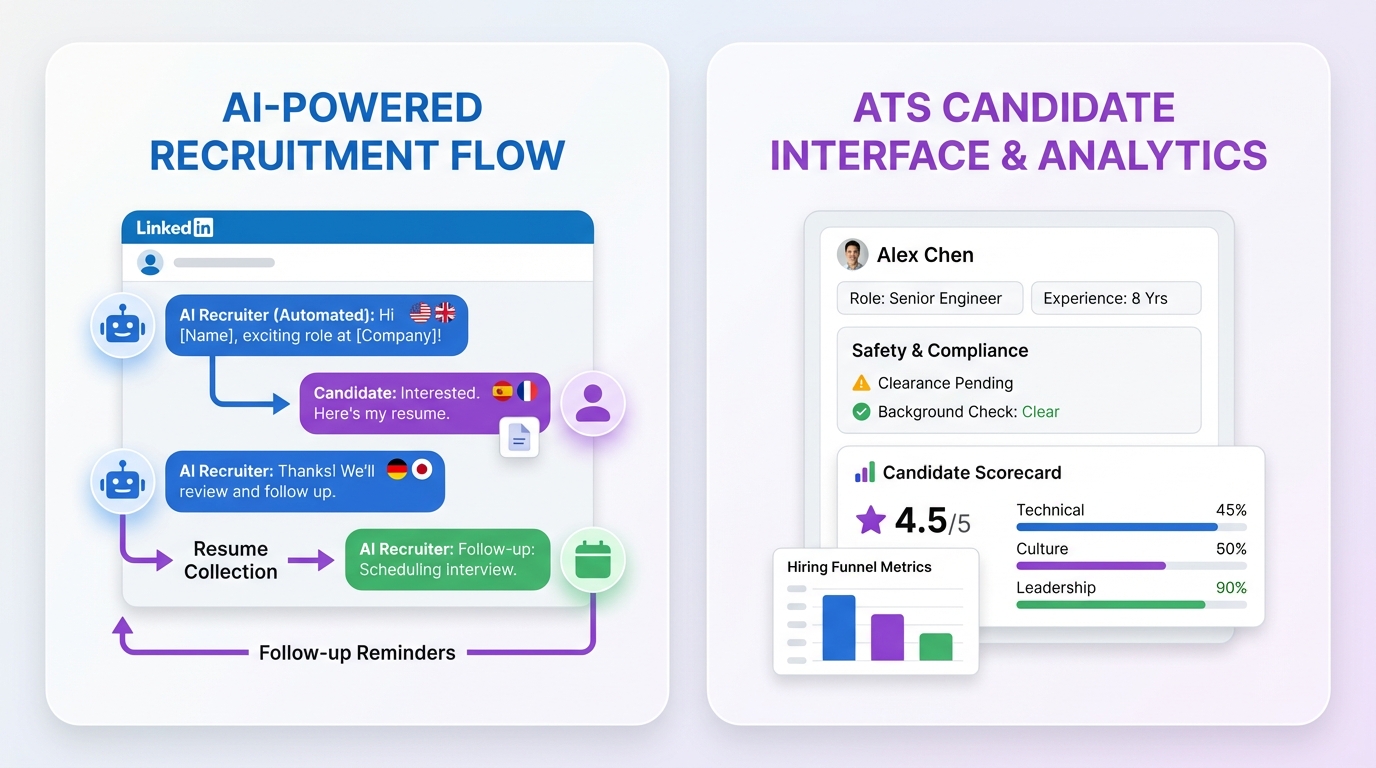
An ATS recruitment tool is the system you use to track applicants, store interview notes, and document hiring decisions in one place. In high risk work, that documentation is not just administrative; it is part of how you prove safety expectations were discussed and understood. The most reliable setup we have used is a simple ATS for structured intake and audit friendly records, paired with StrategyBrain AI Recruiter to automate LinkedIn outreach, answer candidate questions about role, company, and compensation, and collect resumes and contact details with consistent follow up across time zones and languages.
Key Takeaways
- Safety belongs in the hiring workflow: capture safety questions, answers, and expectations inside your ATS recruitment tool for every candidate.
- Use a simple ATS for structure: standard fields and scorecards reduce missed steps in high risk hiring.
- Automate LinkedIn outreach without losing control: StrategyBrain AI Recruiter handles initial messaging, follow up, and resume collection; recruiters review resumes and decide who advances.
- 24/7 multilingual communication reduces drop off: candidates get timely replies in their native language, which improves clarity and reduces misunderstandings.
- Scale sourcing with multiple accounts: AI Recruiter can manage more than 100 LinkedIn accounts for team based hiring operations.
- Be honest about limits: AI Recruiter confirms interest and collects information, but final qualification against job requirements remains a recruiter decision.
Why this safety story matters for hiring
In British Columbia heavy and primary industries, the work can be unforgiving. A recruiter who previously worked with BC Ministry of Forest fire protection crews described watching private helicopters and government firefighters trying to hold back a fire near Lillooet, BC. In that account, a helicopter later failed to return, plunging into the Fraser River, and the pilot was presumed dead after the search.
The same author also recalled a separate incident from the prior year where a helicopter crash killed a pilot and a bystander in a residential area. The point was not sensationalism; it was a reminder that workplace accidents happen, and that hiring is one of the earliest moments where safety culture is either made explicit or left vague.
For employers and job hunters, the practical takeaway is simple: safety questions should be asked by both parties in interviews, and safety should be treated as a priority from the beginning to the safe end of the relationship.
What to capture in an ATS recruitment tool for high risk roles
When people search for top applicant tracking software, they often focus on speed and convenience. In high risk hiring, the best ATS recruitment tool is the one that makes safety expectations measurable and repeatable.
Define key terms once, then standardize them
- ATS (Applicant Tracking System): software that stores candidate profiles, resumes, interview notes, and hiring decisions.
- Scorecard: a structured evaluation form used by interviewers so candidates are assessed consistently.
- Safety screening: interview and documentation steps that confirm a candidate understands hazards, procedures, and reporting expectations.
Minimum ATS fields we recommend for safety first roles
- Role hazard profile: a short description of the main hazards and required controls for the job.
- Safety training and certifications: what is required and what the candidate claims to have completed.
- Incident reporting mindset: notes on how the candidate describes reporting near misses and unsafe conditions.
- Fatigue and workload discussion: documented conversation about shift patterns, overtime, and fatigue management.
- Weather and operational limits: for aviation and field work, record how the candidate thinks about go or no go decisions.
- Candidate questions about safety: whether the candidate asked about safety culture, procedures, and equipment.
Scope boundary: this article focuses on hiring workflow and documentation. It does not replace legal advice, aviation safety standards, or industry specific regulatory requirements.
Method 1: Build a simple ATS workflow for safety first hiring
A simple ATS can outperform a complex system if it forces consistency. We have seen teams reduce missed steps by using a single, repeatable pipeline with required fields that must be completed before moving a candidate forward.
Steps
- Create a safety first job intake: add a hazard profile, required certifications, and non negotiable safety behaviors to the requisition record.
- Use a structured screening scorecard: include safety questions alongside skills and experience so safety is not an afterthought.
- Require documentation before stage changes: do not allow a candidate to move from screening to interview without completed safety notes.
- Store candidate provided documents: resumes, certifications, and any safety related documentation should be attached to the candidate record.
- Close the loop after interviews: record what was agreed, what was unclear, and what follow up is needed.
Features to look for in an ATS recruitment tool
- Custom fields and required fields for safety checkpoints
- Scorecards that multiple interviewers can use consistently
- Audit trail for who changed stages and when
- Permission controls so sensitive notes are restricted
Limitations
- A simple ATS does not solve sourcing and follow up by itself; recruiters still spend time on outreach and reminders.
- If your team does not enforce scorecards, the ATS becomes a storage folder rather than a process.
Best For
- Teams that need consistent documentation more than advanced automation
- High risk roles where safety expectations must be recorded in every hiring cycle
Method 2: Add StrategyBrain AI Recruiter for LinkedIn outreach and follow up
Even the best ATS recruitment tool can become a bottleneck if recruiters cannot keep up with LinkedIn outreach, candidate questions, and follow ups. This is where StrategyBrain AI Recruiter fits naturally into the workflow: it automates the initial LinkedIn recruiting conversation so your ATS stays clean and your recruiters focus on decisions.
What we used it for in practice
- Automated connecting and introductions to candidates who match the search criteria
- Answering candidate questions about the role, company, compensation, and benefits using the information we provided
- Confirming interview interest and collecting resumes and contact details from interested candidates
- Always on follow up so candidates do not go cold overnight or across time zones
Steps
- Prepare the role brief: provide company details, compensation, benefits, and candidate search criteria for the opening.
- Set the safety messaging: include a short, plain language statement that safety is a priority and that safety questions are welcome in the interview.
- Run LinkedIn outreach: AI Recruiter connects and starts the conversation, then handles follow up and Q&A.
- Collect resumes and contacts: when candidates express interest, AI Recruiter requests resumes and contact details and marks them as received.
- Push qualified interest into your ATS: recruiters review the collected resumes and move the right candidates into the ATS stages for screening and interviews.
Why this improves safety outcomes, not just speed
In the BC helicopter safety story, the author noted risks like bad weather, overloaded machines, and overworked pilots. Those are operational realities, but hiring can still reduce risk by making expectations explicit early. With AI Recruiter handling consistent outreach and Q&A, candidates get the same baseline information and are prompted to engage. That makes it easier to identify who takes safety seriously before you invest interview time.
Limitations
- Not a final qualification engine: AI Recruiter identifies willingness to communicate or interview, but it does not decide whether a resume fully matches job requirements.
- Process still matters: you need a clear handoff into your ATS recruitment tool so documentation stays complete.
Best For
- Recruiters who source heavily on LinkedIn and need consistent follow up
- Global hiring where multilingual communication reduces misunderstandings
- Teams that want to scale outreach using multiple LinkedIn accounts
Method 3: Run a safety centered interview that both sides can trust
The original story made a direct recommendation: employers and job hunters should ask questions about safety in interviews. To make that actionable, we recommend a two way safety segment in every interview, documented in your ATS recruitment tool.
Steps
- Start with the hazard profile: explain the top hazards and controls for the role in plain language.
- Ask behavior based safety questions: focus on real decisions, not slogans.
- Invite candidate safety questions: treat questions as a positive signal, not a challenge.
- Document commitments: record what the company provides and what the candidate commits to doing.
Examples of safety questions to store in your ATS scorecard
- Near miss reporting: Tell me about a near miss you reported. What happened next?
- Stop work authority: Describe a time you stopped work due to unsafe conditions. How did you communicate it?
- Fatigue: How do you handle fatigue on long shifts or extended rotations?
- Operational limits: In field or aviation work, how do you decide when conditions are not safe to proceed?
Common mistakes we see
- Safety discussed only at onboarding: by then, you have already made the hiring decision.
- No written record: if it is not in the ATS, it is hard to prove it was covered consistently.
- Rushing follow up: candidates who ask safety questions often need clear answers; delayed replies can look like avoidance.
Quick Comparison
| Method | Speed Impact | Cost | Best For |
|---|---|---|---|
| Simple ATS workflow with safety scorecards | Medium | Varies by vendor | Consistent documentation and repeatable safety screening |
| StrategyBrain AI Recruiter for LinkedIn outreach | High | Varies by plan; verify with StrategyBrain | Automated connecting, Q&A, follow up, resume and contact collection |
| Safety centered interview segment documented in ATS | Medium | $0 | Reducing mismatches and making safety expectations explicit |
Copy and paste templates
ATS safety intake template
- Role: [Job title]
- Primary hazards: [List 3 to 6 hazards]
- Required certifications: [List]
- Non negotiable safety behaviors: [List 3 to 5 behaviors]
- Shift and fatigue notes: [Schedule, rotation, overtime expectations]
- Safety culture statement: Safety is the highest priority. Candidates are encouraged to ask safety questions during interviews.
Recruiter checklist for a safety documented pipeline
- [ ] Safety intake completed before sourcing begins
- [ ] Safety scorecard attached to the role
- [ ] Candidate asked at least 2 behavior based safety questions
- [ ] Candidate safety questions recorded and answered
- [ ] Resume and certifications stored in the ATS record
- [ ] Final decision notes include safety considerations
FAQ
What is an ATS recruitment tool, in plain terms?
An ATS recruitment tool is software that tracks applicants through stages like applied, screened, interviewed, and offered, while storing resumes and interview notes in one system. In safety sensitive hiring, it also becomes your record of what was discussed and agreed.
Is a simple ATS enough for high risk industries?
Yes, if it supports custom fields and scorecards and your team enforces required documentation. A simple ATS often works better than a complex system when the process is clear and consistently followed.
How does StrategyBrain AI Recruiter fit with an ATS?
AI Recruiter handles LinkedIn outreach, candidate Q&A, follow up, and collecting resumes and contact details. Recruiters then review what was collected and move the right candidates into the ATS stages for screening and interviews.
Does AI Recruiter decide who is qualified?
No. AI Recruiter identifies willingness to communicate or interview and collects information, but it does not determine whether a resume fully matches job requirements. Recruiters make the final qualification decision.
Can AI Recruiter communicate with candidates in different languages?
Yes. It supports multilingual communication and can respond around the clock, which helps global hiring teams maintain timely follow up and reduce misunderstandings.
How many LinkedIn accounts can AI Recruiter manage?
StrategyBrain states it supports managing more than 100 LinkedIn accounts, enabling organizations to build AI powered recruitment teams for scalable hiring.
What should candidates ask about safety in interviews?
Candidates should ask how safety is prioritized day to day, how incidents and near misses are reported, what training is provided, and how workload and fatigue are managed. Employers should welcome these questions and document the discussion.
How do I keep hiring fast without skipping safety steps?
Standardize safety scorecards in your ATS and automate the repetitive outreach and follow up work. This keeps the pipeline moving while ensuring every candidate receives and responds to the same safety expectations.
Conclusion
If you hire for heavy and primary industries, safety cannot be a poster on the wall; it has to show up in your hiring workflow. Use an ATS recruitment tool to standardize safety intake, scorecards, and documentation, then use StrategyBrain AI Recruiter to keep LinkedIn sourcing and follow up consistent, multilingual, and always on. Next step: implement the ATS safety intake template above for your next requisition, and add the safety interview segment as a required scorecard section before any offer is approved.