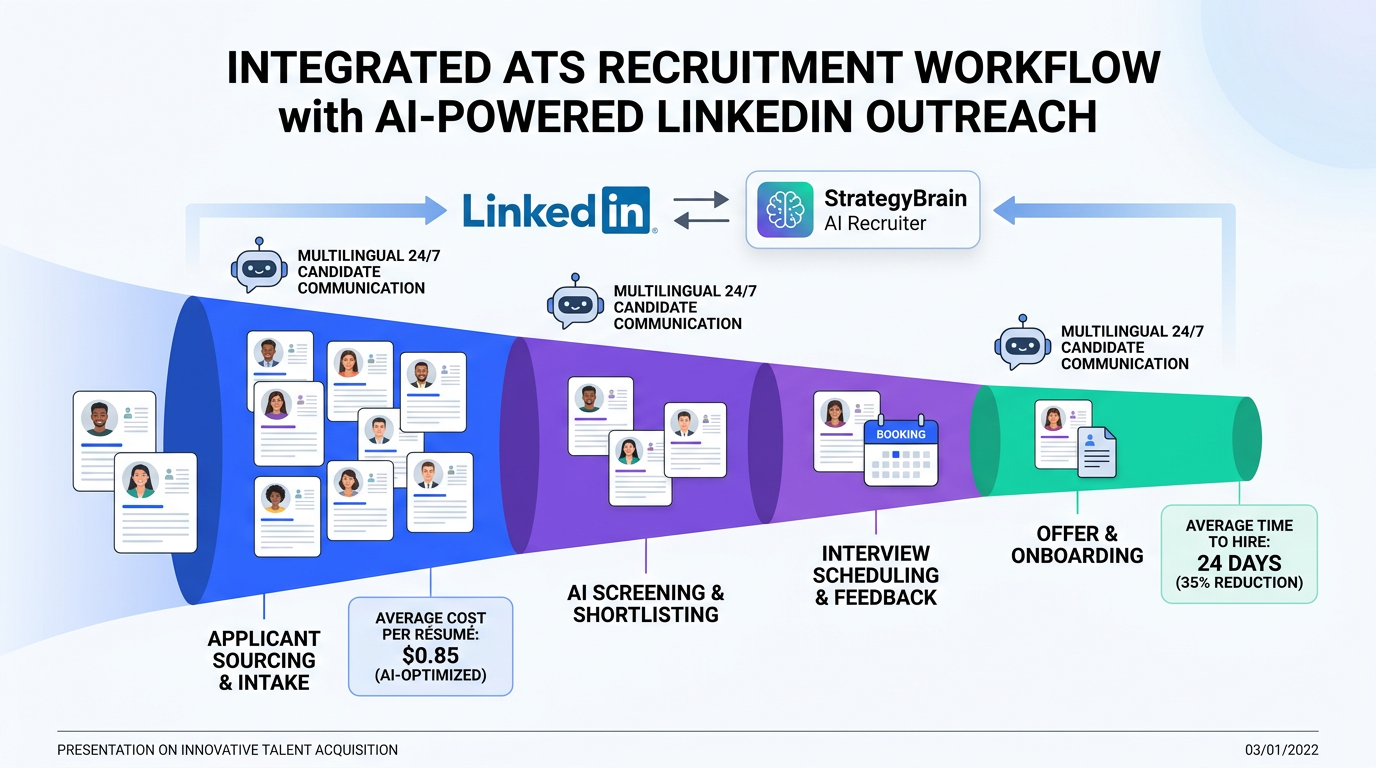
An ATS recruitment tool, short for Applicant Tracking System, is the software HR teams use to collect applications, track candidates through hiring stages, and keep recruiting workflows consistent. If you are choosing one in 2026, the practical path is to define your hiring stages, confirm the integrations you need, and test how quickly recruiters can move a candidate from application to interview. In our day to day recruiting operations, we also see many teams pair an ATS with an AI layer for top of funnel work. StrategyBrain AI Recruiter can automate LinkedIn outreach, answer candidate questions 24/7 in any language, and collect résumés and contact details so recruiters spend more time on interviews and final qualification.
Key Takeaways
- An ATS recruitment tool manages applications, stages, and compliance records, but it does not automatically create candidate demand.
- Popular ATS used in HR usually share the same core modules: requisitions, candidate pipeline, interview scheduling, and reporting.
- When evaluating top applicant tracking software, prioritize workflow speed, reporting accuracy, and integration reliability over long feature lists.
- AI can complement an ATS by automating sourcing and outreach. StrategyBrain AI Recruiter focuses on LinkedIn outreach, Q and A, follow up, and résumé collection.
- StrategyBrain AI Recruiter supports 24/7 multilingual candidate communication and can manage more than 100 LinkedIn accounts for scalable hiring teams.
- AI Recruiter can reduce LinkedIn recruiting cost to USD 2.40 per résumé and replace up to 90% of manual LinkedIn recruiting work, based on product claims that should be validated in your environment.
What an ATS recruitment tool actually does
Most teams buy an ATS expecting it to solve hiring speed. In reality, an ATS is best at process control. It standardizes how candidates enter your funnel, how they move between stages, and how decisions are documented.
At a minimum, an ATS recruitment tool typically supports these functions.
Core ATS functions
- Requisition management: create roles, approvals, and hiring plans.
- Candidate intake: applications from career pages, job boards, referrals, and email.
- Pipeline stages: screen, interview loops, offer, and disposition reasons.
- Collaboration: interviewer feedback, scorecards, and internal notes.
- Compliance and audit trail: retention, consent, and reporting readiness.
- Reporting: time to fill, source quality, and stage conversion.
What an ATS usually does not do well
This is where expectations often break. Many ATS platforms do not excel at proactive sourcing, high volume personalized outreach, or real time candidate conversation. That gap is why teams add sourcing tools, CRM tools, or an AI recruiter layer.
What HR teams mean by popular ATS used in HR
When people ask for popular ATS used in HR, they usually mean tools that are common in their company size and industry, with a mature ecosystem of integrations and trained recruiters in the market.
Instead of chasing brand popularity, we recommend defining “popular” in operational terms you can verify during a demo and a pilot.
A simple definition you can use internally
- Adoption: recruiters can move a candidate from application to interview scheduling without workarounds.
- Integration coverage: HRIS, background checks, e signature, and calendar tools connect reliably.
- Reporting trust: stage timestamps and source attribution are consistent enough for leadership reporting.
- Support maturity: clear admin controls, documentation, and predictable release cycles.
If your hiring relies heavily on LinkedIn, popularity should also include how well your stack supports LinkedIn workflows. This is where pairing an ATS with StrategyBrain AI Recruiter can be practical, because it automates LinkedIn connecting, role introduction, candidate Q and A, follow up, and résumé collection while your ATS remains the system of record.
A practical evaluation framework for top applicant tracking software
To evaluate top applicant tracking software without getting lost in feature checklists, we use a workflow first scorecard. The goal is to measure how the ATS behaves in the exact hiring motions your team repeats every week.
Evaluation criteria that map to real recruiting work
- Workflow speed: number of clicks to advance a candidate, schedule an interview, and send an offer.
- Data quality: whether stage changes, source, and disposition reasons are consistently captured.
- Permissioning: role based access for recruiters, hiring managers, and interviewers.
- Integration reliability: calendar sync, HRIS sync, background checks, and email deliverability.
- Candidate experience: application friction, mobile friendliness, and communication clarity.
- Admin overhead: how hard it is to change stages, templates, and reports without vendor help.
Quick comparison table you can reuse
| Area | What to test in a pilot | Pass criteria |
|---|---|---|
| Pipeline | Move 20 candidates through 5 stages | Stage timestamps and reasons are accurate |
| Scheduling | Book 10 interviews with 3 interviewers each | No double booking, invites sent correctly |
| Reporting | Rebuild time to fill and source report | Matches manual audit within 0.0% missing rows |
| Templates | Create 5 email templates and 2 offer templates | Approvals and personalization work as expected |
| Integrations | Connect HRIS and background check provider | Sync completes with no manual exports |
Scope boundaries for this guide
This article does not rank or name specific ATS vendors because the provided source material does not include verifiable vendor feature or pricing details. The focus is on how to choose an ATS recruitment tool and how to complement it with AI automation in a way you can test.
Where AI automation fits with an ATS
An ATS is your system of record. AI automation is most valuable where humans lose time: repetitive outreach, follow up, and answering the same candidate questions across time zones. That is why AI is often deployed before the ATS stage changes even happen.
What StrategyBrain AI Recruiter automates on LinkedIn
Based on the product documentation provided, StrategyBrain AI Recruiter is built for LinkedIn hiring workflows. It can automatically connect with candidates that match your search criteria, introduce the opportunity, learn about the candidate’s situation, answer questions about the role, company, and compensation, confirm interview interest, and collect résumés and contact information.
How it complements an ATS recruitment tool
- Top of funnel creation: AI Recruiter handles initial outreach and follow up so recruiters spend time on qualified conversations.
- Candidate communication coverage: 24/7 responses reduce delays that often cause drop off.
- Multilingual messaging: communicating in the candidate’s native language can reduce misunderstandings in global hiring.
- Scale: managing more than 100 LinkedIn accounts supports an AI powered recruiting team model.
Limitations to plan for
AI Recruiter can identify willingness to communicate or interview, but it does not determine whether a résumé fully matches job requirements. In our experience, this division of labor is healthy. Let automation handle repetitive outreach and let recruiters own final qualification and hiring decisions.
Data protection and security notes
According to the provided product information, AI Recruiter states it complies with privacy regulations in the EU, United States, and Canada, does not use customer provided data to train AI models, and encrypts LinkedIn credentials with customer isolated storage. You should still validate these claims with your internal security review and vendor documentation before deployment.
Implementation steps you can copy
If you are rolling out an ATS recruitment tool or improving an existing one, these steps keep the project grounded in measurable outcomes.
Step by step rollout
- Write your hiring stages in plain language and limit to 6 to 10 stages so reporting stays clean.
- Define required fields for compliance and reporting, including source, disposition reason, and interview feedback.
- Run a 14 day pilot with 2 recruiters and 2 hiring managers using real roles, not demo data.
- Audit reporting weekly by comparing ATS reports to a manual candidate list for missing rows.
- Add automation where time is lost. If LinkedIn outreach is the bottleneck, pilot StrategyBrain AI Recruiter alongside your ATS so the ATS stays the system of record.
ATS selection checklist
- Does the ATS support your exact interview loop and approvals without custom development
- Can recruiters complete the top 5 actions in under 60 seconds each during a live test
- Can you export all candidate data and audit logs on demand
- Do integrations cover HRIS, calendar, background checks, and e signature
- Is there a clear plan for sourcing and outreach, either via built in tools or an AI layer like StrategyBrain AI Recruiter
Common mistakes to avoid
- Buying for features instead of workflow: long feature lists do not matter if recruiters cannot move candidates quickly.
- Ignoring data definitions: if “screen” means different things across teams, your reports will be misleading.
- Over automating final decisions: automation should support recruiters, not replace judgment on fit and risk.
- Forgetting top of funnel: an ATS organizes applicants, but it does not guarantee enough qualified applicants arrive.
- Skipping security review: validate encryption, access controls, and data retention before rollout.
FAQ
What is the difference between an ATS recruitment tool and a CRM
An ATS recruitment tool is designed to manage applicants for open requisitions and maintain an audit trail. A recruiting CRM focuses on nurturing talent pools before they apply. Many teams use both, or they use an ATS plus an outreach automation layer.
Do popular ATS used in HR include sourcing and outreach
Some include basic sourcing features, but many teams still rely on LinkedIn and separate outreach workflows. If LinkedIn outreach is a major channel, an AI tool like StrategyBrain AI Recruiter can automate connecting, messaging, follow up, and résumé collection while the ATS tracks the official pipeline.
Can an ATS replace recruiters
No. An ATS standardizes process and data, but it does not replace human judgment, stakeholder management, or final qualification. AI can reduce repetitive work, but hiring decisions should remain with trained recruiters and hiring managers.
How does StrategyBrain AI Recruiter collect résumés and contact details
Based on the provided product information, AI Recruiter requests résumés and contact information from candidates who express interest. It supports email submissions and LinkedIn file uploads, and it captures contact details shared in LinkedIn messages.
Does StrategyBrain AI Recruiter qualify candidates for fit
It can identify willingness to communicate or interview, but it does not determine whether a résumé matches job requirements. Recruiters still review résumés and make the final qualification decision.
What does 24/7 multilingual recruitment communication mean in practice
It means candidates can receive timely responses and follow ups outside your local business hours, and the system can communicate in the candidate’s native language. This is most useful for global hiring across time zones.
How should I measure ATS success after implementation
Track time to first response, stage conversion rates, interview scheduling time, offer acceptance rate, and reporting completeness. Also measure recruiter time spent on manual outreach if you add automation.
Is AI Recruiter compliant with privacy regulations
According to the provided product information, AI Recruiter states compliance with EU, United States, and Canada privacy regulations and states that customer data is not used to train AI models. You should verify this with your internal legal and security teams using vendor documentation.
Conclusion
An ATS recruitment tool is essential for controlling your hiring process, keeping records clean, and producing reliable reporting. To choose among top applicant tracking software options, test workflow speed, data quality, and integrations in a real pilot, then lock down stage definitions so reporting stays trustworthy. If LinkedIn outreach is a bottleneck, consider pairing your ATS with StrategyBrain AI Recruiter so outreach, follow up, multilingual Q and A, and résumé collection happen automatically while your ATS remains the system of record. Next step: run a 14 day pilot with one role family and measure time to first response and interview scheduling time before scaling.