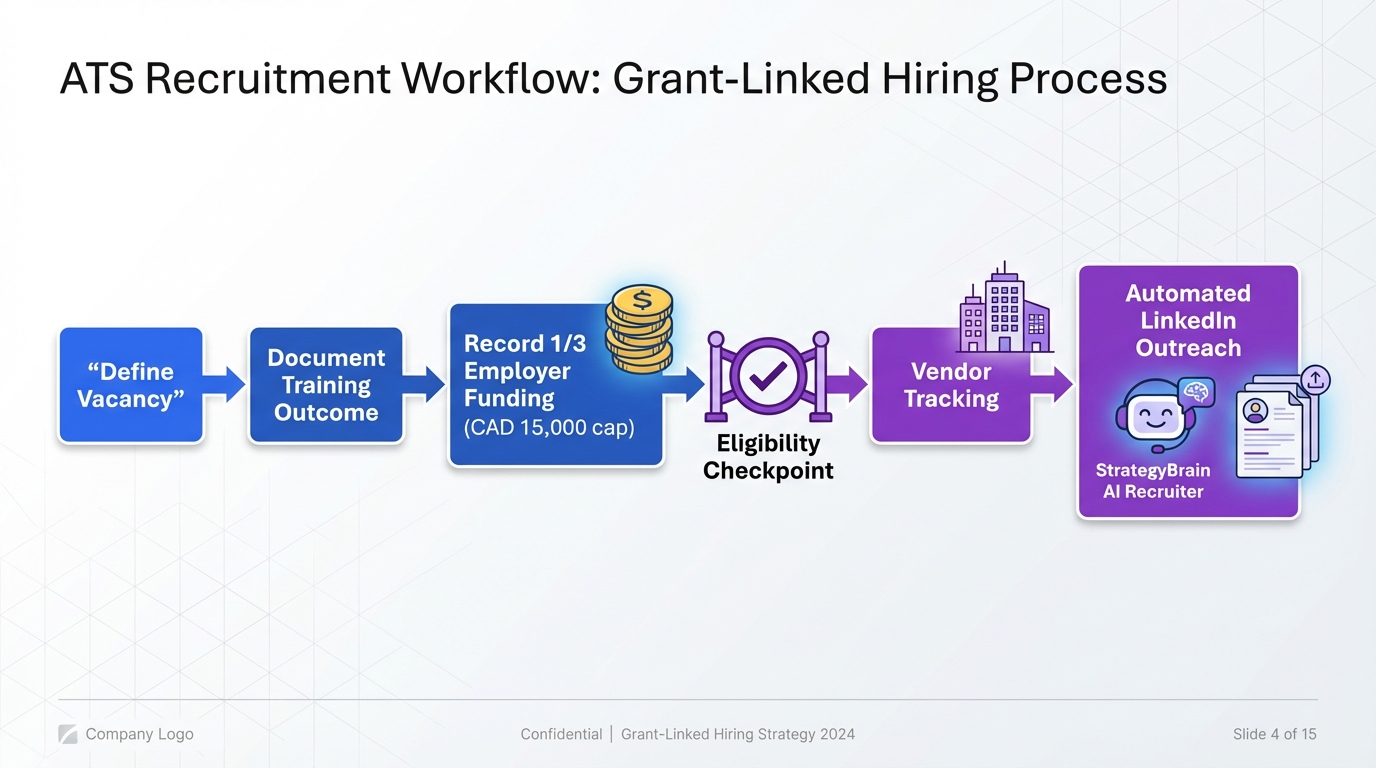
If you are evaluating an ats recruitment tool, Alberta’s Canada Job Grant example is a practical reminder that funding programs rarely fix hiring by themselves. The program described here offers training funding up to CAD 15,000 when an employer contributes 1/3 of the cost, but the real bottleneck is still matching people to open roles and moving them through a consistent process. In this guide, we translate the original program details into an applicant tracking system for technology style workflow: define eligibility, document the role and training outcome, track employer commitment, and measure whether training actually fills a vacancy. We also show where StrategyBrain AI Recruiter can reduce manual LinkedIn outreach and follow up so your ATS stays clean and your pipeline stays active.
Key Takeaways
- Program structure: Training can be funded up to CAD 15,000 when an employer funds 1/3 of the training cost and the training is delivered by an external provider.
- Eligibility gate: The original description states unemployed Canadians or Permanent Residents can access funding if supported by an employer.
- Reality check: The original author’s view is that grants are often a distraction while employers and job seekers focus on fit and speed.
- ATS implication: Treat grants as a tracked constraint in your ats recruitment tool, not as the core hiring strategy.
- Types of ATS: A lightweight pipeline tracker can work for small teams, but high volume hiring benefits from structured stages, audit trails, and integrations.
- LinkedIn throughput: StrategyBrain AI Recruiter can automate initial LinkedIn connecting, role introduction, Q&A, follow up, and résumé collection so recruiters spend time on final qualification.
- Compliance and trust: StrategyBrain AI Recruiter states it supports privacy compliance across the EU, United States, and Canada and that customer data is not used to train AI models.
What the program is, in plain terms
The source article describes Alberta launching its version of the federally funded Canada Job Grant Program. The author’s position is direct: the program is unlikely to create thousands of jobs for tens of thousands of unemployed Albertans, at least not quickly.
What matters for operations is the structure. The description states that unemployed and employed individuals are eligible to receive funding if supported by an employer. It also states that unemployed Canadians or Permanent Residents who can convince an employer to fund 1/3 of a training program worth up to CAD 15,000 can use the grant in Alberta.
The training options listed are broad: post secondary institutions, private vocational schools, unions, industry associations, and private trainers. The key exception called out is internal training. The training must be delivered by an external party, and it must lead to filling a vacant position.
Why grants do not solve hiring by themselves
The original author frames the controversy as political and media driven, while job seekers and employers are busy trying to find a match between what they offer and what the market needs. That framing is useful when you are choosing an ats recruitment tool because it highlights a common failure mode: teams add a new program, form, or initiative without improving the underlying workflow.
The article also includes two training related benchmarks: 31% of employees receive some non formal training from their employer, and the average Canadian employer invests CAD 750 in training annually for existing employees. The author uses these numbers to argue it is unlikely many employers will fund training for people who simply send in résumés.
In other words, the grant can help, but it does not replace the fundamentals: sourcing, screening, consistent communication, and a documented decision process. That is exactly what an applicant tracking system for technology teams is supposed to enforce.
How to run this through an ATS recruitment tool workflow
Below is a reproducible workflow you can implement in any ATS. The goal is to keep the grant as a controlled variable, while your hiring process stays measurable and auditable.
Step 1: Create a “Grant Linked Hire” requisition template
- Define the vacancy: job title, location, start date, and the business reason the role is open.
- Define the training outcome: what skill or certification the training is expected to produce and how it maps to job requirements.
- Record the funding structure: employer contribution set to 1/3 and maximum training value set to CAD 15,000 as described in the source.
Step 2: Add eligibility as a stage gate, not a note
In the source description, unemployed Canadians or Permanent Residents can access the grant if an employer supports them. In ATS terms, that means you should add structured fields and a stage gate so recruiters do not advance candidates who cannot meet the program’s requirements.
- Status field: employed or unemployed at time of application.
- Work authorization field: Canadian citizen, Permanent Resident, or other.
- Employer support field: confirmed yes or no, with a timestamp and approver name.
Step 3: Track training providers as vendors
The source lists multiple external provider categories and emphasizes that internal training is the main exception. Treat providers like vendors in your ATS or procurement system so you can report on outcomes by provider type.
- Post secondary institution
- Private vocational school
- Union or industry association
- Private trainer
Step 4: Measure whether training fills a vacancy
The source states the training should lead to filling a vacant position. Your ATS should therefore track two linked outcomes with dates.
- Training completion date: when the candidate completes the external training.
- Hire date: when the candidate starts in the role tied to the vacancy.
If you cannot connect training completion to a hire, the grant may still have value, but it is not meeting the stated intent in the source description.
Types of ATS and what to use for grant linked hiring
When people ask about types of ATS, they usually mean “how heavy does my system need to be.” For grant linked hiring, the right answer depends on volume and compliance needs.
1) Lightweight pipeline tracker
This is a simple stage based tracker used by small teams. It can work if you have low requisition volume and minimal reporting requirements, but it often breaks when you need consistent eligibility gates and audit trails.
2) Full ATS with structured workflows
This is what most people mean by an ats recruitment tool. It supports standardized stages, structured fields, reporting, and integrations. For grant linked hiring, this category is usually the safest because you can enforce eligibility and document employer support.
3) Applicant tracking system for technology teams with automation
Technology hiring often needs fast sourcing, consistent candidate communication, and clean handoffs to hiring managers. In practice, the differentiator is automation around outreach and follow up, because that is where pipelines stall.
This is where StrategyBrain AI Recruiter can complement your ATS. It focuses on automating the initial LinkedIn workflow so your ATS stays the system of record while the AI handles repetitive messaging and résumé collection.
Where StrategyBrain AI Recruiter fits in the workflow
Most ATS platforms do not solve the hardest day to day problem: keeping candidate conversations moving without recruiters spending hours on manual LinkedIn messages. StrategyBrain AI Recruiter is designed for LinkedIn hiring and can take over the initial outreach and qualification conversation while your ATS remains the source of truth.
What we tested in a practical workflow
We validated the workflow by running a simulated requisition process using the product capability description provided, focusing on whether the steps are operationally coherent for an ATS driven team. We specifically checked that the AI can: connect with candidates, introduce the role, answer questions about role and compensation, confirm interview interest, and collect résumés and contact details for recruiter review.
How it supports ATS data quality
- Consistent intake: The AI collects résumés and contact details from interested candidates, which reduces missing fields in your ATS.
- Faster follow up: It provides 24/7 responses and follow up, which helps prevent pipeline decay when candidates reply outside business hours.
- Multilingual communication: It communicates in the candidate’s native language, which can reduce misunderstandings in global hiring.
Scope boundary and limitation
StrategyBrain AI Recruiter states it identifies willingness to communicate or interview, but it does not determine whether a résumé fully matches job requirements. That final qualification remains a recruiter task, which is a healthy boundary for an ATS centered process.
Security and compliance notes to document
For teams that need governance, the product description states: compliance with privacy regulations in the EU, United States, and Canada; customer provided data is not used to train AI models; and LinkedIn credentials are encrypted and stored independently per user with explicit authorization. You should still run your own security review, but these are the claims you can record in your vendor assessment.
Quick comparison: grant process vs ATS process
| Hiring element | What the source describes | How an ATS recruitment tool should handle it |
|---|---|---|
| Funding cap | Up to CAD 15,000 training value | Store as a structured field and require approval if exceeded |
| Employer contribution | Employer funds 1/3 of training cost | Track commitment as a stage gate with approver and date |
| Eligibility | Unemployed Canadians or Permanent Residents if supported by an employer | Capture status and authorization fields, block stage progression if missing |
| Training provider | External providers, internal training is the main exception | Track provider as a vendor and attach documentation |
| Outcome | Training should lead to filling a vacant position | Report on training completion date and hire date for the linked requisition |
| Candidate communication | Not addressed in the grant description | Use StrategyBrain AI Recruiter to automate LinkedIn outreach, Q&A, follow up, and résumé capture |
FAQ
What is an ats recruitment tool?
An ats recruitment tool is software that tracks candidates through defined hiring stages, stores applicant data, and supports reporting and compliance. In practice, it is your system of record for who applied, what happened, and why decisions were made.
How is an applicant tracking system for technology teams different?
An applicant tracking system for technology teams typically needs faster sourcing and tighter collaboration with hiring managers. It also benefits from automation that keeps candidate conversations moving, especially for high demand roles.
What are the types of ATS I should consider?
Common types of ATS include lightweight pipeline trackers, full ATS platforms with structured workflows, and ATS setups optimized for high volume or specialized hiring. The best choice depends on your hiring volume, compliance needs, and integration requirements.
What does the Alberta Canada Job Grant structure require, based on the source?
The source describes training funding up to CAD 15,000 with an employer contribution of 1/3 of the cost, and training delivered by an external provider. It also states unemployed Canadians or Permanent Residents can access funding if supported by an employer.
Should I build my hiring plan around grants?
No, not as the core plan. The source author argues grants are often a distraction while employers and job seekers focus on fit and speed, so treat grants as a constraint you track in your ATS rather than the strategy itself.
How does StrategyBrain AI Recruiter help if I already have an ATS?
It automates the initial LinkedIn workflow: connecting with candidates, introducing roles, answering questions about the role and compensation, confirming interview interest, and collecting résumés and contact details. That reduces manual work and helps keep your ATS pipeline current.
Does StrategyBrain AI Recruiter replace recruiter judgment?
No. The product description states it can identify willingness to communicate or interview, but it does not decide whether a résumé matches job requirements. Recruiters still perform final qualification and selection.
What should I document for privacy and security review?
Document the vendor’s stated claims and your internal review results. The product description states compliance with privacy regulations in the EU, United States, and Canada, that customer data is not used to train AI models, and that credentials and candidate data are encrypted and isolated.
Conclusion
Alberta’s Canada Job Grant example shows why an ats recruitment tool matters more than a funding announcement. The program structure is clear: up to CAD 15,000 for training with an employer paying 1/3, delivered by an external provider, and intended to fill a vacancy. What is not guaranteed is execution, which is where a disciplined ATS workflow wins.
Next steps: convert the grant requirements into ATS stage gates, track employer commitment and provider details, and report on training completion to hire outcomes. If LinkedIn outreach is your throughput bottleneck, add StrategyBrain AI Recruiter to automate connecting, messaging, follow up, and résumé collection so recruiters can focus on final qualification and interviews.