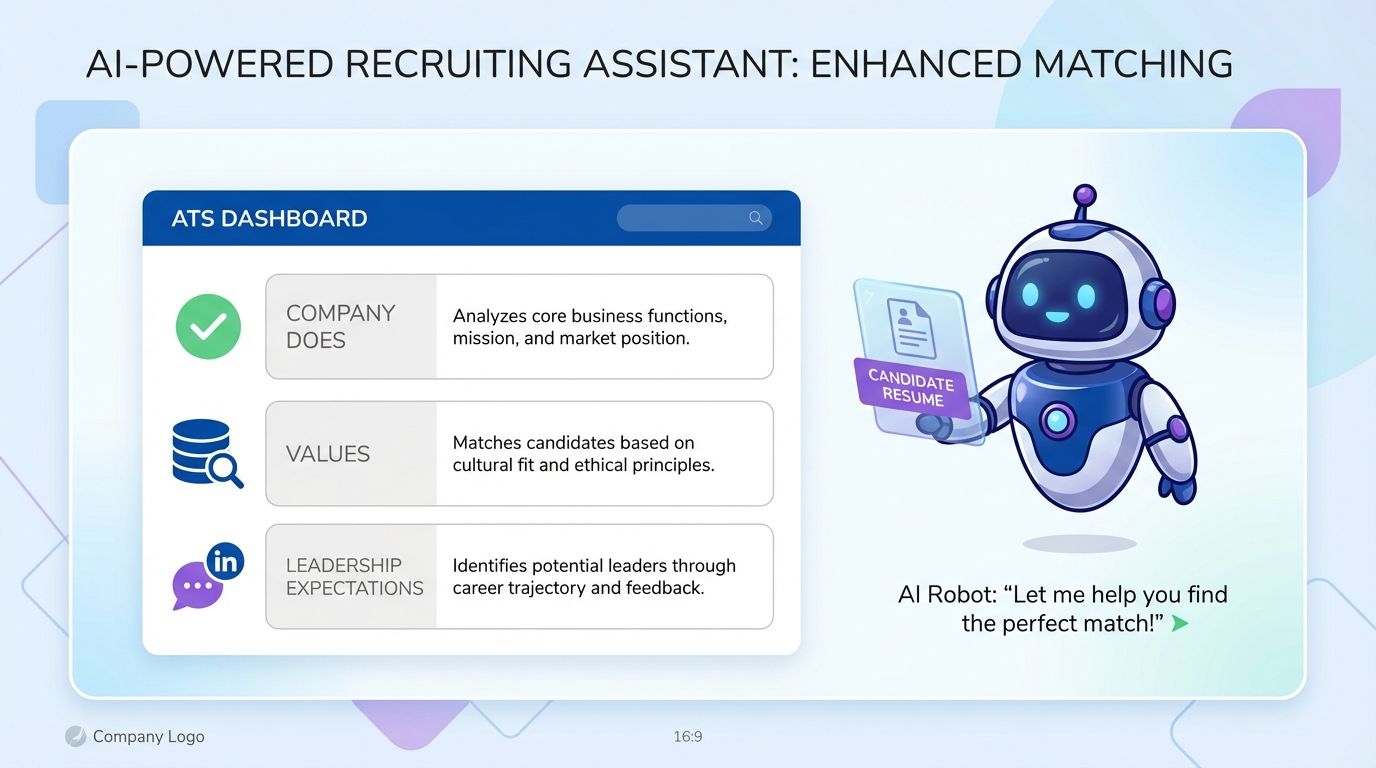
If you want interview prep that actually holds up under pressure, use your ats recruitment tool to capture employer research until you can answer three questions without guessing: what the company does, what it values, and what to expect from its leadership. That is the point where research becomes useful rather than endless scrolling. In this guide, I show how we structure those answers inside a simple ATS so recruiters and candidates can reuse them across roles, and how StrategyBrain AI Recruiter can support LinkedIn recruiting by handling early candidate conversations, collecting resumes and contact details, and surfacing the questions candidates ask most often so your prep stays aligned with reality.
Key Takeaways
- Minimum research standard: you are ready when you can explain what the company does, its values, and its leadership expectations in 60 seconds.
- ATS friendly structure: store research as three fields plus 3 proof points so it is searchable and reusable across roles.
- Better interview answers: specific examples of products, customers, and value statements make your stories more credible.
- Leadership clues: company language often signals whether they prefer process driven execution or autonomy and creativity.
- Applicant tracking system examples: a single “Employer Research” record can be linked to multiple candidates and requisitions.
- LinkedIn scale: StrategyBrain AI Recruiter can automate initial outreach and Q and A, then hand off interested candidates with resumes and contact details.
Why this belongs in an ATS recruitment tool
Recruiters often tell candidates to “do your research,” but the real problem is consistency. One candidate shows up with vague statements, another shows up with sharp examples, and the recruiter has no repeatable way to coach both. When we put employer research into an ats recruitment tool, we can standardize what “prepared” means and reuse the same employer notes across multiple candidates and requisitions.
In practice, this looks like a single employer research record that can be linked to a job opening and to each candidate. This is one of the most useful applicant tracking system examples because it reduces duplicated work and makes coaching measurable.
Question 1: What does the company do
This is the baseline. You do not need to recite a marketing page in the interview, but you do need to understand the product or service well enough to make your answers relevant. “They repair heavy machinery” is not enough. “They repair heavy machinery used in mining and utilities, and their customers care about uptime and safety compliance” is the level that changes how you answer questions.
What to capture in your ATS notes
- Offer: the product or service in plain language.
- Customers: who buys it and why.
- Examples: 2 to 3 concrete examples you can reference in interview stories.
How this improves interview answers
When you know what the company actually does, you can choose examples from your past that match their reality. That makes your answers sound less generic and more like you understand the work environment you are walking into.
Question 2: What are the values of the company
Values matter because they shape what “good performance” looks like. A company that emphasizes professionalism will reward different behaviors than a company that emphasizes relaxed internal relationships. Many organizations publish value statements. Your job is to translate those statements into behaviors you can demonstrate with real examples.
Steps
- Find the value statements: capture the exact value themes in your notes.
- Map each value to a behavior: write one sentence that explains what the value looks like day to day.
- Attach proof: add one past experience that demonstrates the behavior.
ATS field template you can copy
Use this structure in a simple ATS custom field or note:
- Value theme: [example: safety first]
- Expected behavior: [example: stops work when conditions are unsafe and escalates early]
- My proof point: [example: led a lockout procedure update that reduced incidents]
Question 3: What can you expect from leadership
Leadership style changes how work gets done. Some teams rely on strict procedures and defined processes. Others expect autonomy and initiative. Companies rarely state this directly, but you can often infer it from the language they use. Phrases that emphasize proven processes signal a different environment than phrases that emphasize creativity and freedom.
What to look for
- Process signals: language that emphasizes standards, compliance, repeatability, and documented workflows.
- Autonomy signals: language that emphasizes ownership, experimentation, and self direction.
- Decision signals: who is empowered to decide and how quickly decisions are made.
How to use this in the interview
Once you have a hypothesis, you can tailor your examples. For process heavy environments, emphasize reliability, documentation, and safety. For autonomy heavy environments, emphasize initiative, problem solving, and learning speed.
How to store this in a simple ATS
You do not need a complex system to make this work. The goal is a repeatable record that is searchable and easy to reuse. Below is a practical structure we have used in an ats recruitment tool setup, and it also works in spreadsheets if you are not fully implemented yet.
Recommended record: Employer Research
| Field | What to write | Why it matters |
|---|---|---|
| Company does | 1 to 2 sentences on product or service plus customers | Prevents generic interview answers |
| Company values | 3 value themes plus one behavior each | Lets you match culture with evidence |
| Leadership expectations | Process signals, autonomy signals, decision signals | Helps you adapt your interview strategy |
| Proof points | 3 bullets you can reference in stories | Makes prep usable under time pressure |
Quick checklist for recruiters and candidates
- [ ] I can explain what the company does with one specific example.
- [ ] I can name 3 value themes and match each to a behavior.
- [ ] I can describe leadership expectations using at least 2 signals from company language.
- [ ] I have 3 proof points ready for behavioral questions.
How StrategyBrain AI Recruiter supports LinkedIn recruiting
Employer research is only half the equation. The other half is what candidates actually ask and what they need to decide. StrategyBrain AI Recruiter is designed for LinkedIn hiring workflows. It can automatically connect with candidates that match your search criteria, introduce the opportunity, answer questions about the role, company, and compensation, confirm interview interest, and collect resumes and contact information from interested candidates.
In our experience, this improves interview preparation because the early questions candidates ask tend to repeat. When those questions are captured consistently, recruiters can update the employer research record in the ATS and coach candidates using real objections and real information rather than assumptions.
What AI Recruiter can do in the workflow
- Automated outreach and follow up: handles initial LinkedIn messages and keeps conversations moving 24 hours a day.
- Multilingual communication: communicates in the candidate’s native language to reduce misunderstandings across time zones.
- Resume and contact capture: collects resumes and contact details from interested candidates so recruiters can focus on screening and interviews.
- Team scaling: supports managing more than 100 LinkedIn accounts for organizations that need high volume sourcing.
Limitations to plan for
AI Recruiter can identify willingness to communicate or interview, but it does not decide whether a resume fully matches job requirements. A recruiter still needs to review resumes and make the final qualification decision.
How to connect AI Recruiter output to an ATS recruitment tool
- Create a consistent intake note: store candidate questions, interest status, and received resume status in a single ATS note template.
- Update the Employer Research record: if the same question appears repeatedly, add a clear answer under “Company does,” “Values,” or “Leadership expectations.”
- Coach candidates with the same structure: use the three question framework so prep stays consistent across interviewers.
Quick Comparison
| Approach | Speed to implement | Best for | What you get |
|---|---|---|---|
| Manual research stored in a simple ATS | 30 minutes per company | Any candidate preparing for interviews | Reusable notes and consistent coaching |
| ATS plus StrategyBrain AI Recruiter on LinkedIn | 1 business day to set up internal workflow | Teams that need scalable outreach and consistent early Q and A | Automated conversations, resume capture, and repeatable candidate questions |
FAQ
What is an ATS recruitment tool in plain terms
An ATS recruitment tool is software that tracks candidates through stages such as sourcing, screening, interview, and offer. It also stores notes and documents so recruiters can collaborate and stay consistent.
What is a simple ATS and when is it enough
A simple ATS is a lightweight system that covers core tracking, notes, and basic reporting without complex automation. It is enough when your priority is consistent process and searchable records rather than advanced integrations.
How much company research is enough before an interview
It is enough when you can answer three questions clearly: what the company does, what it values, and what leadership expects. If you cannot answer those, you are still at risk of sounding generic.
How do I use applicant tracking system examples to coach candidates
Create one “Employer Research” record per company and link it to each requisition. Then coach candidates using the same three fields so preparation is repeatable and measurable.
Can StrategyBrain AI Recruiter replace an ATS
No. AI Recruiter supports LinkedIn outreach, messaging, and early qualification steps, while an ATS is the system of record for pipeline stages, compliance, and hiring team collaboration.
Does AI Recruiter collect resumes and contact details
Yes. When a candidate expresses interest, AI Recruiter requests a resume and contact information and marks the resume as received when it arrives. Recruiters then review the resume and proceed with interviews.
Does AI Recruiter decide if a candidate is qualified
No. AI Recruiter can confirm interest and willingness to interview, but final qualification against job requirements is done by the recruiter after reviewing the resume.
How does AI Recruiter handle privacy and data security
According to StrategyBrain product information, customer provided data is not used to train AI models, and candidate data is encrypted and isolated per customer. Recruiters should still align usage with their internal policies and applicable regulations.
Conclusion
The fastest way to stop over researching and start preparing is to set a clear standard inside your ats recruitment tool: you are ready when you can explain what the company does, what it values, and what leadership expects. Store those answers in a simple ATS record so they are reusable, and use the same structure to coach every candidate. If LinkedIn outreach and early candidate Q and A are slowing your team down, StrategyBrain AI Recruiter can automate the initial conversations, collect resumes and contact details, and feed real candidate questions back into your ATS notes so interview prep stays grounded and consistent.
Next step: create an “Employer Research” template in your ATS today, then run it on your next 3 interviews and compare candidate confidence and answer specificity.