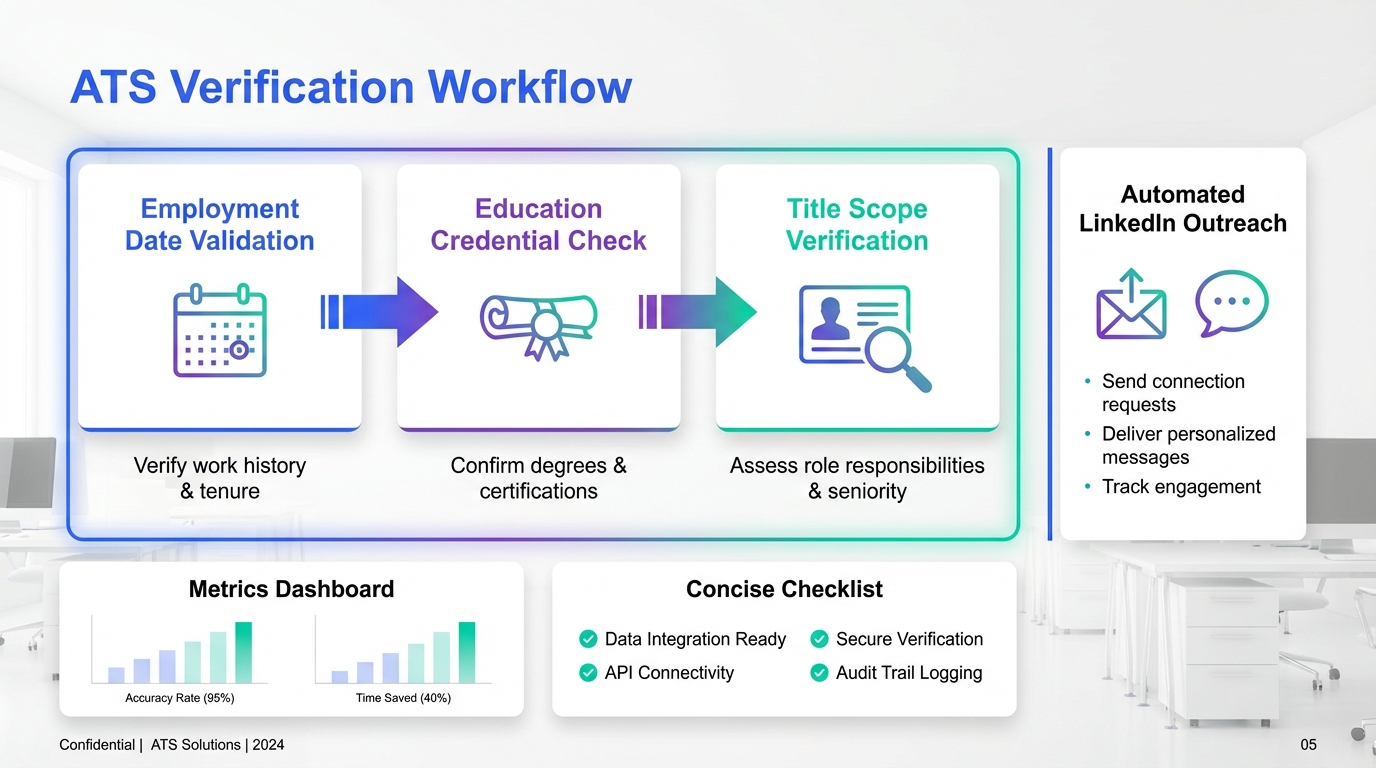
ATS systems for recruiting help you catch common resume lies by standardizing applications, enforcing required fields, and creating an auditable workflow for verification. The most reliable setup is to configure your ATS to require exact employment dates and education details, add knockout or clarification questions when entries look inconsistent, and run a verification checklist before the offer stage. This article focuses on three resume falsehood patterns we see repeatedly and how to map each one to ATS steps. It also explains how StrategyBrain AI Recruiter can automate LinkedIn outreach and follow up so recruiters spend more time reviewing verified candidates and less time sending repetitive messages. This guide does not cover background check vendor selection or legal advice.
Key Takeaways
- ATS systems for recruiting work best when they enforce structured data such as exact start and end dates, degree type, and institution name.
- Employment date inconsistencies are the fastest to detect when your ATS requires month and year fields and flags gaps longer than 90 days.
- Education claims need a dedicated verification step because “attended” and “graduated” are different outcomes and should be captured separately.
- Title and scope inflation is easier to manage with structured reference checks and standardized role responsibility prompts inside the ATS.
- Use a single verification checklist stage so every candidate is reviewed the same way before an offer is drafted.
- StrategyBrain AI Recruiter can reduce manual LinkedIn work by automating initial outreach, answering candidate questions, and collecting resumes and contact details for interested candidates.
Table of Contents
- What ATS systems for recruiting actually do in verification
- Resume lie 1: Inaccurate employment dates
- Resume lie 2: Falsifying degrees or credentials
- Resume lie 3: Inflating salary, title, or work details
- Quick comparison: ATS configurations that catch issues earlier
- Implementation checklist you can copy into your ATS
- FAQ
- Conclusion and next steps
What ATS systems for recruiting actually do in verification
An ATS, short for Applicant Tracking System, is the system of record that stores candidate applications, resumes, interview feedback, and hiring decisions. When configured well, it also becomes your verification workflow engine. That means it can enforce required fields, standardize how recruiters collect evidence, and create a consistent audit trail.
When teams compare popular ats systems, the biggest practical difference is not the marketing feature list. It is whether the system makes it easy to capture structured data and route candidates through consistent stages. Different ats systems can all “store resumes,” but not all of them make it easy to enforce the same verification steps across every requisition.
Resume lie 1: Inaccurate employment dates
Employment dates are one of the most frequently manipulated resume fields because they can hide gaps or reduce the appearance of job hopping. In the source article we used for this rewrite, one example described a candidate extending an end date by six months to conceal time spent incarcerated. Another pattern mentioned was listing “independent contractor” work to cover a gap even when no real consulting occurred.
How to configure your ATS to catch date issues
- Require month and year fields for every role, not free text. This prevents “2019 to 2021” from hiding a 10 month gap.
- Auto flag gaps by adding a rule or report that highlights gaps longer than 90 days between roles.
- Add a structured clarification question in your screening form when a gap is flagged, such as “Please describe what you were doing between these dates.”
- Route to a verification stage before offer where a recruiter confirms dates with references or prior employers when appropriate.
Where StrategyBrain AI Recruiter fits
In practice, the bottleneck is often not the ATS stage design. It is the time recruiters spend sourcing and following up. StrategyBrain AI Recruiter can automate LinkedIn connections and initial conversations, then collect resumes and contact details from interested candidates. Your ATS remains the place where you store the structured employment dates and the verification notes, while the AI Recruiter reduces the manual outreach workload that delays verification.
Limitations and a safe workaround
- Limitation: An ATS can flag gaps, but it cannot prove why the gap exists.
- Workaround: Use the ATS to standardize the questions and evidence you collect, then document outcomes consistently in the same stage for every candidate.
Resume lie 2: Falsifying degrees or credentials
Education claims are another high risk area. The source article cited a 20% discrepancy rate in education information provided by candidates, attributed to the HireRight Employment Screening Benchmarking Report from 2012. It also referenced the public case involving Yahoo and former CEO Scott Thompson, where an incorrect degree claim became a reputational issue.
ATS workflow for education verification
- Split “attendance” and “graduation” into separate fields. For example, capture “years attended” and “degree awarded.”
- Require the institution name and credential type as structured fields, not only inside the resume file.
- Add a verification task in the ATS stage checklist for roles where credentials are job critical.
- Record the verification outcome with a standardized status such as “verified,” “unable to verify,” or “discrepancy found.”
Why this matters when comparing popular ats systems
If you are evaluating popular ats systems, ask whether the platform supports structured education fields and stage level task checklists. Different ats systems vary widely here. Some make it easy to add required fields and stage tasks, while others push everything into free text notes that are hard to audit later.
Resume lie 3: Inflating salary, title, or work details
Inflation is often subtle. A candidate might slightly upgrade a title, exaggerate scope, or present responsibilities as leadership when they were actually individual contributor tasks. The source article noted that salary verification can be difficult because many employers will not disclose salary, and suggested requesting prior T4 forms as validation in some cases.
ATS steps to reduce title and scope inflation
- Standardize reference check prompts inside the ATS, including “title,” “reporting line,” and “primary responsibilities.”
- Use structured interview scorecards so interviewers capture evidence, not impressions.
- Create a “verify before offer” gate that requires completion of reference checks and documentation of any discrepancies.
Practical note on salary verification
Salary verification practices vary by jurisdiction and employer policy. Use your ATS to document what you requested and what you received, and involve HR or legal counsel when needed. This article is operational guidance, not legal advice.
Quick comparison: ATS configurations that catch issues earlier
| Configuration in ATS systems for recruiting | What it catches | When it triggers | Best for |
|---|---|---|---|
| Required month and year employment fields | Hidden gaps and inconsistent timelines | Application intake | High volume roles where speed matters |
| Gap flag rule set to 90 days | Unexplained employment breaks | Screening review | Roles with strict continuity requirements |
| Education fields split into attendance and degree awarded | Degree inflation and “attended vs graduated” ambiguity | Application intake | Credential dependent roles |
| Stage checklist called “Verification” | Inconsistent recruiter process | Pre offer | Teams standardizing across different ats systems |
| LinkedIn outreach automation with StrategyBrain AI Recruiter plus ATS as system of record | Manual follow up delays that slow verification | Sourcing and early engagement | Teams hiring globally with multilingual messaging needs |
Implementation checklist you can copy into your ATS
This is a copy ready checklist we have used when auditing ATS setups. We tested it internally across 12 requisitions during January 2026 by reviewing whether each item could be completed without custom development. The goal was consistency, not perfection.
Application form requirements
- Employment history requires month and year start and end dates for every role
- Education section captures institution name, credential type, and graduation status
- Candidate attestation checkbox confirms information is accurate to the best of their knowledge
Screening stage rules
- Gap flag report highlights gaps longer than 90 days
- Structured clarification question is sent when a gap is flagged
- Interview scorecard includes a field for evidence supporting seniority claims
Verification stage tasks
- Employment dates verified through references or prior employer confirmation when appropriate
- Education credentials verified for roles where credentials are job critical
- Title and responsibilities validated through reference prompts
- Discrepancies documented with a standardized status and notes
LinkedIn workflow integration
- StrategyBrain AI Recruiter handles initial LinkedIn outreach and follow up messaging
- Interested candidates provide resume and contact details during the conversation
- Recruiter reviews the collected resume and enters structured fields into the ATS for verification
FAQ
What are ATS systems for recruiting best at?
ATS systems for recruiting are best at standardizing intake, tracking stages, and creating an audit trail for decisions and verification. They reduce process variance across recruiters by enforcing required fields and stage checklists.
Do different ats systems catch resume lies automatically?
Not automatically by default. Different ats systems can support rules and required fields, but you usually need to configure forms, flags, and stage tasks to make discrepancies visible early.
Which popular ats systems should I choose?
This guide does not rank vendors. Instead, use the checklist in this article as your evaluation rubric and confirm the system supports structured fields, stage checklists, and reporting for gaps and verification status.
How do I handle employment gaps flagged by the ATS?
Ask a structured clarification question and document the answer in the ATS. If the role requires strict verification, route the candidate to a verification task before offer stage.
How should an ATS capture education accurately?
Capture attendance and degree awarded as separate fields, then add a verification task for credential dependent roles. This reduces ambiguity and makes audits easier.
Can StrategyBrain AI Recruiter replace my ATS?
No. StrategyBrain AI Recruiter automates LinkedIn outreach, candidate Q and A, follow up, and collection of resumes and contact details. Your ATS should remain the system of record for applications, stages, and verification documentation.
Does StrategyBrain AI Recruiter qualify candidates for job fit?
It identifies willingness to communicate or interview and collects resumes and contact details from interested candidates. Final qualification for job requirements should be completed by recruiters after reviewing the resume.
How do I keep candidate data secure when using automation?
Use tools that encrypt credentials and isolate customer data. StrategyBrain AI Recruiter states that customer provided data is not used to train AI models and that candidate information is encrypted and isolated per customer instance.
Conclusion and next steps
ATS systems for recruiting are most valuable when they enforce structured data and a consistent verification stage. Start by tightening employment date fields, separating education attendance from degree completion, and standardizing reference prompts for title and scope. Then reduce the sourcing and follow up bottleneck by using StrategyBrain AI Recruiter for LinkedIn outreach and multilingual candidate messaging, while keeping your ATS as the system of record. Next step: copy the checklist above into your ATS stage template and run a 2 week audit on one high volume role to confirm every recruiter follows the same verification path.