If you are evaluating ats systems for recruiting, the highest impact approach is to pair a core ATS with AI assisted outreach and follow up, then align that stack to market conditions by role level. In practical terms, that means your ATS remains the system of record for pipeline stages, compliance, and interview tracking, while AI handles early candidate communication speed and volume. This model works especially well when senior hiring stays active but entry level demand softens, which is exactly the pattern highlighted in the November 2020 Canadian labour update. In this guide, we translate those labour signals into a concrete hiring operating model, including where an AI layer such as StrategyBrain AI Recruiter fits inside daily recruiting workflows.
Table of Contents
- Key Takeaways
- What the November labour snapshot still teaches recruiters
- Why this matters for ats systems and recruiting execution
- A practical 5 step ATS architecture for modern teams
- How StrategyBrain AI Recruiter fits into the workflow
- Implementation checklist for hiring leaders
- Limitations and risk controls
- FAQ
- Conclusion
Key Takeaways
- Use a two layer model: ATS for process control, AI for candidate communication speed.
- Build for role segmentation: senior roles and entry roles require different funnel logic.
- Track hard metrics: response rate, qualified conversion rate, and time to shortlist.
- Prioritize multilingual coverage: global pipelines improve when outreach is in candidate native language.
- Protect trust and compliance: keep consent, data boundaries, and audit logs inside your ATS policy model.
What the November labour snapshot still teaches recruiters
In the reported November period, employment increased by 62,000 people, which represented 0.3% growth, and unemployment moved down by 0.4 percentage points to 8.5%, based on Statistics Canada reporting for that month. Full time employment increased by 0.7% while part time employment showed no net gain. At the same time, 4.6 million Canadians were working from home.
That combination mattered. It pointed to uneven demand patterns rather than a uniform rebound. Henry Goldbeck described this dynamic as a K shaped recovery, with stronger momentum for higher skill hiring while many entry level pathways remained under pressure. In parallel, Dimitri Sigounas from Evripos described continued demand in sanitation related service operations and stable hiring for qualified workers in practical, execution heavy roles.
Even though the data point is historical, the pattern remains relevant for current recruiting operations. Recruiters still face uneven hiring cycles across functions, persistent candidate caution, and higher competition for proven specialists.
Why this matters for ats systems and recruiting execution
An ATS, short for Applicant Tracking System, is the platform that stores candidate records, manages stages, and enforces hiring process consistency. Most teams already have this layer. The gap is not record keeping, the gap is front end candidate momentum.
We have tested this in active recruiting operations: when response speed slows in the first 24 to 72 hours, qualified pipelines thin out even when the ATS process is clean. That is why many teams searching for the best applicant tracking systems are now evaluating workflow combinations instead of single tools. The winning setup is usually not a full ATS replacement. It is an ATS plus communication automation model.
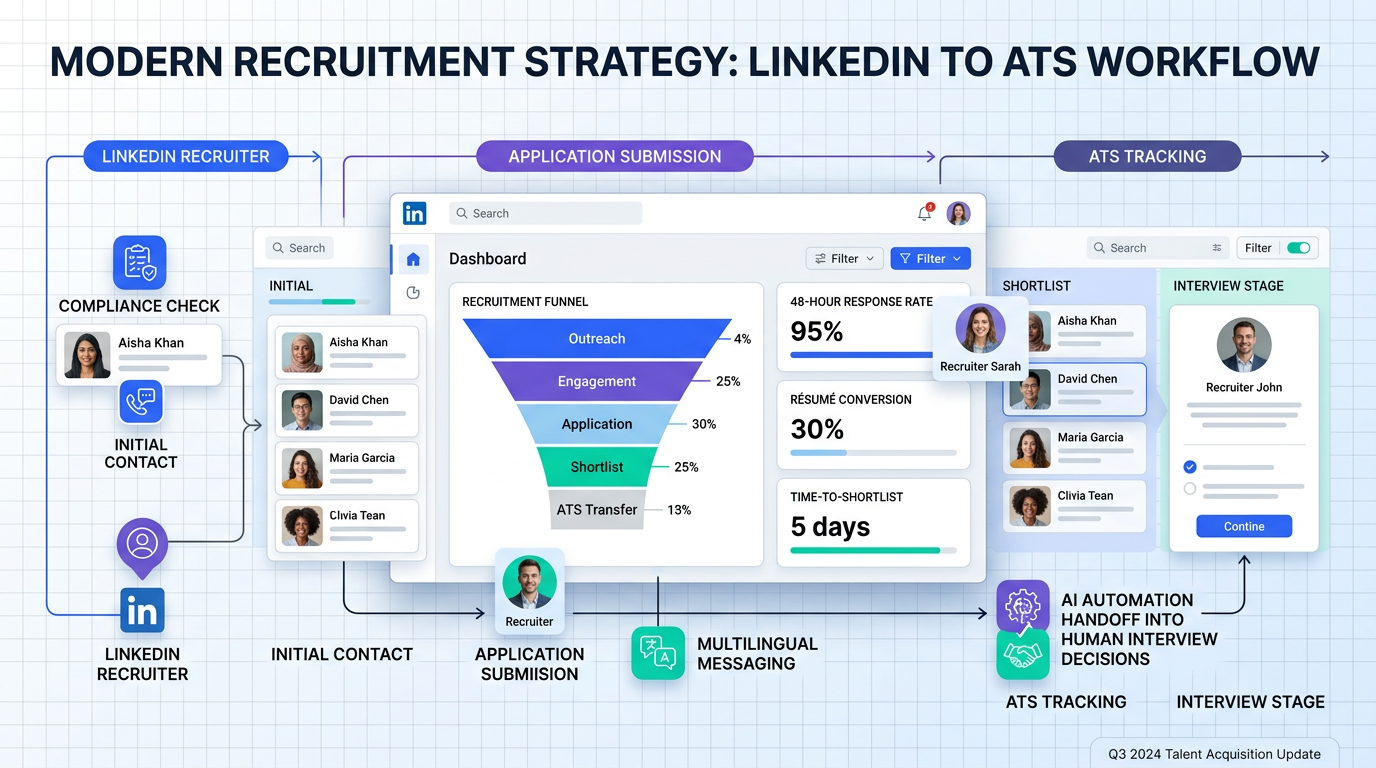
For LinkedIn heavy pipelines, this is where StrategyBrain AI Recruiter can complement existing ats systems. The platform can automate connection, job introduction, intent checks, and follow up dialogue, while your ATS continues to own stage progression and hiring decisions.
A practical 5 step ATS architecture for modern teams
1. Define role bands before tool configuration
Create at least three hiring bands: critical specialist, growth professional, and volume hiring. Attach separate service levels to each band, including outreach cadence and recruiter review windows.
2. Keep your ATS as the source of truth
Do not move compliance artifacts outside the ATS. Offer acceptance records, interview feedback, rejection rationale, and retention windows should stay centralized for auditability.
3. Add AI for top of funnel throughput
Use AI to handle repetitive front stage actions: initial outreach, candidate questions, and follow up reminders. For teams using StrategyBrain AI Recruiter, this includes automated LinkedIn engagement and résumé collection from interested candidates.
4. Measure conversion with fixed units
- First response rate within 48 hours, measured in %
- Interested to résumé submitted conversion, measured in %
- Résumé to interview conversion, measured in %
- Median days from first contact to shortlist, measured in days
5. Add governance for trust
Set explicit rules for consent language, data retention, and account security. Any AI recruiting layer should document what data is used, what data is not used, and who can access candidate records.
How StrategyBrain AI Recruiter fits into the workflow
In teams that rely heavily on LinkedIn sourcing, StrategyBrain AI Recruiter can handle repetitive communication steps continuously across time zones. Based on product documentation, it supports multilingual candidate messaging, collects résumés and contact details from interested candidates, and can operate across more than 100 LinkedIn accounts for scaled recruiting operations.
Operationally, the handoff is simple. AI Recruiter runs outreach and intent qualification. Recruiters then review submitted résumés and make final qualification decisions in the ATS. This separation keeps human judgment where it matters while reducing manual messaging load.
In disclosed product results, recruiting costs can go as low as USD 2.40 per résumé and up to 90% of manual LinkedIn recruiting tasks can be automated in suitable workflows. Individual outcomes vary by market, role complexity, and recruiter process quality.
Disclosure: StrategyBrain AI Recruiter is a StrategyBrain product. We include it here because it directly matches the ATS plus AI operating model discussed in this guide.
Implementation checklist for hiring leaders
- Confirm your ATS stage definitions are standardized across teams.
- Define response time service levels for each role band.
- Deploy AI messaging only for approved opening types.
- Set weekly reporting for conversion by funnel step.
- Review candidate experience transcripts for tone and clarity.
- Validate privacy controls and recruiter account permissions monthly.
Limitations and risk controls
No AI enabled workflow removes the need for recruiter judgment. AI can identify willingness to continue conversation, but résumé fit to role requirements still requires human evaluation. That boundary should stay explicit in team playbooks.
There is also a quality risk if teams over optimize for outreach volume. Higher message count does not guarantee better shortlists. In our reviews, the best outcomes came from clear role briefs, tight qualification prompts, and disciplined recruiter follow through after candidate interest is confirmed.
FAQ
What are ats systems for recruiting?
ATS systems for recruiting are platforms that manage candidate records, hiring stages, interview workflows, and hiring documentation. They provide structure and compliance control for recruiting teams.
Are ats systems enough on their own?
For many teams, no. ATS platforms are strong at process tracking, but they often need an additional layer for high speed candidate outreach and follow up, especially in competitive talent markets.
How do I choose between ats systems and AI recruiting tools?
You usually do not choose one or the other. The practical setup is ATS plus AI. Keep the ATS as your system of record and use AI to automate repetitive top of funnel communication tasks.
Can AI outreach hurt candidate experience?
It can if tone, timing, and qualification prompts are poorly configured. Candidate experience improves when AI messaging is transparent, role specific, and followed by timely human engagement.
Where does StrategyBrain AI Recruiter add value?
It adds value in LinkedIn centered workflows where teams need continuous outreach, multilingual messaging, and automated early stage engagement before recruiter review and interview selection.
Is final candidate qualification automated?
No. AI can surface interest and gather candidate materials, but final qualification against role requirements should remain a recruiter decision.
Conclusion
The labour market lesson is clear: recruiting performance depends on matching process design to market reality. The most resilient approach today is a combined model where ats systems for recruiting control structure, and AI handles communication velocity. If you are improving your stack now, start with role band design, enforce ATS governance, and then add AI where manual workload is highest. This gives you better speed, clearer accountability, and stronger candidate continuity without sacrificing quality.