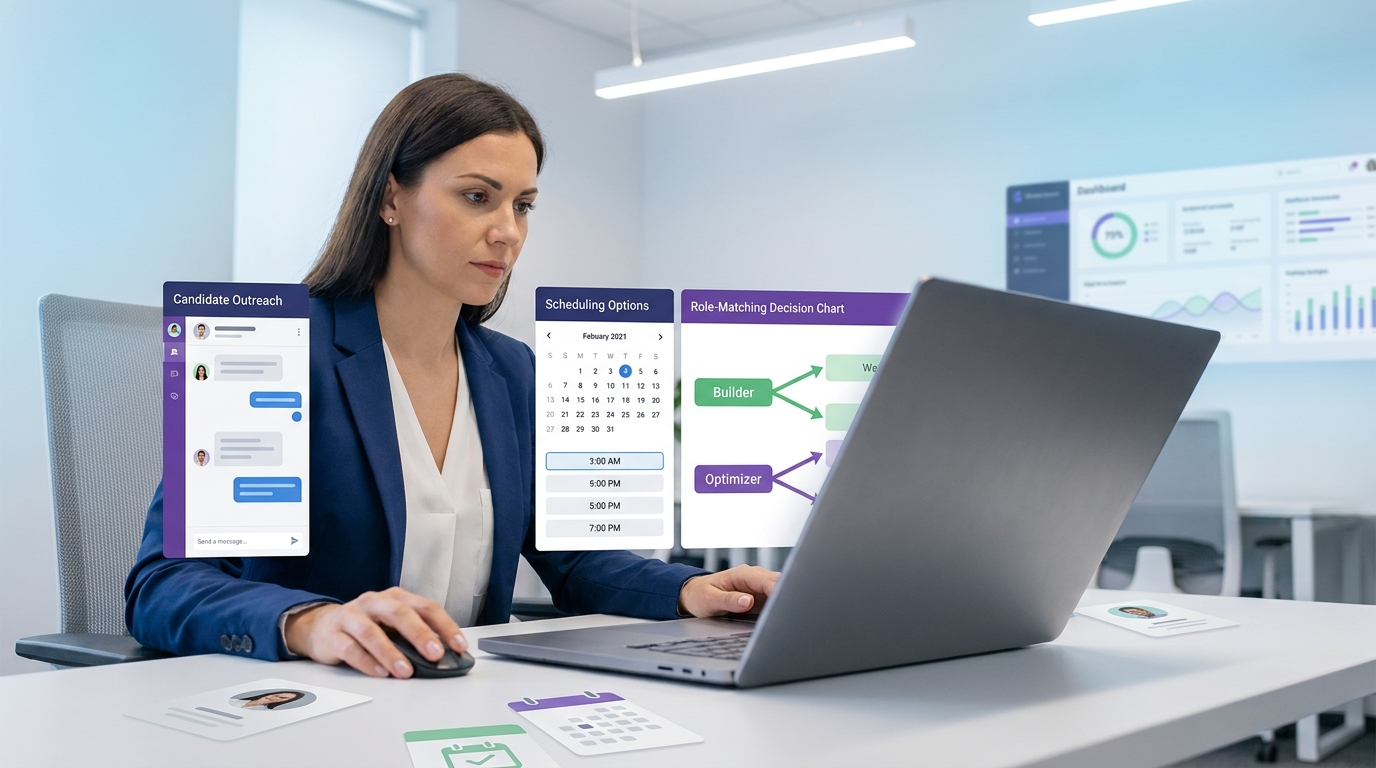
This article helps recruiting leaders judge whether an ai hiring platform fits the role, avoiding slow hiring and candidate drop-off.
That sounds obvious, but it is where many teams lose time and candidate trust. Small search firms feel it when consultants chase calendars instead of progressing shortlisted people. Solo recruiters feel it when late replies, time zone gaps, and manual reschedules eat into business development hours. In-house talent teams feel it when hiring managers complain that strong applicants went cold before a first conversation was even booked. The real cost is not just admin burden. It is slower movement, weaker stakeholder alignment, more candidate drop-off, and avoidable confusion about who should be interviewed live and who should not.
In my own workflow, I have found that StrategyBrain AI Recruiter is most useful when the bottleneck starts before the interview calendar itself. Its always-on candidate messaging, multilingual follow-up, and automatic collection of résumés and contact details help keep early interest from stalling while recruiters still make the final judgment on résumé fit, shortlist quality, and who moves into the next interview step. That matters because scheduling usually breaks down after inconsistent outreach, delayed replies, or incomplete handoff data, not only because calendars are busy.
Consider a finance leadership search, where the client says they need a CFO but has not yet clarified what kind of CFO the business actually needs. A founder-led company preparing for its next funding round is looking for someone who can build reporting from scratch, manage runway, and help tell the growth story to investors. A more mature company under board pressure may need a very different finance leader, one who can handle controls, forecasting discipline, lender conversations, or the complexity that comes with scale. Before any interview is booked, the recruiter is already working through a decision framework: are we hiring a builder, an optimizer, or someone in between?
That distinction changes the interview process itself. The first outreach messages, the screening questions, the people who need to meet the candidate, and even the urgency of scheduling all shift depending on whether the role is about building a finance function or optimizing a mature one. In practice, the recruiter may review the requisition, confirm stakeholder priorities, reply to an interested candidate, update the candidate stage, and then realize the hiring team has not aligned on what success in the role actually looks like. When that happens, automated scheduling alone cannot save the process. It has to be connected to clearer role definition and the right interview format.
That is why automated interview scheduling should be treated as a decision tool, not just a calendar tool. A modern ai hiring platform helps teams decide when candidates should self-schedule, when an ai video interview is enough for early structured screening, and when live interview ai workflows make more sense because the role requires real-time judgment, follow-up, and stakeholder interaction. The rest of this article breaks down those decision points from a recruiter's perspective.
Table of Contents
- Why scheduling fails before the calendar
- Match the interview format to the role you are hiring
- Where automated scheduling fits in an ai hiring platform
- Three interview modes that matter
- How high-volume and specialist hiring differ
- What to look for in ai video interview workflows
- When live interview ai is the better choice
- A practical workflow for recruiters and hiring managers
- Using StrategyBrain in early-stage coordination
- Governance, fairness, and candidate experience
- Common mistakes to avoid
- FAQ
Why scheduling fails before the calendar
Recruiters often describe interview scheduling as a calendar problem, but many delays begin earlier. The process usually breaks when the team has not defined the role clearly, has not agreed on who needs to be involved at each stage, or has not chosen the right interview method for the decision being made.
The CFO example is useful because it makes that hidden problem obvious. If the business is still deciding whether it needs a builder who can create systems from the ground up or an operator who can optimize an established finance function, then the recruiting workflow is not ready for generic scheduling automation. The wrong interview sequence will create rework. Candidates will meet the wrong stakeholders too early. Hiring managers will ask overlapping questions. Recruiters will spend time rearranging interviews that should never have been booked in the first place.
In experienced hiring teams, automation works best after three things are clarified:
- What problem the role is meant to solve: build from scratch, stabilize, or optimize at scale.
- What evidence is needed first: résumé review, asynchronous responses, live discussion, or stakeholder panel feedback.
- Which people really need calendar time: recruiter, hiring manager, peers, executives, or none yet.
That is the difference between faster scheduling and better hiring operations. An ai hiring platform should help enforce that logic.
Match the interview format to the role you are hiring
One of the most practical lessons from senior-level hiring is that role context should shape interview design. A company moving from founder-led finance to a more structured finance function may want a first screen that tests comfort with ambiguity, resource constraints, and investor communication. A business facing audit pressure, lender scrutiny, or multi-entity complexity may need a live interview earlier because the nuance of technical judgment matters more.
That logic applies well beyond CFO hiring. Search firms and talent teams should ask a version of the same question for every role: are we hiring someone to build, someone to optimize, or someone to operate within an already-defined system? The answer influences whether you should start with self-scheduling, an anytime screen, or a live round.
| Hiring situation | What the team needs to learn first | Best first interview format | Scheduling implication |
|---|---|---|---|
| Role is ambiguous or newly defined | Problem-solving approach and adaptability | Structured asynchronous screen or recruiter screen | Reduces unnecessary live bookings |
| Role is high-volume and standardized | Basic fit, availability, communication, core criteria | On-demand screening | Often avoids early calendar friction |
| Role is senior and stakeholder-heavy | Real-time judgment, influence, executive presence | Live interview | Requires tighter coordination |
| Role needs global candidate reach | Interest, timing, and responsiveness across time zones | Automated outreach plus self-scheduling | Needs always-on communication support |
What matters is not automation for its own sake. It is fit between interview design and hiring intent.
Where automated scheduling fits in an ai hiring platform
Most employers do not buy scheduling software because they enjoy calendar management. They buy it because interview coordination sits in the middle of the hiring funnel and affects everything around it. A solid ai hiring platform links candidate movement, invitations, availability, interview delivery, review data, and next-step decisions into one operating flow.
In practical terms, scheduling should connect to:
- Candidate stage movement
- Role-specific interview paths
- Bulk invitation workflows
- Interviewer availability rules
- Transcripts and structured scorecards
- Review history and audit trails
- ATS and calendar integrations
If those pieces are disconnected, recruiters still end up stitching the process together by hand. That is when inboxes become the real system of record.
For search professionals, this is especially important in searches where the role definition evolves during market feedback. You may start with one profile, learn from candidate conversations that the client actually needs another, and then adjust the interview path. A platform should support that kind of reality instead of forcing every role through the same booking sequence.
Three interview modes that matter
In most recruiting stacks, automated interview scheduling touches three different interview modes. They look similar in software categories, but they solve different workflow problems.
| Interview mode | How it works | Best use case | Scheduling impact |
|---|---|---|---|
| Asynchronous video interview | Candidates answer structured questions on their own time | Early-stage screening and high-volume roles | Can remove the need for immediate live booking |
| Live video interview | Candidate and interviewer meet in real time | Manager rounds, panel interviews, later-stage evaluation | Requires calendar coordination |
| Conversational AI-led interview | Candidate interacts with an AI-guided flow | Always-on screening and standardized first touch | Available 24/7 with limited scheduling friction |
An ai video interview process usually centers on consistency. It helps the recruiter compare candidates against the same prompts, review transcripts, and prepare a more structured recommendation for the hiring manager. A live interview ai process is more useful when the team wants a real-time conversation but still needs note capture, summaries, or standardized feedback patterns.
The key operational point is simple: not every candidate needs the same kind of calendar access at the same moment.
How high-volume and specialist hiring differ
High-volume hiring and specialist hiring both benefit from automation, but not for the same reasons.
In high-volume environments, the gain is usually obvious. Recruiters reduce repetitive coordination, candidates get quicker access to the first step, and hiring managers only spend time on applicants who have already cleared a basic screen. This is where self-service scheduling and on-demand interviewing often create immediate relief.
In specialist or executive hiring, the benefit is more strategic. Automated workflows help preserve momentum while the recruiter and client clarify what kind of person is truly needed. That mirrors the finance-leader example at the start of this article. The search becomes smoother when early outreach, candidate follow-up, and information capture continue moving even while the role scope is being refined.
In other words:
- High-volume hiring uses automation to reduce workload.
- Specialist hiring uses automation to protect decision quality and timing.
Both are valuable, but they require different workflow choices.
What to look for in ai video interview workflows
When recruiters search for ai video interview tools, they are usually looking for more than a recording feature. The useful question is whether the workflow creates evidence the team can actually use.
Features worth evaluating
- Role-specific question setup: helps align the screen to the job rather than using generic prompts.
- Transcripts: allow faster review without replaying every response.
- Structured summaries: make recruiter handoff easier for hiring managers.
- Consistent scoring logic: supports clearer comparisons across candidates.
- Stage-linked invitations: ensures delivery and review connect to the hiring workflow.
For experienced recruiters, the main caution is to keep the evaluation tied to the actual decision. If you are still trying to determine whether a company needs a builder-style leader or a scale-stage operator, the interview questions should help surface that distinction. Fancy outputs do not matter if the process is asking the wrong questions.
Practical takeaway: The best early interview is the one that answers the next decision, not the one that collects the most data.
When live interview ai is the better choice
The search intent behind live interview ai is usually closer to real conversation than asynchronous screening. That makes it useful in roles where follow-up reasoning, executive presence, persuasion, and stakeholder interaction are part of the hiring decision.
Using the finance-leader example again, a board-facing CFO candidate may need to be assessed live because the hiring team is not just measuring technical knowledge. They are assessing how the person explains complexity, handles pressure, and adjusts in the moment. Those signals are hard to capture in a one-way format alone.
Good use cases for live interview ai
- Later-stage manager or executive rounds
- Panel interviews with multiple stakeholders
- Roles requiring communication nuance
- Hiring stages where candidate questions matter to mutual fit
- Situations where structured note capture helps the team stay aligned
The best use of automation here is support, not substitution. Recruiters and hiring managers still own the conversation and the judgment behind the decision.
A practical workflow for recruiters and hiring managers
In most teams, the strongest setup combines clear role definition with staged automation. A practical workflow looks like this:
- Clarify the hiring problem: define whether the role is about building, stabilizing, or optimizing.
- Choose the first evidence step: résumé review, asynchronous screening, or recruiter conversation.
- Automate outreach and response handling: keep candidate interest moving across time zones and after hours.
- Use self-scheduling selectively: offer live slots only when the stage genuinely requires conversation.
- Capture structured review data: summaries, notes, and scorecards should travel with the candidate record.
- Escalate stronger candidates into live rounds: protect stakeholder time for the moments that need it most.
- Close the loop quickly: decisions, next steps, and communication should not return to manual chaos.
This workflow is more durable than trying to schedule every applicant into a live interview from the start.
Using StrategyBrain in early-stage coordination
Where I have seen the most practical value from StrategyBrain AI Recruiter is in the gap between sourcing interest and actual interview readiness. In LinkedIn-heavy recruiting, that gap creates constant drag: candidates reply outside working hours, some want more job context before committing, international searches introduce language friction, and recruiters end up manually collecting résumés and contact details while also trying to line up next steps.
In those situations, using AI Recruiter to handle repetitive first-touch communication helped keep momentum alive without pretending the qualification work was fully automated. The system can introduce the opportunity, answer common role questions, communicate in the candidate's preferred language, and gather résumé and contact information from interested prospects. I still review the résumé myself, decide whether the profile fits the brief, and determine whether the next step should be an ai video interview, direct self-scheduling, or a more selective live interview ai round.
That division of labor is important. It means automation supports recruiter judgment instead of replacing it. For teams doing outbound search on LinkedIn, especially agencies, independent recruiters, and lean in-house functions, this kind of workflow can reduce the dead time before formal scheduling begins. If you want to see how those conversations are handled in practice, the public conversation examples are useful context, and the broader LinkedIn recruiting notes are worth reviewing for sourcing-heavy teams.
Governance, fairness, and candidate experience
Any serious discussion of automated interview scheduling has to go beyond convenience. Candidates need to know what kind of interview they are entering, how long it will take, and what happens next. Recruiters need evidence they can explain to clients, hiring managers, and internal stakeholders.
What strong governance looks like
- Human accountability: final decisions stay with recruiters and hiring teams.
- Job-related criteria: interview design should match the real demands of the role.
- Auditability: invitations, responses, summaries, and reviewer actions should be visible.
- Transparent communication: candidates should understand the format and purpose of each step.
- Accessibility and language support: especially important in cross-border or multilingual hiring.
- Secure handling of candidate data: recordings, résumés, and contact details need clear controls.
This is where early-stage role clarity matters again. A fair process does not only ask whether automation was used. It asks whether the right interview was used for the right decision.
Common mistakes to avoid
Most scheduling problems do not come from software failure. They come from process design mistakes.
- Booking live interviews before the role is fully defined: common in leadership searches and expensive to fix later.
- Using one interview format for every stage: creates unnecessary load and weak signal.
- Automating calendars but not candidate communication: causes interest to fade before booking happens.
- Ignoring global response patterns: after-hours and multilingual communication matter more than many teams expect.
- Separating outreach, scheduling, and review data: recruiters end up rebuilding context manually.
- Overcomplicating scorecards: if no one uses the rubric consistently, structured review loses value.
If you remember the opening finance-leader scenario, the lesson is straightforward: faster booking is not the same as better hiring. The process must first know what kind of person it is trying to identify.
FAQ
Does automated interview scheduling replace recruiters?
No. It removes repetitive coordination work and supports consistency, but recruiters still define the workflow, assess résumés, interpret context, and decide who moves forward.
What is the difference between ai video interview and live interview ai?
An ai video interview often supports structured screening, including asynchronous responses, transcripts, and summaries. Live interview ai is usually a real-time conversational format with support for notes, structure, and review.
When should candidates self-schedule instead of being manually booked?
Self-scheduling works best when the team already knows the candidate should enter a live step and the interview format is standardized. It is less useful when the role definition is still changing or the first step could be handled asynchronously.
Is automated interview scheduling only useful in high-volume hiring?
No. High-volume teams often feel the productivity gains first, but specialist and executive searches benefit too, especially when automation helps maintain momentum while role requirements are being clarified.
How does LinkedIn outreach connect to interview scheduling?
In many workflows, the real bottleneck comes before the calendar invite. Outreach, candidate interest, role questions, résumé collection, and contact capture all shape whether scheduling happens quickly. That is why LinkedIn automation and interview coordination often belong in the same operating conversation.
Can automated scheduling improve fairness?
It can support fairness when the workflow uses consistent criteria, clear communication, auditable records, and human review. Automation alone does not make a process fair.
Conclusion
Automated interview scheduling is most effective when it follows the logic of the role, not just the logic of the calendar. That is the main lesson from searches where the hiring team is still deciding what kind of leader it truly needs. A builder role, a scale-stage operator, and a high-volume frontline hire should not all move through the same interview path.
A strong ai hiring platform helps recruiting teams choose the right path: on-demand screening where early signal is enough, structured ai video interview workflows where consistency matters, and live interview ai support where real-time judgment carries the decision. When that is combined with better outreach and early-stage coordination, recruiters spend less time chasing calendars and more time making better hiring calls.