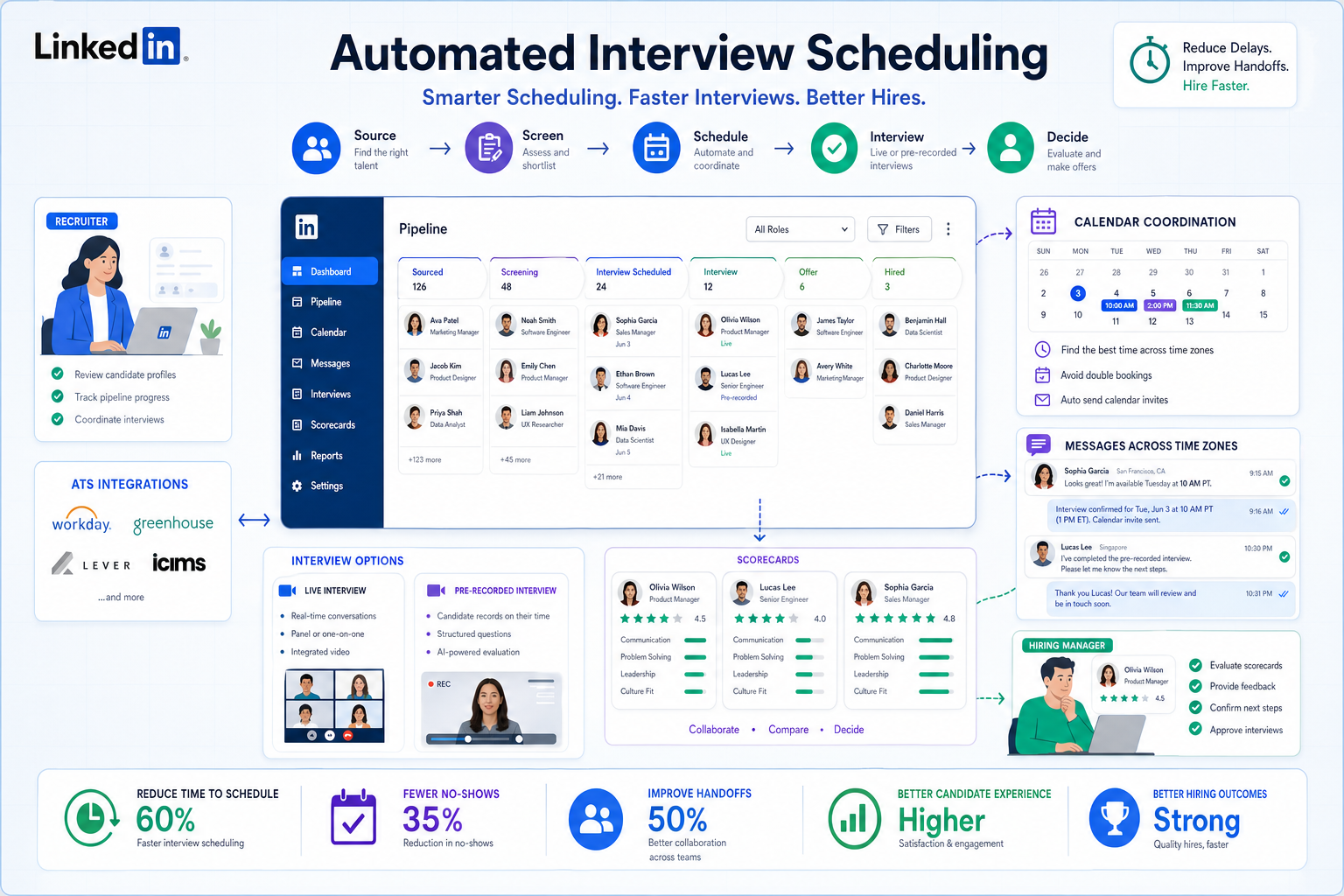
When hiring slows under volume, this article helps HR leaders evaluate ai hiring software to fix workflow gaps, reduce delays, and avoid weak handoffs.
That matters because interview coordination rarely fails in one dramatic moment. It breaks down through small delays: a hiring manager who has not confirmed availability, a candidate who replies after hours, a recruiter who is tracking notes in one place and interview stages in another, or a growing firm that still runs hiring like it did when the team was half the size. For agency owners, that means slower placements and weaker client confidence. For individual recruiters, it means inbox drag, missed follow-ups, and more time spent coordinating than assessing. For internal talent teams, it can create inconsistent candidate communication, poor documentation, and avoidable drop-off.
In practice, I have found that workflow support helps most when it reduces the repetitive front-end work before scheduling even begins. Tools like StrategyBrain AI Recruiter can keep candidate communication moving across time zones, capture resumes and contact details from interested prospects, and handle the back-and-forth that often stalls interview setup on LinkedIn. That does not replace recruiter judgment. Recruiters still decide who is qualified, review resumes, and choose who should move to a live conversation or the next screening step.
The same pattern shows up whenever a business enters a new phase of growth. As hiring expands, HR decisions become more connected: how people are evaluated, how consistently hiring managers score them, and how well the company supports them after they join. A process that worked at 20 employees can start failing at 100, not because the team forgot how to hire, but because the old workflow no longer supports more interview volume, more stakeholders, and more risk.
Picture the trigger point. A growing employer has several roles open, managers are asking for quick shortlists, and the recruiting team is trying to keep compensation expectations, interview standards, and candidate follow-up aligned. One recruiter is reviewing resumes, another is chasing calendar confirmations, and someone still has to decide whether the next step should be a live panel, virtual interview software, or pre recorded video interview software. That is exactly where automated interview scheduling stops being a calendar convenience and becomes a process design question.
So the real buying decision is broader than booking interviews faster. The team needs to know whether its workflow supports structured evaluation, stage visibility, and cleaner handoffs as hiring scales. The rest of this article looks at automated interview scheduling through that lens: not only what the tools do, but how they fit into a more durable recruiting process for headhunters, HR leaders, and hiring teams.
- Why scheduling problems show up as companies grow
- What automated interview scheduling means in recruiting
- Key tool categories buyers should separate
- How the workflow should run in practice
- What features matter most in ai hiring software
- My workflow experience using AI Recruiter before interview booking
- Recruitment software vs generic meeting tools
- Virtual interview software vs pre recorded video interview software
- Best use cases by hiring scenario
- ATS and workflow integrations
- Compliance, trust, and candidate experience
- How to evaluate options without overbuying
- FAQ
Why scheduling problems show up as companies grow
One useful lesson from broader HR operations is that hiring does not sit in isolation. As organizations grow, decisions around evaluation, pay, inclusion, onboarding, and retention start affecting one another. In recruiting, scheduling is often the first place this strain becomes visible because it sits between candidate interest, interviewer readiness, and actual decision-making.
What works for a small team often breaks under higher volume. A founder-led hiring process may rely on quick messages and informal coordination. Later, that same approach can create missed handoffs, inconsistent interviewer preparation, and weak recordkeeping. The problem is not just administrative. It affects fairness, candidate experience, and the quality of hiring evidence collected.
That is why automated interview scheduling should be evaluated as part of a larger operating model. If your team is already struggling with inconsistent scorecards, unclear role expectations, or delayed feedback, software alone will not fix the underlying process. But the right ai hiring software can make a structured process easier to run at scale.
What automated interview scheduling means in recruiting
In recruiting, automated interview scheduling means using workflow technology to handle booking logic that would otherwise sit with recruiters or coordinators. That can include self-serve time selection, matching interviewer availability, managing time zones, sending reminders, and giving candidates a clear way to reschedule.
In a stronger setup, scheduling connects directly to stage movement, interview plans, scorecards, and recruiter communication history. That matters because the real gain is not only speed. It is the ability to move candidates through a consistent process with fewer manual errors and better visibility.
For headhunters and in-house teams alike, the practical test is simple: does the system reduce back-and-forth while preserving judgment and documentation? If it only generates calendar invites, it may save some admin time without solving the workflow gaps that show up when hiring volume increases.
Key tool categories buyers should separate
Buyers often group several different products under one label. That creates confusion during evaluation, especially when the actual need is narrower than the vendor language suggests.
- AI hiring software: recruiting tools that use automation or AI-assisted workflows for tasks such as outreach, screening coordination, scheduling, interview management, or evaluation support.
- Virtual interview software: software for live online interviews, often including video links, interviewer coordination, reminders, and feedback collection.
- Pre recorded video interview software: software for asynchronous interviews where candidates record answers on their own time for later review.
- Structured interviews: interviews built around predefined questions, scoring criteria, and clearer evaluation standards.
- One-way interviews: another name for pre-recorded interviews completed without a live interviewer present.
- Asynchronous interviews: interview steps that do not require candidate and interviewer to participate at the same time.
The distinction matters because a team that needs live panel coordination is solving a different problem from a team that wants more standardized high-volume pre-screening. In many hiring environments, both needs exist, but at different stages.
How the workflow should run in practice
A reliable interview workflow usually starts before a calendar link is ever sent. In healthy recruiting operations, the sequence looks something like this:
- Candidate interest is confirmed through sourcing replies, application review, or recruiter outreach.
- The recruiter decides the correct next step, such as a live screen, hiring manager call, panel interview, or asynchronous screening stage.
- The system sends the right invitation based on interview type, stakeholders, and time zone rules.
- Availability is matched automatically across recruiters, hiring managers, and panels where needed.
- Reminders and rescheduling options are triggered without creating extra manual follow-up.
- Interviewers receive scorecards or question guides so the evaluation remains structured.
- Feedback is logged in one place for the recruiter and hiring team to review before deciding next steps.
The key is that automation supports movement, but people still make the hiring decisions. That balance becomes especially important when teams want faster screening without turning the process into a black box.
Key insight: Automated interview scheduling creates the most value when it supports a complete interview workflow, not when it simply replaces a few booking emails.
What features matter most in ai hiring software
Not every team needs the same setup, but a few capabilities consistently matter when automated scheduling is part of the decision.
1. Scheduling logic built for recruiting
Look for panel coordination, stage-based routing, interviewer availability matching, and candidate self-booking. Recruiting complexity is usually not the meeting itself. It is the number of people, steps, and dependencies around it.
2. Structured interview support
Scheduling should connect to interview kits, scorecards, and standardized question sets. This is where ai hiring software supports better hiring discipline rather than just admin efficiency.
3. Candidate communication tools
Reminders, confirmations, and rescheduling options should be clear and easy to use. Candidate communication often determines whether a process feels organized or chaotic.
4. Support for different interview formats
Some roles call for virtual interview software. Others benefit from pre recorded video interview software in the earliest screening stage. A good workflow allows both without making stage management harder.
5. ATS connectivity
If scheduling status, feedback, and stage movement live in separate systems, recruiters end up doing duplicate work. ATS integration is not a nice extra. It is what keeps the process usable.
6. Audit trails and governance
Teams should be able to review invitations, changes, reminders, and interviewer feedback history. As organizations grow, governance becomes part of process quality.
7. Accessibility and clarity
Instructions, candidate flows, and interview formats should be usable across different needs and geographies. If the process is hard to navigate, automation simply scales the confusion.
My workflow experience using AI Recruiter before interview booking
One place I have seen clear value is in the stage before scheduling, especially on LinkedIn-heavy searches where candidate replies come in unevenly and often outside business hours. When I tested AI Recruiter in that part of the workflow, the main benefit was not that it magically hired people. It was that it kept outreach moving, answered basic candidate questions, and collected resume and contact information from interested prospects before I had to step in personally.
That made scheduling cleaner. Instead of opening my inbox to half-finished conversations, I was often starting with candidates who had already confirmed interest and shared the materials needed for review. I still handled qualification myself, decided whether the person belonged in a live screen, and chose the right next step. But using StrategyBrain AI Recruiter reduced the lag between sourcing and interview setup, which is exactly where many recruiters lose momentum.
It is particularly useful in situations where headhunters or lean internal teams are managing high outreach volume, multilingual communication, or after-hours replies. In those cases, interview scheduling works better when the top of the funnel is already organized. That is also why I see tools like this as complementary to, not a replacement for, virtual interview software or pre recorded video interview software. They solve an earlier coordination problem.
Recruitment software vs generic meeting tools
Many teams begin with standard calendar and meeting software, then outgrow it. The gap usually appears when hiring requires structure, documentation, and repeatability.
| Capability | Recruitment-specific interview software | Generic meeting tools |
|---|---|---|
| Automated interview scheduling | Built around hiring stages and interviewer roles | Usually limited to simple booking links |
| Structured scorecards | Common and often built-in | Usually absent |
| Interview kits | Supports question guides and rubrics | Rarely native |
| Candidate reminders | Purpose-built for interview attendance | Basic notifications only |
| ATS integration | Typically central to workflow design | Often manual or partial |
| Asynchronous interview support | Often available through dedicated workflows | Usually not designed for it |
| Audit visibility | Stronger hiring-specific recordkeeping | Limited process context |
If your hiring volume is modest and the process is simple, generic tools may be enough. But if your team is already seeing delays, inconsistent interviewer preparation, or weak feedback discipline, recruiting-specific software tends to be the better fit.
Virtual interview software vs pre recorded video interview software
These categories are related, but they solve different workflow problems.
Virtual interview software
Virtual interview software is built for live conversations. It works best when the team needs follow-up questions, relationship building, or panel participation. Automated scheduling is highly relevant here because timing and coordination are central to the experience.
Pre recorded video interview software
Pre recorded video interview software supports asynchronous screening. Candidates answer prompts on their own schedule, and recruiters or hiring managers review responses later. It is often useful for early-stage filtering, standardized first-round screening, or hiring environments where live scheduling every applicant would create too much drag.
How to choose between them
Map format to stage. Use live interviews where dialogue matters. Use pre-recorded steps where standardization and speed matter more than real-time interaction. Many teams benefit from both, but not for the same roles or the same decision points.
Best use cases by hiring scenario
Automated interview scheduling is most useful when coordination complexity repeats often enough to create operational risk.
High-volume hiring
Large applicant flow can overwhelm recruiters with routine coordination. Pairing automated scheduling with pre recorded video interview software can create a more manageable first-round screen.
Distributed and cross-time-zone hiring
Teams hiring across regions often feel the benefit immediately. Automated communication and scheduling reduce delays caused by mismatched working hours and scattered follow-up.
Multi-interviewer processes
Panel interviews and interview loops are difficult to coordinate manually. This is where stage-based scheduling and clear scorecards create the biggest practical gains.
Agency recruiting and headhunting
External recruiters need to keep candidates warm while also protecting client confidence. Faster handoffs from outreach to interview booking can make the process feel much more professional.
Growing businesses formalizing hiring
When a company moves beyond informal hiring habits, scheduling is often where process redesign begins. Stronger structure at this stage usually supports fairness, documentation, and better onboarding expectations later.
ATS and workflow integrations
Scheduling automation only becomes sustainable when it fits the systems recruiters already use. For most teams, that means the applicant tracking system is still the operational center.
A well-integrated workflow should show where the candidate is in the process, what interview format is required, who needs to attend, and whether feedback is complete. If scheduling lives in a separate silo, recruiters end up duplicating updates and the team loses visibility.
When reviewing integration depth, ask:
- Does scheduling update candidate stages automatically?
- Can interviewers submit scorecards without leaving the workflow?
- Are reminders, no-shows, and reschedules visible to the whole team?
- Can the process support both live and asynchronous interview paths?
- Is there a usable audit trail for process review?
These questions matter because growth tends to expose every weak handoff. The more connected the workflow, the easier it is to maintain consistency as hiring expands.
Compliance, trust, and candidate experience
Any interview workflow that becomes more automated also needs clearer trust controls. Candidates should understand what is being scheduled, recorded, reviewed, and retained. Recruiters and HR leaders should understand who can access that data and how decisions are actually made.
- Clear consent: candidates should know when recordings, transcripts, or AI-supported communication are involved.
- Human review: final movement decisions should remain visible and reviewable.
- Process documentation: invites, changes, and evaluation steps should be logged.
- Accessibility: candidates should have workable options across different needs and devices.
- Retention controls: teams should know how interview data is stored and managed.
That balance matters because the goal is not speed at any cost. It is a process that becomes easier to defend as the organization grows.
How to evaluate options without overbuying
Before selecting software, define the real bottleneck. Many teams think they need better scheduling when the deeper issue is weak stage design or unclear recruiter ownership.
Questions to ask internally
- Is the real problem booking delays, screening volume, interviewer inconsistency, or candidate follow-up?
- Do we need virtual interview software, pre recorded video interview software, or both?
- What part of the workflow already works inside our ATS?
- Which handoffs create the most delay or confusion today?
- What privacy, accessibility, and documentation standards do we need to support?
Questions to ask during evaluation
- How does the workflow handle panel interviews and reschedules?
- What support exists for asynchronous screening?
- Where do recruiters maintain final control over decisions?
- How does the system fit into sourcing, screening, and ATS processes?
- What recordkeeping and retention controls are available?
For most teams, the best option is not the one with the longest feature list. It is the one that removes repetitive coordination work while preserving structured, human-led evaluation.
FAQ
How do AI interviews relate to automated interview scheduling?
In most recruiting environments, AI supports parts of the workflow such as outreach, routing, reminders, or asynchronous delivery. Recruiters and hiring managers still review evidence and decide who advances.
Is pre recorded video interview software the same as live interview software?
No. Pre recorded video interview software is asynchronous, while virtual interview software is used for live conversations. They support different stages and different hiring goals.
Does automated interview scheduling replace recruiters?
No. It removes repetitive coordination work, but recruiters still qualify candidates, manage stakeholder alignment, and make judgment calls about next steps.
When is scheduling automation most valuable?
It tends to create the most value in high-volume hiring, distributed teams, panel-heavy interview processes, and growing companies moving from informal to more structured hiring.
Can sourcing automation help interview scheduling?
Yes. If candidate communication, resume capture, and interest confirmation are organized earlier in the funnel, interview booking becomes faster and cleaner. That is where tools like AI Recruiter can help without taking over final qualification.
What should teams watch for on compliance?
Focus on consent, human oversight, documentation, accessibility, and retention controls. A faster process is only valuable if it is also reviewable and trustworthy.
Conclusion
Automated interview scheduling is one of the most practical uses of ai hiring software because it addresses a real bottleneck in hiring operations. But the bigger lesson from growing HR functions is that scheduling should not be treated as a standalone fix. It works best when connected to structured evaluation, clear recruiter ownership, and stronger stage design.
If you are comparing virtual interview software and pre recorded video interview software, start with your workflow, not the feature sheet. Define where coordination breaks, where evidence is collected, and where human judgment matters most.
That is how recruiting teams move from scattered interview admin to a process that is faster to run, easier to review, and more reliable as hiring scales.