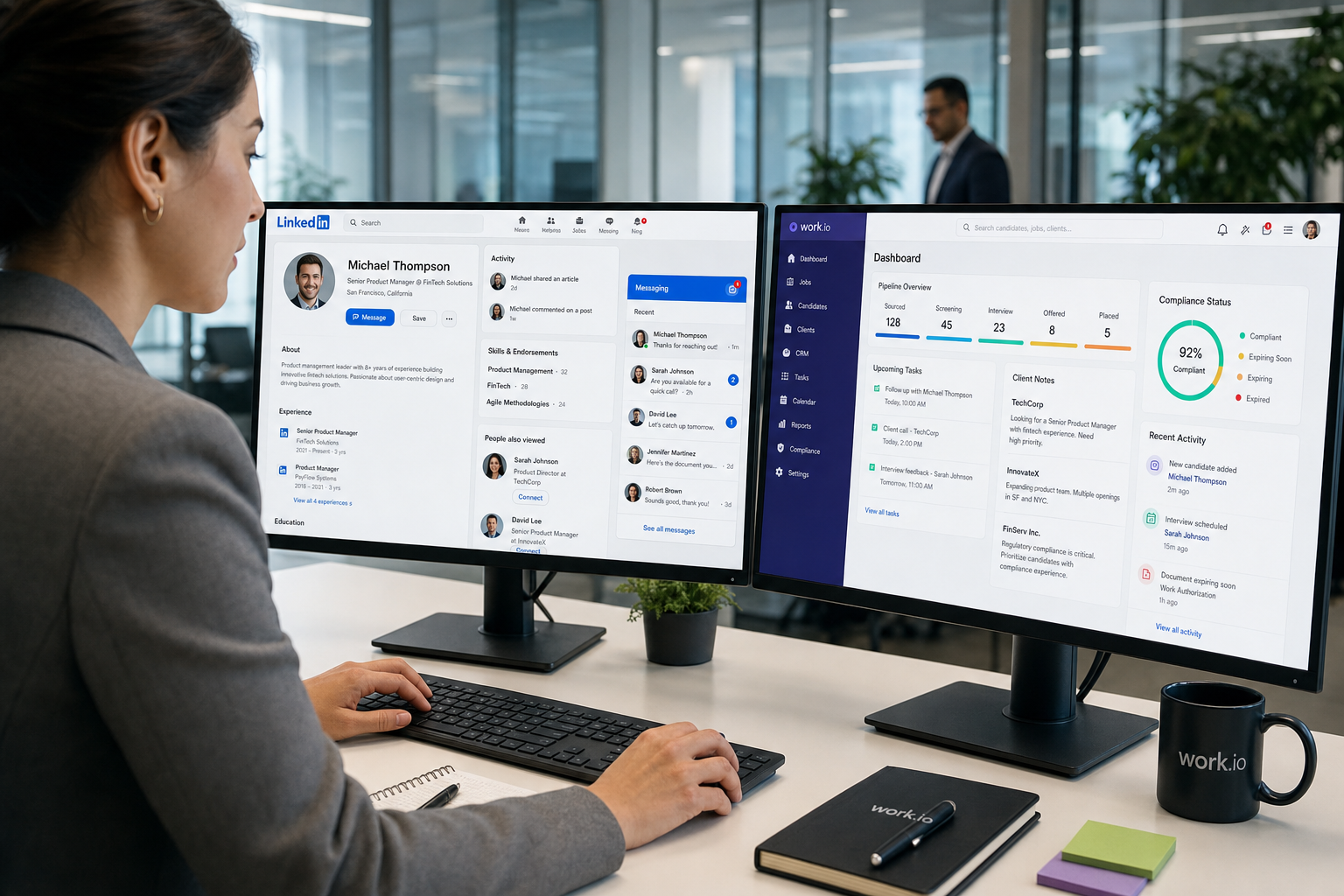
When candidate history, client context, and follow-up scatter, this article helps agency leaders judge recruitment agency software and avoid costly workflow gaps.
That matters because most agency teams do not lose time on sourcing alone. They lose it when candidate history sits in one place, client context in another, and critical follow-up lives in inboxes or memory. For a small or mid-sized firm, that creates familiar damage: duplicated outreach, weak handovers, missed compliance checks, slower shortlist delivery, and unnecessary strain on candidate and client trust.
In my own workflow, I have found that StrategyBrain AI Recruiter is useful when the bottleneck is early outreach and response handling rather than final judgment. Its always-on messaging, multilingual communication, and LinkedIn-based follow-up can keep conversations moving while the recruiter still owns shortlist decisions, CV review, and whether a person should progress. Used that way, it supports the front end of the desk without pretending to replace recruiter assessment.
A good example comes from executive search in Canada, where the market is smaller, more relationship-driven, and heavily shaped by regional differences. When a search starts for a senior leader in Toronto, Calgary, Vancouver, or Montréal, the recruiter often begins with a limited pool of known names, checks prior conversations, maps overlapping board or industry relationships, and then tests whether the role really requires local market credibility, relocation, or a hybrid leadership model.
The friction appears fast. A consultant sends targeted outreach to passive candidates, logs a confidential conversation, updates the client on regional talent constraints, and then realizes the wider team cannot clearly see prior contact history, mobility concerns, or province-specific context in one place. That is exactly where the search stops being just about finding candidates and becomes a software decision. If your system cannot hold candidate nuance, client-side context, and process visibility together, it will struggle in general agency work, in best recruitment software UK evaluations, and especially in healthcare recruitment software environments where shortage, geography, and compliance collide.
Table of Contents
- Why the best recruiting software depends on market reality
- What the best recruiting software actually means for agencies
- How to evaluate recruitment agency software
- Best recruiting software by agency use case
- Why agencies need ATS + CRM, not just an ATS
- Best recruitment software UK: what buyers should check
- Healthcare recruitment software: what matters most
- Where AI-supported outreach fits into the workflow
- Common buying mistakes
- FAQ
Why the best recruiting software depends on market reality
The Canadian executive search example is useful because it exposes a truth that applies far beyond executive hiring. Recruiting performance is shaped by market size, visibility, regional concentration, and relationship density. In smaller or tightly networked talent markets, confidentiality matters more, passive candidates dominate more often, and a recruiter's notes about motivation, mobility, and timing become commercially important.
The same logic applies in agency recruiting generally. If your desk covers a narrow sector, a regional market, or a compliance-heavy niche, the best recruiting software is rarely the one with the longest feature sheet. It is the one that lets consultants manage scarce talent carefully, preserve context across the team, and move from first contact to placement without losing the thread.
Practical takeaway: The more relationship-driven and region-specific your market is, the more your recruitment agency software needs to support context, discretion, and joined-up workflow rather than generic applicant storage.
What the best recruiting software actually means for agencies
If you are comparing the best recruiting software, the category itself needs to be defined properly. For most agency businesses, the real buying decision is not a standalone applicant tracker. It is a recruitment agency software platform or stack that combines candidate workflow, recruitment CRM, search history, outreach tracking, placement visibility, and operational controls.
That distinction matters because agencies work on both sides of the desk. A recruiter is not only moving candidates through stages. They are also managing clients, vacancies, business development notes, follow-up commitments, and commercial outcomes. In executive, permanent, temp, and specialist verticals alike, software breaks down when it treats recruiting as a one-direction process.
For a permanent desk, the software may need to excel at shortlist management, interview coordination, and fee-stage visibility. For temp or contract work, availability, bookings, margin logic, and document status can matter just as much. In tightly regulated sectors, compliance may be inseparable from speed to place.
How to evaluate recruitment agency software
Experienced recruiters usually judge systems by where desk friction appears, not by where marketing pages look strongest. A practical evaluation framework should test whether the platform supports the decisions consultants actually make under pressure.
- Candidate pipeline management: Can recruiters move people cleanly from source to screen, shortlist, interview, offer, and placement?
- Client and vacancy context: Does the system keep account history, role briefs, stakeholder notes, and search nuance attached to the job?
- Searchability and rediscovery: Can consultants quickly find previous candidates, prior outreach, and relevant conversations?
- Communication tracking: Are email, calendar, tasks, and activity visible enough to support handovers and accountability?
- CV parsing and data capture: Does information enter the system in a usable way, or does admin work pile up after every response?
- Placement and forecast visibility: Can managers see live jobs, submissions, interviews, offers, starts, and fall-offs without offline clean-up?
- Compliance workflow: Can the team track documents, statuses, expiry dates, and audit trails where needed?
- Regional and sector fit: Does the software reflect how your actual market works, including geography, local regulation, and talent concentration?
- Usability under desk pressure: Will consultants keep it updated when they are juggling calls, client meetings, and live offers?
- Implementation realism: Can you migrate data, train users, and go live without breaking delivery?
That last point is often underestimated. A system that looks powerful in demo mode can still fail if the team cannot maintain record quality at pace.
Best recruiting software by agency use case
Rather than naming one universal winner, it is more useful to shortlist software by operating model.
| Buyer Type | What to Prioritize | Why It Matters |
|---|---|---|
| Permanent recruitment agencies | ATS + CRM, searchability, candidate outreach history, placement tracking | Helps consultants manage shortlist quality and fee pipeline visibility |
| Executive and search-led teams | Confidentiality, passive candidate tracking, relationship mapping, market notes | Smaller talent pools need stronger context and careful communication control |
| Temp or contract agencies | Availability, compliance tracking, bookings, commercial workflow | Operational control affects fill rate and margin as much as sourcing does |
| UK-focused agencies | UK GDPR support, Right to Work workflow, local job board integrations, GBP-friendly buying | Local fit reduces rollout friction and compliance risk |
| Healthcare staffing teams | Credential tracking, document expiry management, availability visibility, audit readiness | Placement speed only matters if worker readiness is clear and defensible |
| Smaller growing firms | Ease of adoption, clean data model, usable reporting, practical support | Lean teams need discipline without process bloat |
Best for general agency recruiting
For broad permanent recruitment, prioritize systems that make candidate movement and client visibility simple. Good recruitment agency software should reduce duplicate admin while making records searchable enough to support repeat business.
Best for executive and relationship-led search
If your market resembles the Canadian executive search dynamic described earlier, software should help you handle passive candidates, preserve confidentiality, and record nuanced fit factors like regional credibility, relocation appetite, and stakeholder sensitivity.
Best for UK buyers
If you are searching for the best recruitment software UK, treat local operating fit as a first filter rather than a nice-to-have.
Best for healthcare staffing
If your team places regulated workers, healthcare recruitment software should be treated as its own evaluation category, not a generic ATS variation.
Why agencies need ATS + CRM, not just an ATS
One of the most common buying mistakes is assuming an applicant tracking system alone will solve agency workflow. In-house recruiting can sometimes run mainly through job and candidate stages. Agencies usually cannot.
Agency delivery depends on both talent flow and client flow. The ATS side handles applications, screening steps, and candidate progression. The CRM side holds client relationships, contact mapping, vacancy history, and business development context. When those are separated, recruiters create workarounds in inboxes, spreadsheets, or personal notes.
That creates the same problem seen in regionally complex searches: the team may know who the candidate is, but not why they were a near-fit before, which stakeholder objected, what mobility concern they raised, or whether a confidential approach has already been made. Good software keeps that history usable.
- Better continuity: Relationship knowledge stays with the business, not only with one consultant.
- Clearer manager visibility: Leadership can review activity and pipeline without chasing updates manually.
- Fewer dropped actions: Tasks, callbacks, document checks, and follow-ups are easier to track.
- Stronger rediscovery: Previous candidates and client conversations become commercially reusable.
- More reliable forecasting: Jobs, submissions, interviews, offers, and starts can be reviewed in one reporting logic.
Best recruitment software UK: what buyers should check
UK agencies often need a more specific checklist than global vendor pages imply. If you are reviewing the best recruitment software UK, test these areas directly in demo.
1. UK GDPR workflow and data control
The platform should support practical retention discipline, permission handling, role-based access, and clear record management. Compliance should feel built into the workflow, not bolted on after the fact.
2. Right to Work and document handling
Many UK desks need a repeatable process for candidate documents and status checks. Even where full onboarding sits elsewhere, recruiters still need clear visibility before placement.
3. UK-relevant integrations
If your desk depends on local job boards or established email and calendar workflows, ask the vendor to show how those integrations behave in real use, not just on a slide.
4. Commercial and support alignment
Buying, support coverage, invoicing, and rollout support all affect adoption. Agencies with lean operations often value straightforward commercial setup and responsive support during local working hours.
5. Reporting that matches agency language
The system should report in ways branch leaders and directors can use immediately: live jobs, activity, pipeline strength, placements, and where relevant, margin visibility.
Demo tip: ask to see one candidate move from source to compliant placement, then ask to see the client record, vacancy record, and final reporting output. That usually reveals workflow gaps much faster than a broad tour.
Healthcare recruitment software: what matters most
Healthcare recruitment software should not be assessed as a light version of general staffing software. In healthcare, recruiter speed only matters if worker readiness is visible and defensible.
Credential tracking
Teams need a current view of registrations, training, role-specific qualifications, and whether the worker is placeable now. Hidden gaps create avoidable risk.
Document expiry management
Expiry dates are where manual systems often fail. Without clear reminders and visibility, teams end up reacting too late.
Availability and booking readiness
For many healthcare desks, status alone is not enough. Recruiters need to know when a worker is available, whether documents are complete, and whether they can be booked with confidence.
Audit readiness
Healthcare staffing often requires evidence of process, not just intent. Good software should make record history, workflow checkpoints, and document status easy to review.
The lesson is similar to executive search in a smaller regional market: context matters. In one case it is regional credibility and mobility; in the other it is credentials and readiness. Either way, software must hold the details that change placement decisions.
Where AI-supported outreach fits into the workflow
AI-supported workflow is most helpful when it removes repetitive front-end work without weakening recruiter judgment. In my experience, that is where StrategyBrain AI Recruiter can add value alongside a wider recruitment agency software setup.
I have used it as a support layer for LinkedIn outreach when the real challenge was keeping conversations active across time zones, handling after-hours replies, and collecting early interest signals before I stepped in personally. The useful part was not “automation” in the abstract. It was that candidate replies kept moving, basic role questions were answered promptly, and interested people could share CVs or contact details without the thread going cold. I still reviewed every relevant profile, judged suitability myself, and decided who should move into a proper shortlist.
That means the tool fits best in scenarios like:
- Passive candidate markets: where response timing matters and many prospects are not actively applying.
- Cross-border or multilingual outreach: where language and time zones slow first contact.
- High-volume message handling: where recruiters need help keeping up with initial exchanges.
If you want to understand how that workflow is set up, the product walkthrough and the broader headhunter usage notes are the most relevant starting points. The key is to treat it as part of the sourcing and engagement layer, not as a substitute for recruiter evaluation, client advice, or compliance decisions.
Common buying mistakes
- Buying for feature volume instead of desk fit. More functionality does not automatically mean better adoption.
- Treating agency needs like in-house recruiting needs. Agencies usually need CRM, placements, and account visibility as well as ATS workflow.
- Ignoring market structure. Smaller, relationship-driven, or regionally fragmented markets require stronger context capture.
- Leaving compliance too late. This is particularly risky in healthcare recruitment software reviews.
- Skipping local checks. Buyers looking for the best recruitment software UK should test local operational fit early.
- Assuming AI removes the need for recruiter judgment. It can support outreach and response handling, but final assessment still belongs with the recruiter.
- Accepting generic demos. Ask vendors to run your real workflow, including follow-up, record updates, and reporting.
FAQ
How is recruitment agency software different from a standard ATS?
Recruitment agency software usually combines applicant tracking with CRM, placement visibility, and often compliance or commercial workflow. A standard ATS may manage candidates well but still miss the client-side and operational controls agencies need.
What should I look for in the best recruitment software UK?
Focus on UK GDPR workflow, Right to Work support, locally relevant integrations, practical reporting, and a buying setup that fits UK operations.
What makes healthcare recruitment software different?
It needs stronger compliance depth, especially around credential tracking, expiry management, availability, and audit readiness.
Can AI tools replace recruiters in agency workflows?
No. They can help with repetitive sourcing and communication tasks, but final fit assessment, shortlist judgment, compliance decisions, and client advice still sit with the recruiter.
Where does StrategyBrain AI Recruiter fit best?
It fits best at the early outreach and response stage, especially for LinkedIn-driven sourcing, multilingual communication, and after-hours candidate engagement. It works as a support layer, not a replacement for core recruiter decision-making.
Do small agencies need a full ATS + CRM platform?
Not always the most complex version, but most still benefit from a joined-up system that keeps candidate and client history visible and reusable.
Conclusion
The best recruiting software is not the loudest platform in the market. It is the one that matches how your desk actually works. For most agencies, that means evaluating recruitment agency software as an ATS + CRM operating system that can hold candidate context, client reality, and process control together.
The executive search example from Canada makes that clear. When talent pools are smaller, relationships matter more, and geography changes hiring options, recruiters need software that preserves nuance rather than flattening it. The same principle carries into best recruitment software UK decisions and into healthcare recruitment software reviews where compliance readiness is inseparable from speed.
If you are comparing options, keep the evaluation grounded in live recruiter work. Ask every vendor to show sourcing, client notes, candidate progression, follow-up history, placement tracking, and where relevant, compliance workflow in one connected journey. That is usually where the right decision becomes obvious.