When recruitment monitoring is weak, this article helps HR leaders spot hidden hiring breakdowns before delays erode trust and results.
That matters because recruiting problems rarely begin with sourcing volume alone. They show up when a hiring manager sits on feedback, when a candidate waits too long for an answer, when a sensitive employee transition affects employer reputation, or when a recruiter cannot reconstruct who said what and when. For a small search firm, that means slower placements and weaker client trust. For an in-house team, it can mean avoidable attrition, wasted ad spend, strained manager relationships, and a hiring process that feels reactive instead of controlled.
In my own workflow, I have found that StrategyBrain AI Recruiter is most useful when the communication layer is the real bottleneck. Its always-on candidate messaging, multilingual follow-up, and automated collection of resumes and contact details can reduce the manual chasing that often happens before a recruiter can make a real judgment. What it does not replace is the recruiter's final call on fit, resume quality, shortlist decisions, or whether a process should move forward. That division of work matters, especially when timing and tone affect both candidates and the wider team.
Consider one of the most difficult moments in people operations: an employee exit that is tied to performance, restructuring, or conduct. The meeting should be respectful, private, and decisive. The manager needs to be prepared, HR needs to be present, severance and support information should be ready, and the employee should not be blindsided if the issue has been building over time. Even practical details matter, such as holding the conversation away from the person's desk, thinking through whether they collect belongings now or later, and making sure coworkers are not left to fill in the gaps with rumor.
That scene may sound removed from software buying, but it exposes the same operating truth that experienced recruiters already know: hiring and offboarding both break down when expectations are undocumented, communication is scattered, support steps are unclear, and stakeholders are not working from the same record. That is why the best recruiting software is not just a workflow tool. It is infrastructure for recruitment monitoring, for reading recruitment data examples correctly, and for reviewing hr recruitment metrics in enough context to make better decisions before small process failures become bigger people problems.
- Why hiring control matters more than feature count
- What recruitment monitoring should actually capture
- What difficult people moments teach us about recruiting systems
- The hr recruitment metrics that matter most
- Recruitment data examples worth putting on dashboards
- What to look for in the best recruiting software
- Where AI-supported outreach fits in the workflow
- How to implement recruitment monitoring without overwhelming the team
- Common mistakes when using recruiting software data
- FAQ
Why hiring control matters more than feature count
When teams search for the best recruiting software, they often start with visible features: posting jobs, scheduling interviews, storing resumes, or automating reminders. Those matter, but experienced operators usually reach a different conclusion after living through a few difficult hiring cycles. The real value is control.
Control in recruiting does not mean rigidity. It means being able to see pipeline movement, identify stalled decisions, understand source quality, track who owns the next step, and protect candidate experience when the process becomes sensitive or complex. A tool that offers a polished front end but weak visibility can still leave recruiters guessing.
That is why recruitment monitoring should be treated as a core buying lens, not an extra reporting module. Good recruiting software helps teams answer practical questions quickly:
- Where are candidates getting stuck?
- Which managers are delaying decisions?
- Which sources create qualified applicants rather than just application volume?
- What happens to pipeline health when recruiters are overloaded?
- Where does candidate trust drop during the process?
Those questions are not theoretical. They shape time to hire, acceptance rates, recruiter credibility, and the quality of updates hiring managers receive.
What recruitment monitoring should actually capture
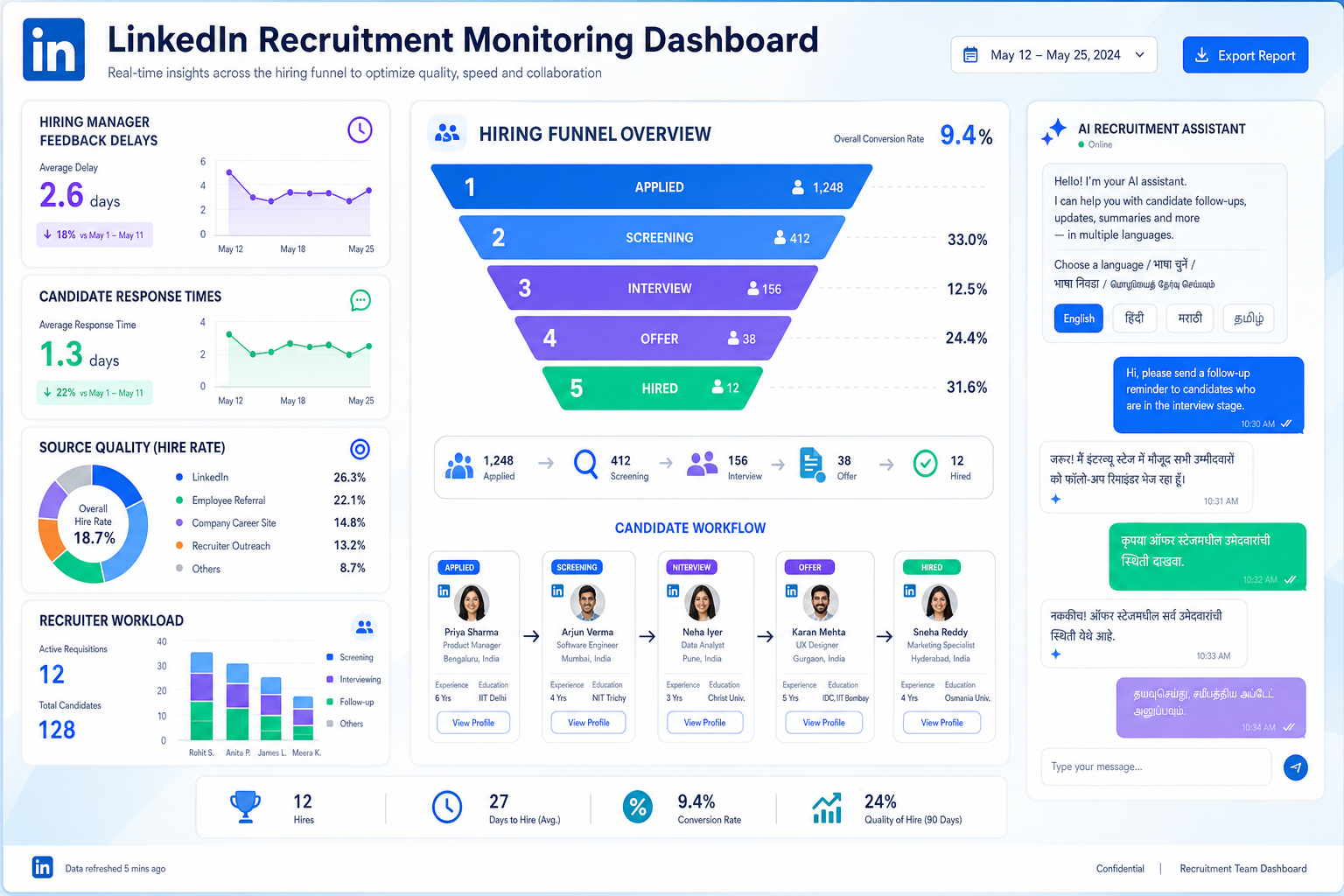
Recruitment monitoring is the ongoing review of hiring activity, funnel movement, source effectiveness, communication responsiveness, stakeholder follow-through, and final outcomes. It is broader than standard ATS reporting because it focuses on whether the process is functioning as a system.
A strong recruiting system should let you monitor:
- Role progress by requisition, business unit, and recruiter
- Stage aging so delays are visible before candidates disengage
- Source quality across application, interview, offer, and hire stages
- Hiring manager behavior such as feedback turnaround and requisition responsiveness
- Recruiter workload relative to role complexity and open volume
- Candidate communication including response timing and drop-off signals
This is the difference between software that records activity and software that improves judgment. Recording is administrative. Monitoring is operational.
What difficult people moments teach us about recruiting systems
The termination example at the start of this article matters because it highlights a truth that recruiting teams often learn the hard way: respectful people processes require preparation, documentation, timing discipline, and clear ownership. In offboarding, poor preparation creates shock, confusion, and unnecessary emotional damage. In recruiting, the equivalent failures show up as ghosting, slow feedback, unclear expectations, and disorganized handoffs.
Three lessons transfer directly into recruiting software evaluation.
1. Avoid surprises through visible history
In a well-managed employee exit, performance or conduct issues should not come out of nowhere. In hiring, the same principle means no stakeholder should be surprised by pipeline status, candidate expectations, or pending risks. The best recruiting software keeps communication records, stage changes, and decision rationale visible enough that recruiters do not have to reconstruct the story from email threads and memory.
2. Choose the right time and handoff points
In a sensitive dismissal, timing and setting matter. In recruiting, timing also changes outcomes: when feedback is delivered, how quickly screens are completed, when offers are extended, and how handoffs occur between recruiter, coordinator, manager, and HR. If software cannot show waiting time between those steps, it cannot support better process control.
3. Support everyone affected, not just the direct participant
The reference article rightly notes that coworkers, managers, and HR are all affected by a termination. Hiring works the same way. A slow or chaotic process does not just affect the candidate. It affects recruiter capacity, hiring manager confidence, team workload, and employer brand. Good software should make those shared effects visible instead of isolating the problem inside one recruiter's queue.
Practical takeaway: If a recruiting platform cannot show documented expectations, response timing, stakeholder accountability, and downstream impact, it is unlikely to support serious recruitment monitoring.
The hr recruitment metrics that matter most
Not every team needs a giant dashboard. The most useful hr recruitment metrics usually fall into six groups: time, conversion, source, quality, communication, and workload. These are the categories I would prioritize first in any software review.
1. Time metrics
- Time to fill: days from approved requisition to accepted offer
- Time to hire: days from candidate entry to accepted offer
- Stage aging: average days spent in each status
- Feedback turnaround time: time from interview completion to decision input
Time metrics reveal where urgency exists only in conversation but not in behavior.
2. Conversion metrics
- Application-to-screen rate
- Screen-to-interview rate
- Interview-to-offer rate
- Offer acceptance rate
- Candidate withdrawal rate
These show whether the funnel is healthy, selective in the right places, or leaking because of process friction.
3. Source metrics
- Source of hire
- Qualified applicant rate by source
- Interview yield by source
- Hire yield by source
A good dashboard prevents teams from overvaluing high-volume channels that produce weak-fit traffic.
4. Quality metrics
- Early retention checkpoints
- Hiring manager satisfaction
- Ramp milestone completion
- Role-specific performance signals
Quality of hire should be treated as a defined operating model, not a vague opinion.
5. Communication metrics
- Response time to inbound candidates
- Scheduling cycle time
- Follow-up completion rate
- Unread or unaddressed candidate messages
This is where many candidate experience issues become measurable instead of anecdotal.
6. Workload metrics
- Open roles per recruiter
- Active candidates per recruiter
- Requisition complexity by portfolio
- Pipeline maintenance versus sourcing time
Without workload context, software can create false recruiter comparisons.
Recruitment data examples worth putting on dashboards
Useful recruitment data examples should help a team act. If a dashboard looks impressive but does not change weekly decisions, it is decoration.
Example 1: Funnel control dashboard
| Stage | Candidates | Conversion Rate | Average Days in Stage | Operational Signal |
|---|---|---|---|---|
| Applied | 240 | 100% | 3 days | Screening capacity under review |
| Screened | 72 | 30% | 5 days | Qualification criteria may be too broad |
| Interviewed | 24 | 33% from previous stage | 8 days | Scheduling or feedback delay risk |
| Offered | 6 | 25% from previous stage | 4 days | Offer alignment worth checking |
| Hired | 4 | 67% from previous stage | 2 days | Review source and process pattern |
This view helps recruiters spot where momentum is lost, much like a prepared HR partner spots where a difficult employee process could go off track.
Example 2: Recruiter workload and outcome view
| Recruiter | Open Roles | Candidates in Pipeline | Time to Hire | Offer Acceptance Rate | Review Focus |
|---|---|---|---|---|---|
| Recruiter A | 12 | 86 | 28 days | 80% | Maintain sourcing balance |
| Recruiter B | 9 | 41 | 36 days | 60% | Check late-stage communication |
| Recruiter C | 15 | 104 | 31 days | 75% | Monitor portfolio load |
This is one of the more practical recruitment data examples because it blends speed, capacity, and outcomes without oversimplifying recruiter performance.
Example 3: Source quality dashboard
| Source Channel | Applicants | Qualified Applicants | Interviews | Hires | Interpretation |
|---|---|---|---|---|---|
| Employee referrals | 20 | 12 | 8 | 3 | Low volume, strong fit |
| Job boards | 140 | 18 | 9 | 1 | High volume, weak fit |
| Direct sourcing | 55 | 20 | 10 | 2 | Moderate volume, solid quality |
| Talent community | 35 | 14 | 7 | 2 | Warm pipeline value |
Source dashboards are only useful when they connect to downstream outcomes, not when they stop at applications.
Example 4: Hiring manager accountability view
| Hiring Manager | Open Reqs | Avg Feedback Time | Interview-to-Offer Rate | Offer Acceptance Rate | Next Conversation |
|---|---|---|---|---|---|
| Manager A | 4 | 1 day | 30% | 85% | Keep current rhythm |
| Manager B | 6 | 6 days | 18% | 50% | Address delay and calibration |
| Manager C | 3 | 2 days | 25% | 70% | Review offer competitiveness |
When handled well, this view turns vague frustration into specific operating dialogue.
What to look for in the best recruiting software
If your goal is better recruitment monitoring, evaluate software against the realities above, not just against a feature demo.
1. A usable system of record
You need one place where recruiters, hiring managers, and HR can see candidate history, source data, stage movement, and communication status. If important context lives outside the platform, reporting will stay fragile.
2. Segmentation that matches real review meetings
Software should let you filter by recruiter, source, role type, business unit, location, and hiring manager. Company-wide averages are not enough for operating decisions.
3. Visibility into delays and handoffs
Think back to the offboarding example: timing and ownership matter. Your recruiting platform should make delayed feedback, aging candidates, incomplete scorecards, and stalled approvals obvious.
4. Candidate communication support
Many teams underestimate how much process quality depends on communication coverage. A tool that supports faster outreach, follow-up, and response logging can improve candidate experience even before a recruiter makes the final selection call.
5. Reporting that ties source to outcome
Top-of-funnel volume is not enough. The software should connect source activity to qualified applicants, interviews, offers, and hires.
6. Export and review practicality
Dashboards should be usable in live hiring reviews. If no one can read or trust them quickly, the system will not influence behavior.
Where AI-supported outreach fits in the workflow
Although the best recruiting software conversation often centers on ATS structure and analytics, outreach workflow still affects monitoring quality. If candidate conversations happen late, inconsistently, or across scattered inboxes, your data quality suffers too.
That is where I have seen AI Recruiter help as a supporting layer rather than as a replacement for recruiter judgment. In LinkedIn-heavy sourcing, the tool can handle repetitive early communication, answer routine candidate questions, collect contact details, and keep follow-up moving outside normal office hours. That makes it easier to maintain cleaner activity history and reduce silent drop-off before a recruiter reviews resumes.
In cross-border or multilingual searches, I also see the value of its native-language communication support. When a search depends on timely follow-up across time zones, response coverage matters. Recruiters still need to review actual resumes, decide who is qualified, and move the right people into interview workflows, but communication no longer depends entirely on one person's available hours.
For readers who want a closer look at how that workflow is framed, the setup overview and the broader LinkedIn recruiting notes are useful starting points. My own takeaway is simple: AI-supported outreach works best when it reduces repetitive communication burden while leaving fit assessment, shortlist control, and final hiring judgment with the recruiter.
How to implement recruitment monitoring without overwhelming the team
One of the biggest mistakes in new software rollouts is trying to measure everything at once. A staged approach works better.
Start with a core operating dashboard
- Time to fill
- Time to hire
- Stage aging
- Source of hire
- Pipeline conversion
- Offer acceptance rate
- Candidate withdrawal rate
This creates a shared language across recruiters, HR, and hiring managers.
Define ownership early
Someone must own stage updates, source tagging, message logging, feedback completion, and outcome tracking. Otherwise, the software becomes a partial record and monitoring loses credibility.
Build a weekly review habit
A weekly operating review should cover:
- Roles with stalled stages
- Candidates waiting too long for a response
- Weak-performing source channels
- Recruiter workload imbalances
- Hiring managers creating avoidable delay
This mirrors the discipline required in any sensitive people process: preparation, clarity, and follow-through.
Add quality indicators after the basics are stable
Once timing and conversion data are reliable, add retention checkpoints, manager satisfaction, and role-specific ramp measures.
Common mistakes when using recruiting software data
Looking only at averages
Average time to hire can hide major differences across teams, locations, and managers.
Confusing activity with progress
More applications or more messages do not automatically mean better hiring outcomes.
Ignoring communication gaps
Candidate delays, unread replies, and slow follow-up are not minor administrative issues. They often explain conversion problems downstream.
Using software for administration only
If the platform only records what happened, but does not help the team see where control is slipping, it is incomplete.
Forgetting the human side of process design
The offboarding example reminds us that dignity, clarity, timing, and support all matter in people operations. Recruiting software should help protect those qualities, not strip them away.
FAQ
What is recruitment monitoring in recruiting software?
Recruitment monitoring is the continuous tracking of hiring activity, stage movement, source quality, communication responsiveness, and final outcomes so teams can improve process control and make better decisions.
Which hr recruitment metrics matter most?
The most practical hr recruitment metrics usually include time to fill, time to hire, stage aging, source quality, conversion rates, offer acceptance, candidate withdrawal, and quality-of-hire proxies such as retention or hiring manager satisfaction.
What are good recruitment data examples for dashboards?
Strong recruitment data examples include funnel-stage dashboards, recruiter workload views, source quality reports, and hiring manager accountability dashboards. The key is that each view should support a decision, not just display numbers.
How does AI-supported outreach fit into recruiting software?
AI-supported outreach can help with repetitive early communication, candidate follow-up, and contact collection, especially in LinkedIn-based sourcing. Recruiters should still own qualification, resume review, and final next-step decisions.
What should I look for in the best recruiting software?
Look for strong reporting structure, clear ownership visibility, useful segmentation, stage aging alerts, source-to-outcome reporting, and practical communication tracking. Those features matter more than a long list of superficial automations.
Conclusion
The best recruiting software is not just a place to store applicants. It is a working control system for recruitment monitoring, helping recruiters, HR teams, and hiring managers see what is happening, understand why it is happening, and respond before delays, weak communication, or poor handoffs damage results.
If you evaluate platforms through that lens, the right priorities become clearer. You need software that supports visible history, accountable timing, useful recruitment data examples, and meaningful hr recruitment metrics. And if your workflow depends heavily on LinkedIn sourcing or round-the-clock candidate communication, a support layer such as StrategyBrain AI Recruiter can help reduce repetitive outreach work while leaving the final judgment where it belongs: with the recruiter.