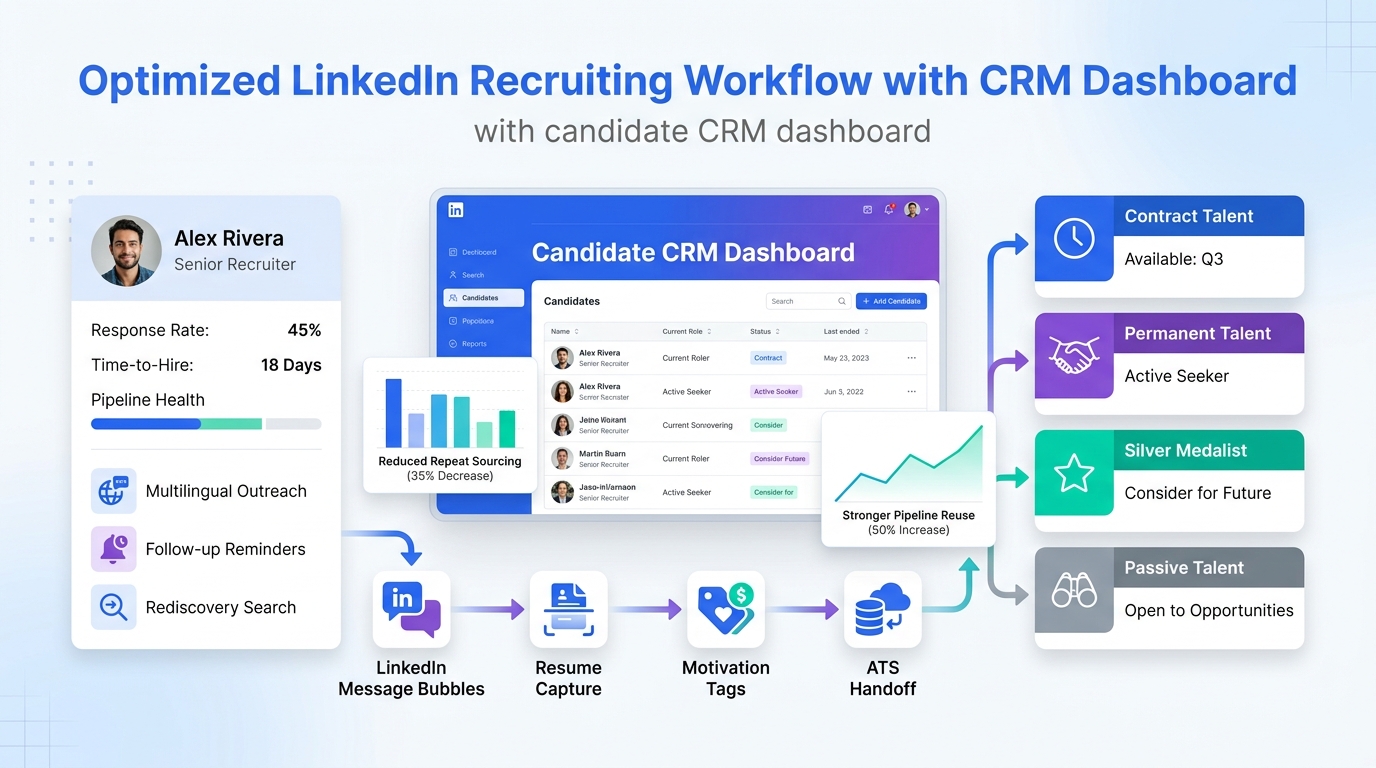
See how recruiting leaders can judge a candidate crm by whether it preserves candidate motivation and prevents repeat sourcing.
That matters because repeated sourcing is rarely just a time problem. For a solo recruiter, it means evenings lost chasing old LinkedIn threads and rebuilding shortlists from memory. For a small agency owner, it means weaker delivery margins, inconsistent outreach across consultants, and candidate goodwill fading between searches. For an in-house talent team, it shows up as slower hiring, thin pipelines for repeat roles, and hiring managers asking why strong past finalists seem to disappear.
In my own workflow, tools like AI Recruiter became useful not because they replace recruiter judgment, but because they reduce the messy front-end work that causes relationship loss in the first place. When I need help keeping LinkedIn outreach moving, replying after hours, and collecting resumes or contact details from interested people, an AI-supported workflow can keep conversations alive while I still make the final call on fit, resume review, and next-step decisions. For teams handling cross-border searches or uneven recruiter bandwidth, the multilingual and always-on communication model described on the StrategyBrain site is especially relevant.
Think about the candidate side for a moment. A finance professional weighing contract accounting work is often making a practical tradeoff, not a reckless one. The attraction is clear: contract work can pay more because benefits are limited, every hour is billable, and the assignment can create fast access to controllers, CFOs, or HR leaders who would be hard to reach otherwise. It can also open the door to industries that might reject the same person for a permanent role.
Now put that opportunity in a recruiter's hands. The recruiter has to identify that this candidate is motivated by compensation structure, network access, and industry entry rather than by a standard long-term employment pitch. Then they need to record those signals, follow up at the right time, and reconnect when another contract or permanent opening appears. If those details live in personal inboxes, LinkedIn messages, or scattered notes, the relationship breaks even when the first conversation went well.
That is exactly why a candidate crm sits near the center of the best recruiting software discussion. The real selection question is not just whether software can store applicants, but whether it can preserve opportunity context, rediscover people whose motivations are already known, and support the kind of segmented follow-up that contract, project-based, and repeat hiring often require. From here, it helps to look at what candidate relationship management systems actually do, how they differ from an ATS, and which candidate relationship management best practices make them worth the investment.
Table of Contents
- Why Candidate CRM Matters in Modern Recruiting
- What Is a Candidate CRM?
- Candidate CRM vs ATS
- What the Best Systems Preserve Beyond Applicant Data
- Types of Recruiting Software to Compare
- Key Features to Look For
- Recruiting Software Categories and Tradeoffs
- How to Choose the Best Recruiting Software
- Candidate Relationship Management Best Practices
- Common Selection and Adoption Mistakes
- FAQ
Why Candidate CRM Matters in Modern Recruiting
Recruiters do not lose candidates only because pipelines are small. More often, they lose them because the original reason a person was interested is never captured in a reusable way. In contract hiring especially, that reason may be immediate pay, short-term flexibility, direct access to decision-makers, or a chance to enter a new industry. In permanent hiring, it may be team scope, leadership exposure, or timing.
The best recruiting software helps teams hold onto that context. Without it, every future search begins with the same wasteful cycle: sourcing from scratch, repeating outreach, and trying to remember who was almost right the last time. A strong candidate crm turns those fragments into something operational.
Practical takeaway: The best systems do not just track who applied. They retain why a candidate engaged, what kind of opportunity they were open to, and when the relationship is worth reopening.
What Is a Candidate CRM?
A candidate crm is recruiting software built to help talent teams attract, organize, segment, nurture, and rediscover people over time. It is designed for relationship continuity before application, between hiring cycles, and after a process closes.
That is the main difference from a simple applicant database. Candidate relationship management systems are meant to support living pipelines: silver medalists, referrals, event attendees, prior applicants, and passive talent who may be open under the right conditions.
In real recruiting operations, this matters most when your team hires repeatedly for similar skill sets, hard-to-fill jobs, or contract roles where timing and motivation can change quickly.
Candidate CRM vs ATS
An applicant tracking system is built to manage active requisitions. A candidate CRM is built to maintain and reactivate talent relationships.
| Category | Candidate CRM | ATS |
|---|---|---|
| Main purpose | Build and nurture talent pools | Manage active applicants for open roles |
| Best timing | Before application and between hiring cycles | After a candidate enters an active requisition |
| Typical workflows | Segmentation, campaigns, rediscovery, events, talent communities | Screening, interviews, feedback, offers, compliance records |
| Core users | Sourcers, recruiters, talent teams | Recruiters, coordinators, hiring managers, HR operations |
| Primary value | Warmer pipelines and better engagement | Structured process execution and visibility |
Most mature teams need both functions, whether in one platform or through integrated systems. The ATS handles process control. The CRM protects relationship memory.
What the Best Systems Preserve Beyond Applicant Data
The accounting contractor example highlights something recruiters see every day: candidates often evaluate opportunities through benefits that are not visible on a resume. A person may respond because the work is paid hourly, because it offers exposure to leadership, or because it is their first realistic path into a new sector.
If your recruiting software stores only resumes and stage movement, that logic disappears. If your CRM records the relationship properly, a recruiter can later search for candidates who wanted contract flexibility, candidates interested in finance leadership exposure, or candidates open to crossing into a new industry.
That is one reason the best candidate relationship management systems are so valuable. They preserve not just identities, but hiring intent and candidate motivation. That makes future outreach more relevant and less transactional.
Types of Recruiting Software to Compare
When teams search for the best recruiting software, they often compare products that solve different problems. Separating software by operating model usually leads to better decisions.
1. Standalone candidate CRM
Best for organizations that already have an ATS but need stronger talent pooling, nurture campaigns, event follow-up, and rediscovery. This is often a good fit for agency recruiters, executive search teams, and in-house sourcing functions.
2. ATS with built-in CRM features
Useful for teams that want one system for active process management and light relationship nurturing. This can work well for internal talent teams with moderate hiring complexity.
3. Unified recruiting platforms
These combine sourcing, CRM, ATS, automation, and analytics in one environment. They are often attractive to larger teams trying to reduce tool sprawl.
4. Channel-specific outreach tools that support CRM workflows
Some tools focus on outbound sourcing and conversation management rather than formal ATS administration. In my own experience, AI Recruiter fits this supporting role well when LinkedIn sourcing volume is high and recruiters need help maintaining timely outreach, handling replies across time zones, and capturing resumes from interested prospects without losing the human handoff. It is not a substitute for recruiter qualification, but it can reduce the drop-off that often happens before a person ever becomes an applicant.
Key Features to Look For
If you are evaluating software for candidate relationship management, these are the features that usually matter most in practice.
Talent pools and segmentation
Your candidate crm should support grouping by skill, seniority, geography, prior process outcome, source, and interest pattern. Good segmentation is what lets you tailor outreach to a contract accountant differently from a permanent controller candidate.
Candidate rediscovery
When a role reopens, recruiters should be able to find relevant past candidates quickly, including silver medalists, former contractors, and people who engaged but were not ready at the time.
Communication history
The system should preserve email, outreach notes, response patterns, and relationship context. This is critical when candidates are evaluating opportunities based on timing, compensation structure, or career access.
Automation with recruiter control
Automation should support consistency without replacing judgment. That means reminders, campaign workflows, and routing logic that still leave final decisions to the recruiter.
Searchability of motivation and context
One underappreciated feature is the ability to search not just for titles and skills, but for candidate signals like contract openness, relocation willingness, industry transition interest, or prior engagement source.
CRM-to-ATS continuity
Once someone becomes an applicant, the team should not lose notes, tags, source history, or earlier conversations.
Reporting that reflects real recruiting work
Useful reporting answers questions like: Which pools generate interviews? Which outreach themes produce replies? How often do recruiters reuse known talent instead of starting over?
Recruiting Software Categories and Tradeoffs
Because this article avoids promoting named recruiting suites, the better way to compare options is by category. Still, most buying decisions come down to three practical models.
CRM-first platforms
Pros: Better for nurture, segmentation, long-cycle recruiting, and rediscovery.
Cons: May require separate ATS workflows and tighter process discipline.
Best for: Search firms, talent communities, recurring niche hiring.
Cost pattern: Often easier to justify when repeat hiring makes rediscovery valuable.
Works with AI-supported outreach: Usually yes, especially when outbound sourcing volume is high.
ATS-first platforms with CRM layers
Pros: Stronger process control, compliance, and recruiter-hiring manager collaboration.
Cons: CRM features may be basic for serious talent pooling.
Best for: In-house teams with structured hiring and moderate relationship-management needs.
Cost pattern: Efficient when one platform can cover most workflows.
Works with AI-supported outreach: Often useful when paired with separate outbound messaging support.
Outreach automation tools that feed the recruiting stack
Pros: Helpful for sourcing scale, faster follow-up, multilingual engagement, and after-hours responsiveness.
Cons: Not a full replacement for CRM architecture or ATS governance.
Best for: Agency desks, hard-to-fill searches, LinkedIn-heavy sourcing teams, cross-border recruiting.
Cost pattern: Value depends on saved recruiter time and improved continuity at the top of funnel.
Works with CRM and ATS: Best when used as an extension, not as the whole system.
That last category is where I found AI Recruiter most useful. I would not trust any tool to make the final assessment on candidate fit, and this one does not claim to do that. What it did help with was the repetitive work that usually delays outreach: initiating conversations on LinkedIn, replying when candidates answer outside local working hours, introducing the role consistently, and collecting resumes or contact details from people who wanted to continue. For recruiters who live in LinkedIn sourcing, that can make a CRM strategy more usable because more of the early relationship data gets captured before it goes cold.
How to Choose the Best Recruiting Software
Start with your hiring environment, not a feature sheet.
- Map your repeat search patterns.
If you fill the same families of roles over and over, relationship management likely matters more than extra workflow bells and whistles.
- Identify lost-context moments.
Where do candidates disappear today? After first outreach? After an event? Between contract assignments? After final-stage rejection?
- Clarify whether candidate motivation affects success.
In many markets, it does. Contract candidates, industry-switchers, and passive professionals often respond to a specific opportunity logic that should be captured and searchable.
- Test rediscovery in the demo.
Ask vendors to show how a recruiter would find people who were open to hourly contract work, interested in moving industries, or previously introduced to a leadership team.
- Check the human handoff.
If a tool automates outreach, make sure the recruiter can still review history, assess the resume, and decide the next step cleanly.
- Review adoption risk.
The best recruiting software is still a bad investment if recruiters keep tracking real conversations in side spreadsheets or private messages.
Candidate Relationship Management Best Practices
The software matters, but operating discipline matters just as much. These candidate relationship management best practices are what make the system useful over time.
Capture the reason, not just the profile
Do not stop at title, employer, and resume. Record why the candidate responded: higher hourly earnings, flexibility, a route into a new industry, exposure to leadership, or future permanent interest.
Build pools around actual opportunity logic
Instead of generic pools, create segments that reflect how candidates evaluate work. For example: finance contractors open to project roles, former finalists for recurring accounting searches, or candidates willing to switch industries for the right entry point.
Re-engage before urgency returns
The right nurture rhythm keeps candidates warm before the next requisition opens. That is especially important in recurring contract hiring.
Use automation to prevent silence
Automation is most useful when it reduces lag between touchpoints. In LinkedIn-heavy sourcing, this is where an AI-assisted workflow can help. I have used AI Recruiter as a support layer for first-touch messaging and follow-up continuity, while keeping all final screening, resume interpretation, and shortlisting decisions with the recruiter.
Preserve context across systems
If a prospect moves from nurture to applicant, the handoff should include message history, source, notes, and motivation markers.
Measure reuse, not just outreach volume
A healthy CRM program should increase the percentage of roles filled from known relationships or previously engaged talent, not just the number of outbound messages sent.
Common Selection and Adoption Mistakes
- Confusing databases with relationship systems: Resume storage alone is not candidate relationship management.
- Ignoring motivation data: Teams often log skills but forget the reason a candidate was open.
- Over-automating with no handoff discipline: Outreach tools can create noise if recruiters do not review context and next steps carefully.
- Buying for labels instead of workflows: A platform called CRM may still be weak at actual rediscovery and nurture.
- Letting relationship history stay in inboxes: If notes never reach the shared system, future searches still restart from zero.
FAQ
What is the main benefit of a candidate CRM?
The main benefit is relationship continuity. A candidate crm helps recruiters retain search history, candidate motivation, outreach records, and rediscovery value between hiring cycles.
How are candidate relationship management systems different from ATS platforms?
Candidate relationship management systems are designed for talent pooling, nurturing, and re-engagement before or between active applications. ATS platforms are designed for managing live requisitions and applicants in process.
When do candidate relationship management best practices matter most?
They matter most in recurring, niche, contract, or hard-to-fill hiring where prior relationships can shorten future searches and improve candidate experience.
Can AI-supported sourcing help a CRM strategy?
Yes, when used carefully. AI-supported outreach can help recruiters keep conversations moving, especially on LinkedIn and across time zones. But recruiters should still own qualification, resume review, and hiring decisions.
Do small recruiting firms need a candidate CRM?
Not always, but many boutique firms benefit from one sooner than they expect. If the same desk fills similar roles repeatedly, the ability to rediscover and re-engage warm talent can protect both recruiter time and revenue.
Conclusion
The search for the best recruiting software gets clearer when you stop asking which tool stores the most data and start asking which one protects the most relationship value. The lesson from contract-focused recruiting is straightforward: candidates often engage for reasons that are highly specific, highly time-sensitive, and highly reusable later.
The best candidate relationship management systems help teams preserve those reasons, not just those resumes. When combined with disciplined process design, recruiter judgment, and sensible automation support, they turn old conversations into future placements instead of forgotten message history.