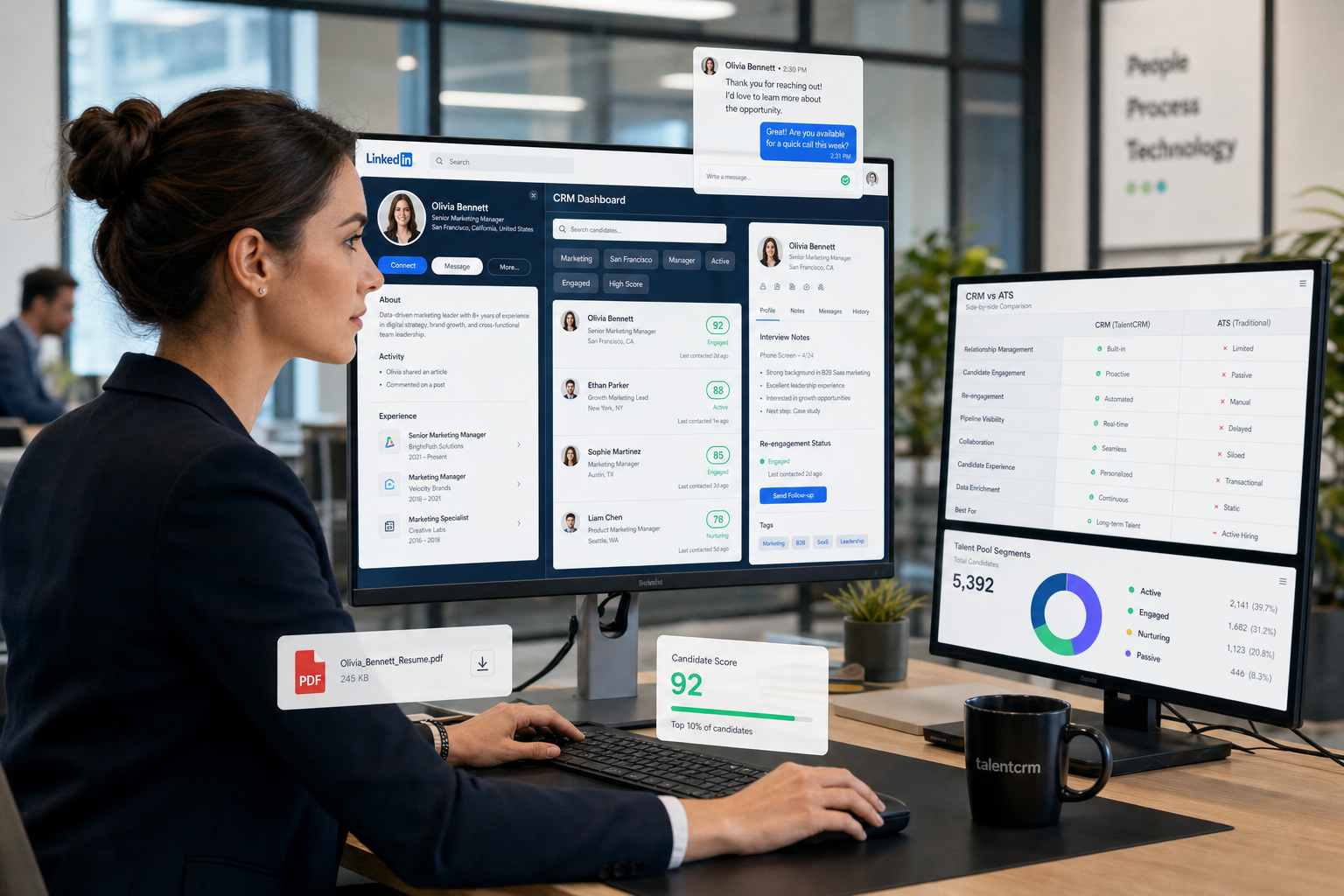
When interview signals keep disappearing, this article helps recruiting leaders judge candidate crm by whether it preserves rediscovery-ready insight.
When those signals live in scattered notes, inbox threads, and recruiter memory, the damage shows up fast: strong silver medalists disappear, hiring managers revisit the same concerns twice, agency recruiters lose warm leads to slower follow-up, and in-house teams mistake a process problem for a sourcing problem. For smaller search firms especially, weak relationship tracking is not just an admin issue; it affects placement quality, repeat business, and candidate trust.
That is why I have found it useful to pair core recruiting systems with workflow support such as StrategyBrain AI Recruiter when outreach volume and follow-up speed start outrunning human bandwidth. In practice, its always-on candidate messaging, multilingual communication, and automated collection of resumes and contact details can reduce the manual chasing that often causes context loss. The recruiter still makes the final call on fit, reviews the resume, and decides whether the candidate should move forward.
Think about a common interview moment. A candidate has already shown the right technical background, but the real decision now depends on deeper questions: can this person admit a weakness, explain how they improved, describe when they were most and least productive, or talk about achievements that mattered beyond titles and credentials? Those answers often reveal more about future fit than another line on a resume.
If the recruiter captures those signals loosely, they fade after the requisition closes. The next time a similar role opens, nobody clearly remembers who was self-aware, who showed initiative, or who seemed driven by the kind of work your team actually values. That is the gap the best recruiting software should close, and it is exactly where candidate relationship management systems and practical candidate relationship management strategies matter most.
Many conversations about the best recruiting software start with workflow speed or ATS features. In day-to-day recruiting, though, the more important question is whether your stack helps you retain the human judgment you worked hard to earn during sourcing, screening, and interviewing. That is where candidate crm becomes more than a database.
- How candidate CRM turns interview insight into reusable pipeline value
- Why character, motivation, and improvement signals should shape your software choice
- How candidate relationship management systems differ from basic applicant tracking
- Which candidate relationship management strategies help teams re-engage the right people
- What to look for in the best recruiting software for proactive hiring
Table of Contents
- Why Candidate CRM Matters
- Interview Signals Worth Saving
- Candidate CRM vs ATS
- What the Best Recruiting Software Should Include
- Types of Candidate Relationship Management Systems
- How to Choose the Right Platform
- Candidate Relationship Management Strategies That Work
- Three Software Approaches Recruiters Compare
- Common Mistakes to Avoid
- FAQ
Why Candidate CRM Matters in Real Recruiting
Candidate crm is the combination of process and software used to attract, organize, nurture, and re-engage talent over time. In practical recruiting terms, it helps teams keep more than contact details. It helps them preserve what they learned about a person across sourcing conversations, interview rounds, rejection points, event interactions, and future openings.
That distinction matters because recruiters rarely lose candidates only at the top of the funnel. More often, they lose accumulated insight. A great finalist who was not selected six months ago may be exactly right for a new role today, but only if the recruiter can quickly recover not just the profile, but the relationship history and evaluation context.
When candidate relationship management systems are working well, teams can:
- Build talent pools around functions, skills, geographies, or hiring plans
- Preserve interview insight that would otherwise stay buried in notes
- Run nurture campaigns through email, SMS, and recruiter-led outreach
- Re-engage silver medalists with better timing and context
- Track who showed growth, initiative, openness to feedback, or strong motivation
- Maintain visibility into pipeline health before requisitions become urgent
Key Insight: The best recruiting software does not just process applicants. It protects recruiter judgment so strong people can be rediscovered and re-engaged with context.
Interview Signals Worth Saving in Your Candidate CRM
The reference point many recruiters miss is simple: some of the most valuable hiring information comes from questions that are not about credentials at all. Questions about weakness, improvement, innovation, productivity, and personal motivation often expose whether a candidate will grow, collaborate, and align with the team in a sustainable way.
These signals are easy to discuss in the room and easy to lose afterward. That is why strong candidate relationship management systems should help capture and retrieve them in a structured way.
1. Honesty and openness to improvement
When a candidate can explain a real weakness and how they worked to correct it, recruiters learn something useful about self-awareness and coachability. In a good system, that insight should be searchable later, not trapped in a private note.
What to preserve: the weakness named, the corrective action taken, and whether the answer felt reflective or rehearsed.
2. Initiative and innovation
Asking when someone improved a process or expanded their role helps identify people who add value over time rather than simply execute instructions. This matters in both agency and in-house recruiting because many hiring managers want someone who can step in and strengthen the role itself.
What to preserve: the example given, whether the impact was practical, and whether the candidate showed ownership.
3. Work ethic and productivity patterns
A candidate's description of their most productive and least productive periods can reveal how they define effort, accountability, and performance. This is often more useful than generic claims about being hardworking.
What to preserve: the circumstances, the candidate's own standard for productivity, and any patterns relevant to the role environment.
4. Deeper motivation beyond resume lines
When recruiters ask about the accomplishments a person found most gratifying outside formal professional or academic labels, they often uncover what actually drives that individual. That matters for culture fit, retention discussions, and future matching.
What to preserve: what the candidate valued, why it mattered, and whether that motivation aligns with the business context of future roles.
This is also why I prefer systems that let recruiters append meaningful tags or structured notes after interviews. In my own workflow, using AI Recruiter to keep outreach moving while I reviewed responses manually worked best when I immediately tagged deeper interview findings once a resume came in and a live conversation followed. The automation handled the repetitive front-end steps; I handled the judgment that actually shaped the shortlist.
Candidate CRM vs ATS: What Is the Difference?
A candidate CRM and an ATS can overlap, but they are built to solve different recruiting problems.
An applicant tracking system is mainly designed to manage live jobs, active applicants, interview stages, approvals, and compliance workflows. A candidate CRM is built for relationship continuity before, during, and after formal application activity.
| Category | Candidate CRM | ATS |
|---|---|---|
| Primary focus | Relationship building and talent nurturing | Application processing and hiring workflow |
| Best timing | Before and between open roles | After a role is open and candidates apply |
| Core users | Recruiters, sourcers, talent teams, HR | Recruiters, coordinators, hiring managers, HR operations |
| Key actions | Segment, nurture, re-engage, personalize outreach | Track applicants, schedule interviews, move stages, manage approvals |
| Main value | Future pipeline strength and reusable candidate insight | Process control, documentation, and execution speed |
For many teams, the right question is not whether CRM replaces ATS. It is whether your ATS has enough CRM depth to preserve recruiting intelligence, or whether a separate CRM layer is needed to do it well.
Why this matters
If your real pain point is rediscovering high-potential people and remembering why they mattered, then more applicant stages alone will not fix it. That is a relationship-management problem. Software selection should reflect that reality.
What the Best Recruiting Software Should Include
When hiring teams ask for the best recruiting software, they usually want fewer dropped candidates, stronger pipelines, and less duplicated effort. If candidate crm is central to that goal, these are the capabilities that matter most.
1. Searchable talent pools and segmentation
Recruiters should be able to organize people by function, location, seniority, hiring readiness, interview outcome, and motivation pattern. Strong segmentation supports stronger candidate relationship management strategies because follow-up becomes more relevant.
Practical test: Can a recruiter pull “product managers in New York who reached final round in the last year and showed strong ownership” without exporting data to a spreadsheet?
2. Structured interview insight capture
This is the capability many teams underestimate. If the platform cannot retain notes in a consistent, reusable way, then valuable hiring signals vanish. The best recruiting software should support scorecards, tags, custom fields, or searchable notes that reflect how recruiters actually assess people.
3. Nurture campaigns with personalization
Automation matters, but blanket messaging does not build real candidate relationships. Good systems support timing, audience logic, and recruiter-level personalization.
Practical test: Can you create distinct follow-up for silver medalists, event contacts, and passive prospects without building everything manually?
4. Unified communication history
Recruiters need one place to review email, text, outreach notes, responses, interview feedback, and handoff context. This is where relationship continuity is either protected or lost.
5. Rediscovery and re-engagement tools
One of the biggest reasons teams invest in candidate relationship management systems is to stop starting from zero every time. Search, tagging, resurfacing, and campaign launch should make re-engagement fast and credible.
6. ATS and workflow integrations
Integration still matters because recruiting does not happen in one tool. Candidate data should sync cleanly with the ATS, calendars, sourcing channels, and interview tools.
7. Reporting that reflects relationship health
Useful reporting should go beyond applicants per requisition. It should show pipeline freshness, nurture engagement, re-engagement outcomes, and response quality by segment.
Types of Candidate Relationship Management Systems
Different teams need different architectures. When evaluating the best recruiting software, it helps to think in categories.
| Software type | Best for | Strengths | Watchouts |
|---|---|---|---|
| ATS with built-in CRM features | Teams that want one operating system | Cleaner movement from sourcing to application | CRM depth may be shallow |
| Dedicated candidate CRM | Sourcing-heavy or repeat-hiring teams | Better segmentation, nurture, and re-engagement | Needs strong ATS integration |
| Outreach automation layer | Teams handling high message volume, multilingual outreach, or after-hours response | Faster front-end communication and less manual chasing | Still requires recruiter review and downstream process discipline |
In my experience, the third category becomes useful when recruiters are not failing at assessment, but at keeping up with first-touch communication and response handling. That is where StrategyBrain AI Recruiter can fit as a support layer: it keeps candidate conversations moving, collects resumes and contact details from interested talent, and helps prevent warm prospects from cooling off simply because the recruiter was tied up elsewhere. The fit decision still belongs to the recruiter.
How to Choose the Right Platform
The best recruiting software is not the one with the longest feature sheet. It is the one that fits how your team hires and what your recruiters most often lose.
- Start with your hiring pattern. Repeated hiring for similar roles usually increases the value of candidate crm.
- Audit what gets lost today. Is it contact data, interview feedback, silver medalist visibility, or speed of follow-up?
- Separate sourcing volume problems from judgment capture problems. These are different issues and often need different tools.
- Test recruiter workflows live. Ask users to rediscover a past finalist, review prior notes, launch re-engagement, and hand the record to a hiring manager.
- Check integration quality early. Duplicate entry destroys adoption.
- Review whether the system preserves deeper evaluation criteria. If your team cares about initiative, coachability, work ethic, or motivation, the software should make those factors easy to store and retrieve.
One of the simplest demo questions I recommend is this: after a candidate was not selected, how quickly can a recruiter later recover the record, understand the previous concerns, and decide whether the person deserves another conversation? That one workflow reveals a lot.
Candidate Relationship Management Strategies That Work
Software only creates value when it reinforces behavior recruiters can actually repeat. The strongest candidate relationship management strategies are usually simple, disciplined, and tied to moments where candidate interest and recruiter insight are both fresh.
Build segmented nurture by likely future fit
Do not just segment by job title. Segment by prior stage reached, strengths observed, development areas, and likely readiness for future roles.
Tag silver medalists with usable context
“Strong candidate” is too vague to help later. Store why they were strong, what concerns remained, and what type of role would fit better next time.
Revisit interview notes before re-engagement
Before contacting a past candidate, review what they said about growth, productivity, and motivation. Better re-engagement starts with better memory.
Use automation for speed, not for replacing judgment
This is where my own experience with AI Recruiter on LinkedIn was helpful. It handled repetitive first-touch tasks and after-hours replies better than I could consistently do at scale, especially when candidates responded outside my workday. But the quality gain came only because I used that saved time to review resumes, compare signals across interviews, and decide who truly warranted a live conversation.
Give hiring managers fuller candidate context
Managers make better decisions when they can see not just resume lines, but prior interest, earlier objections, and signs of self-awareness or initiative from past conversations.
Three Software Approaches Recruiters Compare
For software selection, most teams end up comparing three broad approaches rather than one perfect tool.
1. ATS-first platforms
Use experience: familiar for hiring teams and generally easier for approvals and stage tracking.
Effectiveness: strong for active requisition management, weaker when recruiters need long-term nurture and nuanced rediscovery.
Cost: often easier to justify if the organization already standardizes on one hiring platform, but CRM depth may require tradeoffs.
Best for: companies with strong process control needs and moderate sourcing complexity.
How they work with StrategyBrain AI Recruiter: useful when the ATS remains the system of record while AI Recruiter supports top-of-funnel messaging and resume capture from LinkedIn conversations.
2. Dedicated candidate CRM platforms
Use experience: often better for recruiter-centric search, segmentation, and re-engagement.
Effectiveness: stronger for candidate relationship management systems use cases, especially evergreen hiring and talent communities.
Cost: can introduce another system to manage, so the value depends on hiring volume and repeat roles.
Best for: agency teams, sourcing-heavy organizations, and employers with recurring talent demand.
How they work with StrategyBrain AI Recruiter: effective when CRM segmentation and history are already mature, but recruiters need help scaling front-end outreach and multilingual follow-up.
3. Outreach automation and communication support tools
Use experience: strongest when recruiters are drowning in repetitive first-touch tasks rather than struggling with final evaluation.
Effectiveness: can improve speed to response, help continue conversations after hours, and reduce manual handling of early interest signals.
Cost: value depends on whether the team actually has enough outbound and response volume to benefit from automation.
Best for: headhunters, lean in-house teams, and globally distributed recruiting operations.
How StrategyBrain AI Recruiter fits: based on its published workflow, it is especially relevant where LinkedIn outreach, multilingual communication, and resume collection are bottlenecks. It does not replace final qualification, which is exactly how many experienced recruiters prefer it.
Common Mistakes Teams Make
Treating CRM as a contact database
If the system stores names but not judgment, it will not support better hiring decisions later.
Letting interview insight stay unstructured
Loose notes are easy to create and hard to reuse. That is how promising people get lost between searches.
Over-crediting ATS functionality
Applicant workflow control is important, but it does not automatically solve rediscovery, re-engagement, or long-cycle relationship building.
Automating without clear segmentation
Bulk outreach with weak audience logic can damage candidate trust.
Ignoring follow-up speed in relationship quality
Sometimes the issue is not assessment quality at all. It is delayed communication. A support layer such as AI Recruiter conversation workflows can help here, provided recruiters still own fit decisions and record quality.
FAQ
What is candidate relationship management?
Candidate relationship management is the practice of building and maintaining long-term relationships with potential and past candidates. In software terms, it usually includes talent pools, nurture campaigns, communication history, segmentation, and re-engagement workflows.
What is the difference between a candidate CRM and an ATS?
A candidate CRM focuses on proactive relationship building and future pipeline strength. An ATS focuses on managing active applicants and structured hiring workflows. Many teams need both.
Why does interview insight matter in candidate CRM?
Because hiring decisions are not based only on resumes. Signals around honesty, openness to improvement, initiative, productivity, and motivation often determine whether a past candidate is worth revisiting for a future role.
Who benefits most from candidate relationship management systems?
Agency recruiters, executive search teams, in-house talent acquisition teams, and any employer that hires repeatedly for similar roles or wants to improve follow-up and rediscovery.
Can automation replace recruiter judgment?
No. Automation can help with outreach, response handling, and collecting resumes or contact details. Recruiters still need to assess fit, review candidate materials, and make final decisions about next steps.
Conclusion
The best recruiting software does more than move applicants through stages. It helps recruiters preserve what they learned about people when those lessons matter most later.
If your team keeps losing strong candidates not because it cannot source them, but because it cannot retain context around them, then a better candidate crm approach is likely the missing piece. The strongest candidate relationship management strategies turn interview insight into future hiring advantage, and the right candidate relationship management systems make that repeatable.
For headhunters, recruiting leaders, and hiring teams, that usually means combining disciplined assessment with software that supports both relationship memory and timely outreach. When those two parts work together, pipeline quality improves in a way recruiters can actually feel in the next search.