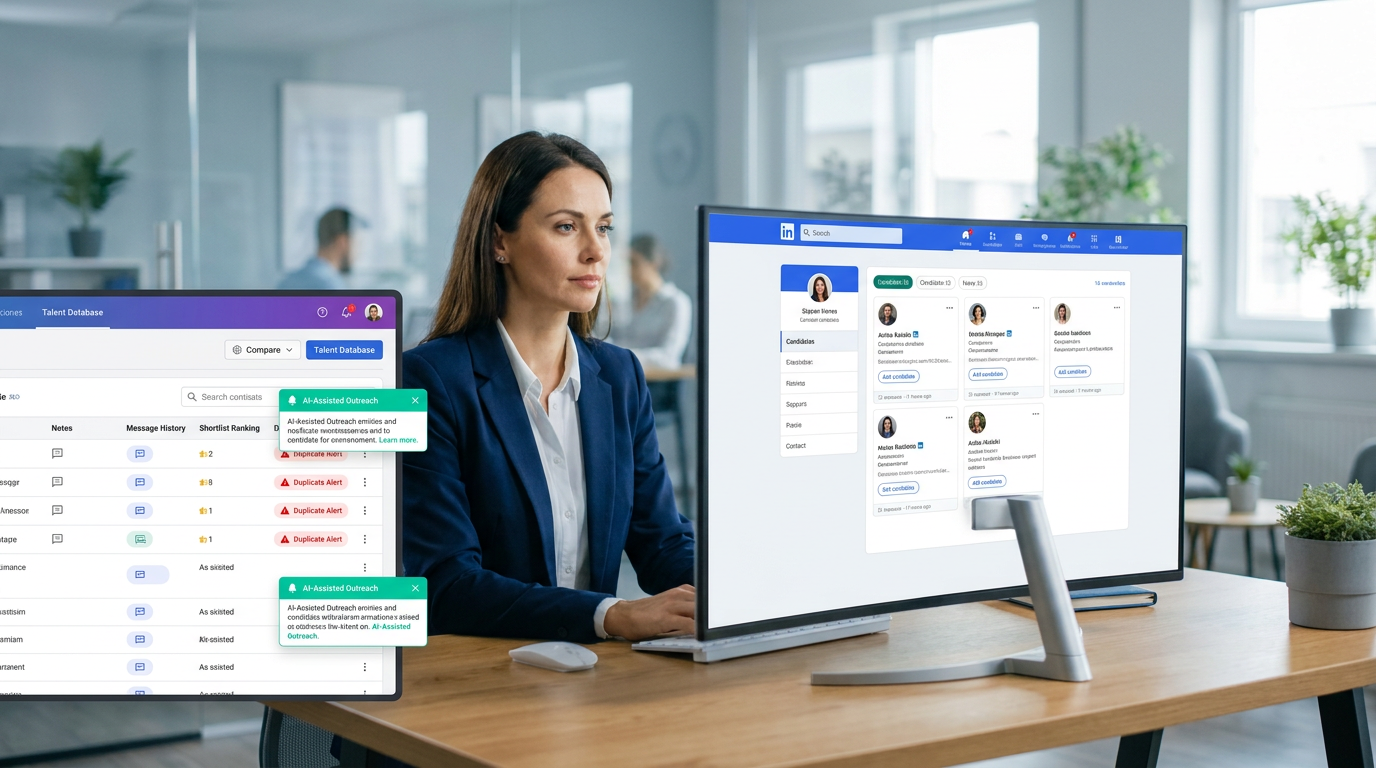
Use this article to judge a candidate database for recruiters before buried talent, duplicate outreach, and weak shortlists cost trust.
That sounds obvious until you are the one cleaning up the downstream damage. A weak database does not just slow sourcing. It leads to missed silver medalists, duplicated outreach, unreviewed LinkedIn replies, sloppy notes, and hiring managers who stop trusting the shortlist because nobody can explain why certain profiles surfaced while stronger people stayed buried. For agency owners, that means wasted billable time and a weaker market reputation. For solo headhunters, it means too many hours spent re-reading resumes and chasing context you should already have. For in-house recruiters, it creates friction between sourcing, screening, and stakeholder alignment.
That is also where AI-supported workflow can help if it is tied to real recruiter control. In my own process, I have used StrategyBrain AI Recruiter to keep candidate conversations moving on LinkedIn, handle after-hours replies, and collect resumes or contact details from interested people without losing the thread. The useful part is not replacing recruiter judgment. It is reducing the repetitive connection and follow-up work so the recruiter can stay focused on final evaluation, resume review, and the decision on who actually moves forward.
A useful reminder comes from an older but still relevant social-media lesson: candidates do not only win or lose attention because of credentials. They also shape employer trust through what they post, how they write, the photo they use, and whether their public presence looks deliberate or careless. A recruiter reviewing a profile can move from headline to comment history to visible activity in minutes, and the decision is rarely based on one datapoint alone. A typo-filled summary, a combative public thread, or an unprofessional image can quietly weaken a candidate before a call is ever scheduled.
That same scene exposes a software problem. If recruiters are evaluating not just resumes but also communication quality, recency, professionalism, and prior engagement, then the best recruiting software cannot behave like a static file cabinet. A real candidate database for recruiters should help teams capture context, support better resume search for employers, and separate serious internal talent reuse from vague promises around free resume database download offers that often lack freshness, consent clarity, or usable detail.
In other words, the software question starts with a human judgment problem: how do recruiters find, interpret, and reuse candidate information without losing context or damaging trust? That is why the best recruiting software is not just about storing applicants. It is about combining search, outreach, workflow, and recordkeeping in a way that matches how recruiting decisions are actually made.
- What a modern candidate database should capture beyond resumes
- How search quality affects shortlist credibility
- Why recruiter judgment still matters even with AI support
- Where applicant tracking systems help prevent context loss
- What to check before trusting free resume database download claims
Table of Contents
- Why the Best Recruiting Software Starts With Context
- What a Candidate Database for Recruiters Should Actually Do
- How Resume Search for Employers Should Work Now
- What Social Signals Teach Us About Search Quality
- Boolean Search vs AI Matching
- Why ATS Workflows Still Matter
- How to Review Free Resume Database Download Claims
- Buyer Checklist
- Common Mistakes
- FAQ
Why the Best Recruiting Software Starts With Context
Recruiters do not assess candidates in a vacuum. They read resumes, compare titles, skim LinkedIn activity, review message history, check whether prior outreach was answered, and try to understand if a person looks current, credible, and reachable. The recruiting system has to support that layered judgment.
That is one reason simplistic feature comparisons often miss the mark. The best recruiting software is not merely the system with the most filters or the biggest database. It is the one that preserves context well enough for a recruiter to explain why a profile belongs on a shortlist. If the software cannot do that, hiring managers tend to lose confidence and ask recruiters to start over manually.
Key insight: Strong recruiting platforms make professional judgment easier to document and defend, not harder to reconstruct after the fact.
The lesson carries over from social media screening. A candidate may look strong at first glance, but once you notice outdated information, careless writing, or public behavior that clashes with the role, your assessment changes. Good software should help that kind of contextual review stay organized rather than live in scattered browser tabs and recruiter memory.
What a Candidate Database for Recruiters Should Actually Do
A candidate database for recruiters should function as a searchable talent system, not a pile of attached files. That means storing structured profile data, resume content, communication history, sourcing notes, application status, and relevant engagement signals in one place.
In practice, the strongest systems help with five jobs recruiters perform repeatedly:
- Find candidates through structured and contextual search.
- Interpret profiles using clean, current, and visible data.
- Re-engage people who were previously sourced or applied.
- Track movement through pipeline stages and ownership.
- Defend hiring decisions with notes, history, and auditability.
If your current system only handles the fourth item, it will never feel like the best recruiting software. It will feel like an obligation.
| Capability | Why It Matters | What Recruiters Gain |
|---|---|---|
| Resume parsing | Converts CV text into searchable fields | Less manual review and faster narrowing |
| Candidate rediscovery | Surfaces past applicants and sourced leads | Better reuse of existing talent pools |
| Search filters and ranking | Improves precision and relevance | More trustworthy shortlists |
| Activity history | Shows who contacted whom and when | Prevents duplicated or missed outreach |
| ATS workflows | Tracks stage, ownership, and feedback | Cleaner team coordination |
| CRM functions | Preserves long-term relationship context | Better nurturing of passive talent |
| Compliance controls | Supports permissioning and recordkeeping | Lower process risk |
One practical benefit I have seen from adding AI-supported outreach alongside a searchable database is that fewer conversations go dark just because the recruiter was offline. With StrategyBrain AI Recruiter, routine LinkedIn back-and-forth and resume collection can continue after hours, while the recruiter still decides whether the profile is actually relevant. That division of labor matters because automation is useful for momentum, but final qualification still belongs with the human recruiter.
How Resume Search for Employers Should Work Now
Good resume search for employers should move beyond exact-term hunting. Recruiters need the ability to search broadly, narrow quickly, and understand why a candidate was returned. If the result set feels random or opaque, adoption drops fast.
At minimum, modern search should support:
- Skills and related skill clusters
- Current and prior titles
- Location and work authorization context where relevant
- Seniority level
- Years of experience
- Industry background
- Compensation expectations if captured
- Pipeline stage and source
- Recency of activity or profile update
- Engagement history and available contact details
The reason this matters is simple: resumes alone rarely tell the full story. Recruiters often care just as much about recency, responsiveness, and professionalism as they do about raw keyword matches. That is the same judgment pattern we see when reviewing a candidate's public-facing profile. Search needs to support human evaluation, not strip it down to literal text matching.
What useful search results should reveal
A recruiter should be able to see whether the system matched a person because of exact keywords, adjacent skills, title similarity, recent activity, prior application history, or previous outreach. Without that transparency, the search engine becomes hard to trust.
In my experience, this is where many teams discover that the database they thought was “fine” is really just storing documents. If it cannot help you explain the shortlist, it is not doing enough.
What Social Signals Teach Us About Search Quality
The social-media screening example is useful because it reminds us that professional evaluation is multidimensional. Recruiters notice writing quality. They notice whether a profile image looks credible. They notice whether public comments are thoughtful or unnecessarily combative. They notice whether a page has been neglected for years.
Those observations should not turn into arbitrary bias, but they do show why context-rich candidate records matter. When recruiters work from memory, browser tabs, and disconnected notes, those observations get lost or repeated inconsistently. Better software gives teams a structured place to record what matters and why.
Three carryover lessons are especially relevant when evaluating recruiting software:
- Polish matters: Clean data and clean presentation affect trust the same way clean writing affects a candidate's professional image.
- Privacy and boundaries matter: Recruiters need clear controls over what data is stored, who can see it, and how it is used.
- Purpose matters: Every note, tag, message, and search action should support a professional hiring outcome, not create more noise.
That is also why I prefer systems that keep messaging history close to candidate records. If someone replied after hours, asked a compensation question, or shared a resume through LinkedIn conversation, I do not want that information trapped outside the search workflow. Tools like AI Recruiter conversation workflows can help preserve that interaction trail while still leaving the recruiter in charge of selection and next steps.
Boolean Search vs AI Matching
There is still no need to choose one or the other. Strong systems support both Boolean control and broader contextual retrieval.
Boolean search remains valuable for recruiters who know exactly what they need: a certification, a niche title, a location boundary, or a precise combination of must-have skills. It is especially useful when clients or hiring managers define non-negotiables clearly.
AI or semantic matching helps when resume language varies or when adjacent experience matters. A strong candidate may not mirror the requisition wording exactly, but could still be highly relevant based on related tools, industries, or role progression.
| Search Type | Strength | Risk |
|---|---|---|
| Boolean | Precise control | Can exclude relevant variation |
| Keyword | Fast first pass | Often noisy and literal |
| Semantic | Finds related experience | Needs transparent logic |
| AI ranking | Speeds broader shortlisting | Should not be a black box |
My recommendation is usually to set boundaries with Boolean, then use AI-supported matching to widen intelligently. That mirrors how recruiters actually think. We start with constraints, then apply judgment.
Why ATS Workflows Still Matter
Even the best candidate search loses value if the recruiting process around it is messy. An applicant tracking system still matters because sourcing is only one part of hiring. Teams also need stage control, owner visibility, feedback capture, and reporting.
The practical advantages are easy to see:
- Stage visibility keeps everyone aligned on next steps.
- Shared notes and history reduce repeated work.
- Audit trails support consistency and compliance.
- Rediscovery links preserve the value of past applicants.
- Reporting helps recruiting leaders understand where friction actually sits.
That last point matters more than many teams admit. When recruiters complain about poor candidate quality, the issue is not always top-of-funnel volume. Sometimes the problem is that strong candidates were already in the system but could not be found, trusted, or reactivated efficiently.
A good ATS plus database combination also gives AI-assisted tools a better foundation. If outreach and message handling are automated but records are disorganized, you just create faster chaos. When the underlying database is clean, tools such as StrategyBrain AI Recruiter can be more useful because conversations, resumes, and contact details feed a process the recruiter can actually manage.
How to Review Free Resume Database Download Claims
The phrase free resume database download gets clicks because it suggests instant access to a broad talent pool. In reality, the offer is often narrower than it sounds.
Sometimes “free” means a limited trial. Sometimes it means search visibility without full export rights. Sometimes it means access to old records with unclear freshness or consent status. That does not make such offers useless, but it does mean buyers should be careful.
Questions worth asking
- Is the data actually downloadable or only searchable in-platform?
- How recently were the profiles updated?
- Are contact details verified or self-reported?
- What permissions and compliance controls apply?
- Can internal resumes be imported and normalized?
- How are duplicates handled?
- Will recruiters see why profiles matched, or just get a list?
In many hiring environments, the better opportunity is not a broad free dataset. It is extracting more value from your own historical talent pool. If your system can surface past applicants, preserve message history, and show who was promising but not selected, that is often more useful than downloading a huge but stale collection of resumes.
Buyer Checklist
If you are evaluating the best recruiting software, use a workflow-based checklist rather than a feature-count contest.
- Can recruiters search by structured fields and contextual signals?
- Can the team rediscover prior applicants reliably?
- Does the system show why candidates were returned?
- Are outreach history and notes easy to review?
- Do ATS stages support real collaboration?
- Is data freshness visible?
- Are permissions and audit trails clear?
- Can AI support repetitive outreach without taking over final qualification?
A simple live test is still the best one. Take three open roles with different search difficulty levels. Then see whether the platform helps your team source, re-engage, shortlist, and report on each role without losing context along the way.
Common Mistakes
1. Treating storage as search
A large resume collection is not the same as a usable database. If parsing is weak and ranking is unclear, recruiters will still work manually.
2. Ignoring profile quality signals
Just as recruiters notice carelessness on social platforms, they notice carelessness in internal data. Incomplete records and weak notes reduce trust in the system.
3. Expecting AI to replace recruiter judgment
Automation can help with connection requests, messaging, and resume capture. It should not be mistaken for final candidate qualification.
4. Forgetting rediscovery
Many teams spend too much on fresh sourcing because they cannot easily reactivate strong people already known to them.
5. Overvaluing free access
Free resume database download offers can be useful for exploration, but low-quality or stale data quickly becomes expensive in practice.
6. Buying around a demo instead of a workflow
Glossy product tours often hide the real test: can your team explain, trust, and act on the shortlist faster than before?
FAQ
What is a candidate database for recruiters?
It is a searchable talent system that stores structured candidate data, resumes, communication history, and pipeline context so recruiters can find and reuse talent more effectively.
How is that different from a resume bank?
A resume bank is often just document storage. A real candidate database for recruiters supports parsing, filtering, ranking, rediscovery, and workflow history.
How should resume search for employers work?
It should combine structured filters, transparent ranking, and contextual matching so recruiters can narrow quickly and still understand why profiles surfaced.
Are free resume database download options truly free?
Often they are limited in scope. Employers should verify export rights, freshness, compliance terms, and data quality before relying on them.
Can AI help without replacing the recruiter?
Yes. AI can support repetitive outreach, after-hours replies, and resume capture, while the recruiter still handles qualification, judgment, and stakeholder decisions.
Why does social-media professionalism matter in this discussion?
Because it highlights how recruiters really assess candidates: not by isolated keywords alone, but by broader professional context. Good recruiting software should support that reality.
Conclusion
The best recruiting software earns its place when it helps recruiters make stronger decisions with less friction. A candidate database for recruiters should not just hold files. It should preserve context, improve rediscovery, support credible resume search for employers, and make it easier to explain why someone belongs on a shortlist.
The social-media lesson is a useful one: professional judgment depends on more than a headline or a resume attachment. Recruiters evaluate polish, relevance, responsiveness, and context. The right software supports that full picture. And when repetitive sourcing communication is handled more efficiently through tools like StrategyBrain AI Recruiter, recruiters can spend more time where their value is highest: evaluating resumes carefully, choosing who advances, and keeping the hiring process credible from first contact to final decision.