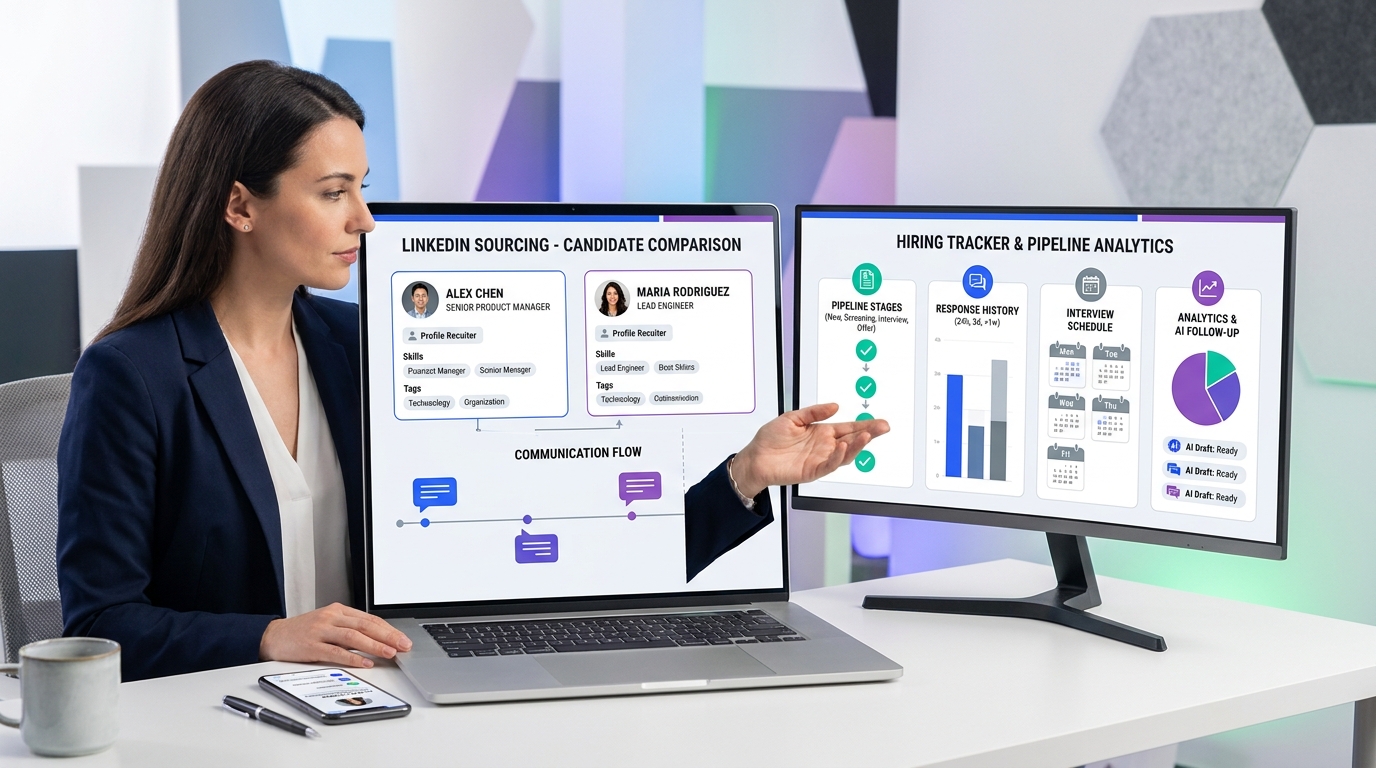
When live searches start slipping, this article helps headhunters judge which candidate tracking tool preserves context, speeds follow-through, and avoids costly hiring mistakes.
That sounds obvious until a live search starts breaking down. A recruiter is juggling inbound applicants, passive outreach, hiring manager updates, interview scheduling, and candidate follow-up, yet the bigger failure usually is not volume alone. It is weak decision discipline. Without a clear hiring tracker, teams lose time on the wrong profiles, miss response windows, frustrate hiring managers, and damage candidate trust because nobody can see which opportunity is actually worth pushing forward.
In my own workflow, tools that add support before the shortlist stage have helped most when they remove repetitive messaging but leave judgment with the recruiter. For LinkedIn-heavy searches, StrategyBrain AI Recruiter is useful for always-on candidate outreach, multilingual follow-up, and collecting resumes or contact details from interested people while the recruiter still owns final qualification, resume review, and next-step decisions. That matters when candidate intent changes after hours and a delayed reply can cost you the conversation.
Think about the decision from the candidate side for a moment, because that is where many searches are quietly won or lost. A finance or accounting professional considering a contract role is often not asking, “Is this job open?” first. They are asking why they should take this opportunity, whether it builds the right industry exposure, whether it closes a skill gap, whether the contract length is clear, and whether the people they will work with are worth learning from. Before accepting interest from a recruiter, they are already weighing career value, project credibility, and the odds that the role leads somewhere better.
Then the process moves into concrete actions. The candidate studies the posting for scope, duration, and required hard and soft skills. In the interview, they ask what the real challenges are, whether the project is truly approved, who the key stakeholders are, and what success should look like by the three-month mark. If your recruiting process cannot capture and respond to those signals consistently, candidate tracking turns shallow. You are no longer evaluating the best recruiting software in abstract terms; you are evaluating whether your candidate tracking tool and hiring tracker can preserve context, communication history, and decision quality from first outreach to offer.
Last reviewed: 2026
Practical takeaway: The best recruiting software is the system that helps recruiters track candidate intent, manage hiring stages, and support informed decisions without burying the team in admin work.
Table of Contents
- Why candidate evaluation logic matters in recruiting software
- What is a candidate tracking tool?
- How to evaluate the best recruiting software
- Must-have features in a hiring tracker
- Where AI and LinkedIn workflows help most
- Best recruiting software by hiring use case
- How to choose the right system
- Common buying mistakes
- FAQ
Why Candidate Evaluation Logic Matters in Recruiting Software
One of the most useful lessons from contract recruiting is that strong candidates do not evaluate opportunities randomly. They compare each role against personal goals, skill development, brand value, compensation, and long-term access to better work. Recruiters should borrow that same discipline when comparing software.
If a candidate can ask, “Will role A or B better advance my goals?” a recruiting team should ask, “Will system A or B better support our actual hiring model?” If a candidate checks whether a project is approved and whether stakeholders are aligned, a buyer should check whether the software supports real recruiter-manager collaboration instead of demo-stage promises.
That is why the best recruiting software is rarely the platform with the loudest feature list. It is the platform that reflects how decisions get made in your environment: how jobs open, how candidates are reviewed, how feedback is captured, and how recruiters keep momentum when candidate interest is fragile.
What Is a Candidate Tracking Tool?
A candidate tracking tool is software that helps recruiters organize applications, record outreach and responses, move people through hiring stages, and keep hiring teams aligned on next steps. In practice, it often sits at the center of an applicant tracking system, but some teams also use the term to describe the part of the stack focused most directly on pipeline movement and visibility.
That distinction matters because search intent around candidate tracking is broad. Some buyers want a lightweight way to replace spreadsheets. Others want the best recruiting software for a more complete workflow that includes sourcing, scheduling, reporting, approvals, and onboarding handoff. Most growing teams eventually need both structure and breadth.
- Centralized records: candidate data, messages, notes, and resumes live in one place
- Clear stage ownership: everyone can see who is moving the process forward
- Better follow-through: fewer candidates disappear between outreach, interview, and offer
- Shared context: hiring managers review candidates with full history, not isolated snapshots
- Faster decisions: recruiters spend less time rebuilding information across tools
For agency recruiters, this structure improves submission quality and response speed. For in-house teams, it reduces handoff friction across recruiter, coordinator, and hiring manager workflows.
How to Evaluate the Best Recruiting Software
From a practitioner standpoint, the best way to evaluate recruiting software is to use the same three-step logic a careful candidate uses when judging a contract opportunity: start with goals, inspect the details, then test assumptions in conversation.
1. Start with your hiring goals
Before demos, ask the equivalent of the candidate’s self-check questions:
- Why are we changing systems now?
- Do we need stronger candidate tracking, better outreach discipline, or reporting clarity?
- Are we hiring for occasional niche roles, steady corporate growth, or high-volume pipelines?
- Which gaps hurt us most today: speed, visibility, collaboration, or candidate experience?
This keeps software selection tied to business need rather than feature theater.
2. Inspect the workflow details
Just as a candidate reads the job posting for contract duration, skills, and scope, a buyer should inspect the daily workflow details that predict success. This is where a hiring tracker either proves useful or falls apart.
| Evaluation Area | Why It Matters | What to Check |
|---|---|---|
| Pipeline design | Determines whether stages reflect real hiring work | Can stages vary by role type without admin friction? |
| Communication tracking | Protects candidate context and recruiter continuity | Are outreach, replies, and handoffs visible in one record? |
| Scheduling flow | Prevents slowdowns after shortlist | How much back-and-forth is removed? |
| Reporting | Shows bottlenecks and source quality | Can you track stage aging, response rates, and conversion? |
| Integrations | Reduces duplicate admin | Does it connect with email, calendars, HRIS, and sourcing tools? |
| Configuration effort | Affects adoption and maintenance | Who will own setup, permissions, templates, and cleanup? |
3. Test assumptions in the demo
Candidates use the interview to ask about challenges, stakeholder alignment, and expected deliverables. Buyers should do the same with vendors. Ask to see the messy parts:
- How does the system handle changing hiring requirements?
- What happens when multiple stakeholders review the same candidate late?
- How easily can recruiters recover context after a long gap in communication?
- How are rejected, silver-medalist, and future-fit candidates tracked for later reuse?
If a demo cannot survive real recruiting questions, it will not survive daily usage.
Must-Have Features in a Hiring Tracker
Most teams comparing the best recruiting software end up converging on the same core capabilities, but the real test is whether those features support decision quality, not just workflow visibility.
Job posting and distribution
Your system should let recruiters publish efficiently across the channels they actually use, while preserving a clean application flow and clear requisition ownership.
Candidate profile organization
Resumes, outreach notes, contact details, interview history, and attachments should be easy to find. Poor profile structure weakens future candidate tracking because recruiters stop trusting the database.
Pipeline movement and stage control
This is the core of a true candidate tracking tool. If you cannot see where candidates stall, why they stalled, and who owns the next move, your system is only storing names.
Interview scheduling
Scheduling is one of the most common hidden delays in recruiting. Software should reduce manual coordination rather than create another place to check.
Feedback collection
Structured scorecards and stage-based comments help prevent vague evaluations and late manager feedback. That is especially important when candidates are comparing multiple opportunities at once.
Search and rediscovery
Many recruiters underestimate how valuable it is to return to prior applicants, past finalists, or passive contacts. Searchability turns old activity into current pipeline value.
Reporting and analytics
Strong analytics should help you explain source quality, funnel conversion, time in stage, and manager responsiveness in operational terms, not just dashboard terms.
Where AI and LinkedIn Workflows Help Most
AI can improve recruiting performance when it supports the parts of the workflow that are repetitive, time-sensitive, and easy to lose track of. It is less useful when positioned as a substitute for recruiter judgment.
In my own LinkedIn-heavy searches, the highest-value support has been in outreach continuity. Candidates often reply after hours, switch languages, or show initial interest but only send a resume after a few follow-ups. That is exactly where AI Recruiter has practical value. It can maintain candidate communication around the clock, continue conversations in the candidate’s language, introduce the opportunity, answer basic role questions, and collect resumes or contact information from interested people. I still review the profile myself, decide whether the background truly fits, and control who moves to interview.
That division of labor is important. The tool handles repetitive top-of-funnel communication; the recruiter remains accountable for judgment, qualification, and stakeholder advice. For agency recruiters and internal teams alike, that can reduce missed opportunities without turning the workflow into blind automation.
If your process depends heavily on LinkedIn sourcing, it is also worth reviewing the vendor’s deeper material on conversation handling and workflow setup, such as the three-step setup overview and the broader LinkedIn recruiting usage notes. The key is to use AI where response speed matters most, not where hiring judgment matters most.
Best Recruiting Software by Hiring Use Case
The “best” system changes with the shape of your hiring work. The opening candidate-side example matters here because software fit is contextual in the same way role fit is contextual.
Small teams replacing spreadsheets
Smaller firms often need a clean hiring tracker that is easy to implement and simple enough for inconsistent hiring cycles. Usability matters more than advanced architecture.
Agency and search workflows
Agency recruiters need speed, communication history, candidate rediscovery, and fast client submission workflows. A strong system should support quick movement without losing notes or relationship context.
Corporate teams with stakeholder complexity
In-house teams need approvals, hiring manager visibility, interview coordination, and better handoffs across recruiters and HR partners. Collaboration design matters as much as sourcing.
High-volume hiring
At scale, candidate tracking must stay usable under pressure. Bulk actions, screening routes, scheduling efficiency, and communication consistency matter more than presentation polish.
LinkedIn-driven sourcing motions
If a large share of your funnel begins with outbound outreach, your core ATS may need support from an AI layer built for communication continuity. In those cases, a recruiter may use the ATS as the system of record and pair it with StrategyBrain AI Recruiter for initial outreach, after-hours replies, and multilingual candidate engagement.
How to Choose the Right System
If you want a practical selection sequence, use this one:
- Clarify your end goal. Faster hiring, better quality, improved manager adoption, stronger reporting, or all four?
- Map the current process. Identify where candidates disappear, where feedback slows, and where recruiters rebuild data manually.
- List candidate-side expectations. What information do serious candidates expect quickly and consistently?
- Test with a real requisition. Run a live scenario from posting or sourcing through shortlist and interview scheduling.
- Decide what AI should and should not do. Outreach support is different from final qualification.
- Plan adoption. Software value depends on recruiter and manager behavior after launch.
This approach keeps the choice grounded in hiring reality. It also reflects a truth many teams miss: the best recruiting software should help your team evaluate opportunities and candidates with the same consistency that strong candidates use to evaluate you.
Common Buying Mistakes
- Buying for features, not workflow: attractive demos often hide clumsy daily usage
- Ignoring candidate context: systems fail when they cannot track why a candidate is interested, hesitant, or timing-sensitive
- Over-automating judgment: recruiters should not outsource fit decisions to generic ranking logic
- Underestimating manager usability: when managers avoid the tool, recruiters become data entry staff
- Skipping communication tests: a platform that cannot preserve outreach history weakens relationship recruiting
- Forgetting implementation ownership: templates, permissions, and data hygiene need a real owner
Most bad software decisions are really bad process decisions that only become visible after the contract is signed.
FAQ
What is the difference between a candidate tracking tool and an ATS?
A candidate tracking tool usually refers to the workflow layer that organizes candidates, stages, and communication. An ATS may include that function plus broader capabilities such as job posting, approvals, reporting, and onboarding handoff.
Which features matter most in a hiring tracker?
Pipeline visibility, communication history, scheduling support, collaboration tools, reporting, search, and integrations matter most for most teams. The right priority order depends on hiring volume and process complexity.
How does candidate tracking software improve recruiting?
It reduces information loss, makes stage ownership clearer, supports faster follow-up, and gives recruiters and managers shared visibility into the hiring process.
Can AI replace recruiters in candidate tracking?
No. AI can support repetitive tasks such as outreach, follow-up, and resume collection, but final qualification, stakeholder advice, and hiring decisions still require recruiter judgment.
Is LinkedIn outreach part of recruiting software?
Sometimes. Some teams manage LinkedIn activity outside the ATS, while others pair their core recruiting platform with a specialized AI communication layer to keep top-of-funnel activity moving.
How should small agencies choose the best recruiting software?
Start with process fit, ease of use, and communication visibility. Small agencies usually benefit more from speed and adoption than from a long list of advanced features they may never use.
Conclusion
The best recruiting software is the one that helps your team make better decisions under real hiring pressure. A strong candidate tracking tool does more than move people across stages. It preserves context, supports follow-through, and helps recruiters respond to the same questions serious candidates are already asking about every opportunity.
If you evaluate systems through that lens, the right hiring tracker becomes easier to spot. Look for software that matches your workflow, protects relationship history, improves candidate tracking, and uses AI where speed helps most without blurring recruiter accountability.