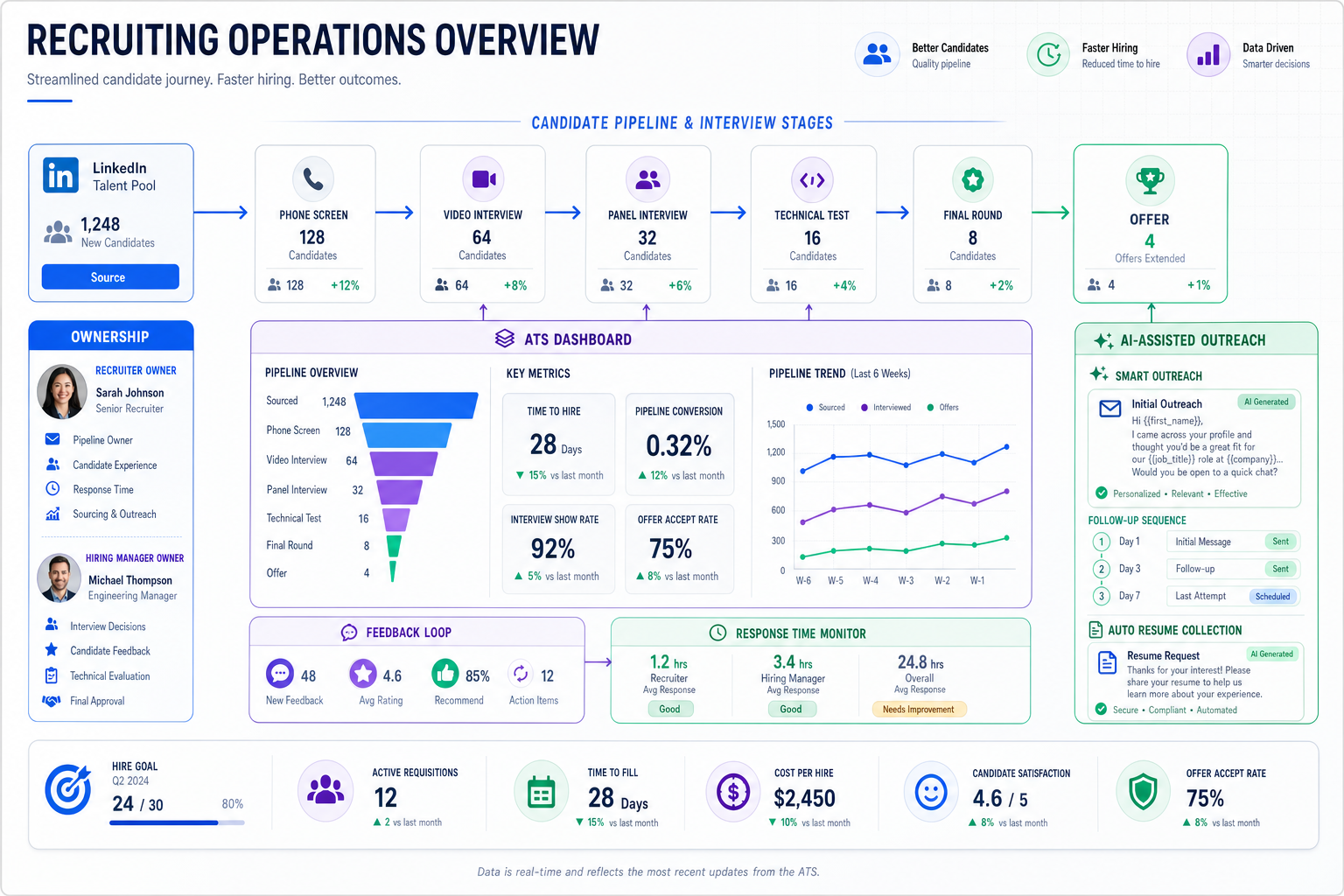
When interview updates slip, this article helps recruiting leaders assess open source recruitment software to avoid candidate drop-off and workflow gaps.
That sounds basic until a live search starts slipping. A recruiter is juggling phone screens, video interviews, panel rounds, technical testing, and follow-up messages that arrive after hours. A small agency owner feels the margin pressure when consultants spend too much time chasing updates. An in-house recruiter feels it when hiring managers assume candidates are being moved forward, while no one has logged feedback. And an independent headhunter feels it most sharply when a strong prospect goes cold simply because the next step was not recorded or answered fast enough.
In my own workflow, I have found that StrategyBrain AI Recruiter can reduce that front-end chaos when LinkedIn outreach and candidate replies start piling up. The most useful part is not replacing recruiter judgment. It is handling repetitive first-contact work, keeping conversations moving across time zones, and collecting resumes or contact details from interested candidates so the recruiter can focus on fit, resume review, and the final decision on who should move to interview.
The candidate-side reality behind this is easy to overlook. Interview conditions are rarely uniform: some conversations happen by phone, some by video, some in groups, some through technical testing, and some with interviewers who seem disengaged or unprepared. One interview infographic cited an average interview length of 40 minutes, noted that 60% of managers use video interviews, and highlighted that 17% of candidates felt the employer was not knowledgeable while 21% said the interviewer seemed bored or unenthusiastic. Those numbers describe candidate experience, but they also expose recruiting operations problems.
Picture the actual handoff. A recruiter sends a candidate into a video interview, then checks LinkedIn for a late reply from another prospect, updates one applicant to a technical round, and reminds a hiring manager to submit notes from a panel discussion. If the system does not capture interview type, timing, ownership, and communication history cleanly, the candidate experiences the employer as disorganized long before anyone talks about offer close rates or employer brand. That is exactly why the best recruiting software is not just a database question. It is an execution question, and that is where open source applicant tracking and open source applicant tracking software deserve a closer look.
Table of Contents
- Quick Answer
- Why Interview Readiness Matters in ATS Selection
- What Open Source Recruitment Software Actually Means
- Who Open Source ATS Tools Are Best For
- Open Source Recruiting Software Comparison
- Features That Matter Most for Recruiters
- Open Source vs SaaS ATS
- How AI-Supported Workflows Fit In
- How to Evaluate the Best Recruiting Software
- Common Buying Mistakes
- FAQ
- Conclusion
Quick Answer
If your team wants control over workflow design, hosting, and data portability, open source recruitment software can be a smart choice. If your team values faster rollout, structured support, and less operational upkeep, a commercial ATS may fit better. In practice, the best recruiting software is the one that helps recruiters manage real hiring complexity: multiple interview formats, candidate follow-up, stage visibility, feedback collection, and clean recruiter-to-hiring-manager handoffs.
That matters because candidates do not experience your software category. They experience your process. When interview logistics are unclear, when video links arrive late, when technical assessments are not tracked, or when interviewers appear unprepared, the recruiting team feels the consequences in drop-off, slower decisions, and weaker trust. The real applicant tracking system benefits come from making those moments predictable.
Why Interview Readiness Matters in ATS Selection
Most ATS buying conversations start with a feature checklist. In day-to-day recruiting, that is usually backwards. A better starting point is interview readiness: can the system support the different interview situations your team actually runs?
The reference data above points to a simple truth. Candidates move through unpredictable interview experiences, and recruiters are the ones stitching those experiences together. A phone screen has different needs from a group interview. A technical test requires clearer preparation than a standard first round. A video interview creates timing and communication risks that do not exist in an in-person meeting. Software that treats all of those moments as the same generic stage often creates hidden work for the recruiter.
From an operations standpoint, interview-ready software should answer five practical questions:
- Do we know what type of interview is happening next?
- Can everyone see who owns the next step?
- Can candidate communication continue without delay?
- Can hiring managers submit structured feedback quickly?
- Can recruiters review the full interaction history before deciding what to do next?
If the answer is no, the process breaks down in ways candidates immediately notice. That is why many teams exploring open source applicant tracking are really searching for process control, not just lower software cost.
What Open Source Recruitment Software Actually Means
Open source recruitment software usually refers to recruiting technology whose source code can be accessed, modified, and deployed by the organization using it. In real buyer language, that often overlaps with open source applicant tracking, open source applicant tracking software, and open source ATS.
An ATS is the workflow engine for hiring. It handles requisitions, jobs, candidate records, interview stages, notes, resume storage, communication history, and offers. Some tools are ATS-first. Others are hiring modules within larger HR systems. Others act more like CRM or workflow layers around recruiting. That distinction matters because a team struggling with interview coordination usually needs ATS-first clarity, not a broad HR platform where recruiting is only one module.
The important question is not whether the code is open. The important question is whether the workflow can be shaped around your recruiting reality. If you run many video interviews, technical evaluations, or hiring-manager-heavy processes, your software should reflect that.
Who Open Source ATS Tools Are Best For
Not every team should choose an open source stack. The strongest fit is usually a hiring team with a defined process owner and some internal technical support. The absence of license fees does not remove the need for administration, security, upgrades, permissions, and integrations.
Startups and lean internal teams
Startups often like open source recruitment software because it offers flexibility without forcing them into enterprise-level purchasing too early. A lean team can define custom stages, application forms, or approval flows that reflect its actual hiring process. The risk is underestimating setup and maintenance. If no one owns the system after launch, recruiters will drift back to spreadsheets and inboxes.
Staffing agencies and headhunters
Agencies need fast search, source tracking, candidate ownership, and clear movement across many live searches. An open source applicant tracking system can help if it supports recruiter-heavy activity and not just basic HR administration. This is especially true when consultants are coordinating multiple interview formats for different clients at once.
Technical organizations with in-house IT support
This is often the best match. Teams with internal administrators or developers can customize workflows, self-host where needed, and build integrations that align the ATS to actual hiring operations. They are also more likely to benefit from data portability and process-specific control.
Practical takeaway: if nobody can clearly answer who will own user permissions, upgrades, and workflow changes six months from now, treat that as a selection risk.
Open Source Recruiting Software Comparison
Recruiters researching this category often encounter a mix of ATS-first systems and broader HR platforms. They should not be compared as if they solve the same problem in the same way.
| Tool | Category Fit | Best For | Key Strength | Watchouts |
|---|---|---|---|---|
| OpenCATS | ATS-first | Teams wanting classic applicant tracking workflows | Relevant for recruiters who specifically want open source ATS functionality | Can require hands-on maintenance and a tolerance for older UX patterns |
| Odoo Recruitment | Recruitment module in a broader business suite | Organizations linking hiring to wider operational systems | Useful when recruiting is one part of a larger business stack | May feel less ATS-focused for recruiter-heavy workflows |
| ERPNext HRMS | HRMS with recruitment capability | Teams seeking HR and hiring in one environment | Supports broader people operations beyond applicant flow | Recruiters should validate pipeline usability and interview management depth |
These are not interchangeable choices. If your biggest pain is managing interview formats, recruiter follow-up, and hiring manager responsiveness, ATS-first design usually matters more than broad HR breadth.
In my own practice, I would also separate ATS selection from outbound sourcing execution. A team might use an ATS to govern pipeline movement and pair it with AI Recruiter for LinkedIn-first outreach, multilingual follow-up, and after-hours reply handling. That split can be useful when the ATS is strong at recordkeeping but weak at keeping candidate conversations alive between stages.
Features That Matter Most for Recruiters
When recruiters compare open source applicant tracking software, they often focus too much on openness and too little on operating rhythm. The best tools reduce friction around the actions recruiters repeat every day.
1. Requisition and job posting control
If jobs are hard to create, approve, edit, and publish, the workflow usually breaks before recruiting even starts. This is the front door of process discipline.
2. Candidate pipeline visibility
This is the core of open source applicant tracking. Recruiters need clear stages, ownership, status movement, and visibility across active searches. Hiring managers need access without creating confusion.
3. Interview-type tracking
The opening case makes this especially important. The ATS should distinguish between phone, video, panel, technical, and final interviews in a structured way. If every step is just labeled “interview,” recruiters end up rebuilding the detail elsewhere.
4. Communication history
Candidate replies should not disappear across inboxes, LinkedIn, and recruiter notes. A recruiter deciding whether to move someone to the next round needs the full context, especially when timing matters.
5. Resume collection and storage
Some teams need parsing. Others mainly need clean storage and searchable records. Either way, the system should make it easy to review materials before deciding on next steps.
6. Scheduling and feedback capture
This is where many teams feel the real advantages of applicant tracking system adoption. The right system reduces back-and-forth, keeps interviewers aligned, and creates a reliable place for structured feedback.
7. Source tracking and integrations
Without source tracking, teams struggle to understand where quality candidates come from. Without integrations, recruiters waste time moving information from one place to another.
Key insight: The best recruiting software does not just store applicants. It keeps interview preparation, candidate communication, and feedback handoffs from falling apart.
Open Source vs SaaS ATS
This choice is really about control versus convenience.
| Factor | Open Source Applicant Tracking Software | Commercial SaaS ATS |
|---|---|---|
| Hosting | Often self-hosted or self-managed | Usually vendor-hosted |
| Customization | Potentially high with internal capability | Usually limited to vendor settings |
| Data portability | Often a major advantage | Depends on export policy and vendor design |
| Support | May rely on internal team or community | Usually formal support and SLA structure |
| Maintenance | Your team handles upgrades and patches | Vendor manages core maintenance |
| Total cost of ownership | License savings can be offset by upkeep | Subscription cost may reduce internal admin burden |
The “free” label can be misleading. Hosting, implementation, compliance review, integration work, and maintenance all have real cost. A fair comparison should include staff time, not just software price.
For recruiting leaders, the practical test is simple: does your team gain enough workflow control to justify the extra ownership burden? If yes, open source may be worth it. If not, a SaaS ATS may be more efficient.
How AI-Supported Workflows Fit In
Many buyers now expect AI features, but the useful question is where automation actually helps the recruiter. In my experience, the strongest use cases are first-touch outreach, candidate response handling, multilingual communication, and resume collection before human review.
That is where StrategyBrain AI Recruiter fits well beside an ATS. I have used it as a support layer for LinkedIn-heavy sourcing when candidate replies arrive outside business hours or across regions. It helps keep conversations active, answers role-level questions, and gathers resumes or contact details from interested candidates. What it does not replace is the recruiter’s evaluation of fit, the reading of the resume, or the decision to shortlist, interview, or reject. That division of labor is important.
For teams evaluating open source recruitment software, this matters because not every ATS needs to do everything natively. Sometimes the better model is a stable applicant tracking core plus an AI-supported communication layer that keeps the front end of the funnel from stalling.
Practical takeaway: ask every provider to explain, in plain language, where automation changes candidate ranking, communication, or screening, and where human review still governs the outcome.
How to Evaluate the Best Recruiting Software
If you want a useful buying process, evaluate software against the way recruiting work actually unfolds.
- Define your hiring reality. Are you running direct hire searches, agency workflows, technical recruiting, or founder-led hiring?
- Map interview complexity. List the interview types you actually use: phone, video, panel, technical, take-home, final round.
- Choose the right category. Decide whether you need ATS-first software, a broader HRMS module, or a workflow layer around your current stack.
- Document communication points. Note where candidates reply, where resumes arrive, and where recruiters lose context today.
- Assess ownership capacity. Who will handle hosting, upgrades, user permissions, and issue resolution?
- Test hiring manager usability. If occasional users cannot leave feedback easily, recruiters end up carrying admin work.
- Calculate total cost of ownership. Include maintenance, support, implementation, integration, and compliance effort.
This framework helps connect open source applicant tracking software to operational outcomes. A system is only valuable if recruiters and hiring managers actually use it the way the process requires.
Common Buying Mistakes
- Confusing open source with low effort. Open code does not eliminate administration.
- Ignoring interview workflow detail. If the system cannot cleanly track interview types and handoffs, recruiters compensate manually.
- Choosing by feature count. Workflow fit matters more than checklist size.
- Overestimating internal support. Systems without clear ownership often become half-used systems.
- Treating all recruiting software as one category. ATS, CRM, HRMS modules, and sourcing automation solve different problems.
- Assuming automation replaces judgment. Recruiters still need to evaluate resumes, candidate fit, and hiring manager feedback.
A simple test works well here: run one realistic search through every system you consider, including sourcing, candidate reply handling, interview setup, and feedback collection. That reveals workflow truth faster than a polished demo.
FAQ
What is an open source applicant tracking system?
An open source applicant tracking system is recruiting software whose code can usually be accessed and modified by the organization using it. In practice, it may offer more control over hosting, customization, and data portability than a typical SaaS ATS.
Is open source recruiting software the same as an open source ATS?
Often, but not always. Open source recruiting software can refer to ATS-first tools, recruitment modules in HR systems, or broader hiring workflow software. Open source ATS is the narrower recruiting-specific term.
Who is open source applicant tracking software best suited for?
It is usually best for teams with clear process ownership and at least some technical support, including startups, staffing agencies, and technical organizations that want more workflow control.
Why does interview workflow matter when choosing recruiting software?
Because candidates experience your process through interview preparation, timing, communication, and follow-up. If the software cannot support those moments clearly, recruiters create manual workarounds and candidates notice the inconsistency.
Can AI tools work alongside an open source ATS?
Yes. Many teams use an ATS for pipeline control and pair it with communication automation for sourcing or follow-up. The key is keeping recruiter judgment in the decision loop.
What are the main advantages of applicant tracking system adoption?
The main advantages of applicant tracking system use are visibility, consistency, cleaner collaboration, and faster movement from one hiring step to the next. Those gains are strongest when the workflow matches how the team actually hires.
Conclusion
The search for the best recruiting software gets easier when you stop treating software selection as a generic feature contest. The more useful question is whether the system keeps recruiting work coherent across real interview conditions, recruiter follow-up, hiring manager feedback, and candidate communication.
If your team wants control, customization, and self-hosting, open source recruitment software is worth serious evaluation. If your priority is faster deployment and less maintenance, a managed ATS may be the better choice. Either way, the winning system is the one that prevents process breakdown where candidates feel it first.
That is also why I see value in pairing strong applicant tracking with tools like StrategyBrain AI Recruiter when LinkedIn outreach, response speed, and after-hours communication become bottlenecks. The recruiter still owns judgment. The software should own the friction. That is the standard worth using when you evaluate open source applicant tracking and open source applicant tracking software for your team.