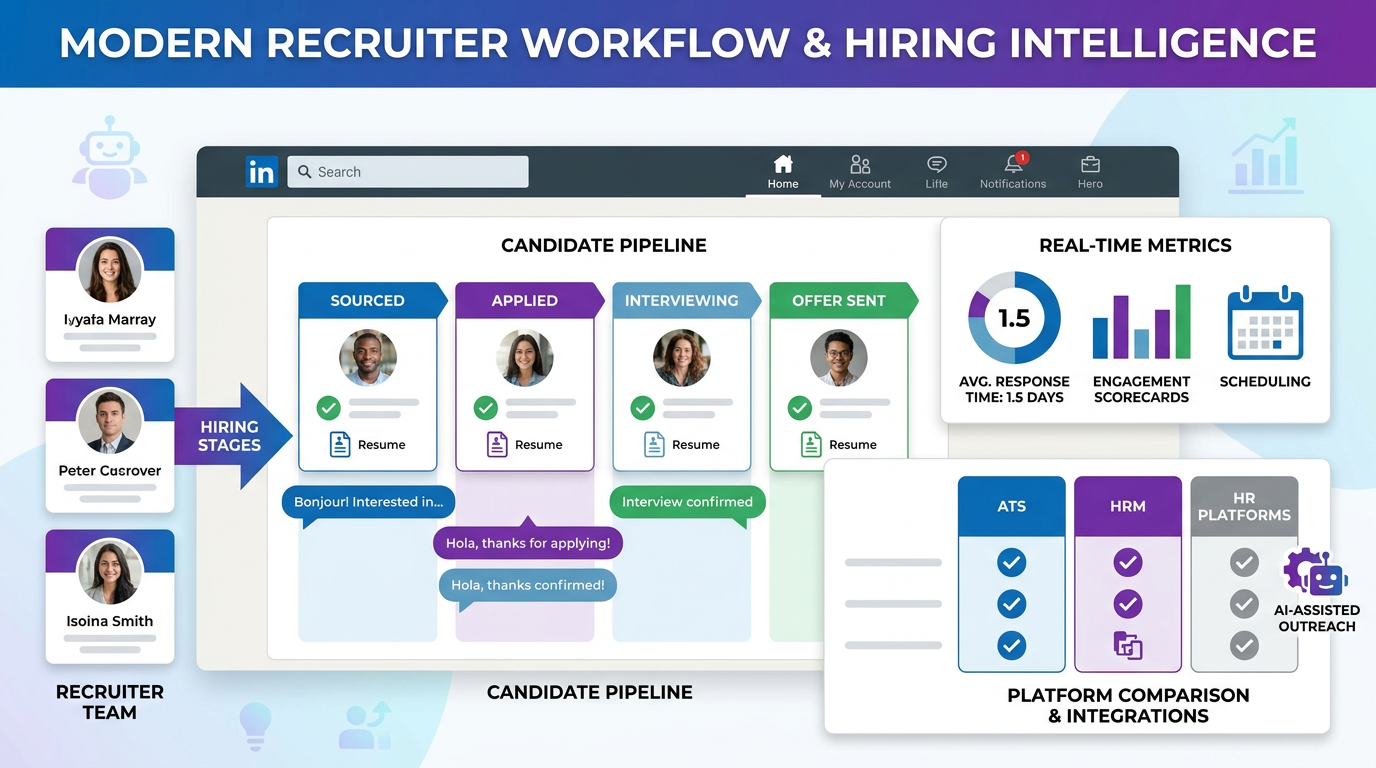
When candidate drop-off is rising, this article helps recruiters judge human resource recruitment software by workflow gaps that cost hires.
That matters most when recruiters are not just filling seats but competing for people who expect growth, steady feedback, flexibility, and values they can recognize in the employer. When those signals break down, the damage is immediate: slower response times, weaker recruiter credibility, more follow-up work, and a hiring process that feels fragmented to both candidates and managers.
In that gap between candidate expectation and recruiter follow-through, I have found AI Recruiter useful as workflow support rather than a substitute for judgment. It helps with two pressure points that often cause drop-off in LinkedIn hiring: timely multilingual outreach and after-hours candidate replies, plus the repetitive work of collecting resumes and contact details once interest is confirmed. The recruiter still decides who is qualified, who moves forward, and how the shortlist is evaluated.
That became especially clear in hiring situations where the candidate was evaluating the employer as much as the employer was evaluating the candidate. In finance and accounting teams, for example, younger professionals often weigh an opportunity by asking practical questions: Will this company invest in development? Will I get useful feedback and mentorship? Is there real flexibility in how the work is done? If the recruiter cannot answer quickly, cannot keep the conversation going, or loses the thread between LinkedIn messages, resume collection, and next-step follow-up, the candidate reads that as a signal about the company itself.
So the software question is not just which system posts jobs or stores applicants. It is whether your recruiting stack can support the real decision criteria candidates use today while giving recruiters cleaner execution. That is why the search for the best recruiting software now overlaps with human resource recruitment software, top hrm software, and broader hr platforms: hiring teams need systems that connect recruiting workflow, communication quality, and downstream HR operations.
Table of Contents
- Why the best recruiting software is no longer just an ATS
- What candidates now expect from the hiring process
- ATS vs HRM vs HR platforms
- Best recruiting software by use case
- Features that matter most
- LinkedIn and AI-supported recruiting workflows
- Candidate experience and retention signals
- Integrations and operational fit
- Structured hiring, compliance, and fairness
- How to choose the right system
- Common buying mistakes
- FAQ
Why the best recruiting software is no longer just an ATS
The old buying logic was simple: if a team needed more order, it bought an applicant tracking system. That still matters, but it is no longer enough. In current hiring markets, recruiting teams are also judged on communication speed, coordination quality, employer credibility, and how well they reflect the actual employee experience candidates hope to find after they join.
That is why the category has expanded. The best recruiting software may be a focused ATS, a recruiting CRM, a broader HRM suite, or one of the larger hr platforms that ties hiring to onboarding and people operations. Buyers searching for human resource recruitment software are often trying to solve a broader operational problem: how to create a hiring process that is organized internally and convincing externally.
From a recruiter's perspective, the practical definition is straightforward. Recruiting software should help your team attract candidates, manage the pipeline, communicate consistently, coordinate decisions, and move accurate data into the next HR workflow without recreating everything manually.
What candidates now expect from the hiring process
The reference point that many employers miss is that candidates do not assess an opportunity on compensation alone. Across professional roles, especially among younger and mid-career talent, they often look for four things early: room to grow, regular feedback, flexibility, and evidence that the company's values are real in day-to-day work.
Those expectations shape software needs more than many buying teams realize.
- Growth and development: Recruiters need a system that lets them track candidate questions, preserve context, and communicate a role clearly across multiple touchpoints.
- Feedback and mentorship signals: Hiring managers need structured scorecards and timely follow-up so the process feels deliberate, not improvised.
- Flexibility: Scheduling tools, messaging options, and remote-friendly workflows matter because candidates notice friction quickly.
- Values alignment: Consistent communication and documented process are part of how fairness and professionalism are perceived.
In other words, what looked in the reference article like an employee-retention issue is also a recruiting-operations issue. If a company says it offers mentorship, flexibility, and meaningful work, but its hiring process is slow, opaque, and disjointed, candidates notice the contradiction before they ever sign an offer.
Practical takeaway: software cannot create a strong employer value proposition, but weak recruiting systems can absolutely undermine one.
ATS vs HRM vs HR platforms
One reason teams struggle to choose the best recruiting software is that they compare different software categories as if they were interchangeable. They are not.
| Category | Main purpose | Best for | Main caution |
|---|---|---|---|
| Applicant Tracking System (ATS) | Job posting, applicant tracking, interview workflow, offer movement | Recruiters who need focused pipeline control | May require separate HR and onboarding integrations |
| Recruiting CRM | Talent pooling, passive candidate engagement, nurture campaigns | Search firms and sourcing-heavy teams | Often weaker for formal requisition controls |
| HRM or HRIS software | Employee records, approvals, workflow, core HR administration | HR teams wanting connected operations | Recruiting can be lighter than a dedicated ATS |
| All-in-one HR platforms | Recruiting, HR, onboarding, payroll, workforce workflows | Mid-market and enterprise standardization | Broader scope can mean slower implementation or less recruiting depth |
If you are reviewing top hrm software, ask a blunt question: is recruiting a serious operating module or just an add-on? Many HRM suites are perfectly serviceable for basic hiring, but they may fall short when recruiters need relationship management, faster communication, talent pooling, or more flexible workflow automation.
Likewise, not all hr platforms have the same maturity in hiring. Some are strongest after the candidate becomes an employee. Others are better at sourcing, coordination, and interview process management.
Best recruiting software by use case
The best buying decisions come from matching software to hiring motion, not to generic product claims.
Small businesses and lean internal teams
Smaller teams usually need speed to adoption, straightforward job posting, clean applicant tracking, and easier collaboration with hiring managers. The value is less about complexity and more about replacing scattered email chains and spreadsheets with one visible process.
For this group, a lighter ATS or practical human resource recruitment software setup often works better than a heavy suite. If hiring volume is modest, overbuying creates friction fast.
Recruiting agencies and individual headhunters
Agency teams often need a combination of ATS discipline and CRM-style outreach. Candidate communication, talent pool management, fast resume capture, and low-friction follow-up become critical. This is also where LinkedIn workflow support can matter most.
In my own experience, using AI Recruiter worked best when the bottleneck was not final assessment but repetitive top-of-funnel activity. It handled first-touch outreach, ongoing message replies outside working hours, and resume collection from interested candidates, which reduced the amount of manual backtracking I normally had to do in LinkedIn. What it did not replace, and should not replace, was recruiter review of fit, shortlist quality, and final client or manager alignment.
Mid-market hiring teams
Mid-market organizations tend to outgrow basic systems first in approvals, reporting, and coordination. They need better visibility across departments, stronger integrations with onboarding or HRIS tools, and more structured communication with managers.
This is often the decision point between a specialized ATS and broader hr platforms. If recruiting is a major internal function, specialized workflow depth can still win. If centralization across HR matters more, an HRM suite may be the better fit.
Enterprise organizations
Enterprise teams usually care most about governance, configurability, audit trails, multilingual communication, complex permissions, and process consistency across regions. The best system here is rarely the one with the nicest demo. It is the one that can support scale without breaking collaboration between recruiting, HR operations, legal, finance, and hiring managers.
All-in-one people operations buyers
Some companies intentionally want recruiting embedded in a wider HR stack. That can be a smart choice when downstream handoffs matter more than specialized sourcing depth. But teams should test the recruiting workflow carefully, especially for scorecards, scheduling, communication, and reporting. Consolidation is useful only if the hiring team can still work efficiently inside it.
Features that matter most
Buyers looking for the best recruiting software should focus on the capabilities that directly affect execution.
1. Pipeline visibility
A good system should show exactly where candidates sit, who owns the next action, and where delays are forming. If recruiters cannot see stalled movement quickly, high-intent candidates slip away.
2. Communication tools
Email templates, text messaging, self-service updates, and multilingual support all matter. They are no longer optional extras for teams hiring across locations or time zones.
3. Scheduling and coordination
Interview logistics consume too much recruiter time in most organizations. Better scheduling workflow is often one of the fastest operational wins.
4. Reporting and analytics
You should be able to track source quality, time in stage, conversion rates, and workload by recruiter or department. Without that, hiring process improvement becomes guesswork.
5. Workflow automation
Good automation should remove repetitive admin work, not hide decision-making. Stage changes, reminders, approvals, and communication triggers are all strong use cases.
6. Integration coverage
Recruiting software should connect smoothly to HRIS, onboarding, payroll, calendars, and sourcing tools. This is especially important when evaluating top hrm software against standalone systems.
7. Structured hiring support
Scorecards, interview kits, and controlled feedback collection matter because they improve consistency and reduce process drift.
8. Candidate experience controls
If your process cannot reliably deliver timely updates, organized interviews, and documented follow-up, it will struggle in markets where candidates are judging the employer just as hard as the role.
LinkedIn and AI-supported recruiting workflows
AI in recruiting is most useful when it improves speed and consistency in narrow, repetitive parts of the process. The strongest application is not replacing recruiter judgment. It is reducing the admin drag that keeps recruiters from spending time on assessment, calibration, and relationship-building.
For LinkedIn-heavy hiring, that usually means support with:
- Initial outreach to targeted profiles
- Fast replies across time zones or outside office hours
- Role introduction and candidate-interest confirmation
- Resume and contact-detail collection once a candidate opts in
- Multilingual communication where language delay would otherwise slow momentum
That is the context where StrategyBrain AI Recruiter is relevant. I would describe it as a top-of-funnel execution tool for recruiters who spend too much time manually chasing LinkedIn conversations. In practice, what stood out to me was not some abstract AI promise but the simple operational relief: messages kept moving, candidates received replies when they were actually available, and interested people could send resumes without waiting for me to come back online. The final qualification step still sat with me, exactly where it should.
For agency recruiters, independent headhunters, and in-house teams doing active sourcing, that separation matters. AI can help maintain momentum. Recruiters still need to decide who truly matches the brief, who is worth presenting, and what risks remain in the profile.
Candidate experience and retention signals
One of the most useful lessons from the reference article is that attraction and retention are connected much earlier than most software buyers think. Candidates infer future culture from present process. If they care about development, mentorship, flexibility, or values, they look for evidence during hiring.
That means candidate experience is not just a branding issue. It is a software and workflow issue.
- If feedback is slow, they assume internal alignment is weak.
- If scheduling is chaotic, they assume collaboration will be difficult.
- If recruiters cannot answer practical questions about growth or flexibility, they assume the company has not thought seriously about them.
- If communication stops after business hours for globally distributed hiring, they may simply move to another opportunity.
The best recruiting software helps prevent those gaps by making communication easier, ownership clearer, and next steps more visible across the team.
Integrations and operational fit
Operational fit is where many buying decisions succeed or fail. A system can look excellent in demo and still create daily friction if it does not connect properly to the rest of the hiring stack.
At minimum, most teams should evaluate integration quality with:
- HRIS or employee record systems
- Onboarding workflows
- Payroll systems
- Job boards and sourcing channels
- Calendar and email tools
- Background check providers
- CRM or outreach tools
For lean teams, the issue is duplicate entry. For larger teams, it is governance and workflow continuity. If your recruiting data cannot move cleanly into the next stage of employment, you are not choosing software so much as relocating admin work.
This is also why comparing standalone ATS tools with top hrm software requires process mapping first. The question is not whether a connector exists. It is whether that connection reflects your real approval path, handoff rules, and ownership model.
Structured hiring, compliance, and fairness
As hiring becomes more distributed and more visible, teams need systems that support defensible process. Speed matters, but discipline matters too.
Look for features such as:
- Interview scorecards tied to role criteria
- Standardized feedback collection
- Role-based permissions
- Activity history and audit trails
- Consistent templates for hiring manager participation
These features support fairness and make recruiting easier to review internally. They also reinforce the same values candidates increasingly care about: clarity, consistency, and transparency.
How to choose the right system
If you are evaluating the best recruiting software, use a practical process.
- Start with hiring model. Are you mainly managing applicants, actively sourcing, or unifying recruiting inside a larger HR stack?
- Map real breakdown points. Is the problem pipeline visibility, candidate communication, manager feedback, or system handoff?
- List non-negotiables. For example: multilingual messaging, structured scorecards, LinkedIn workflow support, HRIS integration, or reporting.
- Test an actual workflow. Use a sample requisition, one outreach sequence, one interview chain, and one hire-to-onboarding handoff.
- Include hiring managers. A system recruiters love can still fail if managers avoid it.
- Check future fit. Can the platform still support you if hiring volume, geography, or process complexity grows?
This is where human resource recruitment software selection becomes more strategic than feature comparison. You are not only choosing a tool. You are choosing what kind of hiring behavior your system will make easy or difficult.
Common buying mistakes
- Confusing category breadth with recruiting strength. Not every HR suite is strong at talent acquisition.
- Buying for demos instead of daily workflow. Real usage is less glamorous than product tours.
- Undervaluing communication design. Slow or inconsistent outreach loses candidates early.
- Ignoring candidate decision criteria. Development, feedback, flexibility, and values affect acceptance more than some teams assume.
- Skipping operational testing. Integrations and permissions often create more pain than core ATS features.
- Expecting AI to replace recruiter judgment. The best use of AI is admin reduction and faster engagement, not blind qualification.
FAQ
What is recruiting software?
Recruiting software is technology used to manage hiring tasks such as sourcing, job posting, applicant tracking, interview scheduling, candidate communication, and reporting. It may be a standalone ATS, part of a CRM workflow, or embedded in larger hr platforms.
How is human resource recruitment software different from HR software?
Human resource recruitment software focuses on attracting, managing, and moving candidates through hiring. HR software usually covers broader employee administration such as records, payroll, and onboarding. Some top hrm software includes recruiting, but the depth varies widely.
What should small recruiting teams prioritize first?
Ease of use, communication workflow, scheduling support, and clear pipeline visibility usually matter most. Small teams often get better results from simpler systems that people actually use.
When do broader HR platforms make sense?
They make sense when recruiting needs to connect tightly with onboarding, employee records, approvals, and broader people operations. They are especially useful when consolidation matters more than highly specialized sourcing workflow.
How is AI used in recruiting software today?
Common uses include outreach drafting, response handling, scheduling support, candidate-interest confirmation, resume collection, and workflow automation. The most valuable use cases reduce repetitive work while leaving fit assessment and hiring decisions with the recruiter.
Is LinkedIn workflow support worth considering in recruiting software?
Yes, especially for agencies, headhunters, and internal teams doing active sourcing. If LinkedIn is a major channel, tools that improve response speed, follow-up consistency, and resume capture can remove a significant amount of manual effort.
Conclusion
The best recruiting software is not simply the platform with the most features. It is the one that supports how candidates actually evaluate opportunities and how recruiters actually work. In many teams, that means choosing human resource recruitment software that improves communication quality, process visibility, and data handoff just as much as applicant tracking.
If your evaluation includes candidate expectations around growth, feedback, flexibility, and values, the software choice becomes clearer. Some teams will need a focused ATS. Others will prefer top hrm software or larger hr platforms. And for recruiters who live in LinkedIn outreach, AI-supported workflow tools such as AI Recruiter can be a practical layer that keeps candidate engagement moving while preserving recruiter control over final judgment.