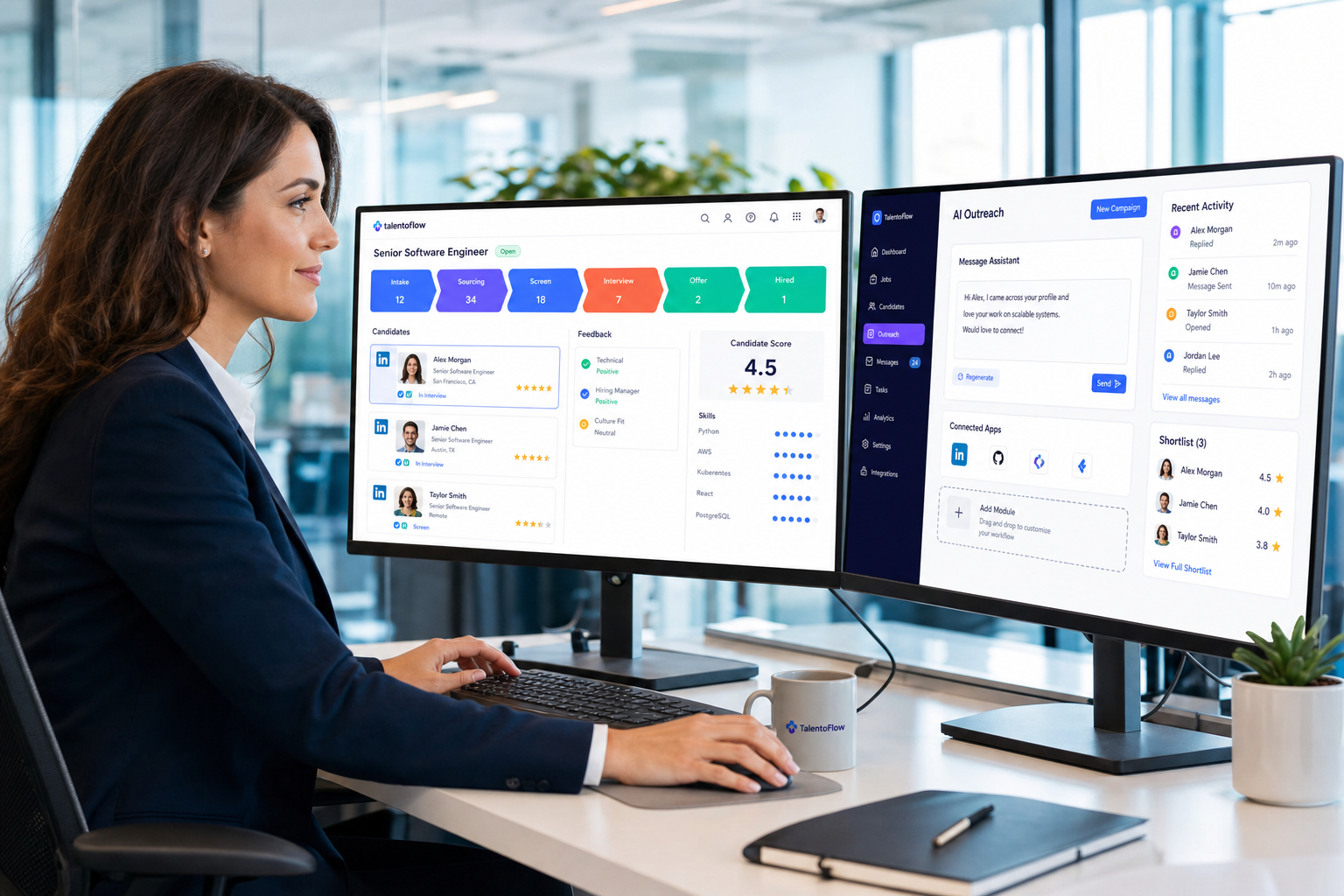
When a search firm owner evaluates open source recruitment software through real intake-to-offer failures, this article helps avoid slower closes and fragmented follow-up.
That sounds simple, but most recruiting teams do not break down because they lack a place to store resumes. They struggle because the process between intake and close is inconsistent. Requisitions get opened without a shared search brief, candidate outreach sits in inboxes or spreadsheets, hiring managers delay feedback, and late-stage offer decisions happen without a reliable record of what was promised or when. For a solo recruiter, that means wasted hours and missed momentum. For a small search firm owner, it means weaker delivery confidence and harder client conversations. For an in-house talent lead, it means avoidable friction with finance, operations, and department heads who expect hiring to move on time.
In my own workflow, I have found that an AI-supported layer can help when the real bottleneck is repetitive outreach and follow-up rather than final judgment. StrategyBrain AI Recruiter is useful here because it can keep candidate communication moving around the clock, handle initial LinkedIn outreach and interest checks, and collect resumes or contact details from people who want to continue the conversation. That matters when candidate replies arrive after hours or across time zones. The recruiter still owns the real recruiting work: reviewing the resume, judging fit, calibrating the shortlist, and deciding what happens next.
The pressure becomes obvious when a company realizes it is running out of time on an important hire and brings in an external recruiter to help secure talent in a specialized field such as finance or accounting. At that moment, nobody is asking for abstract software features. The expectation is practical: the recruiter should arrive with a repeatable method, understand the position well enough to take it to market, and move quickly toward a credible shortlist instead of adding another layer of status meetings.
That same situation also exposes why software choice matters. A recruiter who has to piece together role notes, candidate outreach, market feedback, and offer-stage updates across disconnected tools will struggle to give the transparency and speed clients expect. So when teams search for the best recruiting software, they are usually looking for something more specific than a generic system. They want open source recruitment software, open source applicant tracking software, or a broader open source recruitment stack that supports an established process, better positioning, realistic partnership, and faster close.
Table of Contents
- What Buyers Really Need From Recruiting Software
- What Is Open Source Recruitment Software?
- How Open Source ATS Options Usually Differ
- A Process-First Way to Evaluate the Best Recruiting Software
- Features That Matter Most in Daily Recruiting Work
- The Real Cost of Free and Flexible Software
- How to Choose the Right System for Your Team
- Common Mistakes Recruiting Teams Make
- FAQ
What Buyers Really Need From Recruiting Software
When employers hire a recruiter, they usually expect six things, whether they say them out loud or not: a defined process, data-backed judgment, strong role positioning, transparent partnership, a faster track to qualified candidates, and help getting the offer over the line. Those expectations are useful because they also create a better lens for software evaluation.
In other words, the best recruiting software is not just a digital filing cabinet. It should support the same behaviors a strong recruiter brings to the table:
- Established process: structured stages, consistent records, and clear handoffs
- Data-driven decisions: stage visibility, candidate history, and reporting that informs next steps
- Positioning support: enough context to present the role well and keep messaging aligned
- Partnership and transparency: shared notes, feedback trails, and realistic status updates
- Fast-track execution: quicker shortlist building, interview movement, and follow-up
- Offer and close support: documented approvals, candidate communication, and late-stage coordination
This is why many recruiting teams exploring software end up narrowing the conversation quickly toward ATS functionality. Candidate pipeline control is where process discipline either becomes visible or falls apart.
What Is Open Source Recruitment Software?
Open source recruitment software refers to hiring software whose source code is available under a license that allows review, modification, or self-managed deployment. In practice, many teams use the term to describe systems that help manage job openings, candidates, communication, interviews, and decisions while giving the organization more control over hosting, configuration, and data ownership.
For everyday recruiting operations, that often overlaps with open source applicant tracking software. The ATS is usually the operational center of the hiring process because it holds the requisition, the applicant record, the pipeline stage, the interview history, and the decision trail.
The distinction is still worth keeping in mind:
- Recruitment software is the broader category and may include sourcing, job posting, careers pages, applicant management, and collaboration.
- Applicant tracking software is more specifically focused on moving candidates through a defined hiring workflow.
That difference matters because search results often blend several types of products into one bucket:
- Dedicated ATS platforms built around recruiter workflow
- Open source HR suites with recruiting as one module
- Workflow tools that can be adapted for hiring
- Job publishing tools with light applicant handling
- Scheduling or communication tools that support, but do not replace, an ATS
If your team is trying to improve execution from intake to offer, the first job is to identify which of these categories you actually need. Otherwise, it is easy to choose something that technically qualifies as open source but does not solve the recruiting problem that triggered your search.
Key takeaway: Teams rarely regret having more clarity on process ownership, stage control, and candidate follow-up; they often regret choosing software before those basics are defined.
How Open Source ATS Options Usually Differ
The market is easier to understand when you sort tools by operating model instead of trying to crown one universal winner. Most options fall into a few practical categories.
| Category | What it typically includes | Best for | Main limitation |
|---|---|---|---|
| Dedicated open source ATS | Jobs, candidates, stage tracking, interview workflow, recruiter collaboration | Recruiting teams that want focused pipeline control | May require more setup and lighter native support |
| Open source HR suite with recruitment module | Recruiting plus employee records and broader HR administration | Organizations seeking one platform across hiring and HR | Recruiting workflows may feel less specialized |
| Self-hostable modern recruiting platform | ATS functions with APIs, deployment flexibility, and customizable architecture | Teams with technical ownership and stronger data-control needs | Licensing and support boundaries may need close review |
| Adjacent hiring tools | Scheduling, communication, workflow automation, or posting support | Teams filling one narrow process gap | Not a full replacement for applicant tracking |
The practical lesson is the same one experienced recruiters learn when taking on a search: not every promising option serves the same part of the workflow. Some are stronger at record keeping. Some are stronger at broader HR continuity. Some are better if you want to build around APIs and internal systems. The best recruiting software depends on whether your main pain is process control, broader HR administration, or technical flexibility.
A Process-First Way to Evaluate the Best Recruiting Software
One of the most useful insights from real search work is that software should be judged against recruiting obligations, not vendor language. If a recruiter is expected to bring a method, move fast, give realistic market feedback, and help close, the system should support those same outcomes.
1. Can it support an established hiring method?
Many growing companies do not start with a mature hiring framework. A good system helps create one. That means configurable stages, structured notes, role-specific scorecards, and enough control to make sure each requisition follows a defined path instead of a recruiter-by-recruiter improvisation.
If you are evaluating open source applicant tracking software, test whether the software makes your process more consistent or simply more visible. Visibility without discipline does not solve much.
2. Does it make decisions more data-driven?
Strong recruiters do not just move resumes around. They gather evidence: where candidates drop off, which roles stall, how long feedback takes, and whether the market is responding to the brief. Software should support that with searchable candidate history, activity logs, stage analytics, and reporting that helps you adjust the search.
Without that, teams end up making late-stage decisions from memory, inbox threads, or side conversations.
3. Does it help position the role properly?
In retained or hard-to-fill searches, positioning matters. Recruiters need a place to capture what makes the role compelling, what trade-offs need to be explained honestly, and how the search has been framed to candidates. Even basic fields for role narrative, compensation expectations, benefits context, and stakeholder notes can prevent rework and mixed messaging.
This is also where tools like AI Recruiter can support the process on the sourcing side. I have used it to keep candidate conversations moving when response timing would otherwise slow the search down. It can introduce the opportunity, answer common early questions, and collect resumes from interested prospects, but the recruiter still has to evaluate whether the profile actually fits the brief and whether the role has been positioned appropriately.
4. Will it strengthen partnership and transparency?
A good recruiter does not promise fantasy candidates or hide market friction. The right software should make that partnership easier by keeping hiring teams aligned on open requisitions, active candidates, pending feedback, and blockers.
Look for:
- Shared visibility into stage movement
- Clear ownership of next steps
- Feedback capture tied to candidate records
- Notes that preserve market calibration conversations
- Audit trails around approvals and decisions
This matters because transparency is not just a client-service issue. It reduces wasted interview cycles and helps teams adjust when the original search assumptions do not match the market.
5. Can it accelerate shortlist and close without creating chaos?
Speed in recruiting is not only about sending more messages. It is about reducing avoidable friction between sourcing, screening, interview scheduling, feedback, and offer coordination. The best recruiting software should help the team compress those handoffs without losing decision quality.
That is why a practical workflow often combines an ATS with a communication layer. In my experience, an ATS keeps the record straight, while a tool like StrategyBrain AI Recruiter helps maintain candidate momentum on LinkedIn outside working hours and across markets. The recruiter still reviews resumes, decides who advances, and owns the shortlist.
Features That Matter Most in Daily Recruiting Work
Whatever category you choose, the most valuable features are usually the ones that support the sequence of real recruiting work, not the longest checklist.
| Feature | Why recruiters care | Why hiring teams care |
|---|---|---|
| Requisition management | Keeps intake and approvals organized | Clarifies what is actually open and prioritized |
| Candidate pipeline tracking | Makes next actions visible | Improves accountability around feedback |
| Resume and candidate record storage | Preserves history in one place | Reduces repeat review and context loss |
| Structured feedback capture | Supports fairer evaluation and cleaner debriefs | Helps stakeholders compare candidates consistently |
| Interview coordination support | Reduces scheduling drag | Speeds movement between stages |
| Offer workflow visibility | Prevents late-stage confusion | Aligns approvals, timing, and communication |
| Careers page or posting tools | Simplifies publishing and applicant flow | Improves consistency for live openings |
| API or integration flexibility | Connects outreach, calendars, and reporting | Supports cleaner operational handoffs |
When I review software, I focus less on isolated features and more on whether the system preserves continuity from one recruiting obligation to the next: intake, market positioning, outreach, response handling, shortlist review, stakeholder feedback, and close. That is where the operational value of open source recruitment really shows up.
The Real Cost of Free and Flexible Software
One of the most common mistakes in this market is treating open source as a cost category instead of an operating model. License fees may be low or nonexistent, but implementation and maintenance are real.
With open source recruitment software, the practical costs often include:
- Setup: workflow design, permissions, and process mapping
- Hosting: infrastructure, security, backups, and uptime monitoring
- Maintenance: updates, compatibility checks, and issue handling
- Integration work: email, calendars, reporting, HR systems, and custom connections
- Training: recruiter adoption, hiring manager usage, and admin handoff
- Support ownership: internal technical resources or outside implementation help
That does not make open source a bad choice. It simply means the value proposition is usually control, flexibility, and data ownership rather than effortless savings. For some teams, that is exactly the right trade-off. For others, especially smaller firms with limited technical support, the maintenance burden can outweigh the licensing advantage.
The same logic applies when you add sourcing automation or communication tools. The benefit comes when each layer solves a clear workflow problem. If LinkedIn follow-up is the bottleneck, an AI communication layer may be worth it. If stage discipline is the problem, no messaging tool will replace an ATS.
How to Choose the Right System for Your Team
If you want a realistic selection process, score each option against your actual recruiting environment rather than against a generic “best software” list.
1. Define your recruiting model first
Are you running retained search, contingency search, in-house hiring, or a mixed model? A solo recruiter handling specialized roles has different needs from an HR team managing volume hiring across departments.
2. Clarify who owns the system after launch
This is one of the least glamorous but most important questions. Self-hosted and customizable systems are only as good as the team that maintains them. Decide who handles updates, permissions, integrations, and workflow changes.
3. Map the points where your process currently breaks
Look at where searches lose momentum:
- Role intake lacks detail
- Sourcing messages go unanswered or unmanaged
- Hiring manager feedback is slow
- Candidate records are fragmented
- Offer-stage communication is inconsistent
Then assess whether the software addresses those failures directly.
4. Separate sourcing support from ATS depth
Some teams confuse outreach capability with core applicant tracking. They are related, but not the same. An ATS should manage the record and workflow. A sourcing or communication layer should help generate and maintain candidate engagement.
That distinction is why I would not use AI Recruiter as a replacement for an ATS, but I would absolutely use it alongside one when LinkedIn sourcing volume and after-hours follow-up are slowing a search down. It is most helpful when the recruiter needs to maintain more consistent outreach, handle multilingual communication, and capture resumes or contact details faster, while still keeping final qualification in human hands.
5. Review license, export, and data-control terms carefully
Not all open source projects offer the same rights or long-term flexibility. Verify what you can modify, how data can be exported, and whether the deployment model matches your security and compliance requirements.
6. Test on a real requisition, not a demo fantasy
The best way to evaluate software is to run one realistic workflow through it: intake, candidate outreach, response logging, shortlist review, interview coordination, and offer approval. This quickly reveals whether the system supports the kind of recruiter-client partnership your searches actually require.
Common Mistakes Recruiting Teams Make
Even experienced teams can make poor software decisions when urgency takes over. These are the patterns I see most often.
Mistake 1: Buying for features instead of recruiting obligations
If the system cannot help your team run a disciplined search, it will not become the best recruiting software just because the checklist is long.
Mistake 2: Confusing communication speed with qualification quality
Faster outreach helps, but it does not remove the need for recruiter judgment. A tool can surface interested candidates and collect resumes; it does not replace search calibration or shortlist evaluation.
Mistake 3: Ignoring the reality-check function
Recruiters often need to tell stakeholders when the brief, compensation, or timing does not match the market. Your software should make those signals visible rather than burying them in private notes.
Mistake 4: Underestimating maintenance effort
Self-hosting and deep customization sound attractive until the internal owner gets busy or leaves. Operational ownership needs to be explicit.
Mistake 5: Treating “open source” as the strategy by itself
Open source applicant tracking software is a deployment and control choice, not a hiring strategy. It works best when paired with a defined process and accountable recruiting practice.
FAQ
Is open source recruitment software the same as an ATS?
Not always. Open source recruitment software is the broader category, while an ATS focuses more specifically on managing candidates through a hiring pipeline. In practice, many teams searching for open source recruiting tools end up prioritizing ATS capability first.
Who benefits most from open source applicant tracking software?
Teams that value self-hosting, data ownership, process customization, or integration flexibility often benefit most. That can include agencies, in-house talent teams, and organizations with stronger technical support.
What makes the best recruiting software different from a basic hiring tool?
The best recruiting software supports a full hiring method: intake, pipeline control, market feedback, collaboration, decision tracking, and offer-stage coordination. A basic tool may only solve one slice of that process.
Can AI sourcing tools replace recruiter judgment?
No. They can help with repetitive communication, candidate engagement, and information capture, but recruiters still need to assess fit, review resumes, calibrate the shortlist, and manage final decisions.
Where does StrategyBrain AI Recruiter fit in this workflow?
It fits best as a sourcing and communication support layer, especially for LinkedIn-heavy workflows. It can automate initial outreach, continue candidate conversations after hours, communicate across languages, and collect resumes or contact information from interested candidates. It does not replace the ATS or the recruiter’s final evaluation.
Is open source recruitment cheaper than SaaS?
Sometimes on licensing, but not always in total operating cost. Hosting, setup, maintenance, support, and integration work can be significant. The main advantages are usually flexibility and control.
Conclusion
The search for the best recruiting software becomes clearer when you evaluate software the same way clients evaluate recruiters: does it support a real process, improve judgment, strengthen transparency, accelerate delivery, and help close? That is the standard that matters more than category labels.
Open source recruitment software can be a strong choice when your team values data ownership, deployment control, and workflow flexibility. If your main need is pipeline discipline, start with ATS depth. If your operation also depends heavily on active sourcing and rapid follow-up, pair that ATS with the right communication layer. In my experience, that is where a tool like StrategyBrain AI Recruiter can be genuinely useful: it keeps LinkedIn outreach moving, captures resumes and interest signals efficiently, and gives the recruiter more time to focus on evaluation and close.
The real goal is not simply finding software that looks open source on paper. It is choosing a system that helps recruiters, clients, and hiring teams work with more clarity, more speed, and fewer avoidable breakdowns from intake to offer.