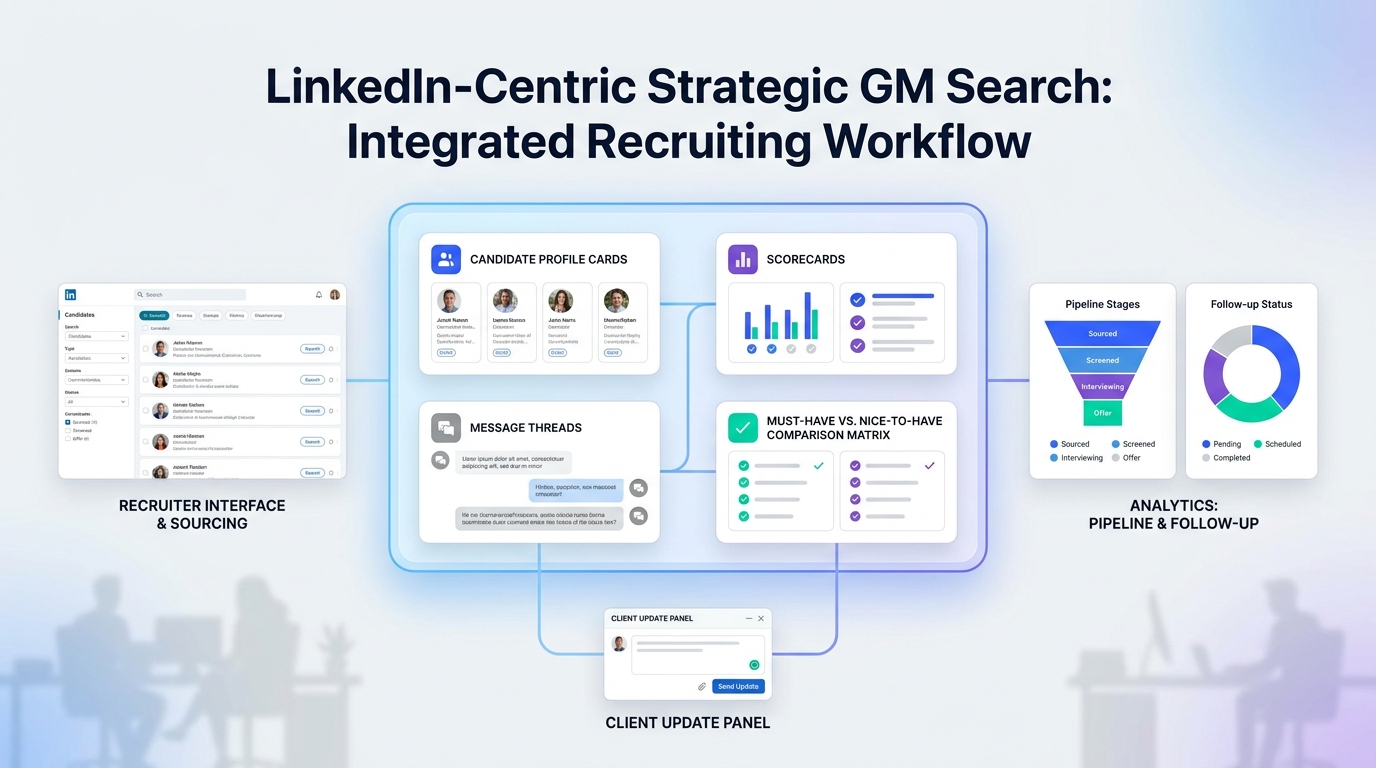
When a search turns strategic, placement agency software should help agency leaders compare fit, preserve search logic, and avoid costly follow-up gaps.
That matters most when the role is not just another requisition but a business-critical hire. In smaller search firms, one missed follow-up can cost a retained assignment, damage a client relationship, or let a high-value candidate go cold. For solo recruiters and lean agency teams, the pain is usually not effort alone. It is scattered notes, inbox-based workflow, weak visibility into who said what, and too much reliance on memory when a search becomes sensitive or multi-stakeholder.
In my own workflow, tools that reduce that friction are the ones worth keeping. When outreach starts on LinkedIn and responses come in across time zones, StrategyBrain AI Recruiter has been useful for handling repetitive first-touch messaging, keeping candidate conversations moving after hours, and collecting resumes or contact details from interested people without forcing me to babysit every thread. It does not replace recruiter judgment; I still review the resume, assess fit, and decide whether a candidate should move forward.
A good example is a general manager search for a business unit, the kind of assignment that can genuinely change an operation. In the reference case, the hiring team and client had already seen what happened when the previous GM fell short, so the search started with a sharper question than title matching: what separates leaders who run a modest operation from those who can scale it dramatically? The answer was not geography alone. It was ownership, culture fit, ambition, and the ability to develop a team while driving results through a system of KPIs or another structured operating model.
That kind of search does not fail because recruiters do not work hard. It fails when the workflow cannot hold the real evaluation logic. You need to capture must-haves versus nice-to-haves, compare leadership patterns across conversations, track which candidates have already proven themselves in similar environments, and preserve the context behind every outreach and client calibration call. That is why the best recruiting software is not just a database question. For agency teams comparing platforms from recruitment technology companies, or benchmarking how the top 10 recruitment companies usually run executive and operational searches, the real issue is whether the system supports disciplined, context-rich search work.
Practical takeaway: For most agency teams, the best recruiting software combines ATS structure, CRM memory, candidate outreach support, and client-side workflow. If your system tracks applicants but not the logic behind a sensitive search, it will slow down the desk when the role becomes more strategic.
Table of Contents
- Why software fit matters on business-critical searches
- What the best recruiting software really means
- The software categories buyers confuse most often
- How to evaluate leadership-search workflow fit
- Feature comparison for placement agency software
- Must-have features for staffing and search teams
- Applicant tracking system benefits in agency and in-house hiring
- Where AI helps without replacing recruiter judgment
- A step-by-step software selection process
- Best-for use cases by team type
- How pricing usually works
- Mistakes that create bad software decisions
- FAQ
Why software fit matters on business-critical searches
When you are hiring a general manager, branch leader, practice head, or other business-unit operator, the search usually starts with business diagnosis, not sourcing volume. The client wants to understand why the last leader underperformed, what the strongest leaders do differently, and which signals actually predict success in that environment.
That is where weak software shows up fast. Recruiters can source names, but if the system does not hold scorecards, operating context, structured notes, and relationship history in one place, the search turns into parallel documents and memory-based updates. On a straightforward contingent search, that may be survivable. On a strategic assignment, it creates risk.
The reference scenario is useful because it reflects how experienced search teams actually work. Before they went deep into market mapping, they clarified must-haves and nice-to-haves. They looked beyond location. They focused on leadership style, culture fit, ambition, team development, and evidence that a candidate had already used a disciplined business system. Those are evaluation criteria, and your placement agency software should make them easier to capture and compare.
What the best recruiting software really means
“Best” does not mean the longest feature list. It means the system that supports the way recruiters actually move through a search: intake, calibration, sourcing, outreach, screening, submission, interview coordination, stakeholder alignment, offer movement, and post-placement follow-up.
For agencies, especially those handling retained or hard-to-fill work, the best recruiting software usually needs an ATS plus CRM foundation. A pure applicant tracker often handles stages well enough, but it can fall short when recruiters also need to manage client-side relationships, long-cycle candidate nurturing, submission history, and the reasoning behind candidate prioritization.
In other words, true placement agency software should reduce friction in five places:
- capturing candidate and client context accurately
- separating must-haves from preferences
- moving candidates through a visible process
- preserving communication history across the desk
- showing where the search is stalling and why
Those are the conditions that make the common advantages of applicant tracking system adoption tangible instead of theoretical.
The software categories buyers confuse most often
Buyers searching for the best recruiting software often compare products that are not really in the same category. That creates bad demos and worse decisions.
1. Applicant tracking system for recruiters
An applicant tracking system for recruiters manages candidates through stages such as application, screening, interview, feedback, offer, and hire. The core applicant tracking system benefits are visibility, consistency, better handoffs, and cleaner reporting.
For in-house TA, that may be enough. For agencies, it often is not.
2. Recruiting CRM
A recruiting CRM is built for relationship continuity. It helps with passive candidates, outreach history, segmented talent pools, re-engagement, and long sales-cycle recruiting. If your firm fills repeat roles or runs search work over weeks and months, CRM depth matters.
3. Staffing or placement agency software
Placement agency software combines ATS and CRM functions with agency workflow: client records, job orders, submissions, placement tracking, and recruiter activity visibility. This is usually the right center of gravity for staffing firms and search agencies.
4. Sourcing and outreach tools
These tools help find people and initiate conversations. They can be valuable, especially when teams depend on outbound search. In my experience, they work best when they feed a stronger system of record rather than becoming a shadow workflow on their own.
That is one reason I have used AI Recruiter selectively in LinkedIn-heavy searches. It is most helpful when you need candidate conversations to continue outside recruiter working hours, when multilingual communication matters, or when you want to reduce manual first-contact work while still keeping final qualification with the recruiter. In leadership searches, I would not delegate fit assessment to automation, but I will absolutely use workflow support to keep the top of the funnel responsive.
5. HRIS
An HRIS is mainly for post-hire records, onboarding, and HR administration. It may integrate with recruiting, but it is not a substitute for active search management.
How to evaluate leadership-search workflow fit
The reference GM search gives a better evaluation framework than most generic software lists. For roles where a wrong hire can hurt an operation, recruiters need software that supports at least three layers of judgment.
Business context capture
The system should let you record why the search exists, what the prior leader lacked, what success looks like in this business unit, and which constraints are real versus assumed. If recruiters cannot store that context clearly, the search degrades into title matching.
Structured candidate comparison
You should be able to compare candidates against criteria such as leadership ownership, culture fit, ambition, team-building ability, and operating discipline. In the reference case, success was tied to leaders who had used a defined system for performance management, whether KPI-led or another structured model. Software should help retain those distinctions across interviews and stakeholder discussions.
Relationship-driven market coverage
The best people for this kind of role are rarely waiting in a clean applicant queue. The reference article emphasized local and regional networks, proactive outreach, repeated conversations, and understanding candidate aspirations. That is recruiting CRM territory as much as ATS territory.
So if you are evaluating the best recruiting software for search work, ask a blunt question: can this system support how headhunting actually happens, or only how applicants are processed?
Feature comparison for placement agency software
Scoring tools by workflow category is more useful than comparing marketing language from different recruitment technology companies.
| Category | Main Purpose | Best For | Limits if Used Alone |
|---|---|---|---|
| ATS | Track candidates through hiring stages | Structured in-house hiring and stage control | May miss client-side workflow, nuanced relationship history, and long-cycle search notes |
| Recruiting CRM | Manage relationships and nurture pipelines | Search firms, repeat hiring desks, passive talent engagement | May lack deeper requisition and process controls |
| Placement agency software | Combine ATS plus CRM for agency operations | Staffing firms, headhunters, temp and perm teams | Needs strong integrations and disciplined setup |
| Sourcing or outreach tool | Find talent and automate first-touch messaging | Outbound search and LinkedIn-led recruiting | Should not become the only system of record |
| Interview tool | Schedule interviews and collect feedback | Multi-stakeholder interview processes | Does not solve client tracking or candidate relationship management |
| HRIS | Manage employee data after hire | HR operations after placement | Weak fit for active agency recruiting workflow |
Must-have features for staffing and search teams
The best recruiting software should reflect recruiter reality, not product category theory. These are the features I would prioritize for most agency teams.
Candidate pipeline management
Recruiters need a clear view of where each person stands: contacted, engaged, screened, shortlisted, submitted, interviewing, offered, or placed. This is one of the most immediate applicant tracking system benefits.
Client and job order management
Agency teams need detailed client records, role requirements, contacts, and change history. Without that, a tool may work for internal recruiting but fail as actual placement agency software.
Submission tracking
Submission history should show who was sent, when, to whom, with what positioning, and what happened next. That matters on every desk, but especially on retained or repeat-client work.
Searchable notes and structured scorecards
For leadership searches, this is non-negotiable. You need to search past conversations, compare operating experience, and keep interview reasoning accessible to the whole team.
Outreach support
Outbound recruiting still drives many agency placements. If your desk depends on LinkedIn messaging, look for software and connected tools that support first-touch efficiency without losing control of quality.
I have found StrategyBrain AI Recruiter most useful here when a search requires consistent follow-up across many candidate threads. It can keep communication moving, answer early candidate questions about the role, and gather resumes from interested people while I stay focused on shortlist judgment and client calibration. That is particularly helpful when a recruiter is balancing live searches rather than working one assignment in isolation.
Analytics and reporting
Look for reporting on time to submit, source quality, stage conversion, pipeline age, recruiter activity, and search bottlenecks. Leadership will eventually ask why a role is slow. Your system should answer that without manual reconstruction.
Integrations
Email, calendar, job distribution, communication tools, and downstream HR systems all matter. Integration quality often determines whether a system saves time or just relocates admin.
Applicant tracking system benefits in agency and in-house hiring
Search intent around this topic overlaps a lot, so it is worth being precise. An applicant tracking system for recruiters is still a core layer for most teams. The difference is what surrounds it.
For in-house teams, the main applicant tracking system benefits usually include standardized hiring stages, better hiring-manager collaboration, cleaner feedback loops, and more consistent reporting.
For agencies, those same benefits matter, but agencies also need:
- client relationship memory
- job order context
- submission tracking
- long-term candidate nurturing
- activity visibility across multiple recruiters
That is why placement agency software is usually a better frame than ATS alone for search firms and staffing businesses.
Advantages of applicant tracking system adoption that recruiters feel quickly
- Less guesswork: you can see the latest activity without searching old emails.
- Better handoffs: recruiters know who has spoken to whom and what was discussed.
- Stronger process control: searches move through defined stages instead of informal updates.
- Cleaner reporting: pipeline problems become visible earlier.
- Better client communication: status updates are easier to support with actual data.
Where AI helps without replacing recruiter judgment
AI should be judged by workflow value, not marketing volume. In recruiting, the best use cases are usually support functions: search assistance, first-touch messaging, note organization, screening support, and pipeline analytics.
That is particularly true in executive, leadership, or operationally sensitive searches. No serious recruiter should outsource final fit judgment to automation. The recruiter still has to interpret nuance, test motivation, assess cultural alignment, and manage the client relationship.
Practical AI questions to ask in demos
- Does it speed up sourcing or only summarize data?
- Can it keep candidate communication active after hours?
- Does it help organize notes and outreach history?
- Can it support multilingual communication if your market requires it?
- Where does human review remain mandatory?
Among recruitment technology companies, this is where product positioning often gets muddy. The useful framing is simple: what does the tool do that saves recruiter time without weakening recruiter judgment?
A step-by-step software selection process
Software selection works best when you test recruiting reality before you compare branding.
- Map the real workflow. Include intake, market mapping, outreach, screening, submissions, interviews, offer movement, and placement follow-up.
- Document must-haves versus nice-to-haves. This mirrors the strongest search practice from the GM case and prevents bad compromises later.
- Write down your decision criteria. If leadership, culture fit, or operational-system experience matter in your searches, the software should support that level of evaluation.
- Test with a live scenario. Ask vendors to show a recruiter opening a role, logging candidate conversations, searching prior records, submitting a profile, and reporting status changes.
- Review client-side workflow. For agencies, this is where ATS-only systems often break down.
- Check integrations early. Especially email, calendar, sourcing channels, and downstream systems.
- Validate AI claims carefully. Separate outreach assistance from actual qualification, and make sure the recruiter remains in control of final decisions.
This process is useful whether you are choosing a new placement agency software stack or narrowing the field among larger vendors often associated with the top 10 recruitment companies.
Best-for use cases by team type
Best for staffing agencies
Prioritize ATS plus CRM depth, client management, submission tracking, searchable notes, and strong recruiter search. If the tool cannot support both sides of the desk, adoption will struggle.
Best for executive and professional search
Look for long-cycle relationship management, scorecards, stakeholder alignment support, and strong activity history. Here, the biggest advantages of applicant tracking system tools come from clarity and discipline more than volume automation.
Best for high-volume internal recruiting
An applicant tracking system for recruiters with structured stages, scheduling, and analytics may be enough if client workflow is irrelevant.
Best for hybrid teams
Organizations that combine internal recruiting with agency-style service models need especially careful category fit. A strong system for one workflow can frustrate the other.
When readers search for the top 10 recruitment companies, they are often trying to understand how mature firms run recruiting operations at scale. In practice, those firms usually succeed because they match process, specialization, and systems to the type of search they run. Software should be judged the same way.
How pricing usually works
Pricing in this market is often quote-based, especially for agency-oriented systems. Compare structure, not just the headline number.
Common pricing variables
- recruiter seats
- ATS-only versus ATS plus CRM scope
- record volume or workflow complexity
- analytics or AI modules
- implementation and migration effort
- integration needs
- support and training requirements
For agency buyers, ask whether temp, perm, multi-desk, or executive-search workflows change setup complexity. The wrong fit usually costs more in admin and missed adoption than the subscription difference itself.
Mistakes that create bad software decisions
- Choosing by feature count. Recruiter adoption depends on workflow fit, not list length.
- Confusing agency and in-house needs. This is still one of the most common buying mistakes.
- Ignoring context capture. Strategic searches need more than stage tracking.
- Overvaluing AI language. Ask what is automated, what is suggested, and what still needs recruiter review.
- Skipping realistic demos. A polished demo is not the same as live desk usage.
- Underestimating reporting needs. If you cannot explain why a search is stalling, the software is not helping enough.
Across many recruitment technology companies, the real separator is not the marketing claim. It is whether the system helps recruiters maintain quality when the search becomes nuanced, relationship-driven, and commercially important.
FAQ
What is the best recruiting software for agencies?
For most agencies, the best recruiting software is a form of placement agency software that combines ATS structure with CRM functionality, client records, submission tracking, reporting, and outreach support.
How is placement agency software different from an ATS?
Placement agency software usually includes ATS functions plus agency-specific workflow such as client management, job orders, submissions, and placement tracking. A standard ATS is often more limited to candidate-stage movement.
What features matter most for executive or leadership search?
Searchable notes, scorecards, relationship history, candidate comparison, client context capture, and structured reporting all matter more in leadership search than simple applicant volume alone.
How is AI used in recruiting software today?
AI is most useful for sourcing assistance, first-touch messaging, note organization, analytics, and workflow support. Recruiters should still handle fit judgment, resume evaluation, and final next-step decisions.
Can LinkedIn outreach tools replace recruiters?
No. They can reduce repetitive messaging and keep conversations active, but recruiters still need to qualify resumes, assess motivation, and guide the hiring process.
How much does recruiting software cost?
Costs vary widely based on seats, workflow scope, integrations, implementation, and reporting depth. Focus on operational fit, not just subscription price.
Conclusion
The best recruiting software is the one that matches the work you actually do. If your team runs relationship-heavy, context-sensitive searches, a basic applicant tracker will usually feel too thin. For many firms, that means choosing placement agency software with ATS plus CRM depth, stronger client workflow, and practical support for outbound recruiting.
The lesson from the general manager search is straightforward. Strong recruiting starts by understanding what success really looks like, separating must-haves from preferences, and running a disciplined process around that logic. Your software should make that work easier to execute, easier to share, and easier to measure.
If you are evaluating tools now, start with your workflow, not the vendor category. That is the clearest path to seeing which applicant tracking system benefits matter for your desk, how outreach support should fit alongside recruiter judgment, and which systems are built for serious agency execution rather than generic hiring admin.