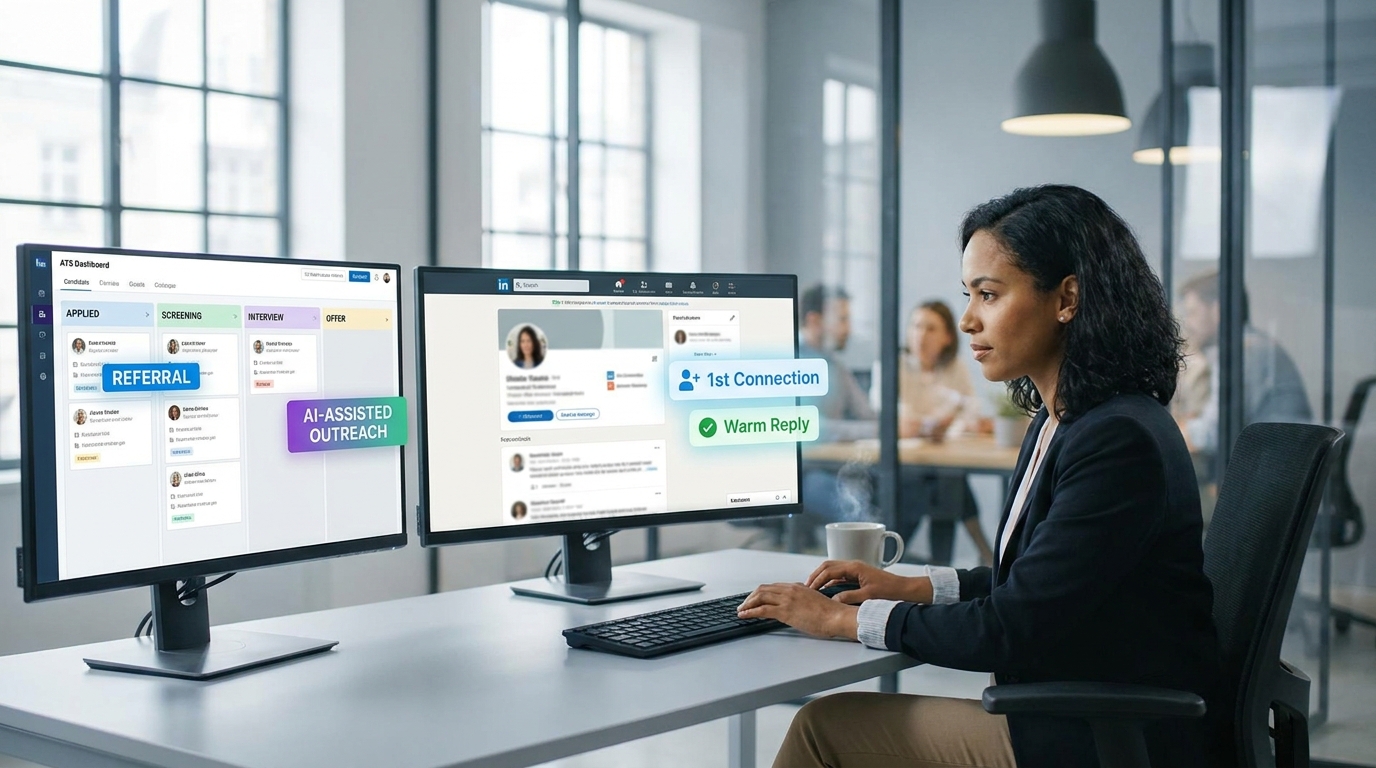
This article helps HR leaders judge whether freeware recruitment software can stop lost replies, weak handoffs, and hiring delays.
The real cost of a weak recruiting stack is rarely the subscription line. It shows up when agency recruiters lose warm replies in inboxes, when in-house teams cannot see who owes feedback, and when founders assume hiring is slow because talent is scarce when the real issue is fragmented process. A tool can be free and still be expensive if it creates admin work, weak handoffs, or poor candidate follow-through.
That is also why I have become more practical about where automation belongs. In my own workflow, tools such as StrategyBrain AI Recruiter are most useful when they handle the repetitive front end of recruiting: candidate outreach, after-hours follow-up, and multilingual message continuity. It helps reduce the lag between first contact and response collection, but the recruiter still owns the final judgment, résumé review, and next-step decision. Used that way, it supports rather than replaces disciplined recruiting operations.
A useful way to think about recruiting software starts outside software altogether. Picture a small gathering where the host knows every guest well, but the guests do not know one another. The value of the event is not only that people show up. It is that the right people meet, conversations branch quickly, and each person leaves with new connections they would not have found alone. In recruiting, the same dynamic happens when a recruiter is not just collecting names but actively connecting roles, conversations, and context across a living network.
That is where many hiring teams break down. A recruiter may source a promising person through a friend-of-a-friend introduction, continue the conversation on LinkedIn, collect a résumé later by email, and then summarize the exchange in a spreadsheet no hiring manager reads in time. The opportunity is real, but the workflow is brittle. If your process depends on relationship-driven recruiting, then the best recruiting software is not simply the cheapest database. It is the system that helps you preserve context, move people forward, and decide when freeware recruitment software, a free online applicant tracking system, or a cheap ATS is actually enough.
- Why relationship-driven recruiting still needs systems
- What freeware recruitment software really means now
- What the best recruiting software should include
- Free online applicant tracking system vs cheap ATS
- How to choose by hiring team and workflow
- A practical comparison checklist
- Common selection mistakes
- When to upgrade from free recruiting software
- FAQ
Why relationship-driven recruiting still needs systems
Experienced recruiters know that strong hiring does not come only from job ads and inbound applications. It often comes from trusted circles, referrals, former candidates, and the friend-of-a-friend introductions that turn into real conversations. The lesson from relationship-based recruiting is simple: your network is not a static contact list. It is a professional resource that can make you better at spotting fit, testing market feedback, and reaching people who would never apply cold.
But network-driven recruiting creates an operational challenge. The more your work depends on nuanced conversations, referrals, and long-tail follow-up, the more important your system becomes. Without one, valuable context disappears between LinkedIn messages, email threads, recruiter notes, and hiring manager delays.
I have seen this most clearly when testing sourcing-heavy workflows. When candidate responses come in outside office hours, or in multiple languages, a manual process slows quickly. That is one reason I found AI Recruiter helpful in sourcing-led work. It can continue first-touch communication, answer role-level questions, and collect résumés or contact details while I focus on qualification and stakeholder alignment. It does not decide who is right for the role; it gives the recruiter a cleaner handoff into that decision.
Practical takeaway: If your recruiting edge comes from relationships and referrals, your software should protect conversational context just as carefully as it stores résumés.
What freeware recruitment software really means now
The term freeware recruitment software sounds straightforward, but in practice it usually means a cloud-based ATS with a free tier, not an old downloadable recruiting program. That distinction matters because modern hiring is collaborative. Recruiters, hiring managers, coordinators, and founders all need visibility into the same candidate record.
For that reason, a free tool is only useful if it can support actual workflow, not just record storage. At minimum, it should help your team create jobs, collect applicants, track stages, assign next steps, and capture communication history. If it cannot hold the process together, it is not acting like recruiting software in any meaningful sense.
That is also where the main advantages of applicant tracking system software show up. Instead of asking who last spoke to the candidate, where the résumé is, or whether feedback ever came back, the team can work from one visible pipeline. For recruiters who balance warm-network outreach with formal hiring steps, that visibility is not a bonus feature. It is the infrastructure that stops good prospects from drifting away.
What the best recruiting software should include
The best recruiting software is not the one with the longest feature grid. It is the one that keeps real hiring motion intact, especially when a promising candidate enters through an informal path and then needs to be moved into a structured process. In my experience, five capabilities matter most early.
1. Job posting and candidate intake
A workable ATS should publish roles, receive applications, and centralize inbound candidate data. If your team still copies résumé details from email into spreadsheets, intake is your first problem to fix.
2. Pipeline management that reflects your actual stages
This is the operating core of an applicant tracking system for recruiters. The stages should match your workflow, whether that is applied, sourced, contacted, screened, submitted, interview, final, or offer. If your software cannot reflect how your team actually works, adoption will weaken fast.
3. Searchable candidate records and communication history
This is especially important for referral-led and sourcing-led teams. You need more than a résumé attachment. You need searchable profiles, tags, notes, and prior conversation context so that one recruiter’s relationship capital does not vanish when the next requisition opens.
4. Interview coordination and stakeholder collaboration
Even a free online applicant tracking system should help interview teams review profiles, leave feedback, and understand ownership. If hiring managers only interact through email, the process remains scattered.
5. Basic reporting and workflow visibility
Good software should answer simple but important questions: where are candidates stalling, which roles are underperforming, and which recruiters or managers need follow-up. You do not need enterprise analytics on day one, but you do need visibility that supports action.
| Core capability | Why it matters | What to verify on a free plan |
|---|---|---|
| Job posting | Creates a clean starting point | How many active jobs are included |
| Pipeline tracking | Keeps candidate movement visible | Whether stages are editable |
| Candidate records | Preserves network and sourcing context | Search, notes, tags, and storage limits |
| Collaboration | Improves recruiter-manager handoffs | Feedback tools, permissions, and user seats |
| Reporting | Supports process correction | Whether dashboards are actionable or superficial |
When I layer sourcing automation into this stack, I want it to support these fundamentals rather than bypass them. For example, AI Recruiter conversations make the most sense when they feed recruiter-owned review and next steps, not when they create another disconnected stream of candidate information.
Free online applicant tracking system vs cheap ATS
A free online applicant tracking system and a cheap ATS can both be sensible choices, but they fit different moments in team maturity.
A free ATS usually works well for startups, solo recruiters, small agencies, or internal teams that need structure before they need depth. It is often enough to centralize applicants, formalize stages, and stop the worst spreadsheet chaos.
A cheap ATS usually becomes the better move when the team already understands its process and needs fewer restrictions. The issue is often not cost alone. It is the hidden price of limitations: active job caps, user seat limits, weak branding, thin reporting, or poor permissions.
| Factor | Free ATS | Cheap ATS |
|---|---|---|
| Best fit | Early-stage or occasional hiring | Steady hiring with broader collaboration |
| Main benefit | Low barrier to adoption | More control without major budget pressure |
| Typical limits | Job caps, seat restrictions, simpler workflows | Some budget tradeoffs, but stronger everyday usability |
| Operational effect | Helps create discipline | Helps maintain consistency as hiring grows |
| Upgrade signal | Manual workarounds start multiplying | Need for deeper automation or analytics |
In practice, many teams get more value from a cheap ATS than from a free system that cannot hold multi-stakeholder hiring together. That is particularly true if your recruiting model depends on outreach, referral loops, and long-running candidate relationships rather than one-off applicant volume.
Practical takeaway: Compare free and low-cost options by recruiter hours recovered and context preserved, not just by monthly spend.
How to choose by hiring team and workflow
The right system depends heavily on how recruiting actually happens inside your organization.
Startups: speed and low admin burden
Startups usually benefit from freeware recruitment software when they need immediate order without heavy setup. The ideal system gets a founder or lean recruiter out of email-driven hiring and into a visible pipeline quickly. Prioritize simplicity, clean intake, and fast manager feedback.
SMBs: collaboration and repeatability
SMBs often need more from their ATS because more departments and hiring managers are involved. This is where a cheap ATS often beats a free plan. The key requirement is consistency: feedback should come back the same way across teams, and role status should be visible without constant chasing.
Staffing agencies: speed, search, and candidate reuse
Agencies usually outgrow basic free plans faster than in-house teams. They need strong search, tagging, reusable talent pools, and fast recruiter coordination. If the system cannot help consultants find prior candidates quickly, it will slow desk productivity.
Agency workflows are also where I found AI-supported LinkedIn sourcing most useful. It kept initial conversations moving when I could not manually cover every response window, but I still handled shortlist review and client-facing judgment myself.
In-house teams: stakeholder alignment and process control
Internal talent teams often need stronger visibility across approvals, interviews, and hiring manager activity. A free online applicant tracking system can work for smaller teams, but once several departments participate regularly, low-cost paid structure is often more stable than free-plan improvisation.
A practical comparison checklist
When comparing recruiting software, evaluate operational limits before you evaluate marketing language.
- Active job limits: Can your current hiring load fit without immediate upgrades?
- User seats: Can recruiters, managers, and HR all participate directly?
- Pipeline flexibility: Does the system match your real stages?
- Candidate search: Can you rediscover past conversations and referrals easily?
- Communication capture: Can you keep notes, files, and interactions in one place?
- Interview workflow: Does feedback return through the system or outside it?
- Reporting: Can you spot stalls and ownership gaps quickly?
- Upgrade path: Will the tool scale with your next stage of hiring?
If outreach is a large part of your recruiting model, also ask whether your ATS and sourcing workflow work together cleanly. A sourcing tool that creates candidate interest but leaves the recruiter to manually rebuild records elsewhere adds friction back into the process.
Common selection mistakes
Most ATS mistakes are not caused by missing features. They come from poor buying logic.
Confusing contact collection with actual workflow support
Some tools look useful because they gather names and résumés. That is not enough. The software must support movement, ownership, and follow-up.
Underestimating hiring manager behavior
If managers cannot review candidates easily or leave feedback quickly, recruiters will carry the entire process manually. That usually becomes the real bottleneck.
Choosing free software that behaves like a trial
Not all free plans are equal. Some are genuinely usable. Others are only broad enough to demonstrate the interface.
Ignoring context-rich recruiting
Teams that rely on referrals, sourcing, and repeat relationships need stronger records than teams that only process inbound applications. If that distinction is ignored, the chosen tool will feel thin very quickly.
Failing to define upgrade signals early
Before implementation, decide what conditions would justify moving from freeware recruitment software to a cheap ATS or a more advanced setup. Without that threshold, teams stay in workaround mode too long.
Practical takeaway: Write your recruiting process in plain English before evaluating software. If the process is fuzzy, every demo will sound better than the reality of day-to-day use.
When to upgrade from free recruiting software
Free recruiting software is often enough for a phase. The key is recognizing when that phase ends.
- Your open roles regularly hit plan limits. Volume is the simplest upgrade trigger.
- More stakeholders need direct access. Shared logins and side-channel feedback are warning signs.
- Candidate context is being rebuilt manually. If notes, messages, and files keep living in separate places, the system is no longer doing enough.
- Recruiters spend too much time on repetitive front-end work. This is where workflow support or sourcing automation can help.
- You need clearer reporting and accountability. Growth usually creates more stage-level management needs.
For sourcing-heavy teams, an upgrade does not always mean replacing the ATS first. Sometimes it means keeping the ATS and improving the top of funnel with tools like StrategyBrain AI Recruiter, especially when response speed, multilingual outreach, or after-hours continuity are the pain points. The recruiter still remains responsible for evaluating the résumé, qualifying fit, and deciding whether to advance the candidate.
That has been my own practical takeaway. Software is most valuable when each layer does its job well: sourcing tools maintain live conversation flow, and the ATS keeps structure, visibility, and decisions intact.
FAQ
What does freeware recruitment software usually include?
It usually includes core ATS functions such as job posting, candidate intake, stage tracking, team collaboration, and basic reporting. The biggest difference is often in the limits rather than the existence of those features.
Is a free online applicant tracking system enough for a small business?
Yes, a free online applicant tracking system can be enough for a small business if hiring volume is moderate and the workflow is straightforward. It is most useful when the goal is to centralize applicants and create process discipline fast.
What makes a cheap ATS better than a free plan?
A cheap ATS often removes the limits that create daily friction, such as caps on open jobs, user seats, pipeline flexibility, or reporting depth. It can be the more economical choice once free-plan workarounds consume recruiter time.
How important is candidate relationship context in recruiting software?
It is very important for teams that rely on sourcing, referrals, and repeat outreach. In those environments, the system should preserve conversation history, notes, and past engagement rather than acting like a simple applicant inbox.
Can sourcing automation replace recruiter judgment?
No. Automation can help with first-touch outreach, message continuity, and collecting résumés or contact details, but final qualification, fit assessment, and advancement decisions still belong to the recruiter or hiring team.
Conclusion
If you are searching for the best recruiting software, the useful question is not whether a system is free. It is whether it supports how your team actually hires. For relationship-driven recruiting, that means preserving context, reducing handoff friction, and helping candidates move from conversation to decision without getting lost.
Freeware recruitment software can absolutely be enough when your workflow is still lean. A free online applicant tracking system is often the right first step. A cheap ATS becomes the better choice when limits start creating delays, manual reconstruction, or weak collaboration. The best setup is the one that keeps both your network and your process working together.