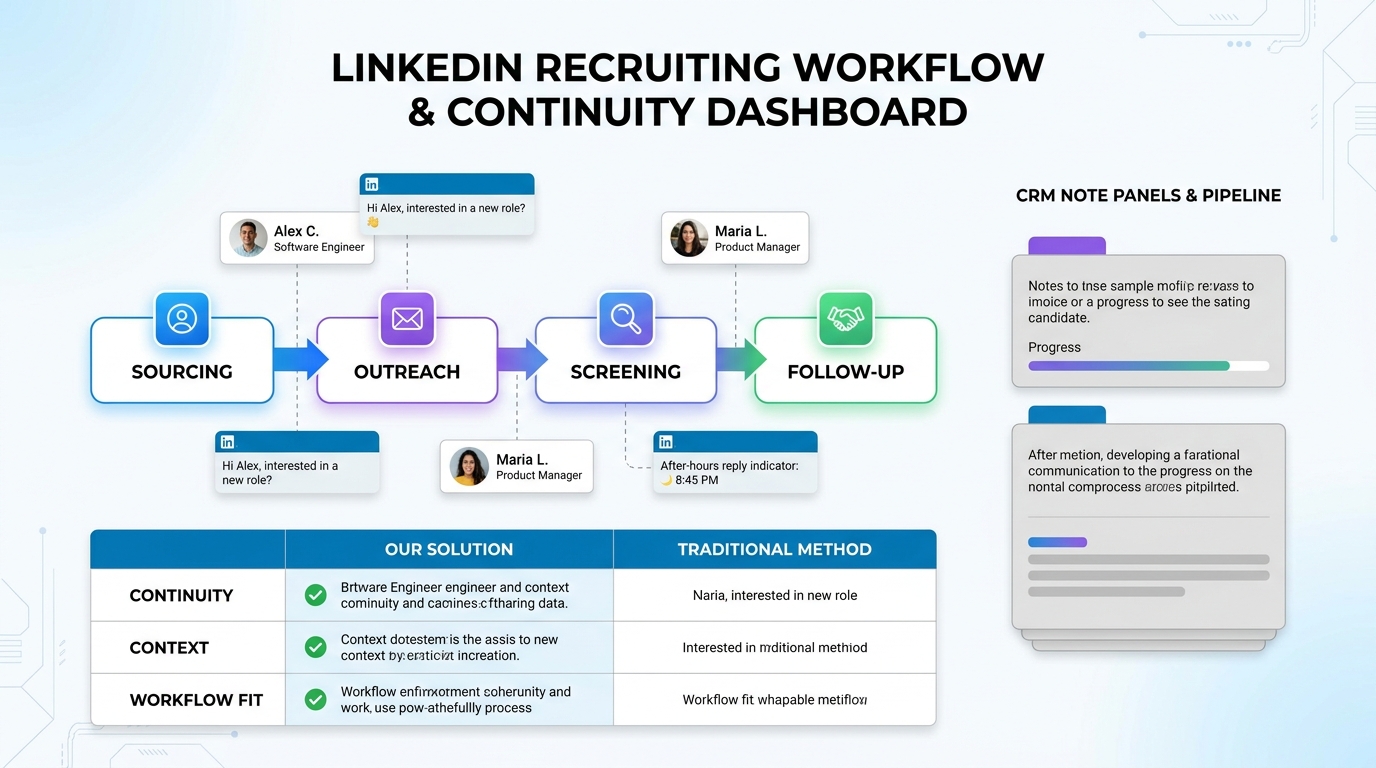
Missed follow-ups and scattered notes quietly hurt recruiter productivity, so this article helps recruiters judge recruitment online for recruiters by continuity, context, and workflow fit.
That matters more than many teams admit. In smaller search firms, independent desks, and lean in-house talent teams, the real damage rarely comes from a lack of applicants alone. It comes from missed replies after hours, weak handoffs between sourcing and screening, scattered notes on promising people, and the slow erosion of trust when candidates feel like they are being handled by a fragmented process. For recruiters, that means lost momentum. For agency owners, it means lower desk productivity. For employers, it means weaker pipelines and harder-to-fill roles staying open longer than they should.
One practical way I have seen teams reduce that friction is by using an AI-supported outreach layer before human review. In my own workflow, StrategyBrain AI Recruiter has been most useful when I need fast initial LinkedIn outreach, timely candidate replies outside working hours, and multilingual communication for cross-border searches. What it does not do is replace recruiter judgment. I still review the résumé, decide whether the profile actually fits the brief, and choose whether to move someone into interview or keep them in nurture.
The reason this matters became obvious to me in a very ordinary setting: a summer gathering where the host knew every guest well, but many of the guests had never met each other. The most useful outcome was not the food or the small talk. It was the quality of the introductions. People walked away impressed by who they had met, and that is a familiar recruiting lesson. Valuable hiring often starts when the right people are brought into the same orbit, not when a requisition is simply posted and left to collect applications.
That scene exposes a hiring truth that software buyers often miss. The best recruiting software is not only a system for processing applicants. It is also a system for building and reusing networks, surfacing who should know whom, and keeping relationship history intact when a recruiter revisits a search. That is why recruitment online for recruiters, head hunter jobs, and even searches from people looking for a company that will help me find a job can point to very different needs inside the same market.
Table of Contents
- Why Relationship Quality Matters in Recruiting Software
- What the Best Recruiting Software Actually Includes
- Applicant Tracking System Benefits in Real Recruiting
- How to Choose by Recruiting Team Type
- Feature Checklist for Recruitment Online for Recruiters
- Where LinkedIn Automation Fits Without Replacing Recruiters
- Software vs Human Recruiting Services
- A Practical Buying Process
- Common Evaluation Mistakes
- FAQ
Why Relationship Quality Matters in Recruiting Software
Experienced recruiters know that hiring is partly a systems problem and partly a people problem. The systems side is obvious: job posting, applicant tracking, scheduling, reporting, and approvals. The people side is less visible but often more decisive. Good recruiters build circles of trusted candidates, referrals, former finalists, hiring managers, and domain experts who sharpen future searches. The stronger that network becomes, the less every search has to begin from zero.
That is the most useful lesson to borrow from the reference idea above. Professional growth is rarely isolated from personal networks, and recruiting works the same way. The recruiter who treats a network like a living resource, rather than a static contact list, tends to uncover better candidates faster. Software should support that behavior. If it stores names but loses context, it is not helping much. If it captures messages, interest level, notes, target-company history, and next steps, it starts to become operationally valuable.
For teams doing recruitment online for recruiters, this shifts the buying question. Instead of asking only whether a platform has an ATS, ask whether it helps recruiters preserve the quality of introductions, follow-up, and rediscovery. That is especially important in relationship-heavy work such as executive search, specialist agency recruiting, and many head hunter jobs.
What the Best Recruiting Software Actually Includes
Many teams use the phrase best recruiting software as if it means one tool. In practice, it usually means a stack or a platform that covers three connected functions: applicant tracking, recruiting CRM, and talent relationship management.
An applicant tracking system for recruiters handles inbound applicants, stage movement, interview feedback, and hiring workflow visibility. A recruiting CRM supports outreach, nurturing, and prospect management before application. Talent relationship management goes further by helping recruiters maintain long-term contact with referrals, passive candidates, silver medalists, alumni, and specialist communities.
From a working recruiter's perspective, the best recruiting software should support at least these day-to-day outcomes:
- Source candidates across several channels without losing message history
- Post jobs efficiently to major boards and career destinations
- Build talent pipelines that can be reused later
- Track applicants with clear stage ownership
- Manage referrals with context, not spreadsheets alone
- Coordinate interviews with less scheduling friction
- Report on bottlenecks so hiring leaders can adjust
For executive recruiters, that definition needs one more layer. Searches tied to head hunter jobs usually involve passive candidates, confidential outreach, and long-cycle relationship building. In that setting, software should not only log applicants. It should help map target companies, preserve nuanced notes, and keep search intelligence accessible over time.
Applicant Tracking System Benefits in Real Recruiting
Any serious evaluation of the best recruiting software should include the ATS at the center. Even when CRM and sourcing matter more strategically, the ATS is usually where process discipline either takes hold or falls apart.
The main advantages of applicant tracking system adoption are practical. Recruiters move faster when candidate records are centralized, hiring stages are standardized, and communication history is visible. Hiring managers make better decisions when interview feedback and approvals are not buried in inboxes.
| ATS Benefit | Recruiter Impact | Business Impact |
|---|---|---|
| Centralized records | Reduces duplicate work and missing notes | Improves visibility across open roles |
| Clear stage workflow | Keeps follow-up consistent | Creates a more reliable hiring process |
| Interview coordination | Lowers admin burden | Reduces candidate drop-off |
| Search and filtering | Makes database reuse easier | Speeds up time to shortlist |
| Reporting | Shows where searches stall | Supports hiring planning and accountability |
For recruitment online for recruiters, the biggest ATS benefit is not just order. It is continuity. A recruiter can stop, restart, hand over, or revisit a search without having to reconstruct the whole story from memory. That continuity is exactly what relationship-led recruiting needs.
Practical takeaway: The best systems do not merely store candidate data; they preserve the logic behind prior outreach, introductions, and decisions.
How to Choose by Recruiting Team Type
The right system depends on how your team actually hires. Teams often buy for a category label when they should buy for an operating model.
In-house talent acquisition teams
In-house teams usually need balanced capability: ATS workflow, career-site support, interview scheduling, reporting, recruiter-hiring manager collaboration, and enough CRM functionality to keep warm talent engaged. Their challenge is often consistency across departments rather than pure candidate volume.
Ask whether the system can support both everyday hiring and occasional specialist searches. If it handles only the easy requisitions, recruiters will end up creating side processes for hard roles.
Agency and staffing recruiters
Agency desks need speed, database reuse, client submission visibility, and a cleaner way to manage active conversations across many roles. For them, the applicant tracking system benefits often show up as faster rediscovery, better communication history, and stronger control over recruiter workload.
In agency recruiting, the database is not just storage. It is part of the desk's future revenue capacity. That is why software that loses relationship context becomes expensive in a very practical way.
Executive search and headhunter teams
Teams handling head hunter jobs need software that supports target-company mapping, nuanced notes, passive candidate outreach, and long-cycle status tracking. The workflow is less about processing many applications and more about building trust with a smaller number of relevant people.
That is also where network quality becomes a software issue. A senior recruiter often succeeds because one introduction leads to another. If the system cannot support that chain, much of the real search value remains trapped in the recruiter's memory.
High-volume or temporary staffing teams
High-volume teams care about throughput: broad posting, fast screening, interview scheduling, compliance workflow, and onboarding handoff. Their software should remove repetitive tasks and make stage movement obvious.
In this environment, simplicity matters. If recruiters need too many clicks to move candidates or cannot quickly identify who is placeable now, the platform is slowing the desk down.
Feature Checklist for Recruitment Online for Recruiters
Below is a more grounded checklist for teams comparing the best recruiting software.
1. Job distribution that saves time
Multi-board posting matters when recruiters handle several openings at once. Re-entering jobs manually is rarely a good use of recruiter time.
2. Searchable candidate history
This is one of the most underrated features. A useful system helps you find not just a name, but the last conversation, prior role fit, referral source, and current level of interest.
3. Pipeline and referral management
Referrals and warm talent often produce stronger outcomes than cold applications. Software should make those relationships easier to revisit and maintain.
4. Outreach and response workflow
For many recruiters, especially those active on LinkedIn, messaging rhythm matters. Delayed replies lose candidate attention. Good software should support outreach and response tracking without forcing recruiters to manage everything manually.
5. Interview scheduling
Scheduling is often where momentum dies. Better coordination improves candidate experience and recruiter efficiency at the same time.
6. Reporting that reflects real bottlenecks
Useful analytics should show where candidates stall, which channels are underperforming, and where hiring manager delays are hurting results.
7. Mobile-friendly candidate experience
If the application or communication flow is clumsy on mobile, many otherwise suitable candidates will disappear early.
8. Integrations with everyday tools
Email, calendars, collaboration tools, and sourcing workflows should connect cleanly. Recruiting rarely happens in one system alone.
Where LinkedIn Automation Fits Without Replacing Recruiters
Because so much recruitment online for recruiters now includes LinkedIn outreach, it is worth separating automation that supports recruiters from automation claims that overpromise. In my experience, the right role for LinkedIn automation is narrow but valuable: handling repetitive first-touch activity, maintaining response continuity, and collecting interest signals so the recruiter can focus on fit and judgment.
That is where AI Recruiter can fit into a broader recruiting stack. I have found it most relevant when a search has too many repetitive opening messages for one person to manage well, when candidates reply after hours, or when multilingual communication slows an otherwise good international search. Its LinkedIn-focused automation, always-on messaging, and ability to collect résumés or contact details can reduce dead time between first contact and recruiter review. If you want to see the broader use cases, the setup overview and the public conversation examples are useful starting points.
What I would stress to any recruiter is that this is a workflow assist, not a replacement for professional assessment. The final qualification step still belongs to the human recruiter. I still decide whether the résumé aligns with the brief, whether the candidate's motivations make sense, and whether it is the right moment to involve the hiring manager. That distinction is important if you want efficiency without weakening standards.
For executive search and headhunter teams, this can be especially useful when the administrative burden of outreach starts crowding out the more valuable work of target mapping, market judgment, and relationship building. For in-house teams, it can help preserve responsiveness on specialist or international searches without turning recruiters into full-time message coordinators.
Software vs Human Recruiting Services
This topic also overlaps with candidate-side intent, so it helps to separate software buyers from people seeking career support.
| Need | Best Fit | Who Usually Pays |
|---|---|---|
| Run employer hiring workflows | Recruiting software | Employer |
| Fill a specialist or senior role | Executive search or headhunter | Employer |
| Hire at scale or staff temporary roles | Staffing agency plus software | Employer |
| Get help finding a job | Staffing firm, placement service, or coach | Varies |
If someone searches for a company that will help me find a job, they may be looking for a staffing agency, placement firm, recruiter, or career coach. That is a different intent from an employer looking for the best recruiting software. The overlap matters because recruiters often serve both sides of the market, but the solution category is not the same.
A good rule is simple: buy software when the core problem is workflow, visibility, scale, and coordination. Use human recruiting services when the problem is market access, confidential search capacity, or personal job-search support.
A Practical Buying Process
If you are evaluating the best recruiting software, start with process mapping rather than a feature parade.
- Define your hiring model. High-volume, specialist, executive, agency, or mixed?
- Map the real workflow. Include sourcing, outreach, screening, scheduling, offer steps, and reporting.
- Identify where context gets lost. This is often where software value is highest.
- Separate must-haves from nice-to-haves. Keep the evaluation honest.
- Test with a real recruiting scenario. Use one actual role and one realistic candidate path.
- Check recruiter adoption risk. A tool that looks good in demo but creates extra admin will fail quietly.
If LinkedIn sourcing is a major part of your workflow, test that layer explicitly. Measure whether your chosen process improves response continuity, preserves message history, and makes it easier to move genuinely interested people into human review. That is the most practical way to judge whether an automation layer such as StrategyBrain AI Recruiter adds value in your environment.
Common Evaluation Mistakes
- Confusing applicant management with relationship management. An ATS alone may not support recruiter-led network building.
- Buying for edge cases. The best recruiting software should handle the majority of your work well.
- Ignoring communication continuity. Delayed follow-up weakens both candidate experience and recruiter productivity.
- Overlooking hiring manager behavior. Software cannot fix every delay, but it should make delays visible.
- Mixing candidate-help intent with employer-buying intent. A reader looking for a company that will help me find a job needs a different answer from a software buyer.
- Assuming automation can replace judgment. It can reduce repetitive work, but fit assessment still belongs to the recruiter.
FAQ
What is the difference between an ATS and a recruiting CRM?
An ATS mainly tracks applicants through the hiring process. A recruiting CRM is more focused on sourcing, outreach, and nurturing candidates before they apply. Many teams need both.
What are the main applicant tracking system benefits for recruiters?
The main benefits are centralized records, clearer workflows, easier collaboration, better reporting, and less manual coordination. In practice, the biggest gain is continuity across active searches.
Is the best recruiting software the same for in-house teams and agencies?
No. In-house teams often need balanced workflow and hiring-manager collaboration. Agencies usually need stronger search, database reuse, and communication tracking.
What does head hunter jobs mean in this context?
It usually refers to recruiting work focused on senior, specialist, or passive candidates. The process is more relationship-led than standard high-volume applicant processing.
Does a company that will help me find a job usually charge job seekers?
It depends. Staffing agencies are often paid by employers, while career coaches may charge candidates directly. Job seekers should always ask how the model works.
Can LinkedIn automation replace a recruiter?
No. It can help with repetitive outreach, after-hours replies, and collecting early interest, but the recruiter still needs to review fit, evaluate the résumé, and make the next-step decision.
Conclusion
The best recruiting software is not simply the platform with the longest feature list. It is the one that helps recruiters keep introductions warm, preserve relationship context, and move people through hiring without avoidable friction. That is the real operational meaning of strong recruitment online for recruiters.
If your work depends on relationship-led sourcing, passive candidate outreach, or complex searches tied to head hunter jobs, evaluate software by how well it protects continuity, not just how well it tracks applicants. And if your audience is actually looking for a company that will help me find a job, be clear that software and human recruiting services solve different problems. Once you separate those needs, choosing the right workflow becomes much easier.