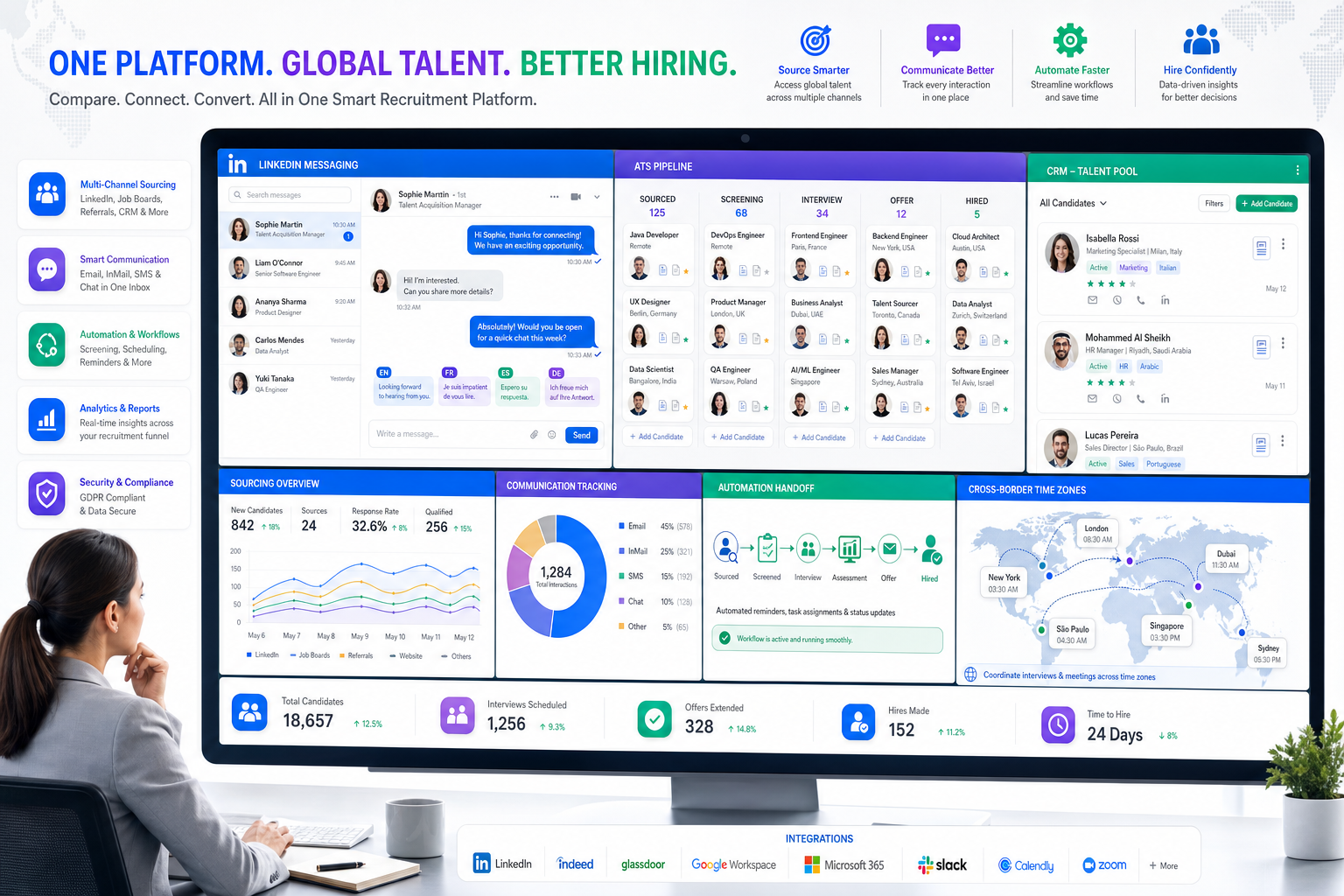
This guide helps recruiters compare the best recruitment platforms to stop cross-border follow-up gaps from costing placements.
That matters most when hiring expands across borders or talent markets tighten. Recruiters lose momentum when candidate replies arrive after hours, sourcing notes live in separate tools, and hiring managers want updates before outreach history, résumé status, or next steps are fully documented. For small search firms, that means missed placements and weaker client confidence. For in-house teams, it means slower hiring, uneven candidate experience, and too much recruiter time spent on admin instead of judgment.
In that kind of workflow, tools that reduce repetitive outreach and message handling can help without removing recruiter control. I have found that AI Recruiter is most useful when LinkedIn outreach volume rises, candidate replies come in across time zones, and recruiters need a cleaner handoff from first contact to human review. Its 24/7 multilingual messaging, automated outreach conversations, and résumé/contact capture can take pressure off the front end of sourcing, while the recruiter still makes the final call on fit, résumé quality, and interview decisions.
A useful way to frame this comes from a cross-border talent reality that has been visible for years. When HSBC published an expat ranking that placed Canada 3rd and the United States 30th, the headline was not just about national pride. It reflected how professionals weigh work opportunities through job security, work-life balance, healthcare, savings, safety, family factors, and long-term quality of life. Once candidates start comparing locations that way, recruiters are no longer filling a role against salary alone. They are managing a decision process shaped by context, timing, and trust.
Picture the recruiting work behind that moment: a recruiter opens a requisition tied to relocation or cross-border hiring, checks the last LinkedIn reply from a candidate who asked about healthcare and family stability, updates the candidate stage, and then has to remind a hiring manager which concerns are holding the process back. If those conversations sit in inboxes, spreadsheets, and memory, the team cannot see why one opportunity is winning and another is stalling. That is exactly why evaluating the best hiring platforms for employers now requires more than an ATS feature list. It requires software that supports sourcing, candidate communication, workflow control, and better decision tracking.
Table of Contents
- Why global context now matters in recruiting software selection
- What counts as recruiting software today
- ATS-first vs CRM and recruitment marketing platforms
- How to identify the best hiring platforms for different employers
- Must-have features in the best recruitment platforms
- How to evaluate AI and automation without losing human judgment
- Applicant tracking system benefits that matter in practice
- A practical scorecard for comparing platforms
- Common buying mistakes employers make
- FAQ
Why Global Context Now Matters in Recruiting Software Selection
Experienced recruiters know that candidate choice is rarely one-dimensional. The HSBC expat ranking is a good reminder that professionals compare opportunities across economic factors, career growth, healthcare, safety, integration, family life, and social stability. Canada’s high placement in that ranking versus the much lower U.S. position showed how dramatically destination perception can shape employer competitiveness.
For recruiting teams, that changes the software conversation. The best recruiting software should not only track applicants. It should help teams keep a usable record of why candidates hesitate, what follow-up they need, and which decision themes repeat across roles and locations. When candidates ask about quality of life, benefits, relocation realities, or long-term stability, those signals need to be captured somewhere visible.
I have seen this most clearly in LinkedIn-heavy recruiting. Messages often begin with job scope and compensation, then quickly shift toward practical concerns such as health coverage, family relocation, time zone expectations, and whether the opportunity is actually worth the move. In those cases, I prefer workflows that pair an ATS with outreach support. During busy sourcing periods, I have used AI Recruiter to keep initial conversations moving overnight and across languages, especially when candidates respond outside normal recruiter hours. What helped was not some promise of automatic hiring; it was the simple fact that interested candidates could continue the conversation, share contact details or a résumé, and then be routed back to me for review.
That is the larger lesson behind today’s best recruitment platforms: they must support the full decision environment around hiring, not just the administrative record after someone applies.
What Counts as Recruiting Software Today
The term best recruiting software gets used loosely, but buyers are usually comparing several categories at once: applicant tracking systems, recruiting CRM tools, sourcing workflow tools, recruitment marketing software, and broader talent acquisition suites.
For a recruiter or HR team, the difference matters. An applicant tracking system for recruiters is mainly designed to organize applicants, move them through stages, and document activity. A broader recruitment platform may add candidate sourcing, nurture workflows, texting, employer branding tools, talent pool management, and onboarding integrations.
If your team is asking for the best hiring platforms, start by defining the problem:
- Too many applicants and weak process control? You likely need a stronger ATS core.
- Too few qualified applicants? You may need sourcing and CRM capabilities.
- Slow scheduling and poor coordination? Workflow automation and interview management matter most.
- Candidates hesitate because of broader life or relocation questions? Communication tracking and structured follow-up become more important than raw posting volume.
This framing helps employers avoid buying for hypothetical future complexity while missing the immediate source of hiring friction.
ATS-First Platforms vs ATS-Plus-CRM and Recruitment Marketing Platforms
One of the clearest ways to compare the best recruitment platforms is to separate ATS-first systems from platforms that also support sourcing and candidate engagement. Employers often think they are shopping for one category when they are actually evaluating two or three.
ATS-first platforms
These focus on requisitions, applicants, interview stages, offers, approvals, and compliance records. They fit organizations whose biggest need is process discipline. If most candidates apply directly and the main issue is visibility, this category often delivers the most immediate applicant tracking system benefits.
ATS-plus-CRM platforms
These combine applicant tracking with relationship management. Recruiters can build talent pools, run outreach, tag candidate interests, and re-engage prospects before they formally apply. This matters for repeat hiring and harder-to-fill roles.
Recruitment marketing platforms
These emphasize employer brand, campaign tracking, career sites, landing pages, chat, and top-of-funnel conversion. They matter when the problem begins before the candidate enters the pipeline.
| Platform Type | Best Fit | Main Strength | Main Limitation |
|---|---|---|---|
| ATS-first | Structured in-house hiring teams | Process control and applicant visibility | May be weaker for proactive sourcing |
| ATS plus CRM | Teams hiring continuously across similar roles | Pipeline management before application | Can be more complex to roll out |
| Recruitment marketing | Employers focused on attraction and conversion | Top-of-funnel engagement | Often still needs an ATS core |
| Talent acquisition suite | Larger organizations with broad workflow needs | Cross-functional coverage | Can be heavy for lean teams |
In practice, teams make better decisions when they choose the right category before comparing products within that category.
How to Identify the Best Hiring Platforms for Different Employers
The best hiring platforms for employers depend on hiring volume, team structure, and recruiting model. A lean HR team should not buy software the same way as a multi-country talent acquisition function or an agency desk doing active outbound work every day.
Small employers or lean HR teams
Smaller employers usually need simplicity, speed, and clear ownership. The best recruiting software here is easy to configure, easy for hiring managers to use, and strong enough to centralize applicants and communication history. The main advantage is reducing inbox confusion and manual handoffs.
Mid-sized in-house recruiting teams
As volume grows, the best recruitment platforms need stronger approvals, scheduling support, stage governance, and reporting. At this stage, candidate communication becomes more important because repeated hiring often depends on nurturing and re-engagement, not just processing applications.
Enterprise employers
Larger organizations need stronger permissions, integrations, reporting, and multi-team consistency. If roles span markets or involve relocation, teams also need a more disciplined way to log candidate concerns beyond salary and title.
Staffing agencies and search firms
Agency recruiters often need both ATS and CRM behavior because their work depends on repeat outreach, relationship continuity, and fast submissions. A basic ATS may not be enough if candidate conversations start on LinkedIn and continue outside business hours. This is where lightweight automation can help. In my own outbound work, I found that AI Recruiter was useful for handling first-touch messaging and collecting response signals while I stayed focused on shortlist quality and client conversations.
Practical advice: Ask whether your team is mainly processing inbound applicants, building outbound pipelines, or guiding candidates through complex opportunity decisions. That answer narrows the right software category much faster than a long feature checklist.
Must-Have Features in the Best Recruitment Platforms
Most serious evaluations of the best recruitment platforms converge on a similar set of capabilities. If a system cannot handle these well, it is hard to call it one of the best hiring platforms for real-world recruiting.
1. Job posting and source visibility
The platform should make publishing easy, maintain consistency across roles, and show where applicants come from. That gives recruiters cleaner visibility into sourcing performance.
2. Applicant tracking and stage management
This is still the foundation of an applicant tracking system for recruiters. Teams need configurable stages, clear ownership, logged movement, and shared notes. One of the most practical applicant tracking system benefits is replacing scattered spreadsheets and memory-based updates with one visible workflow.
3. Candidate sourcing and pipeline management
The best hiring platforms do more than store applicants. They help recruiters find, tag, organize, and revisit candidates. This becomes essential when hiring depends on outbound effort or repeated follow-up.
4. Interview scheduling and coordination
Scheduling drains recruiter time faster than many buyers expect. Strong systems reduce manual chasing and keep candidate progress visible to hiring managers.
5. Reporting and recruiting analytics
Reporting should show where hiring slows down, which sources produce usable candidates, and where follow-up is breaking. For global or relocation-sensitive hiring, good notes and reporting also reveal what concerns are affecting acceptance.
6. Integrations and downstream workflow support
Software value drops when recruiting ends in manual handoff. Integrations with HR systems, calendars, assessments, and onboarding workflows help protect continuity.
7. Candidate engagement tools
Texting, nurture messaging, talent pools, chat, and outreach support increasingly separate average systems from the best hiring platforms for employers. This is especially true when candidates expect quick answers or respond outside normal working hours.
How to Evaluate AI and Automation Without Losing Human Judgment
AI is now central to the best recruiting software market, but experienced buyers should still evaluate it carefully. The best use of automation is reducing repetitive work, not replacing recruiter judgment.
Useful automation often includes:
- Scheduling support
- Candidate rediscovery in existing databases
- Outreach sequencing and reminders
- Reply handling across time zones
- Résumé and contact collection
- Task nudges and note capture
The practical question is simple: does the automation save recruiter time without hiding the basis of hiring decisions? If not, it may create more risk than value.
That is why I separate conversation support from final qualification. In LinkedIn-based sourcing, I am comfortable using AI Recruiter for the repetitive front end of outreach, candidate replies, and résumé collection. I am not outsourcing final assessment to it, and neither should most employers. The recruiter still needs to review the résumé, judge relevance, and decide whether the candidate should move forward.
The best recruitment platforms use AI where recruiters already lose time to admin. They do not turn screening into a black box.
Applicant Tracking System Benefits That Matter in Practice
Buyers often understand ATS value in theory but not in day-to-day recruiting terms. In practice, the advantages of applicant tracking system adoption show up in consistency, speed, and visibility.
Workflow consistency
Without a defined system, each recruiter and hiring manager runs the process differently. A solid ATS creates standard stages, shared notes, and cleaner handoffs.
Faster coordination
One of the clearest applicant tracking system benefits is less back-and-forth on status, ownership, and next steps. Recruiters spend less time chasing updates and more time moving candidates forward.
Better process visibility
Leadership can see where hiring slows down, which teams delay feedback, and which sources actually deliver. This matters even more when candidates are comparing offers using broader life criteria, not just compensation.
Improved recruiter efficiency
The best recruiting software reduces duplicate data entry, centralizes communications, and keeps the process auditable.
Stronger hiring manager collaboration
Hiring managers engage more consistently when reviewing candidates is simple and visible. That usually matters more than advanced feature depth.
A Practical Scorecard for Comparing Platforms
If you are comparing the best hiring platforms, use a scorecard rather than relying on demos alone. This topic attracts strong comparison intent because buyers want practical selection criteria, not generic promises.
| Evaluation Area | What to Check | Why It Matters |
|---|---|---|
| Employer fit | Company size, hiring model, team structure | Prevents overbuying or underbuying |
| ATS depth | Stages, requisitions, approvals, notes | Supports reliable process control |
| CRM capability | Talent pools, nurture flows, rediscovery | Helps with repeat and passive hiring |
| Candidate engagement | Texting, outreach support, branding, chat | Improves responsiveness and conversion |
| Reporting | Pipeline bottlenecks, source tracking, delays | Shows where hiring breaks down |
| Ease of use | Recruiter, HR, and manager experience | Adoption determines real value |
| Integration readiness | Calendars, HR systems, onboarding tools | Reduces manual handoffs |
| Automation quality | Admin support vs black-box decisions | Keeps human judgment in control |
| Global communication support | Time zones, multilingual replies, follow-up continuity | Important for cross-border hiring |
Use this scorecard in stakeholder meetings. It shifts the conversation from surface impressions to workflow fit.
Common Buying Mistakes Employers Make
Even experienced teams choose poorly when the buying process is rushed. These are the mistakes I see most often when employers evaluate the best recruitment platforms.
- Confusing categories. Teams ask for one tool when they actually need ATS, CRM, and outreach support.
- Buying for edge cases. Software should first handle your common workflow well.
- Overvaluing automation demos. AI should reduce admin, not obscure judgment.
- Ignoring hiring manager usability. If managers avoid the system, recruiters pay the price.
- Underestimating candidate decision complexity. Many roles are won or lost on communication quality, not just sourcing volume.
- Skipping implementation reality. Clear ownership and process design matter as much as features.
A disciplined buying process usually beats a longer feature spreadsheet.
FAQ
What is the difference between recruiting software and an ATS?
Recruiting software is a broad category that can include applicant tracking, sourcing, CRM, scheduling, reporting, and communication tools. An ATS is one part of that stack, mainly focused on managing applicants and workflow stages.
What are the main advantages of applicant tracking system adoption?
The main advantages are workflow consistency, better visibility, recruiter efficiency, and stronger hiring manager collaboration. In practice, an ATS reduces manual coordination and gives employers more control over the hiring process.
How do employers choose the best hiring platforms for their team?
Start with your hiring model, team size, and volume. Then identify whether your biggest challenge is applicant processing, outbound sourcing, candidate engagement, or process governance. The best hiring platforms for employers match how the team actually hires.
Do the best hiring platforms replace recruiter decision-making with AI?
No. Strong systems use AI to automate repetitive tasks such as scheduling, messaging, reminders, and candidate rediscovery. Human review should still guide screening, shortlisting, interviewing, and final selection.
When is an ATS-first platform enough?
An ATS-first platform is often enough when most candidates apply directly, the process is structured, and the main need is better visibility and consistency. If your team relies heavily on outbound sourcing or repeat nurturing, broader platform capabilities matter more.
Why does global hiring context matter when comparing the best recruitment platforms?
Because candidates often evaluate opportunities using more than pay and title. They may compare healthcare, family fit, stability, work-life balance, and long-term quality of life. Software that helps recruiters capture and manage those conversations usually supports better hiring outcomes.
Conclusion
The best recruiting software is the system that helps your team hire with more consistency, speed, and control. For some employers, that will be a focused ATS. For others, it will be one of the best recruitment platforms with stronger sourcing, CRM, and candidate engagement built in.
If you are comparing the best hiring platforms, define your hiring model first, then evaluate how the platform supports workflow control, communication continuity, and recruiter judgment. That matters even more when candidates are comparing opportunities the way global professionals often do: across job security, lifestyle, healthcare, family impact, and long-term fit. The right system helps your team track those real decision factors, not just move applicants from one stage to the next.