Choosing the best recruitment platforms gets easier when hiring leaders use this article to spot pipeline risks, compare systems, and avoid reactive buying.
That standard matters because many teams still buy recruiting software to patch an immediate vacancy, then discover the real problem is broader: passive candidates go cold, hiring managers lose visibility, future roles reopen with no pipeline, and recruiters spend too much time rebuilding search activity that should already live in a system. For small search firms, solo recruiters, and in-house talent teams, the cost is not just slower hiring. It shows up in missed placements, weaker client confidence, fragmented candidate relationships, and unnecessary admin work.
In my own workflow, one useful support layer has been StrategyBrain AI Recruiter when the bottleneck is early outreach and follow-up rather than final selection. It helps keep candidate conversations moving through automated LinkedIn communication, after-hours replies, and multilingual outreach, which is especially useful when a recruiter is trying to keep future-fit talent warm instead of only chasing active applicants. The recruiter still owns the real judgment: reviewing the résumé, deciding whether the person fits the brief, and choosing the next step.
A more strategic view of hiring starts earlier than most software demos suggest. In many organizations, talent acquisition is not simply the act of filling an open requisition; it is the ongoing work of planning for skills the business will need in six months, two years, or longer, then building relationships before pressure peaks. That changes the day-to-day actions. A recruiter is not only posting a role and screening inbound applicants. They are checking future headcount plans, revisiting past candidate conversations, updating a talent pool, and deciding whether employer brand messages and sourcing activity are strong enough to support growth later.
Once you look at hiring through that talent acquisition lens, software evaluation changes too. The best recruiting software is not just the system that moves applicants from stage to stage. The best hiring platforms for employers and the best recruiting platforms are the ones that help teams connect immediate recruiting with long-term pipeline building, manager collaboration, reporting, and candidate relationship continuity.
Table of Contents
- Why Talent Acquisition Should Shape Software Choice
- Quick Comparison: What the Best Recruitment Platforms Should Include
- How to Evaluate the Best Recruitment Platforms
- Best Recruiting Software by Employer Type
- Applicant Tracking System Benefits in Real Hiring Workflows
- Why Candidate Relationships Matter as Much as Open Jobs
- Why Integrations Matter More Than Most Buyers Expect
- AI Features, Human Oversight, and Compliance
- Common Buying Mistakes to Avoid
- A Practical Selection Process for Recruiting Teams
- FAQ
Why Talent Acquisition Should Shape Software Choice
If you are comparing the best recruiting software, it helps to separate recruitment from talent acquisition. Recruitment is usually the immediate action: open role, active search, interview process, offer. Talent acquisition is broader and more strategic. It connects workforce planning, sourcing, employer brand, candidate relationship management, and process measurement to the organization’s longer-term growth.
That distinction is not just semantics. It changes what software needs to do. A tool that works for one-off hiring may fail when the business needs repeatable hiring for expanding teams, confidential searches, high-demand skills, or future openings that are not yet approved but already predictable.
In practice, strong hiring teams think beyond today’s vacancy list. They ask what roles and skills the company will need in the next two quarters, which candidate relationships should be nurtured now, how employer messaging affects response rates, and where the hiring process breaks down over time. The best recruitment platforms should support that full operating model, not just resume storage.
This is also why many employers eventually outgrow a basic ATS. An applicant tracking system for recruiters may manage applicants and approvals well enough at first, but talent acquisition usually requires more: searchable talent pools, reusable communication history, source quality tracking, multi-stakeholder visibility, and enough reporting to see whether the team is building future capacity or merely reacting.
Key insight: when software is chosen only for current vacancies, recruiters often end up rebuilding pipelines role by role. When it is chosen for talent acquisition, the system becomes a long-term hiring asset.
Quick Comparison: What the Best Recruitment Platforms Should Include
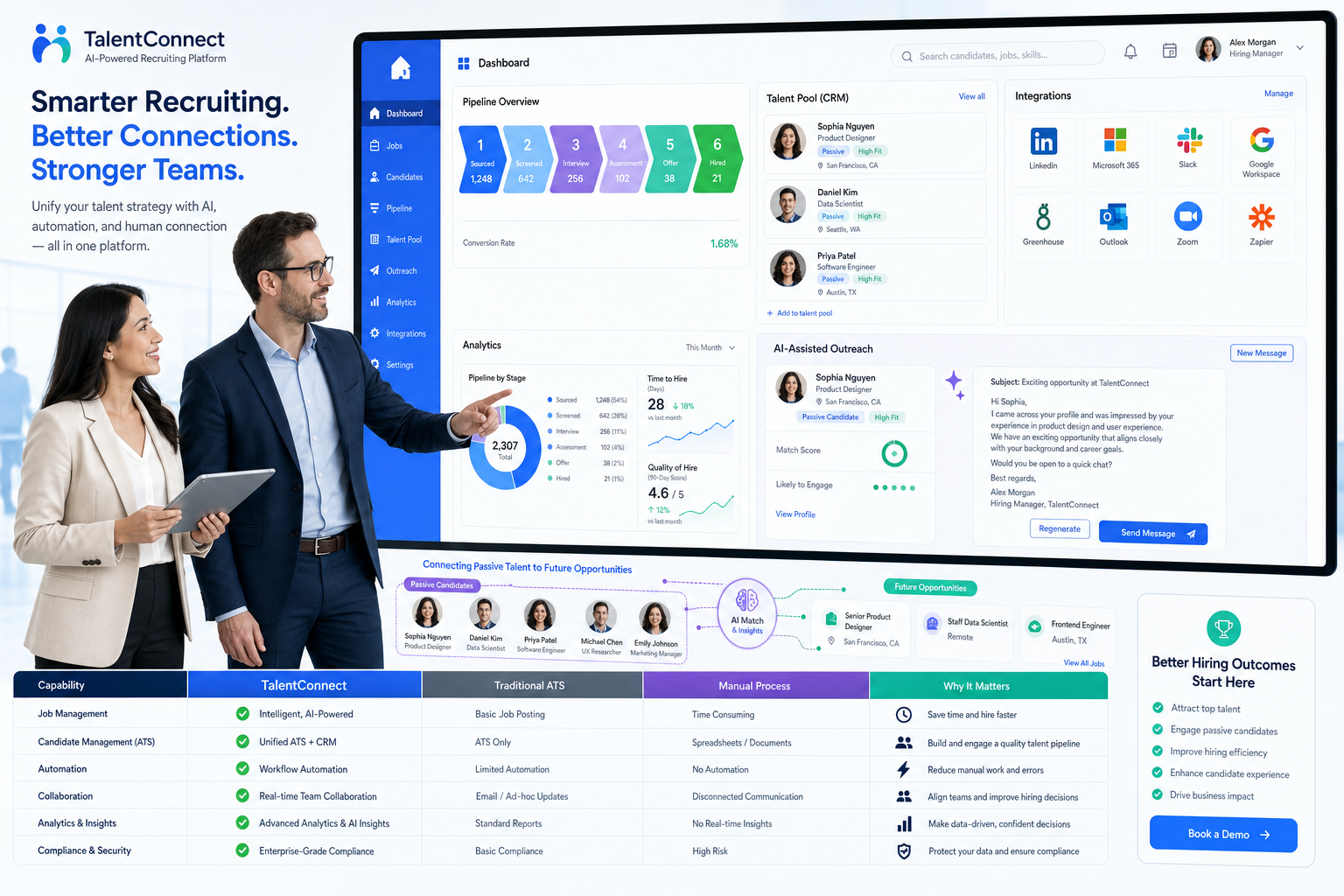
When employers compare the best recruitment platforms, a practical framework is more useful than a generic top-tools list. The comparison below reflects how experienced recruiters actually test systems in live hiring environments.
| Category | What to Look For | Why It Matters for Employers |
|---|---|---|
| Core ATS | Job posting, workflow stages, resume parsing, approvals, reporting | Creates process structure and protects against lost candidates |
| Recruiting CRM | Talent pools, nurture campaigns, re-engagement history | Supports future hiring, not only active openings |
| Automation | Scheduling, reminders, status updates, outreach support | Reduces admin load and keeps follow-up consistent |
| Collaboration | Scorecards, feedback collection, role-based access | Helps recruiters and hiring managers stay aligned |
| Integrations | HRIS, HCM, payroll, job boards, email, calendar, onboarding | Prevents duplicate entry and disconnected handoffs |
| Analytics | Source tracking, conversion rates, stage aging, time-to-fill | Shows whether the process is improving over time |
| Compliance | Permissions, audit trails, retention rules, AI governance | Supports defensible hiring operations |
| User Experience | Ease of use for recruiters, managers, and candidates | Drives adoption across the whole hiring team |
For buyers searching for the best hiring platforms for employers, the most important question is whether the software helps fill current roles while preserving what your team learns for the next hiring cycle.
How to Evaluate the Best Recruitment Platforms
The best recruiting software for one organization may be the wrong system for another. The strongest evaluation process starts with operating reality, not the feature sheet.
1. Start with your hiring model
Are you hiring for steady professional roles, high-volume frontline positions, confidential leadership searches, multi-location growth, or agency-style client work? Talent acquisition needs differ sharply by model, and the best recruiting platforms are usually optimized around those patterns even when marketing language sounds universal.
2. Map immediate hiring against future hiring
This is where the talent acquisition perspective becomes useful. A system should help your team run open requisitions today while retaining candidate relationships, source knowledge, and reporting insight for roles that will open later. If it cannot do that, you may solve a short-term posting problem while preserving a long-term pipeline problem.
3. Separate must-haves from nice-to-haves
Most teams need core ATS workflows, search and filtering, candidate communication, reporting, and coordination. Some need stronger CRM capabilities, text outreach, campus workflows, or high-volume automation. This is where the real applicant tracking system benefits become visible: the right system removes repeat admin from the workflows your team runs every week.
4. Test recruiter and hiring manager adoption
A platform that only recruiters understand creates friction instead of control. During demos, ask to see how a hiring manager reviews candidates, gives feedback, and tracks decisions. Many software rollouts fail not because the ATS is weak, but because the manager experience is too clumsy for real adoption.
5. Review implementation, support, and workflow maturity
Buyers should understand setup scope, integration support, template configuration, training expectations, and governance controls. The best hiring platforms for employers are not only feature-rich; they are realistic to implement and maintain under deadline pressure.
Best Recruiting Software by Employer Type
One of the clearest ways to assess the best recruitment platforms is to segment by employer type. That reflects how the market is actually used and helps buyers avoid overbuying or underbuying.
Small business hiring teams
Smaller employers usually need strong usability, straightforward workflow design, and enough reporting to stay organized without a dedicated recruiting operations owner.
Practical advice: prioritize fast setup, intuitive candidate tracking, and communication efficiency over deep customization.
Mid-market employers
Mid-sized organizations often need a more balanced mix of ATS, CRM, automation, approvals, and analytics because multiple departments and stakeholders are involved.
Practical advice: focus on workflow flexibility, manager adoption, and integration depth.
Enterprise organizations
Large employers usually need stronger governance, standardized workflows, regional or business-unit variations, and reliable system connections across the employee lifecycle.
Practical advice: evaluate permissions, auditability, security controls, and scalability before optional features.
Staffing agencies and search firms
Agency teams tend to value candidate relationship management, search speed, submission tracking, and pipeline reuse just as much as ATS workflow. They often need to move fast across multiple briefs without losing communication history.
Practical advice: prioritize search quality, talent pooling, communication continuity, and recruiter productivity.
High-volume hiring teams
When many similar roles must be filled quickly, process discipline matters more than polished interfaces alone. Automation, scheduling, mobile candidate experience, and drop-off reporting are central.
Practical advice: choose systems that reduce stage delay, improve follow-up consistency, and make bottlenecks obvious.
Applicant Tracking System Benefits in Real Hiring Workflows
Buyers often ask whether they really need more than spreadsheets, inboxes, and calendar invites. In most growing teams, they do. The core applicant tracking system benefits are operational before they become strategic.
- Centralized candidate records: recruiters and hiring managers see the same notes, stage history, and documents.
- Structured workflows: stages are clearer, which reduces inconsistent candidate handling.
- Faster coordination: scheduling, approvals, and feedback collection happen in one environment.
- Better reporting: teams can spot weak sources, stalled stages, and slow decision cycles.
- Improved candidate experience: timely communication lowers frustration and drop-off.
These applicant tracking system benefits matter whether you are reviewing the best hiring platforms for employers or simply trying to fix a fragmented process. The system itself does not create hiring quality, but it makes quality easier to repeat.
Why Candidate Relationships Matter as Much as Open Jobs
One of the strongest lessons from talent acquisition is that not every valuable candidate is active when your role opens. That is why many of the best recruiting platforms include CRM-style capabilities alongside ATS workflow.
When a recruiter can revisit prior conversations, re-engage silver medalists, segment talent pools, and maintain consistent outreach history, the team becomes less dependent on restarting the market every time a requisition opens. This is especially important in sectors where good candidates are scarce, selective, or passive.
I have seen this play out most clearly on LinkedIn-heavy searches. If a recruiter is juggling outreach across time zones or waiting on off-hours replies, momentum disappears quickly. In that situation, using AI Recruiter as a support layer can help sustain first-touch outreach, answer basic role questions, and collect résumés or contact details from interested candidates while the recruiter focuses on actual fit assessment. It is not a substitute for search judgment, but it does reduce the dead space between initial contact and human review.
That distinction matters. Good talent acquisition software should help build relationships at scale without pretending that candidate qualification is fully automatic.
Why Integrations Matter More Than Most Buyers Expect
Integration quality is one of the most overlooked buying criteria for the best recruitment platforms. Recruiting software does not operate in isolation. It usually needs to connect with job boards, HRIS or HCM systems, payroll tools, email, calendar workflows, and onboarding systems.
Without strong integrations, recruiters re-enter data, managers work from partial information, and downstream HR teams repair records manually. That weakens many of the promised applicant tracking system benefits because the process is only efficient inside one screen, not across the real hiring lifecycle.
Integration questions employers should ask
- Does the platform sync candidate and hire data with HRIS or HCM systems?
- Can it support source tracking cleanly across posting and outreach channels?
- How well does it handle calendar and email workflows for interviews?
- Can offer-stage and hire data move downstream without duplicate entry?
- Are integrations native, configurable, or dependent on middleware?
For talent acquisition leaders, these are not side questions. They determine whether the system helps the full hiring model or only part of it.
AI Features, Human Oversight, and Compliance
AI is now part of the conversation around the best recruiting software, especially in sourcing, matching, screening support, workflow automation, and candidate communication. Used carefully, these capabilities can reduce repetitive recruiter work. But software evaluation should not treat AI as automatically trustworthy.
Employers should ask what is automated, what is only assisted, how outputs are reviewed, and what controls exist for bias monitoring, transparency, and auditability. If a platform influences candidate ranking or screening decisions, recruiters and HR leaders need to understand where human oversight remains mandatory.
In my experience, AI is most defensible when it supports process continuity rather than replacing accountability. For example, using AI-supported LinkedIn outreach to maintain conversations, answer common role questions, and collect candidate materials is materially different from letting a system make the final fit call. The recruiter should still review the résumé, interpret the brief, and decide whether the candidate moves forward.
- What decisions are automated versus assisted?
- How are AI outputs explained to users?
- What controls exist to monitor bias or inconsistent outcomes?
- Can employers set review checkpoints before decisions are finalized?
- What records are retained for audit and process review?
For employers comparing the best hiring platforms for employers, the safest approach is to value AI that accelerates recruiter execution while preserving judgment and accountability.
Common Buying Mistakes to Avoid
Even experienced teams make avoidable errors when selecting the best recruitment platforms. Most of them come from buying for features instead of operating model.
- Choosing a tool that is too reactive: it may handle current applicants but fail to support long-term talent acquisition.
- Ignoring candidate relationship management: teams then rebuild the same pipeline from scratch for repeat roles.
- Underestimating hiring manager adoption: process delays quickly return if managers avoid the system.
- Overvaluing flashy automation: speed alone is not useful if quality and oversight decline.
- Skipping integration review: disconnected tools erode expected efficiency gains.
- Not defining success metrics: buyers should know whether they are optimizing for speed, pipeline depth, candidate experience, or reporting accuracy.
The best software decisions reflect recruiter workload, manager behavior, candidate communication realities, and the company’s future hiring plan, not just the next open req.
A Practical Selection Process for Recruiting Teams
If your team is actively shortlisting the best recruiting software, use a structured process rather than relying on polished demos alone.
- Document the current workflow: from headcount planning and requisition approval to outreach, interviews, and handoff.
- List pain points by stakeholder: recruiters, coordinators, hiring managers, and HR operations usually experience different friction.
- Define capabilities needed for both recruitment and talent acquisition: ATS, CRM, automation, analytics, integrations, compliance controls.
- Group requirements into must-have, should-have, and future-state: this keeps decisions grounded.
- Use scenario-based demos: ask vendors to show a realistic search, passive candidate follow-up, and interview cycle.
- Test reporting and governance: dashboards and audit trails matter as much as recruiter screens.
- Review implementation and support: confirm ownership for setup, training, and post-launch issue resolution.
From experience, the best hiring platforms for employers are usually the ones that make everyday recruiting easier for multiple stakeholders at once while still preserving the strategic value of pipeline data over time.
FAQ
What is recruiting software?
Recruiting software is technology that helps employers manage hiring workflows, including job posting, candidate tracking, communication, scheduling, reporting, and sometimes candidate relationship management. The best recruitment platforms usually extend beyond a basic ATS.
What is the difference between recruitment and talent acquisition?
Recruitment usually focuses on filling current vacancies. Talent acquisition is broader and more strategic, covering long-term workforce planning, sourcing, employer branding, candidate relationships, and hiring process improvement over time.
Why does talent acquisition matter when choosing software?
Because software that only supports immediate openings may not help with future hiring needs. The best recruiting platforms should support both active hiring and long-term pipeline building.
Do the best recruiting platforms include CRM functionality?
Many do. A recruiting CRM helps employers build talent pools, re-engage past applicants, and maintain relationships with passive candidates who may fit future roles.
What integrations should employers expect?
Common integrations include HRIS or HCM systems, payroll tools, job boards, email and calendar systems, and onboarding workflows. These preserve the real-world value of applicant tracking system benefits by reducing duplicate work.
How should employers think about AI in recruiting software?
AI should be evaluated based on what it automates, how transparent it is, and where human oversight remains. The strongest use cases usually support recruiter efficiency without removing human accountability from candidate decisions.
Can AI help with LinkedIn-heavy sourcing without replacing recruiters?
Yes. Tools such as StrategyBrain AI Recruiter can support repetitive outreach, candidate replies, and résumé collection, while the recruiter still handles qualification, fit assessment, and interview decisions.
Conclusion
The best recruiting software is not simply the system with the longest feature list. The best choice is the platform that matches your hiring model, supports long-term talent acquisition, preserves candidate relationships, integrates with the rest of your people systems, and improves execution without weakening judgment.
For employers comparing the best recruitment platforms, the most useful lens is simple: can this system help us fill roles today and build a stronger hiring engine for tomorrow? If the answer is yes, you are much closer to finding the best hiring platforms for employers and the best recruiting platforms for sustained results.