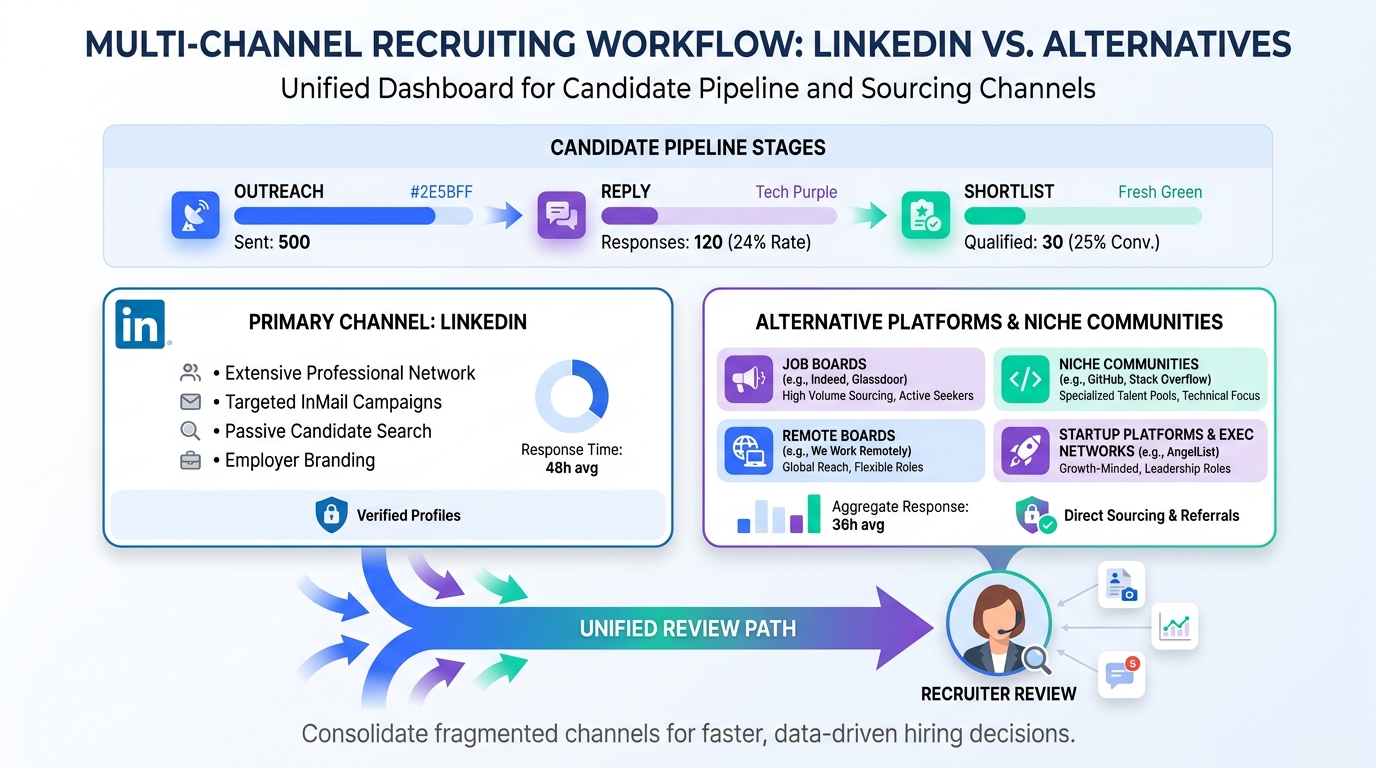
When outreach fragments, this article helps recruiters compare websites like LinkedIn by search type, candidate intent, and workflow risk.
That sounds obvious until a search starts to stall. A recruiter uses one platform for outreach, another for applications, a third for niche networking, and then loses the thread between who was approached, who replied, who needs follow-up, and which channel actually fits the role. For solo headhunters, that means wasted evenings and duplicate messages. For small agencies, it means slower shortlists and weaker candidate experience. For in-house teams, it often means hiring managers see activity but not progress.
In my own workflow, tools that reduce that fragmentation matter more than tools that promise a magical replacement for LinkedIn. When I have used StrategyBrain AI Recruiter, the most practical value has been in three areas tied directly to that problem: automating first-touch LinkedIn outreach, keeping candidate conversations moving after hours, and capturing resumes or contact details once someone is interested. The recruiter still has to decide fit, review the resume, and make the next call, but the repetitive front end gets lighter and easier to control.
The real tension shows up most clearly in senior searches. An executive candidate looking at a finance leadership move is not behaving like a mass-market applicant. Many of those opportunities never appear on broad job boards, and the recruiter involved may not be a general recruiter at all, but a specialist search consultant working on a retained, confidential mandate for one client. That changes the candidate’s calculation from “Where should I apply?” to “Which networks make me visible to the right search professionals without putting my information everywhere?”
That is why any serious linkedin alternatives guide has to start with candidate intent and recruiter type, not just a list of platform names. If a search depends on confidentiality, specialist networks, thought leadership, or private conversations, the best linkedin alternatives for job search will look very different from the platforms that work for broad, high-volume applications. The rest of this article compares those options by that real-world logic.
Table of Contents
- Why People Look for Websites Like LinkedIn
- Three Questions to Ask Before Choosing an Alternative
- Quick Comparison of LinkedIn Alternatives
- Best Alternatives for Professional Networking
- Best Alternatives for Active Job Search
- What Executive Search Teaches Us About Platform Choice
- How Recruiters Should Work Across Multiple Channels
- Common Mistakes to Avoid
- FAQ
Why People Look for Websites Like LinkedIn
People usually search for websites like LinkedIn when LinkedIn is not failing completely, but failing for a specific purpose. In recruiting, I see that happen in five common situations:
- The role is niche, and the right people spend more time in specialist communities than on public professional feeds.
- The search is confidential, so broad visibility is a disadvantage rather than a benefit.
- The candidate wants remote, startup, portfolio-led, or regional opportunities that get buried on general networks.
- The recruiter needs faster first-contact and follow-up than manual LinkedIn messaging can realistically support.
- The team is mixing sourcing, networking, and active applications without a clear channel strategy.
So a LinkedIn alternative is not always a direct clone. It may be a job board, a private community, a startup talent network, a remote-work board, a portfolio platform, or a regional professional network. The right comparison is not “What replaces LinkedIn everywhere?” but “What does this platform do better for this hiring motion?”
Three Questions to Ask Before Choosing an Alternative
The executive-search perspective is useful here because it forces better questions. Before a candidate or recruiter commits to a platform, three issues matter most.
1. Who is actually on the other side?
In senior hiring, there is a big difference between an in-house recruiter, a contingent recruiter, and a retained search consultant. The same principle applies to platforms. Some channels are built around direct employer access. Others are dominated by agencies, communities, or peer referrals. If you do not know who the real gatekeepers are, visibility can be misleading.
2. Who does the platform really serve?
Executive search firms work for the hiring organization, not the candidate, even if the candidate benefits when there is a fit. Many platforms work the same way. Some are optimized for employer demand, others for candidate discovery, and others for conversation and reputation. If you expect candidate-friendly behavior from an employer-first channel, or vice versa, you will read the signals wrong.
3. What makes someone discoverable there?
On some platforms, visibility comes from applying early. On others, it comes from publishing, participating in industry groups, speaking at events, showing a portfolio, or building specialist credibility over time. That is exactly how senior candidates become visible to executive recruiters: not by mass-applying, but by being findable through expertise, association activity, and relevant market presence.
Those three questions make this a better linkedin alternatives guide than a simple round-up, because they reveal whether you need a networking channel, a search database, a portfolio platform, or a job board.
Quick Comparison of LinkedIn Alternatives
| Platform Type | Best For | What It Does Better Than LinkedIn | Main Limitation |
|---|---|---|---|
| General job boards | High-volume active job search | Large listing volume and straightforward applications | Heavy competition and variable quality |
| Startup hiring platforms | Growth-stage and startup roles | Better alignment with stage, pace, and role context | Narrower role mix |
| Remote job boards | Remote-first candidates and distributed teams | Cleaner remote filtering | Smaller inventory than broad boards |
| Niche communities | Specialist talent and trust-led hiring | Higher relevance and better peer signal | Lower scale |
| Portfolio networks | Creative and technical work-sample hiring | Shows proof of work faster | Weak for roles without visible output |
| Regional professional networks | Country-specific hiring | Stronger local relevance and language fit | Limited global reach |
The best option among websites like LinkedIn depends on whether your goal is broad reach, specialist access, confidentiality, or speed.
Best Alternatives for Professional Networking
If your next move depends more on reputation and relationships than on quick applications, networking-led alternatives often outperform broad professional platforms.
Regional professional networks
These work well when hiring is tied to local language, country-specific employer brands, or regionally concentrated business communities. Candidates often find employers here that barely register on global platforms, and recruiters get a better signal on local relevance.
Industry communities and associations
The reference article made an important point that applies far beyond executive search: candidates become visible by participating in their professional association, speaking at industry events, or publishing useful thinking. In practice, that means community-led networks can be far more effective than a static profile when credibility matters.
For senior candidates in particular, these communities are some of the strongest linkedin alternatives for job search because they create trust before a role is ever discussed.
Portfolio-first networks
For designers, developers, writers, and some product or research professionals, work samples beat profile summaries. Recruiters can assess substance faster, and candidates can demonstrate range without relying on headline optimization.
Best Alternatives for Active Job Search
If your goal is immediate applications and interview volume, the best websites like LinkedIn are usually those built for active search rather than ongoing networking.
1. General job boards
Best for: Candidates who want volume and employers who need broad applicant flow.
Pros
- Large number of live openings
- Simple filters for title, location, and compensation
- Strong for immediate application activity
Cons
- High applicant competition
- Less relationship-building value
- Signal quality can vary by role and employer
2. Startup hiring platforms
Best for: Candidates targeting early-stage or growth companies.
Pros
- Better role-stage alignment
- More direct company context
- Less enterprise noise
Cons
- Narrower market coverage
- Not ideal for traditional corporate pathways
- Role availability may swing by function
3. Remote job boards
Best for: Candidates prioritizing distributed work and recruiters hiring across geographies.
Pros
- Remote intent is explicit from the start
- Less wasted filtering
- Useful for candidates outside major hubs
Cons
- Smaller pool than broad boards
- Remote labels can still hide location constraints
- Quality differs by board
4. Community-driven career platforms
Best for: Practical job search, peer referrals, and pathways outside polished profile culture.
Pros
- Access to talent and roles missed by standard networking sites
- More grounded candidate conversations
- Useful in local, operational, or nontraditional hiring paths
Cons
- Less effective for top executive search
- Profile depth may be inconsistent
- Employer response quality matters a lot
What Executive Search Teaches Us About Platform Choice
The reference perspective on executive recruiters is worth carrying through the whole article because it explains why platform choice is really about search method, not brand loyalty.
First, not all recruiters are the same, and not all channels are either. A retained executive search consultant handling a confidential board or VP mandate is solving a different problem from a recruiter filling a mid-level role with broad market supply. Candidates who ignore that difference often overinvest in the wrong channels.
Second, the best opportunities are not always advertised. In senior hiring, much of the work happens through private research, discreet networking, targeted outreach, and long-cycle relationship building. That is why publishing thought leadership, participating in industry groups, and maintaining a specialist reputation can matter as much as applying.
Third, recruiter relationships are reciprocal. One of the most practical lessons from executive search is that visibility is not just self-promotion. Good candidates also share market intelligence, make referrals, and become useful contacts. In recruiting terms, that means the strongest alternatives to LinkedIn are often the places where expertise travels both ways.
So if you are comparing linkedin alternatives for job search, ask whether you need a platform for application volume or a channel for professional visibility among specialist recruiters. Those are different jobs.
How Recruiters Should Work Across Multiple Channels
Once you start using several alternatives, process matters as much as source quality. This is where many teams fail: they add channels faster than they improve coordination.
- Assign each channel a purpose. Know whether it is for active applicants, confidential outreach, specialist networking, or portfolio review.
- Separate recruiter type from source type. A senior retained search workflow should not be measured like a broad contingent pipeline.
- Define visibility signals. Decide what counts as proof on that platform: community activity, portfolio quality, reply rate, referrals, or direct applications.
- Keep one review path. Candidate conversations can start anywhere, but shortlist decisions need a single workflow.
- Track which channels produce the right interviews. Volume alone is not enough.
In my own LinkedIn-heavy sourcing work, the point where things break is usually the handoff between outreach and real evaluation. That is the narrow gap where AI Recruiter has been most useful for me: it can keep first-contact messaging moving, respond when candidates reply outside working hours, and collect resumes and contact details from interested people so the recruiter can step in at a cleaner decision point. I would not use it to outsource judgment, because it does not replace actual assessment, but it is effective at removing repetitive traffic that slows a search down. If you want the broader workflow context, the usage notes here are close to the real problem many headhunters run into.
That matters especially when LinkedIn is still one part of the stack rather than the whole stack. Many recruiters do not need a total replacement. They need better orchestration around LinkedIn plus better non-LinkedIn channels for the roles that do not belong there.
Common Mistakes to Avoid
Treating every alternative as a full LinkedIn substitute
Most platforms do one thing better, not everything better. Confusing specialization with replacement leads to bad sourcing decisions.
Ignoring recruiter model and search type
The lesson from executive search is clear: confidential senior searches, specialist mandates, and broad mid-market recruitment do not belong on the same channel mix.
Optimizing for visibility instead of fit
A candidate can be highly visible and still poorly placed. A recruiter can generate huge activity and still miss the right shortlist. Platform relevance matters more than raw exposure.
Letting follow-up collapse
This is where process and tooling show up in real life. If replies arrive at odd hours, resumes come through different channels, and nobody records next steps consistently, even a good source underperforms.
FAQ
What are the best websites like LinkedIn for job search?
The best options depend on your goal. General job boards work well for broad application volume, while startup platforms, remote boards, niche communities, and regional networks can work better when the search is more specific.
Are LinkedIn alternatives better than LinkedIn?
Not universally. LinkedIn is still strong for general visibility and recruiter discovery. Alternatives often beat it in narrower use cases such as remote hiring, startup roles, portfolio-led hiring, or confidential specialist search.
What are the best linkedin alternatives for job search at senior level?
Senior candidates often do better with specialist communities, industry associations, regional executive networks, and direct relationships with retained search professionals than with broad application-based platforms alone.
Can recruiters rely on websites like LinkedIn without losing control of workflow?
Yes, but only if each source has a clear role and candidate follow-up is managed consistently. The problem is rarely the number of channels alone; it is the lack of coordination between outreach, response handling, and shortlist review.
How can recruiters make LinkedIn itself easier to use?
For teams that still source heavily on LinkedIn, automation can help with repetitive front-end work such as first outreach, after-hours replies, and collecting candidate details. A tool like StrategyBrain AI Recruiter can support that part of the workflow while the recruiter keeps final responsibility for fit, screening, and interview decisions.
Conclusion
The most useful way to compare websites like LinkedIn is not to ask which site looks most familiar. Ask which channel fits the search. A confidential executive search, a startup hiring sprint, a remote-first role, and a high-volume general search all need different environments.
That is also why the executive-search lens improves any linkedin alternatives guide. It reminds candidates and recruiters that visibility, trust, confidentiality, specialization, and recruiter type all change what “best” means. If you keep that framework in mind, the strongest linkedin alternatives for job search become much easier to spot.