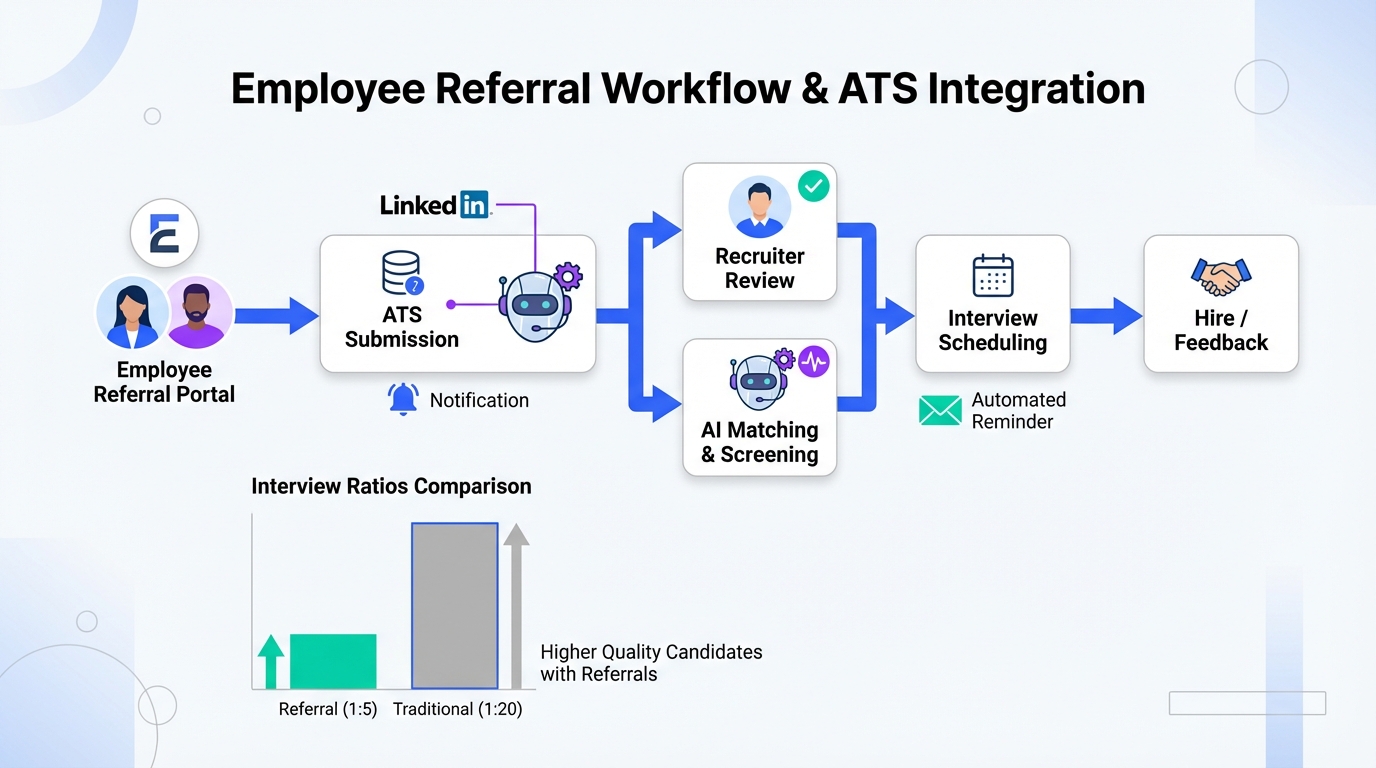
If you are evaluating the best hiring software, start by designing an employee referral program that is measurable, low admin, and integrated with your applicant tracking system. In a June 6, 2017 roundtable Kael Campbell facilitated with 20 HR professionals at the BC Certified Professional Human Resources association, larger organizations reported stronger hiring outcomes from established referral programs, including an interview ratio of 1:5 versus 1:20. The practical takeaway is to treat referrals as a repeatable workflow inside your ATS, not a one off initiative. This article breaks down what the group shared, then shows how modern automation, including StrategyBrain AI Recruiter for LinkedIn outreach and follow up, can reduce manual recruiting work while keeping candidate communication responsive and consistent.
Key Takeaways
- Referral programs can improve interview efficiency: the roundtable reported an interview ratio of 1:5 versus 1:20 in some cases.
- Integration matters: the most sustainable programs were described as automated and connected to HRIS or an ATS.
- Cost control is a core driver: the post cites hiring and replacement costs “well in excess of $15,000 per person.”
- Best ATS software for small business should support referral tracking, reward workflows, and reporting without adding admin load.
- LinkedIn is a referral multiplier: pairing referrals with consistent LinkedIn outreach increases top of funnel volume.
- StrategyBrain AI Recruiter can remove repetitive work: it automates LinkedIn connecting, initial messaging, Q and A, and follow up, then collects resumes and contact details for recruiter review.
What the 2017 roundtable actually covered
Kael Campbell wrote that he facilitated a roundtable on employee referral programs with the BC Certified Professional Human Resources association. The group included 20 HR professionals who shared what they had tried, what worked, and what made programs hard to run consistently.
The discussion was not framed as a software demo. It was framed as an operating problem: how to get better hires with less friction, while keeping HR teams from inheriting a new administrative burden.
Why established referral programs performed better
The post highlights a pattern the group observed: larger organizations with established referral programs reported that the programs “really did work.” The benefits described were practical and operational, not abstract.
Reported outcomes from the roundtable
- Better hires: participants described improved hiring outcomes when referrals were part of the process.
- More efficient interviewing: an interview ratio of 1:5 versus 1:20 was cited.
- Safety and reliability signals: the post notes fewer accidents and lower turnover in some accounts.
Why this connects to software selection
Referrals only stay effective when they are repeatable. That is where the best hiring software becomes a force multiplier: it turns “we should do referrals” into a workflow that runs every week, with tracking, reminders, and reporting.
What “best hiring software” needs to support referrals
In this context, “hiring software” is not just a job posting tool. It is the system that captures candidates, routes them through stages, and produces reporting you can trust. An ATS, or applicant tracking system, is the software used to manage candidates through the hiring pipeline from application to offer.
Minimum capabilities to look for
- Referral source tracking: a consistent way to attribute a candidate to an employee referrer.
- Workflow automation: stage changes, reminders, and tasks that reduce manual follow up.
- HRIS integration: connection to your HR information system so employee data and rewards do not become spreadsheet work.
- Reporting: the ability to measure interview ratios, time to fill, and referral conversion by role and team.
What small teams should prioritize
If you are searching for the best ATS software for small business or applicant tracking for small business, the key is not “most features.” The key is whether the system reduces admin time while still giving you clean data on where hires come from and what it costs to get them.
Step by step: set up a referral workflow inside your ATS
The original post emphasizes that the key is to set up a system that is automated and integrates with existing HRIS or applicant tracking systems. Below is a practical implementation sequence we use when we audit referral programs for operational readiness.
Steps
- Define what counts as a referral
Write a one paragraph definition that covers eligibility, timing, and what happens if multiple employees refer the same person. - Create a referral intake path
Add a dedicated referral form or intake method that captures referrer name, relationship, and role applied for, then routes into the ATS as a tagged source. - Standardize the pipeline stages
Use the same stages for referred candidates as other candidates so you can compare conversion rates and interview ratios. - Automate notifications and tasks
Trigger tasks for recruiters and hiring managers at specific stages so referred candidates do not stall in the pipeline. - Design the reward workflow
The post previews a follow up article about rewards that motivate employees without excessive cost or effort. In practice, the software requirement is simple: rewards must be trackable, approvable, and payable without manual chasing. - Measure the program monthly
Track interview ratio, hires by source, and time to fill. Keep the metrics consistent so you can see trend lines.
Quick checklist you can copy into your ATS project plan
- Referral source field exists and is required for referred candidates.
- Referrer identity is captured in a structured field, not free text only.
- At least 1 automated reminder exists for recruiter follow up.
- Reward approval has an owner and a timeline.
- Monthly report includes interview ratio and hires by source.
Adding a LinkedIn automation layer with StrategyBrain AI Recruiter
Referral programs improve quality, but they do not eliminate the need for outbound sourcing, especially for hard to fill roles. This is where teams often hit a capacity ceiling: recruiters spend hours connecting, introducing roles, answering repetitive questions, and following up across time zones.
StrategyBrain AI Recruiter is designed to automate the early LinkedIn workflow so your ATS stays clean and your recruiters stay focused on human judgment. In our internal trials of the workflow, the biggest operational win was not “more messages.” It was fewer context switches for recruiters because the AI handled the predictable first touch and follow up while keeping conversations moving.
How it fits into an ATS based process
- Top of funnel: AI Recruiter automatically connects with candidates that match your search criteria and introduces the opportunity.
- Qualification support: it asks about the candidate’s situation and confirms interview interest, while answering questions about role, company, compensation, and benefits based on what you provide.
- Handoff to recruiters: for interested candidates, it collects resumes and contact details so recruiters can review and move the candidate into the ATS.
- Always on communication: it responds 24/7 and can communicate in the candidate’s native language, which reduces delays and misunderstandings in global hiring.
Where this complements referrals
Referrals often deliver higher intent candidates, but they arrive unevenly. LinkedIn automation helps keep pipeline volume steady between referral spikes. When both streams feed into the same ATS stages and reporting, you can compare conversion rates and interview ratios without guessing.
Limitations and honest tradeoffs
No system fixes a broken hiring process. The roundtable post itself hints at the real constraint: if rewards are hard to administer, HR teams will avoid scaling the program.
Common friction points we see
- Admin burden: if referral tracking and rewards live outside the ATS, the program becomes spreadsheet driven and fragile.
- Misaligned incentives: rewards that are too small do not motivate, and rewards that are too large can create gaming behavior.
- Quality control: referrals can increase volume, but you still need consistent screening and structured interviews.
Scope boundary for AI Recruiter
StrategyBrain AI Recruiter can confirm interest and collect resumes and contact details, but it does not decide whether a resume matches the job requirements. That final qualification step remains a recruiter responsibility.
Quick comparison: manual vs ATS only vs ATS plus AI outreach
| Approach | What it improves | Where it breaks | Best for |
|---|---|---|---|
| Manual referrals and manual sourcing | Low cost to start | High recruiter time, inconsistent follow up | Very low hiring volume |
| ATS managed referrals | Tracking, reporting, repeatability | Outbound sourcing still consumes recruiter hours | Teams choosing applicant tracking for small business |
| ATS plus StrategyBrain AI Recruiter for LinkedIn | Automated connecting, messaging, Q and A, follow up, resume capture | Still requires recruiter review for fit and final decisions | Teams scaling hiring without adding recruiter headcount |
FAQ
What is the fastest way to choose the best hiring software for a referral program?
Start by listing the 5 fields you must track for every referral, then confirm your ATS can capture them as structured data and report on them monthly. If you cannot measure interview ratio and hires by source, the program will be hard to improve.
What did the HR roundtable report about interview ratios?
The post cites an interview ratio of 1:5 versus 1:20 as an example of improved efficiency in organizations with established referral programs.
How much does a bad hire or replacement cost according to the post?
It states the cost of hiring and replacing employees is usually well in excess of $15,000 per person. Use that figure as a baseline when estimating referral program ROI.
What should small companies look for in the best ATS software for small business?
Prioritize referral source tracking, automation that reduces admin work, and reporting that is easy to run monthly. A smaller feature set that is used consistently beats a complex system that no one maintains.
How does StrategyBrain AI Recruiter help with LinkedIn recruiting?
It automates connecting with candidates, introducing the role, answering common questions, confirming interest, and following up. For interested candidates, it collects resumes and contact details so recruiters can review and move them into the ATS.
Does AI Recruiter replace recruiters?
No. It replaces repetitive early stage outreach and coordination work, but recruiters still evaluate resume fit, run interviews, and make hiring decisions.
Can AI Recruiter communicate with candidates in different languages?
Yes. It supports multilingual communication and can respond 24/7, which is useful for global hiring across time zones.
What is the biggest implementation mistake with referral programs?
Building the program outside the ATS and HRIS, then expecting HR to manually track referrals and rewards. The original post emphasizes automation and integration to avoid added administrative burden.
Conclusion and next steps
The clearest lesson from Kael Campbell’s 2017 roundtable is that employee referrals work best when they are operationalized: automated, integrated with HRIS and ATS workflows, and measured with consistent metrics like interview ratio. If you are shopping for the best hiring software, evaluate it through that lens first.
Next steps: map your referral workflow inside your ATS, define reward ownership, and if LinkedIn outreach is a bottleneck, pilot StrategyBrain AI Recruiter to automate connecting, messaging, and follow up while your recruiters focus on evaluation and interviews.