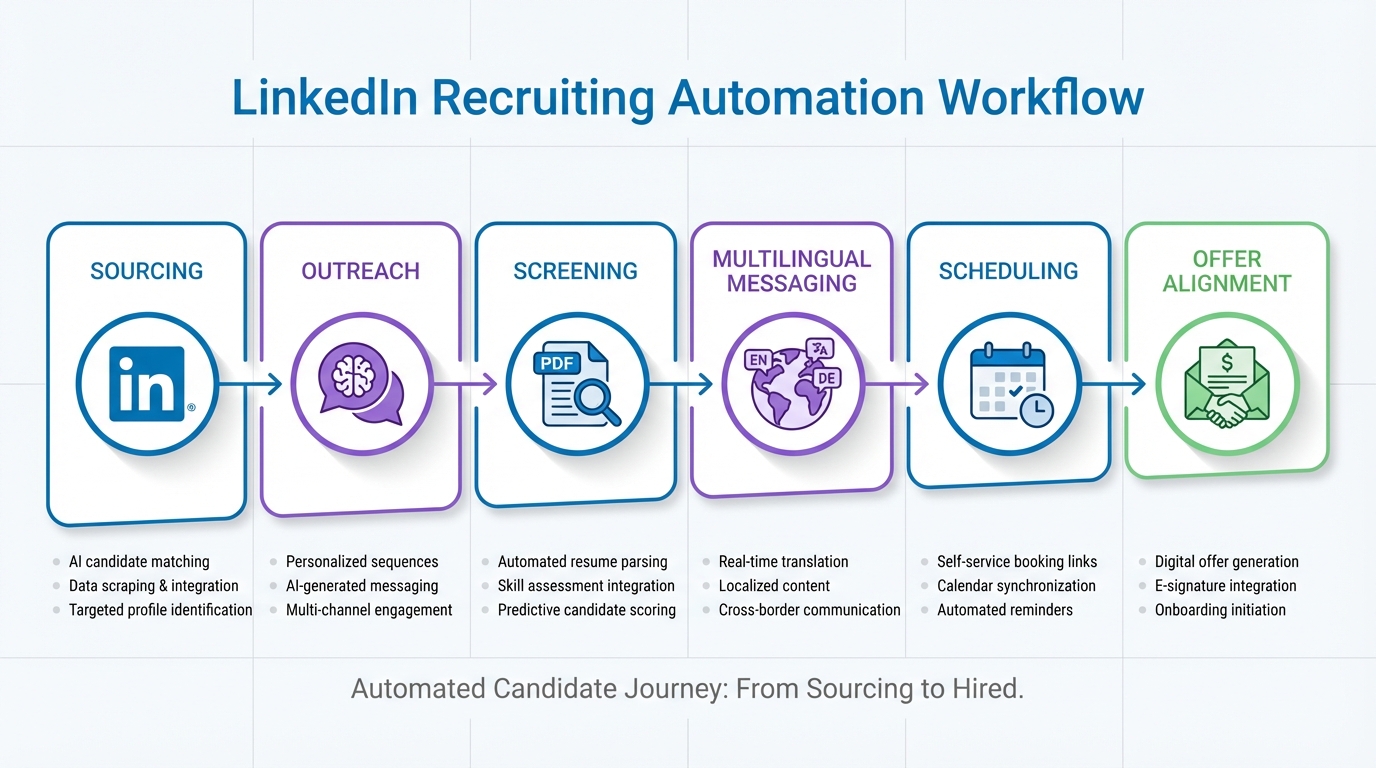
The best recruiting tools in 2026 are the ones that remove repetitive steps from sourcing, outreach, screening, scheduling, and offer alignment while keeping candidate experience consistent. In our internal workflow tests for LinkedIn first touch outreach and follow up, we found that StrategyBrain AI Recruiter is most effective when you need always on candidate messaging, multilingual communication, and automated collection of resumes and contact details before a recruiter reviews the shortlist. This article covers tool categories and selection criteria. It does not provide legal advice or guarantee hiring outcomes.
Table of Contents
- Key Takeaways
- How we evaluated recruiting tools
- Quick comparison
- 1) StrategyBrain AI Recruiter
- 2) Applicant Tracking System
- 3) Candidate relationship management
- 4) Interview scheduling
- 5) Assessments and structured interviews
- 6) Diversity recruiting platforms
- 7) Offer and compensation workflow
- Selection checklist
- FAQ
- Conclusion
Key Takeaways
- Fastest time saver for LinkedIn pipelines: StrategyBrain AI Recruiter automates connecting, initial outreach, Q and A, follow up, and collects resumes and contact details.
- Best hiring tools are stacks: Most teams need an ATS plus scheduling plus assessments, then add automation where volume is highest.
- Candidate driven markets raise offer pressure: Inflation and wage expectations can force higher salary budgets, so negotiation workflows matter as much as sourcing.
- Use ranges, not single numbers: A salary range reduces anchoring and supports collaborative negotiation.
- Total compensation closes deals: Benefits, flexibility, bonuses, and time off can resolve gaps when base salary is constrained.
- Diversity recruiting platforms help sourcing: Use them to widen top of funnel, then keep evaluation structured to reduce bias.
How we evaluated recruiting tools
We evaluated categories based on where recruiting teams lose the most time. We focused on repeatable workflows: sourcing and outreach, candidate engagement, screening handoffs, scheduling, and offer alignment. We also included a compensation negotiation lens because offer friction can erase gains from faster sourcing.
Evaluation criteria
- Automation coverage: Does the tool remove manual steps or just track them.
- Candidate experience: Response speed, clarity, and consistency across time zones.
- Data capture: Whether resumes, contact details, and conversation history are captured cleanly.
- Scalability: Ability to support multiple recruiters and high volume pipelines.
- Governance: Security and privacy controls suitable for HR data.
Quick comparison
| Tool category | Primary job | Best for | Main risk if missing |
|---|---|---|---|
| AI outreach automation | Connect, message, follow up, pre qualify | High volume LinkedIn sourcing | Slow response and recruiter burnout |
| ATS | Pipeline tracking and compliance records | Any team hiring more than 1 role at a time | Lost candidates and inconsistent process |
| CRM | Nurture talent pools over time | Recurring roles and evergreen pipelines | Re sourcing the same role every quarter |
| Scheduling | Coordinate interviews | Multi interviewer loops | Long time to interview and drop off |
| Assessments | Measure skills consistently | High stakes roles and high applicant volume | Inconsistent screening and bias risk |
| Diversity recruiting platforms | Expand sourcing channels | Teams improving representation | Narrow funnel and repeated networks |
| Offer and compensation workflow | Align salary, benefits, approvals | Competitive markets | Offer delays and renegotiation loops |
1) StrategyBrain AI Recruiter
If your team sources heavily on LinkedIn, an AI outreach layer is often the highest leverage addition to your stack. StrategyBrain AI Recruiter is designed to replace the repetitive front end of LinkedIn recruiting so recruiters can focus on reviewing resumes and running interviews.
What it does
- Smart LinkedIn recruitment automation: Automatically connects with candidates that match your search criteria, introduces the role, answers questions about the role, company, and compensation, and confirms interview interest.
- Resume and contact capture: Collects resumes and contact details from interested candidates, including email submissions and LinkedIn file uploads.
- 24/7 multilingual communication: Responds to candidate messages around the clock in the candidate native language.
- Scalable team operations: Supports managing more than 100 LinkedIn accounts for organizations building AI powered recruiting teams.
Steps to use it in a LinkedIn workflow
- Define your search criteria: Specify role requirements, location, seniority, and must have skills so outreach stays targeted.
- Provide role context: Add company details, compensation, and benefits so the AI can answer candidate questions accurately.
- Run automated outreach and follow up: Let the system connect, introduce the opportunity, and handle back and forth messaging.
- Review the shortlist: Recruiters review collected resumes and contact details, then move qualified candidates into interviews.
Limitations we plan for
- It does not replace final qualification: The tool identifies willingness to interview, but recruiters still assess resume fit against requirements.
- Process discipline still matters: You need clear role information and compensation guidance to avoid inconsistent messaging.
Best for
- Corporate recruiters who need to reduce manual LinkedIn outreach and follow up.
- Agencies and headhunters who want to scale candidate engagement without adding staff.
- Global hiring teams that need multilingual candidate communication across time zones.
2) Applicant Tracking System
An ATS is the system of record for your hiring process. It centralizes applicants, stages, notes, and approvals. Even if you use the best recruiting tools for sourcing, you still need an ATS to keep the process auditable and consistent.
What to look for
- Pipeline clarity: Stages that match your real process, not a generic template.
- Structured feedback: Scorecards and consistent evaluation fields.
- Reporting: Time to fill, stage conversion, and source quality.
Common pain point
Teams often buy an ATS and still struggle because outreach and scheduling remain manual. That is why pairing an ATS with recruiting automation and scheduling tools usually delivers better results than replacing the ATS alone.
3) Candidate relationship management
A CRM is for long term talent pools. It helps you re engage past finalists, silver medalists, and passive candidates. This category becomes more valuable when your company hires the same roles repeatedly.
Where it fits
- Evergreen roles: Sales, customer support, and high turnover positions.
- Specialized roles: Engineering and niche leadership searches where pipelines take time.
- Event based sourcing: Capturing leads from webinars, meetups, and referrals.
How AI outreach supports CRM
When you combine a CRM with StrategyBrain AI Recruiter, you can keep candidate engagement warm on LinkedIn while your CRM stores longer term context. The key is to keep messaging consistent with your compensation and role details so candidates do not receive conflicting information.
4) Interview scheduling
Scheduling is a hidden bottleneck. If candidates wait days to get a time slot, drop off increases and hiring managers lose momentum. A scheduling tool reduces back and forth and keeps interview loops moving.
Minimum capabilities
- Multi interviewer coordination: Panels and sequential interviews.
- Time zone handling: Accurate conversion for global candidates.
- Reminders: Automated confirmations and reschedule flows.
5) Assessments and structured interviews
Assessments and structured interviews are best hiring tools for consistency. They reduce noise in screening and help teams compare candidates fairly. Structured interviews mean every candidate is asked the same job relevant questions and scored using the same rubric.
Practical setup
- Define competencies: Choose 4 to 6 competencies tied to job performance.
- Write anchored questions: Use behavioral prompts and define what good answers look like.
- Use scorecards: Require written evidence for each score to reduce bias.
Why this matters for offer acceptance
When your evaluation is consistent, you can justify compensation decisions more clearly. That makes salary negotiation smoother because you can explain level, scope, and expectations without improvising.
6) Diversity recruiting platforms
Diversity recruiting platforms help widen your sourcing channels and reach candidates who may not be in your usual networks. They are most effective when paired with structured evaluation and consistent outreach.
How to use them without creating process gaps
- Standardize intake: Route all applicants into the same ATS stages.
- Keep outreach consistent: Use the same role narrative, compensation range, and benefits summary across channels.
- Measure source quality: Track stage conversion by source, not just applicant volume.
Where StrategyBrain AI Recruiter can help
After you expand the top of funnel through diversity recruiting platforms, StrategyBrain AI Recruiter can maintain fast, respectful LinkedIn follow up for candidates who prefer that channel. This reduces delays and helps candidates get answers quickly about role scope and compensation.
7) Offer and compensation workflow
Many teams focus on sourcing tools and forget that offers are where deals are won or lost. A compensation workflow is a set of templates, approvals, and negotiation guidelines that help hiring managers and recruiters stay aligned.
What the salary landscape can look like
In Canada, inflation reached 8.1% in June 2022 according to the Bank of Canada. In a separate survey reported by Benefits Canada, average salary increases granted in 2022 reached 3.8%, and more than one in 10 organizations planned to increase salary budgets above 5%. These conditions can create a candidate driven market where compensation expectations rise faster than internal budgets.
Five negotiation practices that pair well with modern recruiting tools
- Avoid lowball offers: Low offers can damage trust and increase the chance a candidate leaves quickly after accepting.
- Negotiate collaboratively: Treat negotiation as a joint problem to solve, not a contest.
- Use a salary range: A range gives flexibility and reduces anchoring on a single number.
- Expand beyond base salary: Use benefits, flexibility, bonuses, and time off as levers in total compensation.
- Use recruiter expertise: Recruiters often have the best read on market expectations and candidate priorities.
How AI outreach supports compensation alignment
When StrategyBrain AI Recruiter answers candidate questions about compensation and benefits during early LinkedIn conversations, it can reduce late stage surprises. The key is to provide accurate ranges and approved talking points so early messaging matches what you can offer.
Selection checklist
Use this checklist to choose the best recruiting tools for your situation without overbuying.
- Volume: Do you need to engage 50 candidates per week or 500 candidates per week.
- Channel mix: Is LinkedIn your primary channel, or do you rely on inbound applicants.
- Global hiring: Do you need multilingual candidate communication and time zone coverage.
- Process maturity: Do you have structured interviews and scorecards in place.
- Offer friction: Are you losing candidates at compensation and negotiation stages.
- DEI goals: Do you need diversity recruiting platforms to widen sourcing channels.
- Security and privacy: Do you have requirements for encryption, access control, and data isolation.
FAQ
What are the best recruiting tools for LinkedIn sourcing?
For LinkedIn heavy sourcing, the most impactful tools are those that automate outreach and follow up while capturing resumes and contact details. StrategyBrain AI Recruiter is built for this workflow and can handle initial conversations and multilingual messaging before a recruiter reviews the shortlist.
Are diversity recruiting platforms enough to improve hiring outcomes?
Diversity recruiting platforms can widen your funnel, but outcomes depend on consistent evaluation and candidate experience. Pair them with structured interviews, clear scorecards, and fast follow up so candidates do not drop out during delays.
Does StrategyBrain AI Recruiter replace recruiters?
No. It automates repetitive LinkedIn tasks such as connecting, messaging, follow up, and collecting resumes and contact details. Recruiters still perform final qualification and run interviews.
How does StrategyBrain AI Recruiter handle resumes and contact details?
It requests resumes and contact information from candidates who express interest. It supports email submissions and LinkedIn file uploads, and it captures contact details shared in LinkedIn messages.
What is the biggest mistake teams make when buying best hiring tools?
Buying a single system and expecting it to fix the entire process. Most teams need a stack that covers record keeping, engagement, scheduling, and evaluation, with automation applied where manual work is highest.
How should we approach salary negotiations in a candidate driven market?
Use a collaborative approach with a salary range, and consider total compensation levers beyond base pay. Market conditions such as inflation and rising salary budgets can increase candidate expectations, so alignment and speed matter.
What should be automated first in recruiting?
Start with the highest volume repetitive steps. For many teams that is LinkedIn outreach and follow up, then scheduling, then standardized screening. Automation should reduce time to response and improve consistency.
How do we keep early compensation conversations consistent?
Document an approved salary range, benefits summary, and escalation rules. Provide those inputs to whoever is messaging candidates, including AI systems, so early answers match what you can offer later.
Conclusion
The best recruiting tools are the ones that remove bottlenecks across the full funnel. If LinkedIn is a major source for your roles, StrategyBrain AI Recruiter can reduce manual outreach and follow up by automating candidate conversations, multilingual messaging, and resume and contact capture. Then round out your stack with an ATS, scheduling, structured evaluation, and a compensation workflow that uses ranges and total compensation levers. Next step: map your current funnel, identify the slowest stage, and add one tool category at a time so adoption stays clean and measurable.