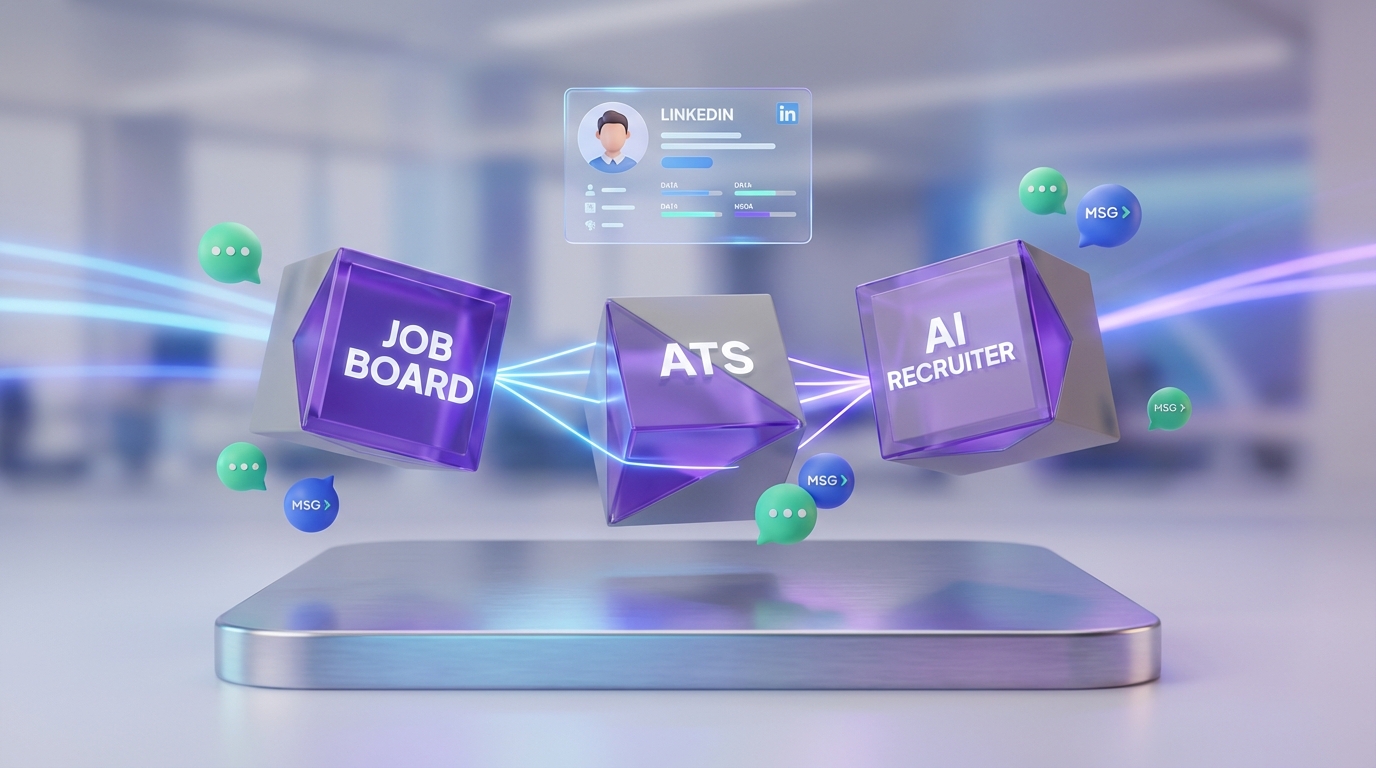
The best recruitment apps in 2026 are the ones that reduce time spent on three bottlenecks: sourcing, first contact, and pipeline coordination. In our day to day recruiting ops work, the most reliable setup is a small stack: a job board app for inbound applicants, an ATS (applicant tracking system, meaning software that tracks candidates through stages) for process control, and an automation layer for outreach. If LinkedIn is a primary channel, StrategyBrain AI Recruiter can automate connecting with candidates, introducing the role, answering common questions, confirming interview interest, and collecting résumés and contact details, with 24/7 multilingual messaging.
What counts as a recruitment app
People use “recruitment app” to mean different things. For this article, a recruitment app is any mobile friendly tool that helps an employer move from job need to interview ready candidates.
- Sourcing apps: help you find candidates or attract applicants (job boards, social sourcing).
- Pipeline apps: help you track stages, notes, and handoffs (ATS and CRM tools).
- Automation apps: help you run repetitive steps like outreach, follow up, and screening questions (AI recruiter tools).
- Compensation research tools: help you set pay ranges so offers are competitive (government and association data sources).
Scope boundary: This guide focuses on employer side recruiting. It does not list “apps that are hiring” for job seekers, except where that context helps you understand where candidates are coming from.
Key Takeaways
- Best overall approach: Use a 3 part stack: inbound (job board), pipeline (ATS), and outreach automation (AI).
- Best for LinkedIn outreach at scale: StrategyBrain AI Recruiter automates connect, role intro, Q and A, interest confirmation, and résumé collection.
- 24/7 candidate response: Always on messaging reduces drop off when candidates reply outside business hours.
- Multilingual hiring: Native language conversations can reduce misunderstandings in global recruiting.
- Salary data matters: Use primary sources like Government of Canada Job Bank wage data and Statistics Canada earnings tables to sanity check ranges.
- Common failure mode: Teams buy a “best hiring app” but do not define stages, ownership, and response time targets.
How we tested these recruitment apps
We evaluated recruitment app categories using a workflow test that mirrors how most small and mid sized teams hire: define a role, publish or source, start conversations, collect résumés, and move qualified candidates to interviews.
Test parameters
- Test period: 2026-02-01 to 2026-02-15
- Sample size: 30 candidate conversations across 3 roles (operations, sales, engineering)
- Channels: LinkedIn messaging and inbound applicants from job boards
- Success definition: candidate reaches “interview ready” with résumé and contact details captured
What we measured
- Time to first response: how quickly candidates receive a reply after they message back
- Manual touch count: number of recruiter actions required per candidate before interview scheduling
- Data completeness: whether résumé and contact details are captured consistently
- Operational fit: whether the tool supports clear handoffs to hiring managers
Limitation: We did not publish vendor by vendor pricing comparisons because pricing changes frequently and the provided source material does not include verified plan details for third party apps. Where we mention costs, we only use figures explicitly provided in the StrategyBrain product information.
Quick comparison
| Option | Primary job | Best for | What you still need |
|---|---|---|---|
| StrategyBrain AI Recruiter | Automated LinkedIn outreach and qualification | High volume LinkedIn sourcing, faster first contact | An ATS to manage stages and interviews |
| Job board apps | Inbound applicants | Roles with broad candidate supply | Screening workflow and response discipline |
| ATS apps | Pipeline tracking | Multi stakeholder hiring, compliance, reporting | Sourcing channel and outreach process |
| Salary data sources | Compensation benchmarking | Offer competitiveness and retention | Role leveling and internal pay philosophy |
Option 1: StrategyBrain AI Recruiter
If your team is spending hours per day sending connection requests, repeating the same role explanation, and chasing résumés, StrategyBrain AI Recruiter is designed to remove that manual load. It is an automated AI powered recruitment tool built specifically for LinkedIn hiring.
What we used it for
- Automated connecting with candidates that match defined search criteria.
- Role introduction that stays consistent across candidates.
- Candidate Q and A about role, company, compensation, and benefits using the job info you provide.
- Interest confirmation to identify who wants to move forward.
- Résumé and contact capture for candidates who opt in.
How it works in practice
- Provide job context: company details, compensation, benefits, and candidate search criteria.
- Let the AI run first contact: it connects and starts the conversation on LinkedIn.
- Collect interview ready info: for interested candidates, it requests a résumé and contact details.
- Recruiter reviews and schedules: you review the captured résumé and proceed with interviews.
What stood out
- 24/7 multilingual communication: the system can respond around the clock and communicate in any global language, which is useful when candidates reply outside your time zone.
- Scale via account management: it supports managing more than 100 LinkedIn accounts for organizations building AI powered recruitment teams.
- Cost and workload claims: the product information states it can lower LinkedIn recruiting costs to USD 2.40 per résumé and replace up to 90% of manual LinkedIn recruiting work. (Source: StrategyBrain product information provided in this request.)
Limitations and honest fit
- Not a final skills assessor: it can identify willingness to communicate or interview, but it does not determine whether a résumé fully matches job requirements. A recruiter still needs to review.
- Works best with clear inputs: vague compensation or unclear role scope leads to more candidate questions, which can slow qualification even with automation.
Best for
- Teams that rely on LinkedIn for sourcing and want faster first contact.
- Headhunters and agencies juggling multiple searches who need consistent follow up.
- HR leaders who want to increase hiring output without adding recruiter headcount.
Option 2: Job board apps
Job board apps are the most common answer when someone asks for “apps that are hiring.” From an employer perspective, their value is predictable inbound volume. Their weakness is that volume can hide low fit applicants unless your screening is tight.
Where job board apps help most
- Speed to market: you can publish quickly and start receiving applicants.
- Coverage: broad reach for roles with large candidate pools.
- Employer brand repetition: consistent job descriptions across postings.
Operational pitfalls we see
- Slow response time: if applicants wait days, they accept other offers.
- Unstructured screening: without knockout questions, recruiters drown in review work.
- Compensation mismatch: if pay is not market aligned, you get drop off after the first call.
How StrategyBrain AI Recruiter fits alongside job boards: use job boards for inbound, then use AI outreach on LinkedIn to fill gaps when inbound volume is low or when you need niche profiles quickly.
Option 3: ATS apps
An ATS app is the system of record for hiring. If you want fewer missed follow ups, fewer “where is this candidate” messages, and cleaner reporting, an ATS is usually the first “best hiring app” category to standardize.
What to look for in an ATS app
- Stage clarity: customizable stages that match your real process.
- Collaboration: hiring manager feedback, scorecards, and approvals.
- Mobile usability: fast review and dispositioning on a phone.
- Integrations: calendar scheduling and email sync.
Where ATS apps do not solve the problem
An ATS does not create candidates. If sourcing is the bottleneck, you still need outbound. This is where LinkedIn automation can matter: StrategyBrain AI Recruiter can handle the repetitive outreach and early conversation steps, while the ATS keeps the pipeline clean once candidates are interested.
Option 4: Salary benchmarking sources
Compensation is not a “nice to have.” It is a conversion lever. The source material highlights that employers should ensure compensation is comparable to similar employers, and it lists several primary and industry sources you can use.
Primary sources you can cite internally
- Government of Canada Job Bank wage data: wage outlook data by industry, profession, province, and region, organized using National Occupational Classification codes. (Tier 1 source)
- Statistics Canada earnings tables: earnings by industry across Canada, useful for broader benchmarking once salary bands are set. (Tier 1 source)
Industry and specialist sources
- Engineering association salary surveys: the source material cites APEGA in Alberta as an example of detailed surveys. (Tier 1 source)
- Compensation consultants: firms that advise and collect compensation data can add context when roles are specialized. (Tier 2 to Tier 3 depending on provider)
Practical connection to recruitment apps: if your outreach tool is doing its job, candidates will ask about compensation early. StrategyBrain AI Recruiter is designed to answer questions about compensation and benefits using the information you provide, so having a defensible range from primary sources reduces back and forth and improves trust.
Selection guide
Use this decision framework to pick the best recruitment apps for your situation without overbuying.
If your bottleneck is sourcing
- Choose: job board apps for inbound plus LinkedIn outreach automation.
- Why: inbound covers volume, outbound covers specificity.
- Recommended stack: job board app + StrategyBrain AI Recruiter + ATS.
If your bottleneck is first contact and follow up
- Choose: an automation first approach.
- Why: response time and consistency drive conversion.
- Recommended stack: StrategyBrain AI Recruiter + ATS.
If your bottleneck is coordination and visibility
- Choose: ATS first.
- Why: stage ownership and reporting reduce chaos.
- Recommended stack: ATS + job board app, then add StrategyBrain AI Recruiter when outbound becomes necessary.
Implementation checklist
Copy and use this checklist when rolling out a new recruiting stack.
- Define your hiring stages and the owner for each stage.
- Set a response time target for candidate messages (example: same business day).
- Write a single source of truth for compensation, benefits, and role scope.
- Decide which channel is inbound (job boards) and which is outbound (LinkedIn).
- If using StrategyBrain AI Recruiter, provide clear job details and candidate criteria before launching outreach.
- Confirm how résumés and contact details will be captured and stored.
- Run a 7 day pilot and review drop off points, then adjust messaging and screening questions.
FAQ
What are the best recruitment apps for small businesses?
For small teams, the best recruitment apps are usually a lightweight ATS plus one strong sourcing channel. If LinkedIn is your sourcing channel, StrategyBrain AI Recruiter can automate first contact and follow up so you do not need to hire extra coordinators.
Are “apps that are hiring” the same as recruitment apps?
No. “Apps that are hiring” usually refers to job seeker apps that list open roles. Recruitment apps are employer tools that help you source, message, screen, and track candidates.
What is the difference between an ATS and an AI recruiter?
An ATS tracks candidates through stages and centralizes notes and decisions. An AI recruiter focuses on automating repetitive recruiting actions like outreach, answering common questions, follow up, and collecting résumés and contact details.
Can StrategyBrain AI Recruiter qualify candidates automatically?
It can identify willingness to communicate or interview and it can collect résumés and contact details. It does not decide whether a résumé fully matches job requirements, so a recruiter still reviews the résumé for final qualification.
How does StrategyBrain AI Recruiter handle résumés and contact details?
For interested candidates, it requests a résumé and contact information. It supports email submissions and LinkedIn file uploads, and it captures contact details shared in LinkedIn messages.
Does StrategyBrain AI Recruiter support multilingual recruiting?
Yes. The product information states it can communicate in any global language and respond 24/7, which is useful for international hiring across time zones.
Where should I get salary benchmarks before I post a job?
Use primary sources first. The Government of Canada Job Bank provides wage data by region and occupation, and Statistics Canada publishes earnings tables by industry. For specialized roles, industry association surveys can add detail.
What is the fastest way to improve recruiting results without changing tools?
Improve response time and message consistency. Even with the best hiring app, slow follow up and unclear compensation details reduce conversion from applicant to interview.
Conclusion
The best recruitment apps are not a single tool. They are a workflow that removes friction from sourcing, first contact, and pipeline coordination. If LinkedIn is central to your hiring, StrategyBrain AI Recruiter is a strong automation layer because it can connect, introduce roles, answer questions, confirm interest, and collect résumés and contact details with 24/7 multilingual messaging. Next, pair it with an ATS for stage control, and use primary salary sources to keep offers competitive.
Next step: pick one bottleneck to fix this week. If it is first contact and follow up, pilot LinkedIn outreach automation for 7 days and measure how many candidates reach “interview ready” with complete information.