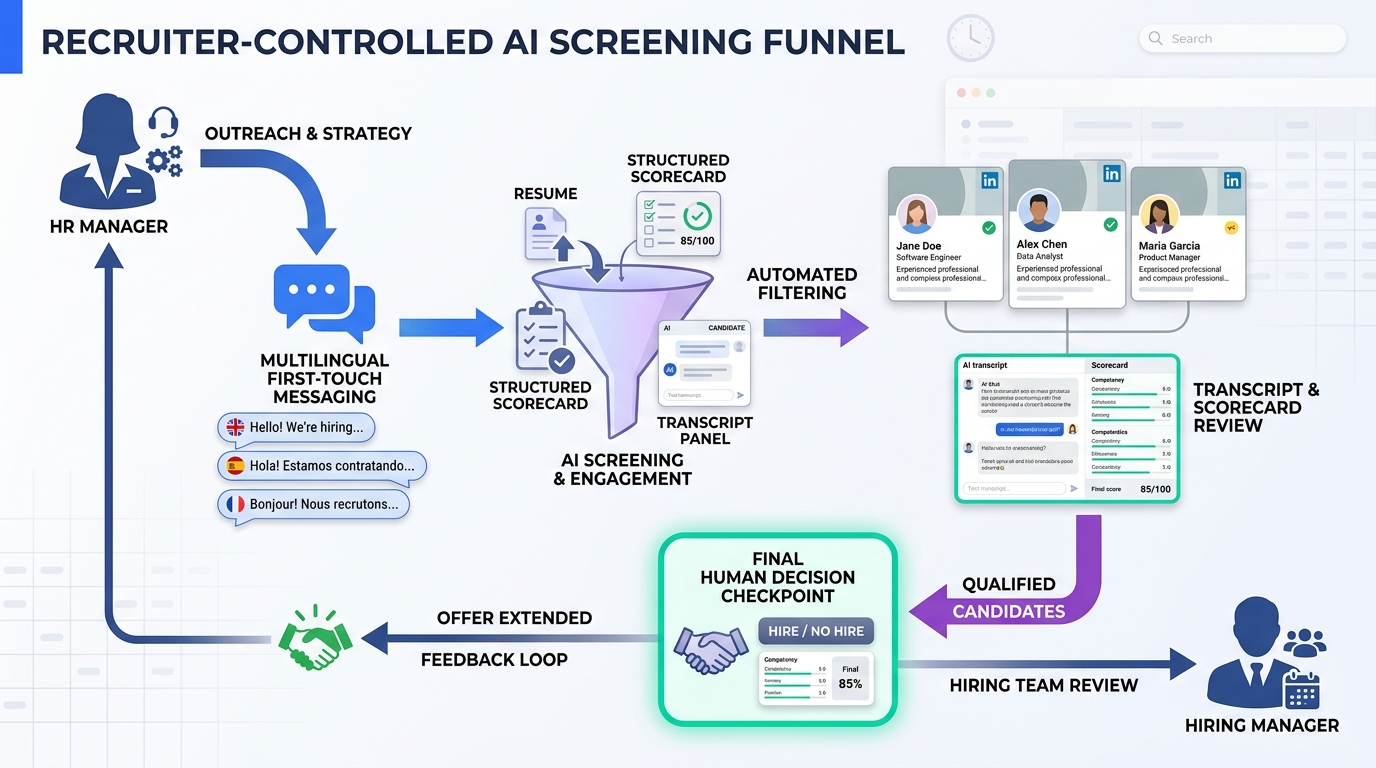
When candidate ai is judged by fit, context, and recruiter control, hiring leaders can avoid shallow screening and defend better early-stage decisions.
That standard matters because early-stage hiring breaks down in familiar ways: recruiters lose hours to first-touch outreach, candidates drift while waiting for replies, hiring managers receive uneven notes, and promising people get screened out for reasons nobody can clearly defend later. For smaller search firms and lean in-house teams, the damage is not just operational. It affects client trust, team capacity, candidate experience, and the economics of every open role.
One practical way to reduce that drag is to use automation where the work is repetitive and keep recruiter judgment where the stakes are highest. In my own workflow, StrategyBrain AI Recruiter has been most useful for always-on candidate messaging, multilingual first-touch communication, and collecting resumes or contact details from interested prospects after outreach. It helps keep conversations moving when recruiters are offline, but the recruiter still owns resume review, final qualification, and the next decision.
That mirrors a choice many professionals already understand from contract hiring. When an accounting contractor weighs a six-month assignment, the appeal is rarely just short-term income. The real calculation is broader: will this role open doors to a new industry, expand the network around finance leaders and hiring authorities, offer a trial run inside a company, and add skills that make the next move easier? The employer values immediate contribution during a busy stretch or project, but the contractor is also testing fit, flexibility, and future opportunity.
Now put that same logic back into recruiting. A candidate exploring a contract opening, a recruiter running first-pass outreach, and a hiring manager trying to compare applicants are all making early judgments under limited information. That is exactly where ai candidate screening, how to use ai in interview design, and candidate concerns about ai during interview start to intersect. The issue is not whether automation exists. It is whether the process helps people make better decisions with better context.
- Why context matters before AI screening starts
- What AI candidate screening actually covers
- How the workflow works in practice
- How to use AI in interview workflows responsibly
- What candidates should expect from AI during interview
- AI screening compared with other hiring methods
- Where recruiting teams gain the most value
- Risks, limits, and compliance checks
- Best practices for rollout
- FAQ
Why Context Matters Before AI Screening Starts
The contractor example is useful because it reminds recruiters that early-stage evaluation is never only about matching keywords. People assess opportunity in layers. A contract candidate may care about access to decision-makers, exposure to a new sector, a low-risk trial inside a company, or the chance to build skills across reporting, forecasting, and audit work. Those same dimensions often matter in permanent hiring too, even if they are not written neatly into the job description.
That is why candidate ai works best when recruiters define the full business context first. What problem is the role solving? Is the company filling a project gap, backfilling a leave, managing a growth spike, or hiring for a long-term team build? Does the candidate need to contribute immediately, or is there room for ramp-up? Without that context, screening becomes shallow and interview scoring drifts toward convenience.
The strongest AI screening setup does not start with automation. It starts with a clear explanation of what success in the role actually looks like.
In practice, this means recruiters should decide upfront which signals matter most: technical readiness, client-facing communication, sector exposure, adaptability, schedule fit, language needs, or stakeholder management. That framing makes later AI-supported ranking more explainable and more useful to hiring managers.
What Is AI Candidate Screening?
AI candidate screening is the use of software to support early hiring review by organizing application data, structured responses, interview inputs, and screening notes before deeper human evaluation. The most effective candidate ai workflow narrows a large pool into a smaller, reviewable shortlist without pretending to replace recruiter judgment.
In modern hiring operations, this usually sits between application intake and full hiring manager interviews. It can include knockout questions, interview scheduling, one-way response collection, transcript generation, recruiter summaries, scorecards, and ranking support.
What candidate ai usually covers
- Reviewing applications against minimum criteria
- Running structured knockout questions
- Managing AI screening interview steps
- Collecting text, audio, or video responses
- Generating transcripts and recruiter summaries
- Scoring answers against defined competencies
- Routing candidates for human review
What it should not do by itself
- Make final hiring decisions without recruiter review
- Hide that automation is being used
- Score vague personal traits with no job relevance
- Ignore accommodation requests
- Override a recruiter without explanation
In my experience, the most reliable systems are the least theatrical. They make first-stage hiring more structured, more searchable, and easier to revisit when a hiring manager asks why one person advanced and another did not.
How an AI Candidate Screening Workflow Works
Most teams follow a similar sequence even when their stack differs. The quality of the output depends less on the novelty of the tool and more on whether each step maps back to real hiring criteria.
- Role setup: Recruiters define must-have qualifications, deal-breakers, and evaluation criteria.
- Candidate notice: Applicants are told where AI supports outreach, screening, transcription, or summaries.
- Input collection: The process gathers resumes, knockout answers, and sometimes written, audio, or video responses.
- Structured questioning: Candidates receive consistent prompts tied to the role.
- Adaptive follow-up: The system may ask clarifying questions within set boundaries.
- Scoring and summarizing: Responses are mapped to pre-built scorecards or review bands.
- Recruiter review: A human checks transcripts, resumes, context, and edge cases.
- Decision routing: Candidates move forward, pause for review, or exit the process.
This is also where outreach automation and screening operations start to connect. If your team sources through LinkedIn or another outbound channel, the front end can become messy fast. I have found that using AI Recruiter for candidate outreach and follow-up reduces the dead time between initial interest and actual screening. It can continue conversations after hours, communicate in the candidate's native language, and capture resumes and contact details from people who want to proceed. That does not solve assessment on its own, but it cleans up the intake stage so the screening workflow starts with fewer gaps.
Why structured interviews matter so much
AI-supported screening is only as fair as the structure around it. If candidates receive inconsistent prompts, if scorecards change by interviewer, or if one hiring manager cares about industry exposure while another cares about presentation polish, then the system is organizing noise rather than evidence.
Structured interviews matter especially for contract and project-based roles. When employers need someone who can contribute quickly during a busy quarter or a defined initiative, recruiters should test for immediate readiness, stakeholder fit, and scope alignment rather than generic interview performance.
How to Use AI in Interview Workflows Responsibly
When recruiters ask how to use ai in interview settings, the best answer is to use it for consistency, documentation, and follow-through, not for blind delegation.
Employer-side uses that are usually practical
- Question drafting: Build role-specific screening questions from job requirements.
- Scorecard design: Standardize how recruiters and hiring managers compare answers.
- Transcript capture: Turn live or recorded responses into searchable notes.
- Summary support: Create concise recruiter handoff notes for hiring managers.
- Follow-up prompts: Surface clarifying questions when a response is incomplete.
- Candidate routing: Group applicants by review priority.
- Multilingual screening support: Reduce friction for candidates who are stronger in another language.
What I have seen work best
The most practical deployments start with high-volume or highly structured roles, especially where recruiters already know what good looks like. In outbound-heavy searches, I also prefer separating communication automation from evaluation. For example, using AI Recruiter conversations to handle initial LinkedIn exchanges and collect resumes can save recruiter time, while the actual resume review and interview decision remain fully human. That division keeps the process efficient without making it opaque.
How not to use AI in interview workflows
- Do not reject people from one opaque score alone.
- Do not use AI to assess undefined "culture fit."
- Do not confuse polished transcripts with strong candidates.
- Do not skip legal or policy review before rollout.
- Do not hide the role of AI from candidates or interviewers.
What Should Candidates Expect From AI During Interview?
Many job seekers search for answers about ai during interview because they want to know whether they are being evaluated by a person, a system, or both. The honest answer is that AI may assist with setup, question delivery, note capture, transcript generation, or score aggregation, but a responsible employer should still keep a human accountable for the decision.
What candidates may experience
- A notice that AI supports part of the screening or interview process
- A one-way video interview or timed written response stage
- Structured questions tied to the role
- Follow-up prompts based on earlier answers
- Transcript or summary storage for recruiter review
- A later live conversation with a recruiter or hiring manager
How candidates often evaluate these opportunities
Here the contract-work lens matters again. Candidates do not just ask, "Can I pass this screen?" They also ask whether the opportunity broadens their network, lets them test a company without overcommitting, opens a path into a new industry, or adds useful skills. Recruiters who remember that are far more likely to design a screening process that feels relevant instead of mechanical.
Preparation help versus misrepresentation
| Approach | Usually acceptable | Usually problematic |
|---|---|---|
| Practicing common interview questions with AI | Yes | No issue before the interview |
| Refining resume language before applying | Yes | Fine if the facts are true |
| Using AI to organize STAR stories in advance | Yes | Fine if the examples are real |
| Using live AI prompts during the actual interview | Sometimes restricted | Can violate employer rules |
| Reading AI-generated experiences as your own | No | Misleading and high risk |
The simplest rule is still the best one: use AI to prepare, not to fake.
AI Screening vs Other Common Hiring Methods
AI screening vs resume screening
Resume screening is usually narrower. It checks documents and knockout criteria. AI candidate screening is broader because it can include structured prompts, summaries, ranking support, and interview-linked evidence. That is useful when a role involves variables a resume alone does not explain well, such as contract availability, project readiness, stakeholder exposure, or transition into a new industry.
AI-assisted screening vs one-way video interviews
A one-way video interview is just a format. AI support is a capability layer that may add question branching, summaries, transcripts, or scoring. Recruiters should not treat the two as interchangeable.
AI-assisted screening vs human-only review
Human-only review offers nuance but becomes hard to scale. AI-assisted review improves speed and consistency, but only if governance is strong. For most teams, the workable model is AI-supported human review rather than human-free automation.
| Method | Main strength | Main limitation | Best use |
|---|---|---|---|
| Resume screening | Quick first filter | Low context | Minimum qualification checks |
| AI candidate screening | Structured multi-step review | Needs controls and explainability | Early-stage hiring |
| Human-only review | Nuance and judgment | Time-intensive | Final selection and complex roles |
Where Recruiting Teams Gain the Most Value
Used carefully, candidate ai can improve hiring operations in ways recruiters actually feel day to day.
- Faster early-stage response: Less delay between candidate interest and recruiter follow-up.
- More consistent evaluation: Structured prompts reduce reviewer drift.
- Better documentation: Transcripts, summaries, and scorecards are easier to revisit.
- Cleaner handoffs: Hiring managers get comparable information across candidates.
- Improved candidate routing: Recruiters can prioritize urgent human review.
- Scalability: Teams can manage more volume without losing visibility.
The biggest gain is usually not magical efficiency. It is removing preventable friction at the exact points where recruiters tend to lose time: repeated first-touch messages, after-hours replies, missing resumes, weak notes, and inconsistent handoffs. That is also where a tool like StrategyBrain AI Recruiter can fit sensibly into a broader process. It keeps outbound communication moving and captures candidate information, while the recruiter remains responsible for qualification and decision quality.
What Are the Risks and Limitations?
Experienced recruiters know that AI candidate screening can create real problems if teams treat it as neutral by default.
Key risks
- Bias and discrimination risk: Bad criteria produce bad screening.
- Accessibility gaps: Standard workflows may not fit all candidates.
- Transcription errors: A poor transcript can distort a strong answer.
- Signal confusion: Teams may overvalue polish over substance.
- Explainability problems: Scores may be hard to defend later.
- Over-reliance: Busy recruiters may trust rankings too much.
- Privacy and data handling concerns: Candidate information must be governed carefully.
These risks matter even more in contract recruiting and industry-switch hiring, where strong candidates may have nontraditional backgrounds. If the workflow is too rigid, it can filter out exactly the people who would have succeeded once given a chance to prove themselves.
Compliance principles worth enforcing
- Tell candidates when AI is involved
- Explain what part of the process it supports
- Keep humans responsible for final decisions
- Offer a path for review when concerns are raised
- Support accommodations clearly and early
- Limit evaluation to job-relevant criteria
- Review outcomes for unfair patterns
Best Practices for Rolling Out AI Candidate Screening
- Define the real business need first. Is the role about immediate project support, long-term growth, or market entry?
- Build scorecards from job reality. Use criteria that reflect how someone will actually succeed.
- Use structured interviews. Consistency makes summaries and comparisons more trustworthy.
- Separate communication automation from decision authority. Let AI handle repetitive contact, not final judgment.
- Be transparent with candidates. Explain the workflow and what data is captured.
- Design for accommodations from the start. Do not bolt accessibility on later.
- Audit outputs regularly. Check rejection patterns, note quality, and transcript accuracy.
- Train recruiters and hiring managers. They need to know what the system can and cannot tell them.
If you want a simple rule, use AI to make hiring more legible. If a feature makes your process harder to explain, harder to audit, or harder for a recruiter to override, it is probably not helping.
FAQ
What does AI evaluate in candidate screening?
In a responsible setup, AI evaluates job-relevant application data, structured answers, screening responses, and scorecard criteria defined by the employer. It should not act as a hidden final decision-maker.
Does a human still make the final hiring decision?
That is how it should work. AI candidate screening is best used for intake, organization, summaries, and ranking support. Recruiters and hiring managers should make the final call.
Are candidates told when AI is used?
They should be. Candidate notice is a core expectation when AI supports outreach, screening, or interview evaluation.
What data may be collected?
Depending on the setup, employers may collect resumes, written responses, audio, video, transcripts, contact details, scorecards, and recruiter notes.
How should recruiters think about AI during interview?
Treat it as support for structure and documentation. It can help with consistency, but it should not replace human judgment or become a black box.
How do accommodations work when AI is part of the process?
Employers should provide a clear request path before screening begins. That may include alternate formats, timing adjustments, language support, or a different interview route.
Can candidates use AI during interview?
For preparation, usually yes. For live interviews, it depends on the employer's rules. Using hidden live assistance can create authenticity and policy issues.
Conclusion
AI candidate screening works best when recruiters treat it as an early-stage support system rather than a substitute for judgment. The contract-work perspective makes that clear: people are not only being filtered, they are also evaluating opportunity, fit, timing, and future value. Good candidate ai workflows respect that reality.
If you are deciding how to use ai in interview workflows or preparing for ai during interview questions from candidates and hiring managers, keep the standard simple. Use AI to create structure, preserve context, and reduce repetitive work. Keep the human recruiter responsible for the call that matters.