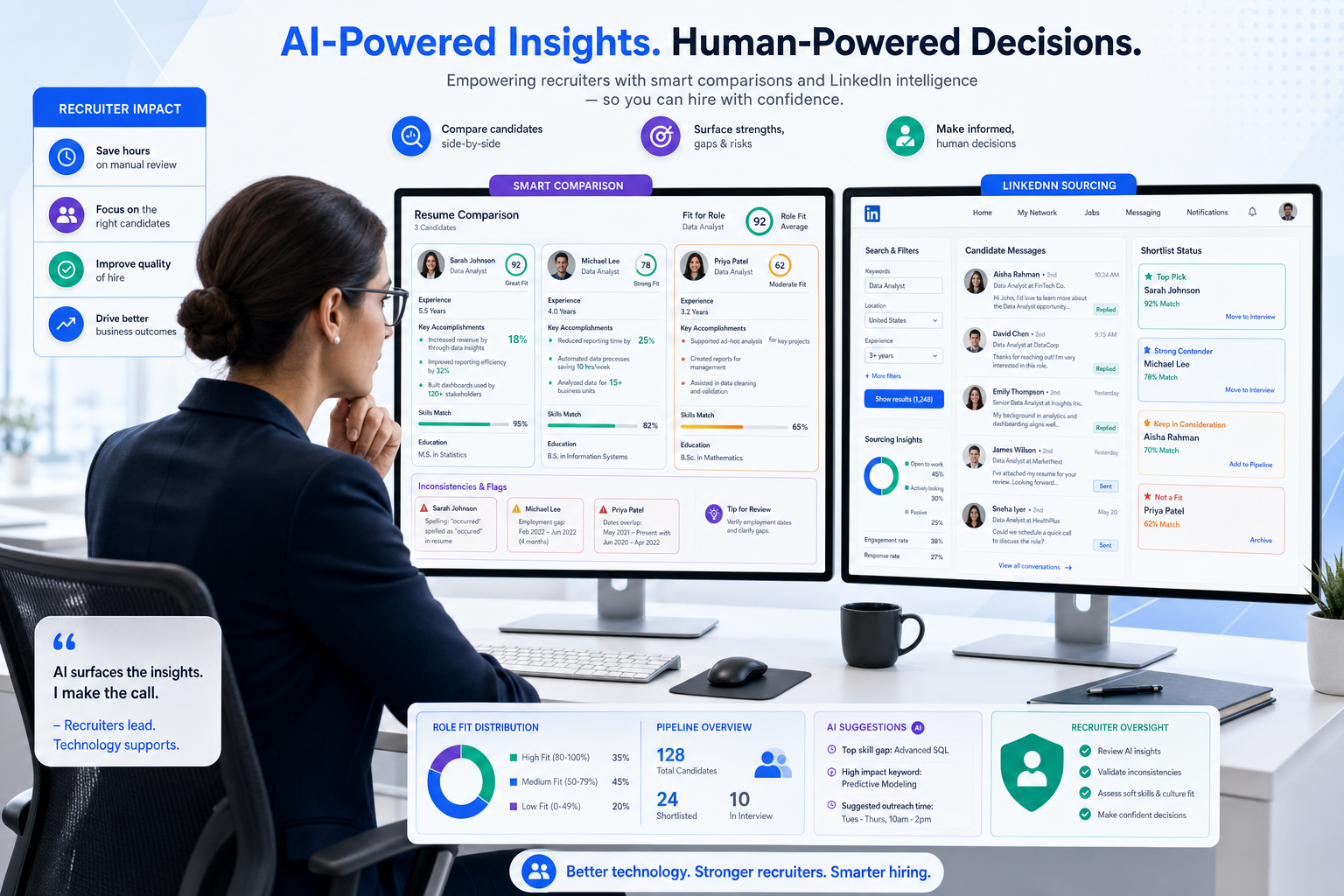
Candidate ai helps recruiters spot weak evidence early, compare resumes more consistently, and avoid weaker shortlists.
That matters because early-stage screening usually breaks down long before the interview panel meets a candidate. Recruiters lose time on resumes with vague achievements, avoidable spelling issues, generic tailoring, flashy formatting that hides substance, and work histories that do not tell a coherent career story. The damage is practical, not theoretical: weaker shortlists, slower submissions, more back-and-forth with hiring managers, and more candidate friction when people who look promising on paper cannot defend the basics in screening.
In my own workflow, tools like StrategyBrain AI Recruiter have been most useful when they handle repetitive top-of-funnel work instead of pretending to make the hire. Its always-on candidate messaging, multilingual outreach, and automated collection of resumes and contact details help keep conversations moving, especially when candidates reply after hours or across time zones. The recruiter still has to decide whether the resume holds up, whether the accomplishments are relevant, and whether the person should move into a structured screen.
That same pattern shows up in a familiar resume review moment. A recruiter opens a finance or accounting application expecting solid detail, then starts scanning for concrete outcomes in each role and finds only duties. The next pass catches punctuation errors. A third look shows formatting that draws attention to style instead of substance. Before the candidate even reaches a first conversation, the file creates unnecessary doubt.
The problem gets worse when the resume is not tailored to the job and the dates do not form a believable story. Now the recruiter is not just asking whether the candidate has the skill set, but whether the application can be trusted as a professional representation of the person behind it. That is the real transition point into AI candidate screening: candidate ai and automated candidate screening are valuable only when they help teams separate presentational noise from job-related evidence, and when an interview with artificial intelligence is designed to test what the resume failed to prove.
- Why resume quality still matters in AI screening
- What AI candidate screening means in practice
- How automated candidate screening actually works
- The five resume signals recruiters still need to verify
- What an interview with artificial intelligence should test
- Benefits, limits, and recruiter judgment
- Fairness, transparency, and compliance
- How to implement candidate ai responsibly
- Quick comparison table
- FAQ
Why resume quality still matters in AI screening
One mistake teams make when they adopt AI is assuming the system will clean up weak application inputs on its own. It will not. If a resume lacks clear accomplishments, includes careless writing mistakes, uses distracting formatting, ignores the job description, or leaves employment gaps unexplained, those issues do not disappear because a model is involved. They simply move downstream into your shortlist.
From a recruiter's perspective, this is where process discipline starts. Good screening is not about magical ranking. It is about turning messy applicant data into a reviewable, structured first pass that highlights what deserves follow-up. That means your workflow should be able to distinguish between a candidate who has real evidence of performance and a candidate whose resume only looks busy.
Practical takeaway: If the resume does not make value easy to see, your screening process should flag it for review, not hide it behind an unexplained score.
What AI candidate screening means in practice
In practical recruiting terms, AI candidate screening uses software models and structured rules to support top-of-funnel evaluation. That can include resume parsing, skills extraction, candidate matching, structured question delivery, transcript generation, summary creation, and ranking support.
When hiring teams discuss candidate ai, they are usually talking about three operational functions: surfacing relevant signals, applying structure consistently, and helping recruiters review larger applicant pools faster. That is very different from handing over final hiring authority to an opaque automated system.
The experienced way to evaluate any workflow is to ask a simple question: does it improve evidence quality at the point where recruiters actually make decisions? If the answer is no, then the technology may be adding movement without adding judgment.
Key terms worth understanding
- Structured interview: every candidate gets the same core questions and scoring criteria.
- AI screening interview: an early-stage interview supported by AI for delivery, transcription, summaries, or scoring assistance.
- Candidate matching: ranking applicants against required and preferred criteria.
- Explainable AI: outputs that show the basis for a recommendation.
- Audit trail: a record of what the system produced and what humans decided.
How automated candidate screening actually works
The strongest automated candidate screening setups use stages, not one black-box judgment. In a healthy process, AI helps the recruiter move from intake to review with better organization and cleaner evidence.
- Application intake: resumes, application forms, and written answers enter the system.
- Resume analysis: the workflow identifies skills, credentials, dates, role history, and possible gaps or inconsistencies.
- Criteria-based sorting: applicants are compared against predefined requirements.
- Structured question delivery: candidates answer role-relevant questions in text, audio, or video.
- Transcript and summary generation: responses are converted into searchable notes.
- Recruiter review: a human checks evidence, context, and next-step fit.
In my experience, the best support layer is often before formal evaluation. When I have used AI Recruiter for outreach and candidate follow-up, the real advantage was not that it qualified talent on its own. It kept conversations alive, gathered resumes from interested people, captured contact details, and reduced the lag between initial interest and actual recruiter review. That is especially useful when candidate response windows are short and top prospects answer outside business hours.
What it does not remove is the need for human scrutiny. Once a resume comes in, the recruiter still has to inspect whether the candidate showed measurable results, whether the application aligns with the role, and whether the profile tells a credible career story. AI can accelerate entry into the funnel; it should not be confused with final qualification.
The five resume signals recruiters still need to verify
The reference point from traditional resume review is still valuable because it shows where AI screening should focus attention. These five signals are often more predictive of screening quality than generic fit scores.
1. Evidence of accomplishment
Each role should show more than responsibilities. Recruiters need outcomes, scope, and where possible some indication of scale. If an applicant claims to have improved reporting, reduced errors, supported hiring, or managed stakeholder relationships, the resume should show what changed. Candidate ai can help identify action-result language, but a recruiter still has to judge relevance.
2. Writing accuracy
Spelling and punctuation errors are not always disqualifying, but they are context-sensitive signals. In client-facing, finance, legal, operations, and detail-heavy roles, they matter. In screening, these errors often indicate either haste or weak presentation discipline. AI can spot patterns, but humans should decide how much weight they deserve.
3. Readable formatting
Simple formatting remains underrated. Dense layouts, inconsistent bullets, too many fonts, or decorative elements make both human and machine review harder. Good resumes are easy to scan because they do not bury the signal. That is one reason structured applications often outperform free-form submissions in high-volume recruiting.
4. Strategic tailoring
One resume rarely serves every role well. Strong applicants adjust language and examples to the actual job. Recruiters reviewing AI-assisted rankings should check whether the match comes from true relevance or from surface keyword overlap. Tailoring is not stuffing keywords; it is aligning evidence with the business need.
5. A believable career story
Dates, progression, and transitions need to make sense. Large gaps are not automatic negatives, but unexplained ambiguity creates friction in review. Good screening surfaces these questions early so the recruiter can ask for context instead of making assumptions.
What an interview with artificial intelligence should test
An interview with artificial intelligence should not merely repeat the resume. It should clarify what the document leaves uncertain. If the resume lists achievements vaguely, the screening questions should ask for specifics. If the work history is broad, the interview should test role-relevant depth.
In practice, this often means standardized early-stage questions delivered in written, audio, or video format, followed by transcription and summary support. For candidates, that can improve scheduling flexibility. For recruiters, it creates comparable evidence across a wider applicant pool.
Useful things to test in an AI-supported screen
- Whether the candidate can explain measurable impact from prior work
- How clearly they connect experience to the actual role
- Whether career moves and date gaps can be explained consistently
- How they handle role-specific scenarios or problem-solving prompts
- Whether communication quality matches what the resume implies
This is where many teams overreach. AI-supported interviewing works best when it is structured around job-related evidence, not personality theater. Recruiters should be cautious about broad claims drawn from tone, style, or presentation habits alone. Use the process to collect comparable responses, then review them with human judgment.
Benefits, limits, and recruiter judgment
The upside of candidate ai is not that it replaces recruiters. It is that it helps strong recruiters operate with more consistency and less admin drag.
Where it adds real value
- Faster first-pass review: high-volume applicant pools become easier to triage.
- Cleaner process design: structured workflows expose missing criteria and vague scorecards.
- Better documentation: transcripts, summaries, and logs improve reviewability.
- Stronger handoffs: hiring managers receive more structured candidate summaries.
- Candidate flexibility: asynchronous steps reduce scheduling bottlenecks early on.
Where it still needs restraint
- Interpreting nonstandard career paths
- Weighing transferable experience
- Handling accommodation needs
- Resolving contradictory evidence across resume and interview
- Making final progression or rejection decisions
From a recruiting operations standpoint, the real test is simple: did the process improve shortlist quality and review consistency? If not, no amount of AI branding will fix poor intake criteria or weak recruiter discipline.
Fairness, transparency, and compliance
AI screening only becomes defensible when it is explainable, reviewable, and limited to job-related use. That means recruiters and HR leaders should understand what inputs are being analyzed, how rankings are generated, and where human oversight is required.
What fairness work should include
- Clear disclosure: candidates should know when AI supports screening.
- Accessible alternatives: especially for timed, audio, or video steps.
- Adverse impact review: monitor patterns across protected groups.
- Score rationale: outputs should be tied to defined criteria.
- Human review: high-stakes decisions should not be fully automatic.
One of the easiest mistakes to make is confusing consistency with fairness. A system can apply the same flawed rule to everyone. That is why recruiter oversight matters: someone has to ask whether the rule itself reflects actual job performance.
How to implement candidate ai responsibly
If you are building or revising a screening workflow, start where recruiters have always had to start: define the evidence you need before you automate anything.
Step 1: Set job-related criteria first
List must-have skills, role-specific requirements, and what strong evidence looks like on a resume or in a screening response. Keep the criteria grounded in actual performance, not abstract fit language.
Step 2: Decide what weak resumes should trigger
Use the five resume signals above as review flags. Missing accomplishments, careless errors, distracting formatting, poor tailoring, and unclear career story should not produce instant rejection by default, but they should influence what the recruiter verifies next.
Step 3: Use AI for support tasks with clear upside
Automate intake, follow-up, structured question delivery, transcript creation, summaries, and candidate organization. In practice, that is where tools like StrategyBrain AI Recruiter fit well in the process: they help maintain outreach momentum, collect materials from interested candidates, and reduce the manual chasing that slows recruiters down.
Step 4: Keep recruiter control over final qualification
The recruiter should confirm whether the resume supports the claim, whether the candidate's answers hold up, and whether the person moves forward. This remains true even when AI has sorted, summarized, or flagged the profile.
Step 5: Train hiring teams to challenge outputs
Teach users to review the evidence behind rankings instead of accepting scores at face value. A useful workflow is one people can question productively.
Step 6: Document and audit
Keep records of inputs, outputs, score changes, exceptions, and accommodation handling. That helps with quality control and future process review.
Quick comparison table
| Screening Element | Where AI Helps | What Humans Should Still Own |
|---|---|---|
| Resume review | Extracting skills, dates, and pattern flags | Judging credibility, relevance, and context |
| Candidate matching | Ranking against defined criteria | Checking whether criteria reflect the real job |
| Outreach follow-up | Handling repetitive messaging and collecting resumes | Confirming fit and deciding next steps |
| Structured screening | Delivering standard questions and creating transcripts | Evaluating answers against job-related evidence |
| Summaries and scorecards | Organizing notes consistently | Approving, adjusting, or rejecting recommendations |
| Final disposition | Flagging cases for review | Making the actual hiring decision |
FAQ
How does AI evaluate candidates?
AI usually evaluates candidates by organizing inputs such as resumes, application responses, structured interview answers, transcripts, and predefined criteria. In good hiring practice, those outputs support recruiter review rather than replacing it.
What is candidate ai in recruiting?
Candidate ai generally refers to AI-supported workflows used to identify, organize, rank, and review candidate information during the hiring process. It is most effective when tied to structured criteria and human oversight.
What data is used in automated candidate screening?
Common inputs include application forms, resumes, skills evidence, structured responses, transcripts, and summary ratings. Teams should limit analysis to role-relevant data and be transparent about what is being reviewed.
How should recruiters use automated candidate screening?
Recruiters should use automated candidate screening to speed up intake, standardize evaluation, and surface follow-up questions. Final decisions should still be reviewed by people who can interpret context and exceptions.
What does an interview with artificial intelligence look like?
An interview with artificial intelligence often involves structured written, audio, or video questions, plus AI-generated transcripts or summaries for recruiter review. The goal should be comparable evidence, not a hidden pass-fail decision.
Can AI reject candidates automatically?
Some systems can automate parts of screening, but high-stakes employment decisions are safer and more defensible when a recruiter reviews the evidence first, especially when rankings are not fully explainable.
How can employers reduce bias in AI candidate screening?
Bias reduction starts with structured criteria, explainable scoring, human review, accommodation processes, and regular outcome checks for adverse impact. Teams should also avoid relying on vague personality judgments.
Conclusion
AI candidate screening works best when it helps recruiters do what experienced recruiters already know matters: spot evidence, question weak presentation, compare candidates consistently, and keep final judgment human. The old resume lessons still apply. Accomplishments matter. Accuracy matters. Simplicity matters. Tailoring matters. Career story matters.
If you are evaluating candidate ai, improving automated candidate screening, or planning an interview with artificial intelligence, build your workflow around those realities. Use AI to reduce admin and organize evidence, not to hide weak process design. That is what makes screening faster, fairer, and more credible for recruiters, hiring managers, and candidates alike.