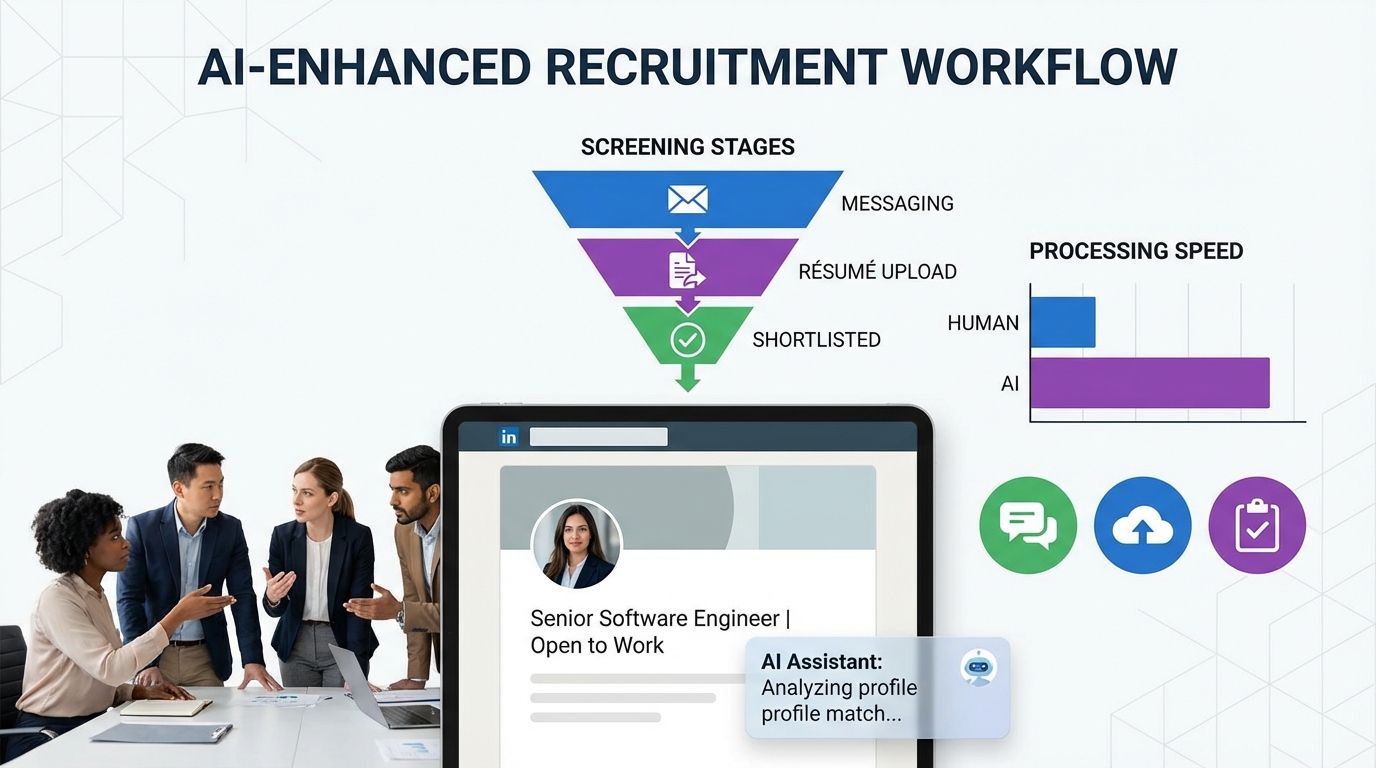
Candidate AI is only as good as the recruiting expertise behind it. If you want automated candidate screening and an AI HR interview style pre screen that improves speed without damaging quality, the safest approach is to let AI handle repetitive first touch work and let specialist recruiters make the final qualification call. In our day to day recruiting operations, we see the same pattern: general business advice can help with leadership and execution, but it often breaks down when it touches sourcing, candidate messaging, and qualification. This matters more in 2026 because LinkedIn workflows, automation, and AI driven chat based screening have changed what good recruiting looks like.
Table of Contents
- What candidate AI means in practical recruiting
- Reason 1: Generalists are not deep enough for modern recruiting
- Reason 2: Specialization matters more than ever
- Reason 3: You cannot be effective if you are not in the work
- Where StrategyBrain AI Recruiter fits in a specialist workflow
- Implementation steps for candidate AI without losing quality
- Quick comparison: Human only vs candidate AI assisted
- FAQ
- Conclusion
What candidate AI means in practical recruiting
In hiring, candidate AI usually refers to software that automates parts of the candidate journey. That can include sourcing support, outreach, chat based Q and A, interest confirmation, and early stage data capture. Automated candidate screening is the subset that helps you filter or route candidates based on structured signals such as location, availability, work authorization, shift preference, and compensation expectations.
An AI HR interview workflow is often a conversational pre screen. It is not a final interview. It is a structured conversation that collects consistent inputs so a recruiter can decide who should move forward. The key boundary is simple: AI can gather and summarize, but humans should decide fit and make hiring decisions.
Reason 1: Generalists are not deep enough for modern recruiting
I am going to walk this back a bit because there are excellent business coaches, and some are also strong recruiters. Still, the core issue remains: many coaches are jacks of all trades and masters of none when it comes to recruiting. Recruiting is a craft with its own failure modes, compliance risks, and market dynamics.
In our experience, generic advice often sounds reasonable but misses the operational details that determine outcomes. For example, a coach might recommend a broad funnel approach, but a specialist recruiter will ask what your response rate is on LinkedIn, what your message sequencing looks like, and how you handle candidate objections about compensation and role scope.
This is exactly where candidate AI can either help or hurt. If you automate the wrong message, you scale the wrong message. If you automate the right message and follow up consistently, you scale what works.
Reason 2: Specialization matters more than ever
Even within recruiting, specialization is real. A recruiter who is excellent in trades and industrial management is not automatically the expert in hiring computer engineers or Agile practitioners. The same logic applies to candidate AI. The prompts, screening questions, and routing rules that work for one job family can fail badly in another.
Specialization also affects what you should automate. In some roles, the highest leverage is outreach and follow up. In others, it is scheduling, portfolio collection, or structured pre screen questions. If you treat all roles the same, automated candidate screening becomes a blunt instrument.
When you design candidate AI with a specialist, you get clearer boundaries. You define what is a hard requirement, what is a preference, and what must be evaluated by a human. That is how you avoid false negatives and avoid wasting hiring manager time.
Reason 3: You cannot be effective if you are not in the work
Recruiting is not like riding a bike. If you are not actively hiring at scale, it is easy to give advice that is out of date. The tooling has changed. Applicant tracking systems are more capable, candidate expectations are different, and AI driven chat and automation are now part of the baseline for many teams.
In 2026, the gap between theory and practice is wider because automation can move faster than process maturity. If you have not personally run outreach sequences, handled candidate Q and A, and measured drop off points, you will miss where candidate AI should be applied and where it should be constrained.
Where StrategyBrain AI Recruiter fits in a specialist workflow
StrategyBrain AI Recruiter is designed for LinkedIn hiring workflows where the biggest time sink is repetitive first touch work. In our testing and implementation work with recruiting teams, the most consistent value shows up when AI Recruiter is used to handle the early conversation loop while recruiters keep control of final qualification.
What it automates well
- Automatically connecting with candidates who match your targeted search criteria
- Introducing the job opportunity and answering common questions about the role, company, and compensation
- Confirming interview interest and collecting résumés and contact information from interested candidates
- Providing 24/7 multilingual candidate messaging so follow up does not stall across time zones
What it does not decide
AI Recruiter can identify willingness to communicate or interview, but it does not determine whether a résumé fully matches the job requirements. That final qualification step stays with the recruiter after reviewing the résumé. This boundary is important for trust, fairness, and hiring quality.
How it supports scale on LinkedIn
For teams that need volume, AI Recruiter supports managing more than 100 LinkedIn accounts so organizations can build AI powered recruiting teams. This is useful when you want consistent outreach and follow up across multiple recruiters or business units without adding the same amount of manual labor.
Security and privacy posture to ask for
When you evaluate any candidate AI system, ask whether customer provided data is used to train models, how credentials are stored, and whether candidate data is encrypted and isolated per customer. AI Recruiter states that customer provided data is not used to train AI models and that credentials are encrypted and stored independently per user with explicit authorization.
Implementation steps for candidate AI without losing quality
-
Define the decision boundary
Write down what the AI can do, such as outreach, Q and A, interest confirmation, and data capture, and what only humans can do, such as final qualification and hiring decisions. This prevents automated candidate screening from becoming an unreviewed gatekeeper.
-
Standardize your pre screen questions
Turn your best recruiter questions into a short, consistent script. Keep it role specific. This is the backbone of an AI HR interview style pre screen that produces comparable answers across candidates.
-
Build a message and follow up sequence
Decide the initial outreach message, the follow up cadence, and the stop conditions. Candidate AI is most effective when it follows up reliably and stops when the candidate declines.
-
Set a résumé and contact capture rule
Decide when the system should request a résumé and what contact details are required for handoff. AI Recruiter supports both email submissions and LinkedIn file uploads, and it captures contact details shared in the conversation.
-
Review weekly with a specialist
Have a recruiter review transcripts, objections, and drop off points every 7 days. Update the script and routing rules. This keeps candidate AI aligned with real market feedback.
Quick comparison: Human only vs candidate AI assisted
| Workflow | Speed impact | Consistency | Best for |
|---|---|---|---|
| Human only outreach and screening | Depends on recruiter capacity | Varies by recruiter | Low volume roles, highly bespoke outreach |
| Candidate AI assisted with human final qualification | Faster first touch and follow up | Higher, if scripts are standardized | LinkedIn sourcing, high volume outreach, global time zones |
FAQ
Is candidate AI the same as automated candidate screening?
No. Candidate AI is broader and can include outreach, chat based Q and A, and scheduling support. Automated candidate screening is specifically about filtering or routing candidates based on defined criteria.
Can an AI HR interview replace a recruiter interview?
It should not replace a recruiter interview for final qualification. It can replace repetitive pre screen conversations by collecting consistent answers and confirming interest, then handing off to a recruiter for judgment and next steps.
What is the biggest risk when using candidate AI?
The biggest risk is automating a weak process and scaling it. If your outreach message is unclear or your screening questions are poorly designed, candidate AI will amplify the problem. A weekly specialist review is the simplest control.
How does StrategyBrain AI Recruiter work on LinkedIn?
Recruiters provide their LinkedIn account and job information such as company details, compensation, benefits, and candidate search criteria. The system connects with relevant candidates, introduces the role, answers questions, confirms interest, and collects résumés and contact details for recruiter review.
Does StrategyBrain AI Recruiter decide who is qualified?
No. It identifies willingness to communicate or interview and gathers information, but it does not determine whether a résumé fully matches job requirements. Recruiters make the final qualification decision.
Can candidate AI support multilingual hiring?
Yes, if the system is designed for it. AI Recruiter is positioned as providing 24/7 multilingual communication so candidates can interact in their native language and receive timely follow up across time zones.
How should I measure whether candidate AI is working?
Track response rate, interested candidate rate, résumé capture rate, and time from first message to recruiter handoff. Review conversation transcripts to see where candidates drop off and adjust the script.
Do I still need recruiters if I use candidate AI?
Yes. Candidate AI reduces repetitive work, but recruiters are still needed for role calibration, final qualification, stakeholder management, and closing. The best results come from pairing automation with specialist judgment.
Conclusion
Candidate AI can be a major advantage, but only when it is built on specialist recruiting practice. General business coaching can support leadership and execution, yet modern recruiting requires deep domain knowledge, current market feedback, and clear boundaries on what automation should do. If you want automated candidate screening and an AI HR interview style pre screen that scales on LinkedIn, use AI for outreach, Q and A, interest confirmation, and résumé capture, then keep final qualification with recruiters. If your team is ready to operationalize that model, StrategyBrain AI Recruiter is designed to run the early LinkedIn conversation loop while your recruiters focus on judgment and hiring decisions.