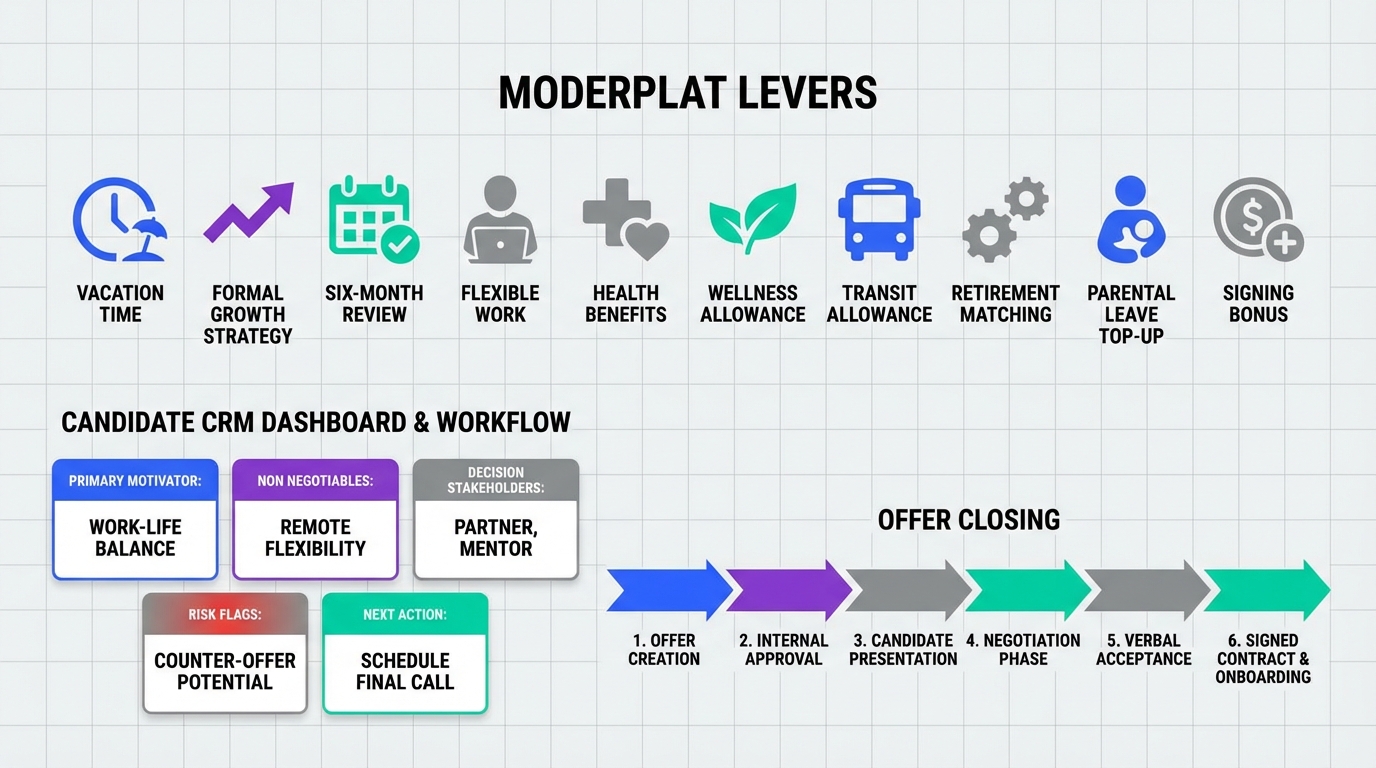
A candidate CRM is a candidate relationship management system that stores candidate context (motivations, constraints, communication history, and next steps) so you can run consistent, personalized follow up through the offer stage. When base salary is fixed, the most reliable way to close is to use your candidate CRM to document what the finalist values, then present a tailored package using 10 specific “value add” levers such as additional vacation, flexible work, benefits, and a signing bonus. In this guide, we turn those levers into a repeatable workflow, plus a practical template you can copy into your candidate CRM. We also show where StrategyBrain AI Recruiter fits into the process by automating LinkedIn outreach and follow up so finalists stay warm while you finalize approvals.
Table of Contents
- What a candidate CRM should capture before you build the offer
- The 10 offer levers to use when salary cannot move
- A candidate CRM workflow for offer closing
- Copyable templates for your candidate CRM
- How StrategyBrain AI Recruiter supports candidate relationship management
- Common mistakes that weaken acceptance rates
- FAQ
- Conclusion
What a candidate CRM should capture before you build the offer
When salary is constrained, the offer becomes a decision design problem. The candidate CRM is where you make that design measurable and repeatable. In our recruiting operations work, the teams that close faster are the ones that treat “candidate motivation” as structured data, not as scattered notes.
Define the minimum fields (so your team stays consistent)
- Primary motivator: career growth, flexibility, stability, compensation upside, mission, or benefits.
- Non negotiables: start date, remote requirements, commute limits, visa constraints, schedule constraints.
- Decision stakeholders: partner, family, current manager, competing offer source.
- Risk flags: compensation gap, counteroffer risk, slow response patterns, unclear priorities.
- Next action and date: the single next step and the exact follow up date.
Why this matters for candidate relationship management strategies
Candidate relationship management strategies work when they reduce uncertainty for the candidate and reduce variability for your team. If you cannot move salary, your leverage comes from speed, clarity, and personalization. A candidate CRM makes those three things operational.
The 10 offer levers to use when salary cannot move
The following levers come from real offer scenarios where the hiring team had no room to increase base salary. The key is to select the levers that match the candidate’s motivators, then document the rationale in the candidate CRM so the same playbook can be reused.
1) More vacation time
Extra paid time off can be a high impact lever for candidates who prioritize work life balance. One practical structure is to grant additional days that the employee can use at their discretion during the year. Another structure is a recurring personal day on a fixed cadence, such as one additional personal day every three months.
2) A formalized growth strategy
If career development is the motivator, convert “we support growth” into a written plan. A formal growth strategy can include training commitments, defined milestones, and a promotion path tied to performance. In your candidate CRM, store the plan as a one page summary so the hiring manager and recruiter stay aligned.
3) A six month salary review
When you cannot increase salary today, a documented salary review at six months can reduce perceived risk for the candidate. The credibility comes from clarity: define what will be reviewed and who approves it. In your candidate CRM, record the review date and the evaluation criteria so it does not become a vague promise.
4) Flexible work arrangements
Flexibility can mean remote work, hybrid schedules, or adjusted start and end times. For candidates with long commutes or family responsibilities, flexibility can be worth more than a small salary increase. Some teams also allow the workday to begin when the employee starts working during a commute, such as on a train ride, as long as expectations are explicit.
5) Health benefits
A comprehensive benefits program can materially change the total value of the offer. If your organization can fully fund benefits, state that clearly. In the candidate CRM, store the benefits summary you shared so the candidate can compare it against other offers without confusion.
6) Gym membership or wellness allowance
A wellness benefit can be a strong differentiator for candidates who value health and routine. It also signals that the employer invests in long term wellbeing. In your candidate CRM, tag this lever under “lifestyle benefits” so it is easy to find for future candidates with similar motivations.
7) Transit, vehicle, or phone allowance
Allowances reduce recurring expenses such as transit passes, parking, mileage, or phone bills. Candidates often evaluate offers based on monthly cash flow, not just base salary. In your candidate CRM, record which expense category matters most to the candidate so you do not offer the wrong allowance.
8) RSP matching and share purchase plans
Retirement matching and equity purchase programs can increase long term value and can support retention. This lever is most effective when the candidate is thinking in multi year horizons. In your candidate CRM, note whether the candidate asked about long term wealth building, because that is a strong signal this lever will land well.
9) Maternity and parental leave top ups
For candidates planning a family, parental leave support can be decisive. One approach is to top up statutory benefits so the employee maintains their current salary during leave. In your candidate CRM, treat this as a sensitive topic: only document what the candidate voluntarily shares, and keep notes factual and minimal.
10) Signing bonus
A signing bonus can bridge a salary gap when budgets are structured to allow one time payments. A real example is a $10,000 signing bonus used to close a candidate when base salary could not increase. In your candidate CRM, record whether the candidate is comparing against a competing offer, because signing bonuses are most effective when they reduce switching friction.
A candidate CRM workflow for offer closing
This is the workflow we recommend when you want candidate relationship management strategies to be consistent across recruiters and hiring managers. It is designed to work with most candidate relationship management tools, and it also pairs well with LinkedIn based sourcing where follow up speed matters.
Steps
- Capture motivators within 24 hours: After the final interview, update the candidate CRM with the candidate’s top 2 motivators and top 2 constraints.
- Select 2 to 3 levers: Choose the levers that directly map to the motivators. Avoid offering everything, because it can feel unfocused.
- Draft a one page offer narrative: Summarize the role impact, growth path, and the selected levers. Store it in the candidate CRM as the “offer story.”
- Run a pre close call: Ask the candidate what would make them comfortable signing. Log objections verbatim in the candidate CRM.
- Send the offer and schedule the next touch: Put the follow up date on the calendar before you send the offer. Record it as the next action in the candidate CRM.
- Follow up with precision: Use a consistent cadence and reference the candidate’s motivators. This is where automation can help, as long as the message stays personalized.
Copyable templates for your candidate CRM
Offer lever selection checklist
- Motivator is work life balance: prioritize vacation time and flexible work arrangements.
- Motivator is career growth: prioritize a formalized growth strategy and a six month salary review.
- Motivator is financial stability: prioritize health benefits, allowances, and retirement matching.
- Motivator is switching cost: prioritize a signing bonus and a clear onboarding plan.
Candidate CRM note template (copy and paste)
Decision Drivers:
1) Primary motivator:
2) Secondary motivator:

Constraints:
1) Non negotiable:
2) Non negotiable:

Offer Levers Selected:
1)
2)
3)

Risks:
1) Counteroffer risk (low, medium, high):
2) Compensation gap summary:

Next Action:
Owner:
Date (YYYY-MM-DD):
Follow up message framework (human written, CRM stored)
Store this as a reusable snippet in your candidate CRM, then personalize the bracketed fields.
- Line 1: Confirm what they said they value most.
- Line 2: Restate the role impact in one sentence.
- Line 3: Highlight the 2 to 3 offer levers you tailored for them.
- Line 4: Ask a single clear question about readiness to proceed.
How StrategyBrain AI Recruiter supports candidate relationship management
Many candidate CRM programs fail at the same point: consistent follow up. Recruiters get busy, finalists wait, and momentum drops. This is where StrategyBrain AI Recruiter can support your candidate relationship management tools by handling the repetitive LinkedIn messaging work while your team focuses on offer design and final qualification.
Where it fits in the workflow
- Initial outreach and re engagement: AI Recruiter can automatically connect with candidates that match your search criteria and start the first conversation on LinkedIn.
- Always on follow up: It provides 24/7 responses and follow up, including multilingual communication in the candidate’s native language, which helps reduce delays across time zones.
- Interest confirmation and handoff: It can confirm interview interest and collect résumés and contact details from interested candidates, then hand the shortlist to the recruiter for final screening.
Important scope boundary
AI Recruiter can identify willingness to communicate or interview, but it does not decide whether a résumé fully matches job requirements. Recruiters still complete the final qualification step after reviewing the résumé.
Operational scaling for teams
If your candidate CRM strategy depends on high volume LinkedIn sourcing, AI Recruiter supports managing more than 100 LinkedIn accounts so organizations can build AI powered recruiting teams and expand outreach capacity without adding the same amount of manual work.
Common mistakes that weaken acceptance rates
- Offering perks without mapping to motivators: A wellness allowance will not close a candidate who wants a clear promotion path.
- Vague promises: A salary review only works if the timing and criteria are documented in the candidate CRM.
- Slow follow up: Delays create space for counteroffers. Use your candidate CRM to enforce next action dates, and consider automation for LinkedIn follow up where appropriate.
- Overloading the offer: Too many levers can feel like negotiation noise. Pick 2 to 3 that matter most.
- Poor documentation: If the rationale is not in the candidate CRM, the next recruiter cannot replicate the win.
FAQ
What is a candidate CRM in recruiting?
A candidate CRM is a system for candidate relationship management that stores candidate profiles, communication history, motivations, and next steps so recruiters can personalize outreach and follow up through the offer stage.
How do candidate relationship management strategies help when salary is fixed?
They help you identify what the candidate values most, then present a tailored total rewards package using non salary levers such as flexibility, benefits, growth plans, and signing bonuses. The candidate CRM keeps the plan consistent and trackable.
Which offer levers work best if the candidate wants work life balance?
Extra vacation time and flexible work arrangements are usually the highest impact levers for work life balance. Document the candidate’s preferences in the candidate CRM so the offer matches what they actually asked for.
How should I document a six month salary review in a candidate CRM?
Record the review date, the decision maker, and the evaluation criteria in plain language. Avoid vague notes, because credibility is what makes this lever effective.
Do signing bonuses replace the need for a candidate CRM?
No. A signing bonus is one lever, but a candidate CRM is the system that ensures you choose the right lever for the right candidate and follow up on time.
How does StrategyBrain AI Recruiter support candidate relationship management tools?
It automates LinkedIn connecting, messaging, and follow up, including 24/7 multilingual communication, and it can collect résumés and contact details from interested candidates. Recruiters then review the résumé and complete final qualification.
Is it safe to store sensitive candidate information in a candidate CRM?
Store only what is necessary for hiring decisions, keep notes factual, and follow your organization’s privacy and retention policies. For sensitive topics such as parental leave planning, document only what the candidate voluntarily shares and keep it minimal.
What is the fastest way to improve offer acceptance using a candidate CRM?
Enforce a next action date for every finalist and run a pre close call to surface objections before the written offer goes out. Speed and clarity are the two easiest acceptance levers to improve immediately.
Conclusion
When base salary cannot move, you can still close great hires by treating the offer as a tailored package and running it through a disciplined candidate CRM workflow. Use the 10 levers above to match what the finalist values, document the rationale in your candidate relationship management tools, and schedule precise follow ups so momentum does not drop. If LinkedIn outreach and follow up is your bottleneck, consider how StrategyBrain AI Recruiter can automate the repetitive messaging and résumé collection steps while your recruiters focus on final qualification and offer design.