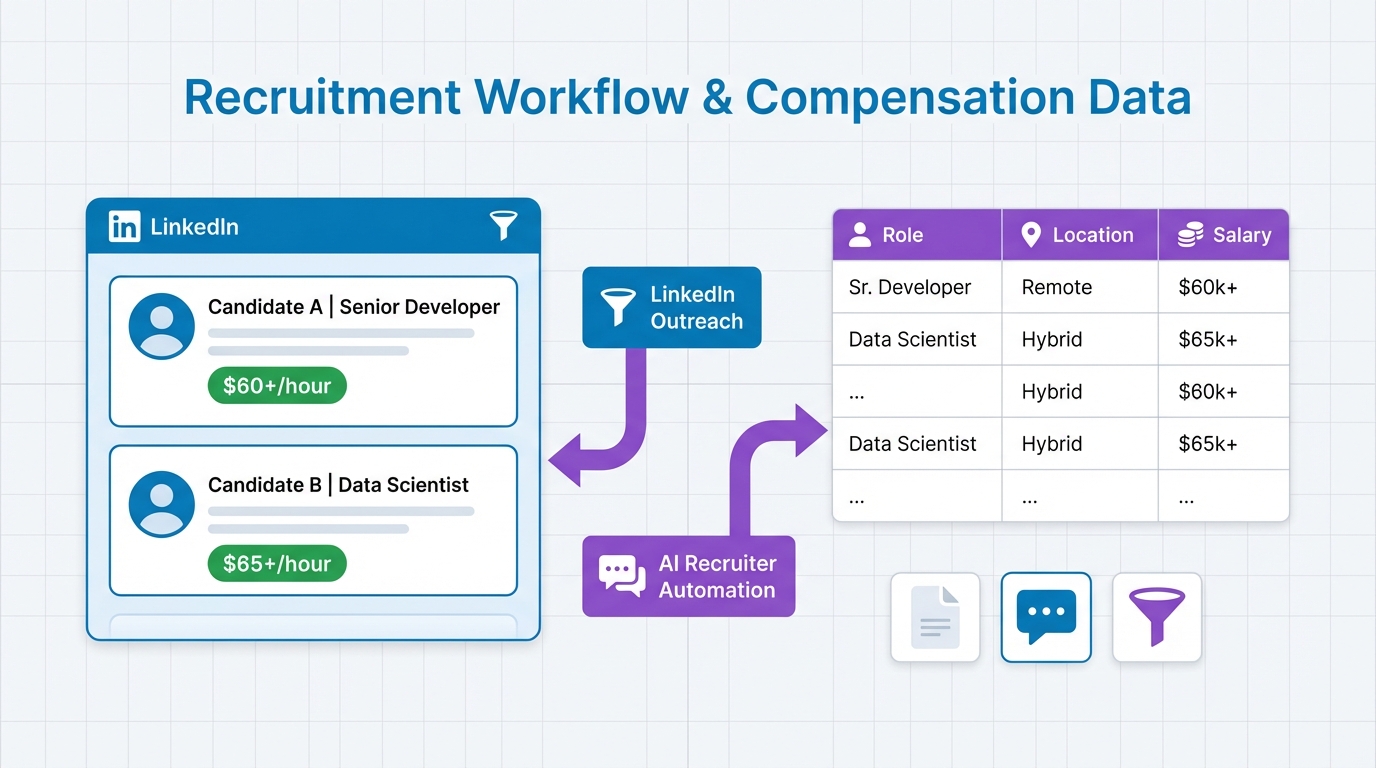
A practical candidate database for recruiters starts with one reliable signal: compensation. In Fort McMurray, trades wage rates have been cited as rising to over $60 per hour and engineering wages to over $65 per hour, and that kind of “top-of-market” pay can ripple into expectations across Canada. This guide shows how to turn those benchmarks into a working database system: what fields to store, how to run a compliant free resume search without creating noise, and how StrategyBrain AI Recruiter can automate LinkedIn outreach, follow up, and resume collection so your database stays current. This article covers database structure and sourcing operations. It does not provide legal advice or predict commodity cycles.
Why wage signals belong in your candidate database
Most recruiter databases fail for one reason: they store “who” but not “why now.” Compensation and cost of living are two of the fastest moving reasons candidates change jobs, relocate, or stop responding.
When a region leads wage growth, it becomes a reference point in candidate conversations. I have seen this play out in screening calls where candidates do not quote a national average. They quote what they believe the best employers pay, then negotiate from there.
So instead of treating pay as a note in a message thread, store it as structured data. That makes your database searchable, segmentable, and usable for outreach that feels relevant rather than generic.
The Fort McMurray benchmarks you can store as data
The source article that inspired this workflow was a thank you note to the people working in and around Fort McMurray and the oil sands, with specific wage and housing figures that are useful as recruiting reference points.
Wage benchmarks mentioned
- Trades wage rates: over $60 per hour.
- Engineering wages: over $65 per hour.
- Government of Alberta median wage for mechanical engineers: $67.31 per hour.
- APEGA 2017 wage for a 5 to 10 year engineer in Alberta: over $138,000 per year.
- Suncor trades wages listed for roles such as plumber, gasfitter, machinist, millwright, carpenter, welder, crane operator, steamfitter pipefitter, refrigeration and air conditioning mechanic, and painter: $62.07 to $68.38 per hour.
Housing cost benchmarks mentioned
- Average 1 bedroom apartment: $1,350 in Fort McMurray.
- Average 1 bedroom apartment: $1,762 in Toronto.
- Average 1 bedroom apartment: $1,897 in Vancouver.
How to use these numbers in a database without overreaching
Do not treat these figures as universal truth for every employer or every candidate. Treat them as conversation anchors and segmentation inputs. In practice, I store them as “market reference” records with a source label and date, then link them to roles and locations in the database.
A recruiter ready candidate database schema
A candidate database for recruiters is only as good as its fields. If you cannot filter it quickly, you will default to blasting messages, and response rates will drop.
Core candidate fields
- Identity: full name, location, time zone, preferred language.
- Role fit: primary trade or discipline, seniority band, certifications, equipment or plant experience.
- Compensation: current pay type, target pay, minimum acceptable pay, currency, and pay unit.
- Mobility: willing to relocate, rotation preferences, travel constraints.
- Availability: notice period in days, earliest start date.
- Engagement: last contacted date, last reply date, status, next follow up date.
- Consent and provenance: where the resume came from, consent status, and retention date.
Market reference fields (the part most teams skip)
- Market reference name: for example “Fort McMurray trades wage range.”
- Value: for example “$62.07 to $68.38 per hour.”
- Region: Fort McMurray, Alberta, Canada.
- Source: employer cited, association cited, or government cited.
- Source year: for example 2017 for the APEGA figure.
- Notes: what roles it applies to and what it does not cover.
Practical template: the “5 filters” I use before outreach
- Role match: must match 1 primary role family.
- Location logic: local, relocation, or rotation must be explicit.
- Pay alignment: target pay must be within your approved band.
- Recency: last activity within 180 days, or a clear reason to re engage.
- Consent: outreach allowed under your policy and applicable law.
Method 1: Build your database from LinkedIn outreach with AI Recruiter
If your database is thin or stale, the fastest way to rebuild it is to turn outbound conversations into structured records. This is where StrategyBrain AI Recruiter fits naturally into the workflow because it automates the repetitive parts of LinkedIn recruiting while keeping the recruiter in control of final qualification.
What AI Recruiter does in this workflow
- Connects automatically with candidates who match your search criteria.
- Introduces the opportunity and answers questions about the role, company, and compensation based on what you provide.
- Follows up 24/7 and can communicate in the candidate’s native language.
- Collects resumes and contact details from interested candidates and marks resumes as received.
- Scales to teams by supporting management of more than 100 LinkedIn accounts for high volume hiring operations.
Steps
- Define your search criteria: role family, location, seniority, and must have skills.
- Prepare a compensation brief: include pay unit and range, plus any rotation or housing support details you can share.
- Run outreach and let AI Recruiter handle the first conversation: connection, intro, Q and A, and follow up.
- Capture structured data: resume received status, contact details, interest level, and next step.
- Recruiter reviews and qualifies: AI Recruiter does not decide final fit. You review the resume and proceed to interview scheduling.
Limitations we plan for
- Final qualification is still human: AI Recruiter identifies willingness to proceed, not full technical match.
- Inputs matter: if you provide vague compensation or role details, candidate questions will expose the gaps.
- Policy alignment required: you still need internal rules for consent, retention, and messaging tone.
Best for
- Recruiters who need a repeatable way to keep a free resume database for recruiters fresh with new inbound resumes from outreach.
- Teams hiring across time zones who benefit from 24/7 multilingual candidate communication.
- High volume LinkedIn sourcing where follow up consistency is the bottleneck.
Method 2: Run a free resume search with a quality filter
Recruiters often ask for a free resume search because budgets are tight or because they want to validate a market before committing to paid tools. The risk is that “free” can quickly become “low signal” if you do not apply a consistent filter.
Steps
- Define your minimum viable profile: 3 must have skills, 1 preferred credential, and 1 deal breaker.
- Search with a narrow query: use role plus location plus one hard skill.
- Extract only what you can justify storing: resume, role history, and contact details with consent where required.
- Normalize titles: map “steamfitter pipefitter” and “pipefitter” into your role taxonomy.
- Tag compensation expectations: if a candidate references top market pay, store it as a structured note.
Quality filter checklist
- Recency: last role end date within 24 months, or clear explanation.
- Specificity: mentions equipment, plant type, or project scope, not only generic duties.
- Mobility clarity: relocation or rotation preference stated.
- Contactability: at least 1 reliable contact method.
Where StrategyBrain AI Recruiter fits
After you identify a shortlist from a free resume search, AI Recruiter can take over the repetitive LinkedIn steps: connect, introduce, answer questions, and collect updated resumes and contact details. That turns a one time search into an ongoing database refresh loop.
Method 3: Turn inbound resumes into a searchable database
Inbound resumes are valuable, but they are often trapped in email threads and attachments. The goal is to convert them into structured records that you can search by role, location, pay, and availability.
Steps
- Centralize intake: one mailbox or one intake form for resumes.
- Parse into fields: role family, certifications, locations, and dates.
- Attach the original file: keep the resume as the source of truth.
- Set a follow up rule: next touch date within 14 days of intake.
- Refresh via outreach: use AI Recruiter to re engage candidates on LinkedIn and request an updated resume when needed.
Best for
- Teams with steady inbound flow who need better search and segmentation.
- Recruiters who want a database that supports compensation conversations with real references.
Quick Comparison: 3 ways to fill a candidate database
| Method | Speed to first usable candidates | Cost profile | Best for |
|---|---|---|---|
| LinkedIn outreach with StrategyBrain AI Recruiter | Fast once criteria and messaging are set | Tool based, depends on your plan and LinkedIn setup | Keeping a database fresh through consistent outreach and follow up |
| Free resume search with a quality filter | Medium, depends on search surface and volume | Low direct cost, higher time cost | Validating a market and building an initial shortlist |
| Inbound resume intake to structured database | Medium, improves over time | Low to medium, depends on parsing and storage | Organizations with steady inbound applicants |
Operating rules: privacy, consent, and data hygiene
Database quality is not only about sourcing. It is also about trust. Candidates notice when recruiters mishandle data or send irrelevant messages.
Data hygiene rules that prevent database decay
- Deduplicate weekly: merge records by email, phone, and LinkedIn profile identifier.
- Expire stale records: set a retention date and review before re contacting.
- Log every touch: last contacted date and outcome must be mandatory fields.
- Separate “interested” from “qualified”: interest is not fit, and your pipeline should reflect that.
Security and compliance notes for AI Recruiter users
StrategyBrain AI Recruiter states that it complies with privacy regulations in the EU, United States, and Canada, and that customer provided data is not used to train AI models. It also states that LinkedIn account credentials are encrypted and stored independently per user with explicit authorization. Treat these as implementation claims that you should validate against your internal security review process.
FAQ
What is a candidate database for recruiters?
A candidate database for recruiters is a structured system that stores candidate profiles, resumes, engagement history, and searchable fields like role, location, and compensation so you can source and re engage efficiently.
Is a free resume database for recruiters realistic?
It can be realistic for early stage sourcing if you apply strict quality filters and invest time in normalization. Most teams eventually add automation or paid data sources because time becomes the limiting cost.
How do I run a free resume search without spamming candidates?
Start with a narrow query, store only relevant fields, and contact candidates only when you have a role that matches their profile and pay expectations. Track consent and outreach outcomes so you do not repeatedly message uninterested people.
How does StrategyBrain AI Recruiter help build a database?
AI Recruiter automates LinkedIn connection requests, initial outreach, Q and A about the role and compensation, follow up, and resume collection. That turns conversations into structured records you can store and search.
Does AI Recruiter replace recruiter screening?
No. AI Recruiter can identify interest and collect resumes and contact details, but it does not determine whether a resume fully matches job requirements. Recruiters still do final qualification.
How should I store compensation data in my database?
Store compensation as structured fields with a unit and currency, plus a source note. For market references, store the region, the figure, the source label, and the year so you can cite it accurately in conversations.
Why include housing costs in a recruiter database?
Housing costs affect relocation decisions and net take home perception. Storing reference figures helps recruiters explain tradeoffs when candidates compare cities like Fort McMurray, Toronto, and Vancouver.
What is the minimum set of fields I need to start?
At minimum, store role family, location, contact method, last contacted date, status, and a resume attachment. Add compensation and mobility fields next because they drive response and conversion.
How often should I refresh my candidate database?
For active roles, refresh weekly through outreach and inbound processing. For evergreen pipelines, refresh at least every 90 days by confirming availability, location, and compensation expectations.
Conclusion
If you want a candidate database that recruiters actually use, treat compensation as first class data. The Fort McMurray figures cited above are a clear example of how a leading wage market can shape candidate expectations elsewhere. Build your schema so you can search by pay, location, and mobility, then choose a fill strategy that matches your constraints: free resume search for validation, inbound parsing for steady flow, and StrategyBrain AI Recruiter for consistent LinkedIn outreach, follow up, and resume capture.
Next step: pick one role family, implement the “5 filters” in your database, and run a two week refresh cycle. If follow up is your bottleneck, pilot AI Recruiter on a single LinkedIn account first, then scale once your messaging and compliance checks are solid.