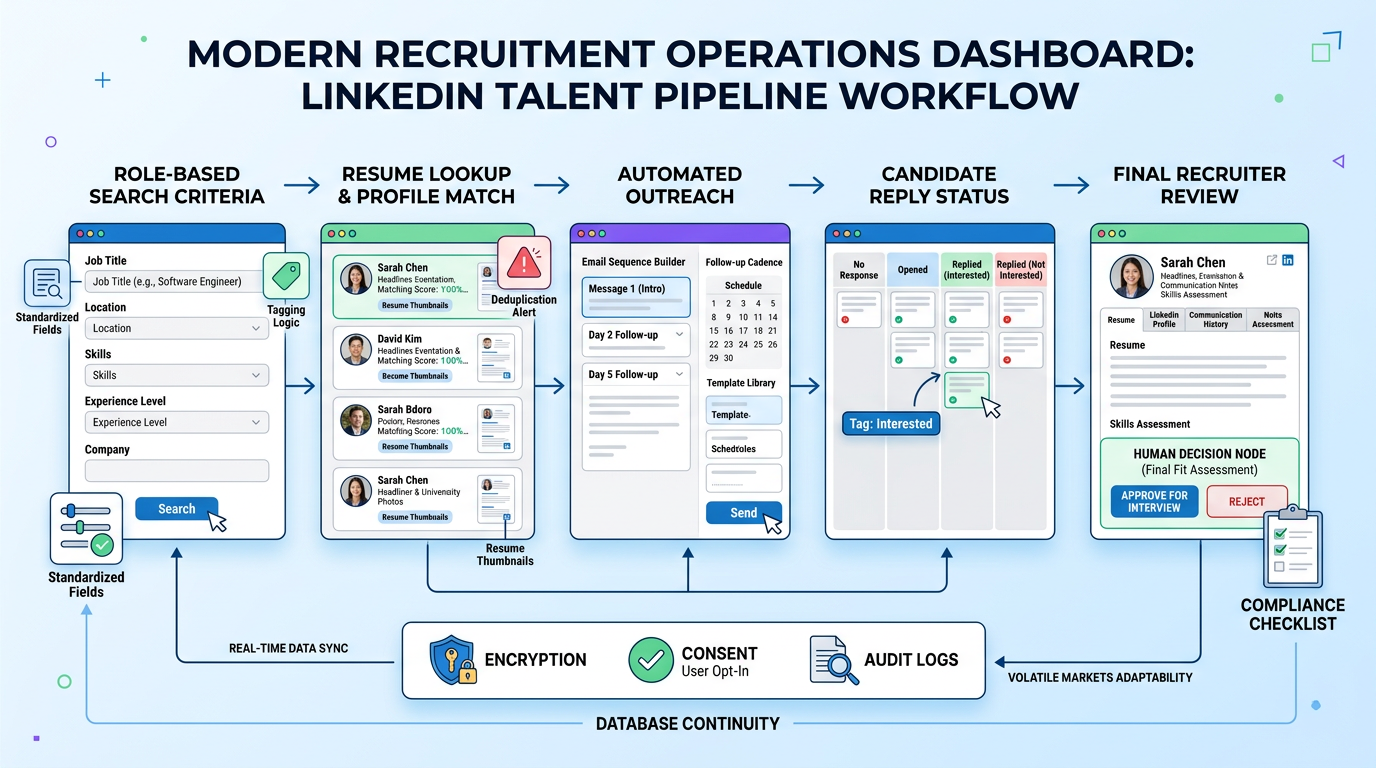
A reliable candidate database for recruiters is built by combining three habits: clear role based search criteria, consistent resume lookup, and fast candidate follow up. If your team needs to browse resumes quickly without losing context, the most practical model is a structured database fed by ongoing outreach and qualification. StrategyBrain AI Recruiter supports this by automating first contact on LinkedIn, collecting candidate resumes and contact details, and keeping recruiter review focused on final fit decisions. This article explains the workflow, shows where many teams lose quality, and gives a practical framework you can apply in cyclical markets such as energy, construction, and operations hiring.
Table of Contents
- Key Takeaways
- Why Candidate Databases Matter in Volatile Labor Markets
- A Practical Framework to Build a Recruiter Database
- How StrategyBrain AI Recruiter Fits the Workflow
- Quality Control and Compliance Checklist
- Common Mistakes and Fixes
- FAQ
- Conclusion
Key Takeaways
- Start with structure: A useful candidate database for recruiters must store role, skill, location, compensation range, and response status in standardized fields.
- Keep resume lookup repeatable: Use one naming and tagging system so recruiters can browse resumes in under 60 seconds per profile scan.
- Use automation where it counts: StrategyBrain AI Recruiter can automate candidate outreach and initial interest checks, then capture resume and contact details for recruiter review.
- Match market reality: Workforce transitions can be large. One widely cited report noted 100,000 energy related job losses beginning in 2014, which changed cross industry talent flow patterns.
- Protect trust: Candidate data handling must follow privacy standards, with encryption, access control, and clear consent handling.
Why Candidate Databases Matter in Volatile Labor Markets
Recruiting quality drops when teams react only to open requisitions. A candidate database gives continuity. It preserves candidate context across hiring cycles and helps recruiters re engage qualified talent when demand returns.
This is especially relevant in sectors with sharp shifts. Industry reporting on Canada’s energy labor market documented severe disruption after 2014, including 100,000 job losses and a long transition period for many skilled workers. During these periods, transferable talent often moves into adjacent functions such as analytics, instrumentation, software, and environmental operations. Recruiters who maintain a searchable database can identify these transfer paths faster than teams working from inbox archives.
We also see a second pattern. Hidden job markets increase during uncertainty, which means fewer roles are publicly listed. In those conditions, candidate relationship depth becomes more valuable than job board volume.
A Practical Framework to Build a Recruiter Database
1) Define the minimum data model first
Before adding tools, define required fields. Without this, resume lookup becomes inconsistent and duplicate profiles increase.
- Candidate identity: full name, preferred contact method, location
- Professional snapshot: current title, years of experience, core skills
- Role fit data: target function, compensation expectations, work authorization
- Pipeline status: contacted, replied, interested, interview ready
- Evidence files: resume version, notes, screening outcomes
2) Standardize intake and resume lookup rules
Recruiters should use one intake checklist and one tagging logic. For example, tag by function plus seniority plus geography. This allows teams to browse resumes quickly and compare like with like during shortlisting.
- Apply the same role taxonomy across all open positions.
- Use controlled tags for skills and certifications.
- Store one primary resume and date stamp every update.
- Require note templates so handoffs stay readable.
3) Build follow up cadence into the database
A database without communication history becomes stale. Every candidate record should include last outreach date, response sentiment, and next action date. This keeps pipeline value high even when hiring slows.
How StrategyBrain AI Recruiter Fits the Workflow
StrategyBrain AI Recruiter is most effective in the top and middle of funnel where manual effort is highest. It can automate LinkedIn connection requests within recruiter defined search criteria, introduce job opportunities, answer candidate questions, and identify interest level before recruiter review.
When candidates are interested, the system can request resumes and contact details, then mark records for recruiter action. This improves speed in teams that need to browse resumes daily across multiple requisitions. For global hiring, multilingual messaging supports communication in candidate native language and helps reduce misunderstanding during first contact.
For larger teams, multi account operations help expand outreach capacity while keeping review centralized. Recruiters remain responsible for final qualification and hiring decisions, which is important for role fit and compliance.
Where recruiters still need human judgment
- Final skill match validation against job requirements
- Compensation negotiation and expectation alignment
- Culture and team fit assessment
- Interview panel feedback synthesis
Quality Control and Compliance Checklist
Use this checklist weekly to keep your candidate database for recruiters accurate and trustworthy.
- All new profiles include required fields and status tags.
- Every resume lookup action logs date and reviewer name.
- Duplicate profiles are merged within 48 hours.
- Candidate consent and communication preferences are recorded.
- Data access is role based and encrypted in storage and transit.
- Inactive profiles are reverified or archived after defined periods.
Common Mistakes and Fixes
| Problem | Impact | Fix |
|---|---|---|
| Unstructured notes | Slow shortlisting and poor handoffs | Use mandatory note templates with fixed fields |
| No resume version control | Outdated information in interviews | Store one primary resume with update date |
| Inconsistent outreach timing | Low response rates | Use scheduled follow up rules by pipeline stage |
| Database not linked to sourcing activity | Pipeline decays during low hiring periods | Run continuous talent mapping and periodic re engagement |
FAQ
What is a candidate database for recruiters?
It is a structured repository of candidate profiles, resumes, communication history, and qualification notes that supports ongoing hiring decisions. It is not just storage. It is an operational system for sourcing, screening, and re engagement.
How is resume lookup different from resume scanning?
Resume lookup is the process of retrieving relevant resumes from your database using filters and tags. Resume scanning usually refers to parsing or screening resume content. Strong recruiting operations need both.
Can recruiters browse resumes effectively without AI?
Yes, but productivity drops as volume rises. AI supported workflows can reduce repetitive messaging and data capture work so recruiters spend more time on candidate evaluation.
Does StrategyBrain AI Recruiter replace recruiters?
No. It automates repetitive outreach and early conversation steps. Recruiters still make final qualification and hiring decisions.
How often should we clean and refresh the database?
Run a light cleanup weekly and a deeper audit monthly. At minimum, verify status accuracy, deduplicate records, and revalidate contactability.
What data protection controls are essential?
Use encryption, role based access, audit logs, and clear data retention rules. Candidate data should be handled under relevant privacy regulations and limited to authorized recruiting use.
Conclusion
A high performing candidate database for recruiters is a discipline, not a one time setup. Start with a strict data model, keep resume lookup consistent, and maintain communication history so recruiters can browse resumes with confidence when hiring demand shifts. StrategyBrain AI Recruiter adds practical leverage by automating early outreach, multilingual engagement, and resume collection while preserving recruiter control over final decisions. Your next step is simple: audit your current database fields this week, standardize tagging, and launch a 30 day cleanup and follow up cycle.